
It is January 1st. You have decided that by this time next year, you will not be doing exactly what you are doing now. Maybe you are burned out on full‑time clinical work, eyeing industry. Maybe you want an academic leadership role, a non-profit position, a digital health startup. Whatever it is—you know this much: your current network will not get you there as is.
Here is the blunt reality: a career pivot in medicine is 80% relationships, 20% everything else. Skills matter, but you will not even hear about half the roles you want unless you rebuild your network with intent.
So you are going to treat this like a year‑long project. Four quarters. Clear milestones. At each point, you should have specific names, conversations, and outcomes checked off. No vague “I should network more.”
Let’s walk quarter by quarter.
Q1 (Months 1–3): Clarify Your Pivot and Map Your Network
At this point you should stop sending random “let me pick your brain” emails. You are not ready yet. First quarter is about clarity and infrastructure.
Month 1: Define the Pivot and Your Story
By the end of Month 1 you should:
- Have a working pivot destination
- Have a 2–3 sentence “positioning statement”
- Have a rough list of 20+ people you could reasonably contact
Step-by-step:
Pick a primary target lane (not a fantasy buffet).
You are allowed to be curious, but you are not allowed to be vague forever. Choose 1–2 serious directions, for example:- Academic medicine -> Division leadership
- Private practice -> Medical director in a health system
- Clinical -> Pharma MSL / safety / medical affairs
- Clinical -> Digital health / startup clinical lead
- Any role -> Policy / public health / non-profit
If you say “I’m open to industry, academic leadership, consulting, maybe a startup,” people will not know how to help you. Pick a lane to start conversations.
Write your positioning statement.
This is what you say when someone asks, “So what are you looking to do next?” It should sound like this:- “I am a hospitalist with 8 years of experience, now looking to move into medical affairs at a mid‑size pharma or biotech, ideally in oncology or immunology.”
- “I am a pediatrician with a background in QI, exploring medical director roles in integrated health systems focused on outpatient operations.”
If it reads like a generic LinkedIn bio, rewrite it. It must be specific enough that someone can think of a person or a company.
Audit your current network.
Open your email, LinkedIn, hospital staff directory, alumni database. Pull names into a simple spreadsheet. At this point you should have three columns at minimum:- Name / role
- How you know them
- Relevance to your future lane (0–3 scale: 0 = none, 3 = direct)
Aim for at least 20–30 names. Include:
- Former co‑residents and fellows
- Prior attendings or chiefs
- Conference contacts (that person you sat next to at AHA in 2019)
- Former patients’ family members who mentioned “I work at [health tech / pharma]” (yes, them too, carefully and professionally)
Clean up your professional presence.
By the end of Month 1, your “front door” should not contradict your pivot.- LinkedIn: headline aligned with where you want to go, not just “Attending Physician at X”
- PubMed / Google Scholar: pin or highlight work that reinforces your pivot (e.g., QI, health policy, clinical trials)
- Faculty page or practice website: short, updated blurb that does not read like you froze in 2016
Month 2: Segment and Prioritize Your Network
Now that you have names, you need a system. Random outreach is why most people quit networking. It feels chaotic because it is.
By the end of Month 2 you should:
- Have your network segmented into clear tiers
- Know who you will contact in which order
- Have 2–3 email templates ready
- Segment contacts into tiers.
| Tier | Description | Example Contact Types |
|---|---|---|
| A | High trust & high relevance | Former co-fellow now in pharma, ex-PI in your new field |
| B | Moderate trust or moderate relevance | Conference contacts, distant colleagues, alumni in your target sector |
| C | Low trust but high potential reach | Big-name leaders, LinkedIn connections you barely know, industry speakers |
At this point you should have:
- 5–10 people in Tier A
- 10–20 people in Tier B
- A flexible, growing Tier C list
- Define what you want from each tier.
- Tier A: warm advice, referrals, honest feedback
- Tier B: informational interviews, introductions
- Tier C: occasional, high‑quality touchpoints (commenting on their work, attending their talks, savvy cold outreach)
Build 2–3 outreach templates you can slightly customize.
Do not improvise every email. You will get exhausted.Example for Tier A (someone you know well):
Subject: Quick career sanity check?
Hi [Name],
I am seriously exploring a move from full‑time clinical [specialty] into [target lane, e.g., medical affairs / digital health]. Given your experience at [company / institution], I would value your perspective.
Would you be open to a 20‑minute call sometime in the next few weeks? I am especially interested in how people with my background can position themselves for roles like yours.
Best,
[You]You need one like this for Tier B and one crisp, respectful version for cold outreach (Tier C).
Lay out your first 6–8 weeks of touchpoints.
Use a simple tracker. Even a basic Gantt-style view helps.
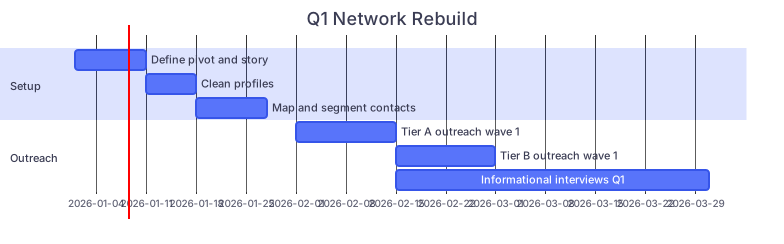
| Task | Details |
|---|---|
| Setup: Define pivot and story | a1, 2026-01-01, 10d |
| Setup: Clean profiles | a2, after a1, 7d |
| Setup: Map and segment contacts | a3, after a2, 10d |
| Outreach: Tier A outreach wave 1 | b1, 2026-02-01, 14d |
| Outreach: Tier B outreach wave 1 | b2, 2026-02-15, 14d |
| Outreach: Informational interviews Q1 | b3, 2026-02-15, 2026-03-31 |
By end of Month 2, the calendar should show when you will email whom, not just “network sometime.”
Month 3: Start the Conversations (Correctly)
This is where most people panic and ghost themselves. You are going to run a simple playbook.
By the end of Month 3 you should:
- Have completed 6–10 real conversations
- Have at least 3 new warm second-degree contacts
- Have heard the same 2–3 themes about your target path multiple times
Start with Tier A.
First two weeks of Month 3:- Email 3–5 Tier A contacts.
- For each one, schedule:
- 20–30 min Zoom/phone call
- 3–4 focused questions ready
Examples:- “If you were me and wanted to be in your role in 2–3 years, what would you do this year?”
- “What are the 2–3 most common ways physicians break into your field?”
- “Who else would you recommend I speak with?”
At this point you should be asking for advice and introductions, not jobs.
Then move to Tier B.
Second two weeks of Month 3:- Email 5–10 Tier B contacts.
- Expect a lower response rate. That is normal.
- Your goal is to:
- Understand pathways into this lane
- Learn the language (how do they describe success?)
- Expand your list with 1–2 new names per call
Track everything.
After each conversation, log:- Date
- 1–2 key insights
- Any new names they mentioned
- Follow‑up date (2–4 weeks later with an update or thank you)
If you are not writing anything down, you are not networking. You are chatting.
Q2 (Months 4–6): Expand, Deepen, and Be Visible
By Quarter 2, you should be past the awkward “I’m thinking maybe…” stage. You now have:
- A credible story
- A sense of what roles exist
- Some vocabulary in your target area
Now the work shifts to deliberate expansion and visibility.
Month 4: Build a Target List and Content Footprint
By the end of Month 4 you should:
- Have a list of 15–30 target organizations or roles
- Be visibly engaging 1–2 times per week online in your new lane
Create a target list.
Split it into 2 types:- Organizations:
- 5–10 “reach” (large academic centers, big pharma, top health tech)
- 10–20 “plausible” (regional systems, mid‑size companies, non-profits)
- Role archetypes:
- “Associate Medical Director, Medical Affairs”
- “Clinical Lead, Health Tech”
- “Director of Quality, Hospital Medicine”
This list grounds your networking so you stop floating.
- Organizations:
Engage publicly in your new lane.
You are not going to become a LinkedIn influencer. You just need a small, consistent footprint.
Two actions:
Comment weekly on 2–3 posts by:
- People in your target roles
- Companies on your target list
- Thought leaders in your niche
Comments must be substantive. Not “Great point!” but: - “We saw something similar in our hospital when we implemented X. One hidden challenge was Y.”
Once every 2 weeks, share:
- A brief reflection on an article relevant to your pivot
- A one‑paragraph summary of a project you did that aligns with your target lane
At this point you should be Google‑able as someone with an interest and some experience in this new area.
Month 5: Attend at Least One Event Strategically
No, not just the same specialty conference you always attend where you hide with your old co‑residents.
By the end of Month 5 you should:
- Have attended at least 1 event (virtual or in‑person) aligned with your pivot
- Have 5+ new names with whom you have spoken at least briefly
- Pick the right event type.
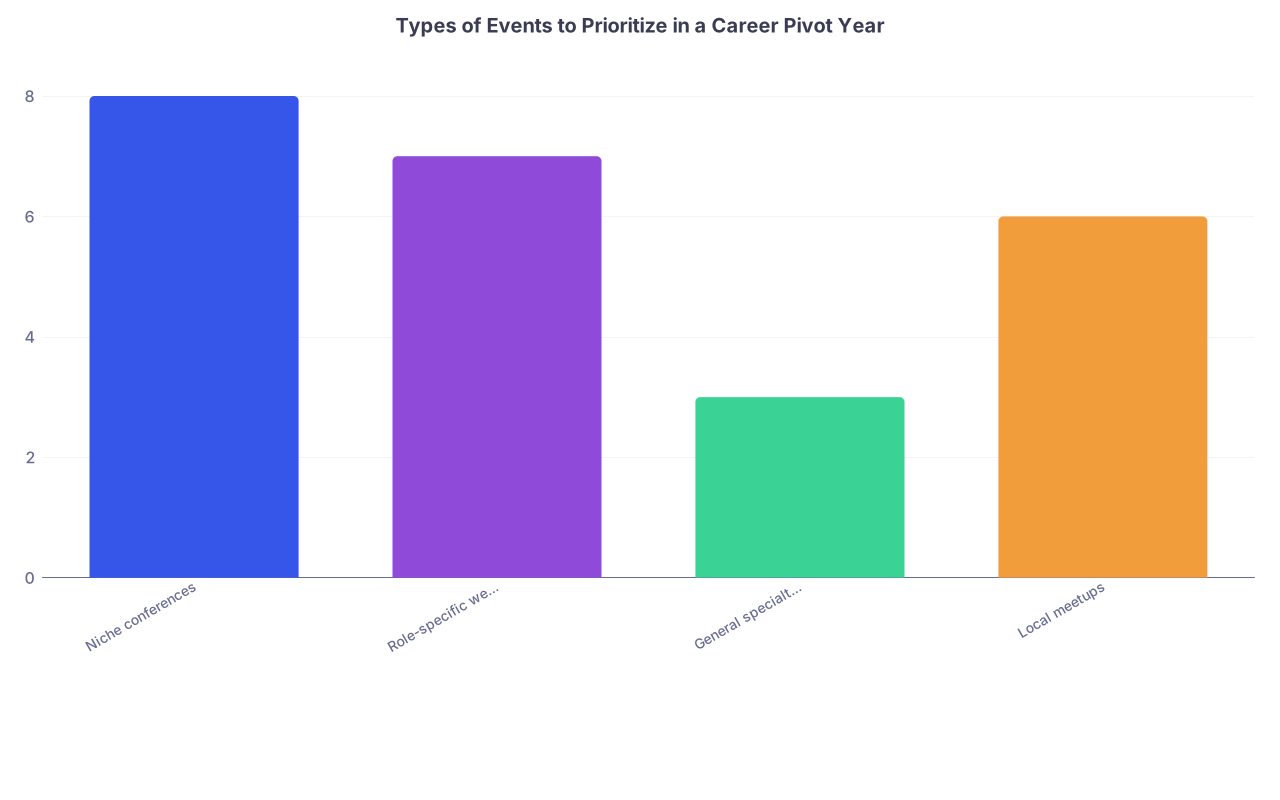
| Category | Value |
|---|---|
| Niche conferences | 8 |
| Role-specific webinars | 7 |
| General specialty conferences | 3 |
| Local meetups | 6 |
Prioritize:
- Niche conferences in your new lane
- Example: DIA (for drug development), HLTH (health tech), IHI (quality)
- Role‑specific webinars
- “Physicians in Pharma 101”
- “Transitioning to Medical Affairs”
- Local meetups with cross‑discipline folks
- Bio‑tech breakfasts
- Health policy roundtables
- Pre‑plan who you want to meet.
One week before:
- Pull the attendee or speaker list if possible.
- Choose 5–10 names:
- 2–3 speakers you will ask a question in Q&A or afterward.
- 3–5 attendees from organizations on your target list.
Prepare 1–2 specific questions for each. “How did you get into this?” is fine, but lazy. Ask:
- “What surprised you most about moving from clinic to industry?”
- “If you were hiring a physician for your team right now, what would you look for?”
Follow up within 48 hours.
Short email or LinkedIn message:Hi [Name],
I enjoyed your comments on [panel/session] at [event]. I am a [current role] exploring [target lane]. Your point about [specific detail] stuck with me.
If you are open to it, I would appreciate a brief call sometime this month to ask a few follow‑up questions about how physicians can contribute effectively in roles like yours.
Best,
[You]
Your job is not to collect business cards. It is to turn 1–2 of these into real conversations.
Month 6: Convert Conversations into Real Opportunities
By the end of Month 6 you should:
- Have 2–3 people who now think of you when they hear about relevant openings
- Be on the radar at 2–3 target organizations
Ask for specific introductions.
With people who have been helpful and seem invested:- “I noticed [Company X] is doing a lot in [your interest]. Do you know anyone there who might be willing to share how they use physicians in their teams?”
- Or, “Is there anyone else you think I should speak with about this path?”
You want warm intros, not “I’ll keep my eyes open” platitudes.
- Signal seriousness with small commitments.
People will start distinguishing between dabblers and serious pivoters. You want to be the latter.
Examples:
- Take a short course (regulatory, clinical trials, health policy).
- Volunteer for a committee, working group, or pilot project related to your future lane.
- Join a relevant professional society section (e.g., AMIA for informatics, ISPOR for health economics).
Mention these in follow‑ups: “Since we spoke, I enrolled in X and joined Y.”
Q3 (Months 7–9): Build Credibility and Reciprocal Value
Midyear is where networks either deepen or fade. Many physicians fall off here. You will not.
Month 7: Start Being Useful
By the end of Month 7 you should:
- Have done at least 2 concrete favors or value‑adds for people in your new network
- Have at least one small collaborative activity in motion
- Look for low‑lift ways to help.
Examples:
- Connect two people with aligned interests:
- “You both are working on value-based care in safety‑net hospitals—thought you should meet.”
- Offer to review a clinical section of a deck, white paper, or grant.
- Share relevant articles or data after conversations:
- “You mentioned burnout metrics; this paper we used for a hospital project may be useful.”
The goal: stop being just the one asking for help.
- Propose a small collaboration.
You do not need an R01. You need something that forces you to work with others in your new lane.
- Short blog post / commentary with a new contact.
- A hospital QI project with an operations or data team that touches your pivot area.
- Presenting a brief internal talk about “What I learned from speaking with X people in [your target industry].”
This changes you from “curious about X” to “actively contributing in X.”
Month 8: Tighten Your Personal Board of Advisors
By Month 8, you will notice a pattern. Two or three people keep showing up as especially helpful, insightful, or connected.
By the end of Month 8 you should:
- Be in regular (monthly or bi‑monthly) contact with 2–4 “informal advisors”
- Have given each of them a clear picture of your timeline and constraints
Name your “advisory group” privately.
These are not official mentors with titles. They are:- A peer who pivoted 2–3 years ago.
- A senior person already in your target lane.
- Maybe one person still in your current world but supportive of your shift.
Write down their names. If you cannot list 2–4, go back to Q2 behaviors.
Clarify your timeline with them.
On your next call:- “My realistic goal is to be in a new role by [X month next year]. That means this year I need to [build skills / position / start interviewing by Y].”
- Ask, “Given that timeline, what would you focus on in the next 3–4 months if you were me?”
This keeps them aligned and increases the chance they will think of you when relevant opportunities emerge.
Month 9: Start Softly Surfacing for Roles
You are not throwing your CV at every posting yet, but you are no longer purely exploratory.
By the end of Month 9 you should:
- Have shared with at least 5 key contacts that you are actively open to specific types of roles
- Have applied to or discussed 2–5 concrete positions (even if you decide not to pursue them)
- Change your language from “exploring” to “positioning for.”
Compare:
- Early: “I am exploring non‑clinical options in pharma.”
- Now: “I am positioning for associate director–level medical affairs roles in immune‑mediated diseases, ideally at mid‑size companies.”
Say this out loud to your advisors and to a few targeted new contacts.
- Use your network to decode job postings.
When you see a role:
- Send the link to someone in or near that organization:
- “Is this the type of role you think would fit my background in 6–12 months?”
- “What is the behind‑the‑scenes reality of jobs like this here?”
Whether you apply or not, these conversations refine your filter.
Q4 (Months 10–12): Convert Network Capital into Real Options
By now you should feel different. You know names, organizations, pathways. People in your new lane know you exist.
The final quarter is about consolidating and choosing.
Month 10: Intensify Targeted Outreach
By the end of Month 10 you should:
- Have spoken with at least one person at 70–80% of organizations on your target list
- Be in at least early discussion stages for a few potential roles or projects
- Systematically work your target list.
For each organization:
- Do you have:
- A first-degree contact?
- A second-degree contact via one of your advisors?
- If yes: request a warm introduction.
- If no: plan 1–2 high‑quality cold outreaches to people with roles like your target there.
You are not carpet‑bombing. You are sniping.
- Ask better questions.
At this stage, your questions should sound like you have done the work:
- “For someone transitioning from 0.8 clinical FTE to this kind of role, what ramp period is realistic?”
- “How often do you see physicians move from [your background] into [role] here?”
This tells them you are operating at a serious, not hypothetical, level.
Month 11: Evaluate Options and Commit to a Direction
By the end of Month 11 you should:
- Have a short list of 2–3 plausible concrete next steps (roles, fellowships, leadership tracks, or internal shifts)
- Have one “Plan A” and one “Plan B” path, each with clear actions
- Lay out your options explicitly.
Write them down. For each:
- Role / path
- Timeframe to transition
- Key gaps (skills, experience, geography, compensation)
- Key people who can help
- Pressure test with your advisors.
Schedule a focused conversation:
- “Here are the 2–3 realistic paths I see now. What am I overestimating? Underestimating?”
- “If you had to bet your own money on where I would be happiest and most effective in 3 years, which would you pick and why?”
You do not need unanimous agreement. You do need to see your blind spots.
Month 12: Close the Loop and Cement the Network
Regardless of whether you land the new role in Month 12 or Month 18, you end the year with a solid, living network. Not scorched earth.
By the end of Month 12 you should:
- Have updated your key contacts on where you landed or what your next year plan is
- Have a sustainable cadence for staying in touch
- Send concise year‑end updates.
To your top 10–20 contacts:
- “This year I explored a transition from X to Y.”
- “Key steps I took: [short list].”
- “Next year my focus will be [A, B, C].”
- “Thank you for [what they did]. If I can be useful to you or your team around [your expertise], I am glad to help.”
You are closing the loop. That is rare and highly valued.
- Set a maintenance rhythm.
For the next 12 months:
- Quarterly: reach out to your 2–4 key advisors with meaningful updates.
- Biannually: touch base with your broader network with something specific:
- New project
- Role change
- Article or talk you gave
Networking in medicine is a long game. Your pivot year is just the first intense season.
Your Next Step Today
Open a blank document and write a 2–3 sentence positioning statement for your pivot. Then list 10 names of people who already know you and have some relevance to that direction. That is your Q1 seed list. Once you have those 10 names on the page, you have officially started your career pivot year.