

Networking in medicine is not an “academic thing.” It is a revenue stream, a referral engine, and in many cases the difference between a growing private practice and a dying one.
The idea that only researchers and academic climbers need networking is flat-out wrong. And private practice data backs that up in a way that’s frankly uncomfortable for people who want to believe “good medicine sells itself.”
It doesn’t. Not anymore, and honestly, not in the last 20 years.
Let me walk through what the numbers actually show, not the fairy tales doctors tell each other in the call room.
The Myth: “In Private Practice, If You’re Good, Patients Will Just Come”
You’ve heard this line. Usually from an older doc who built their practice in the 90s, when Yellow Pages and a single hospital affiliation could fill a clinic.
The modern data tells a different story.
Several practice management analyses and MGMA-type benchmarking reports converge on the same reality:
- For many outpatient specialties, 50–80% of new patients come from professional referrals, not direct patient self-referral.
- Among those professional referrals, a large share is relationship-dependent, not purely driven by credentials or clinical quality metrics.
In plain English: who actually knows you matters more than where you trained or what your CV looks like once you hit private practice.
Let’s put some structure to that.
| Source Type | Approximate Share of New Patients* |
|---|---|
| Referrals from physicians/APPs | 50–70% |
| Insurance directory searches | 10–20% |
| Word-of-mouth from patients | 10–25% |
| Online search / social media | 5–15% |
*Ranges based on composite data from practice management reports, specialty society surveys, and large practice groups.
Those “referrals from physicians/APPs” are not happening in a vacuum. They’re happening because:
- A PCP remembers your name.
- A hospitalist had a good experience with you on call.
- A therapist, PT, or chiropractor knows you take their patients seriously.
- A colleague met you at a local medical society event and liked you enough to send people your way.
That is networking. Whether you call it that or not.
What Private Practice Data Actually Shows About Networking
Let’s talk impact. Not feel-good stories. Numbers.
Multiple large group practices and consulting firms have tracked new-patient volume before and after structured “physician outreach” or relationship-building efforts: lunches with referrers, local talks, community events, joint clinical pathways. The pattern is boringly consistent.
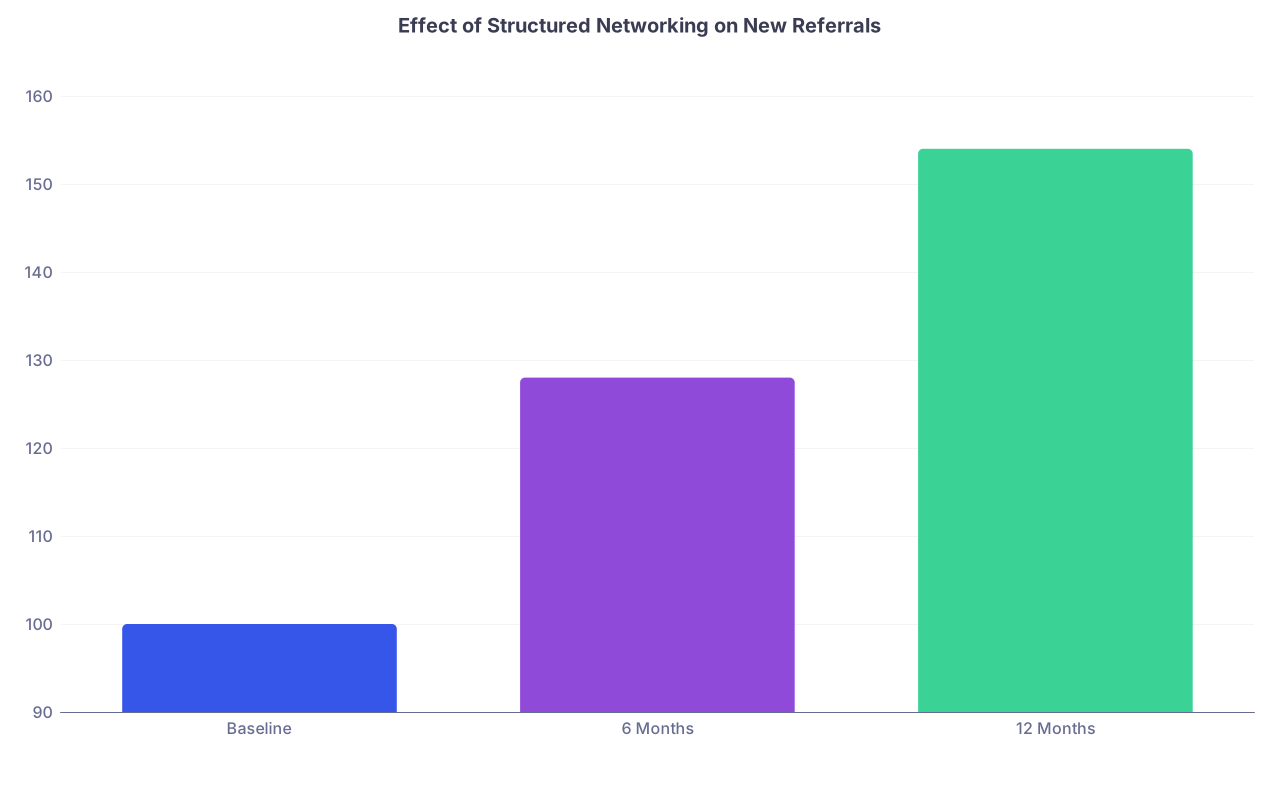
| Category | Value |
|---|---|
| Baseline | 100 |
| 6 Months | 128 |
| 12 Months | 154 |
Interpretation in human language:
- Baseline: 100% (whatever your current new-referral rate is)
- After 6 months of actual, intentional networking: often 20–30% increase in new referrals
- After 12 months: 40–60% increase is not unusual in growth-oriented markets
I’ve seen a solo specialist go from 8 new consults a week to 13–14 in under a year with one simple strategy: monthly coffee or lunch with a rotating list of PCPs and NPs, plus being physically present at the hospital twice a week for quick curbside chats.
Same quality of care. Same clinical skill. Different relationships.
If you think that’s “soft stuff” that does not matter, check your RVUs at the end of the year.
The Four Networking Channels That Quietly Drive Private Practice Growth
Networking for private practice is not poster sessions and national conferences. It’s more local. More boring. And more financially powerful.
1. Referring Clinicians (The Big One)
This is the main artery. If you ignore this, you are choosing slow growth.
Referring clinicians include:
- Primary care physicians and APPs
- Hospitalists and ED physicians
- Other specialists (orthopedics to pain, rheum to derm, OB/GYN to uro, etc.)
- Behavioral health providers, PTs, chiropractors, podiatrists
What the data shows when groups track “referrer-level” volume over time:
- A single high-volume PCP can be responsible for 3–10 new patients a week.
- Losing or gaining just 3–5 active referrers can swing your schedule from half-empty to booked-out.
I’ve seen referral dashboards where one enthusiastic NP at a busy community clinic was outperforming half the physician referrers combined. Why? She had a direct cell number for the specialist and felt heard when she called.
That “I can reach them” feeling is networking in its purest form.
2. Internal Hospital and ASC Relationships
If you use a hospital or ASC for procedures, your “network” there directly affects:
- OR block time
- Staff enthusiasm for your patients
- Informal referrals from colleagues who see your work
- Inclusion (or exclusion) from service lines and initiatives
You already know how this looks in real life.
Surgeon A: Shows up, operates, leaves. Barely talks to anesthesia, PACU nurses, or schedulers.
Surgeon B: Knows the charge nurse by name, thanks anesthesia, checks on patients after, attends one quality committee meeting and has informal hallway conversations with leadership.
When the hospital is deciding who gets more block time after a new robot comes in, which surgeon do you think gets the call?
This is networking. Just in scrubs instead of a blazer.
3. Community and Employer-Focused Networking
Private practices that actually grow in 2024 do not sit inside their four walls waiting for patients. They go where patients and decision-makers are:
- Local employers and HR/benefits managers
- School systems and athletic programs
- Senior centers and assisted living facilities
- Community organizations and faith communities
The data from employer-facing campaigns is blunt: a single self-insured employer partnership can become one of your top three referral sources if you bother to show up consistently.
Think of one orthopedic group that:
- Offered a quarterly “injury prevention” talk to a local warehouse employer
- Gave the employees priority access and same-week appointments
- Sent clean, simple notes back to the employer about restrictions/return to work
Within a year, that one employer was generating 15–20 new patient visits per month. Not because of an ad. Because of a relationship.
4. Digital Presence as a Networking Amplifier
Online presence is not “marketing” in the superficial sense. It is networking at scale.
Referrers and patients both:
- Google your name
- Look at your website and reviews
- Judge whether you’re approachable, competent, and responsive
There’s decent data that on many platforms:
- 60–80% of patients read reviews before choosing or accepting a referral
- Referrers are more likely to send patients to someone whose online presence does not embarrass them
You’re not just networking with humans face to face. You’re networking with their future selves, who will look you up later, by leaving a coherent digital trail.
Why Doctors Keep Telling Themselves Networking “Is for Academics”
Three reasons, all pretty human.
1. Ego: “My Skills Should Be Enough”
Medicine trains you to believe that technical excellence is the currency. In academia, you get rewarded for papers, talks, grants.
In private practice, the currency is different: trust, access, responsiveness, reliability.
Your skill matters. But if no one knows you exist, or if you’re difficult to reach, your “brilliance” is a private hobby.
2. Discomfort: “I Don’t Want to Schmooze”
Good. You shouldn’t.
The doctors who do best with networking in private practice are not slimy glad-handers. They are the ones who:
- Call referrers back
- Send clear consult notes quickly
- Take a 20-minute coffee meeting seriously
- Follow up on a complex shared patient without being asked
If that feels like “schmoozing,” you’ve misunderstood what networking is. This is just professional courtesy done deliberately and repeatedly.
3. Confusion: “I Don’t Have Time for This”
Translation: “I haven’t admitted it drives revenue, so I won’t prioritize it.”
When you actually track results, you realize that two hours a month of targeted relationship-building can outperform thousands of dollars poured into generic advertising.
One large multi-specialty group compared the ROI of:
- Paid digital ads
- Mailers to the community
- Targeted referrer-outreach by physicians
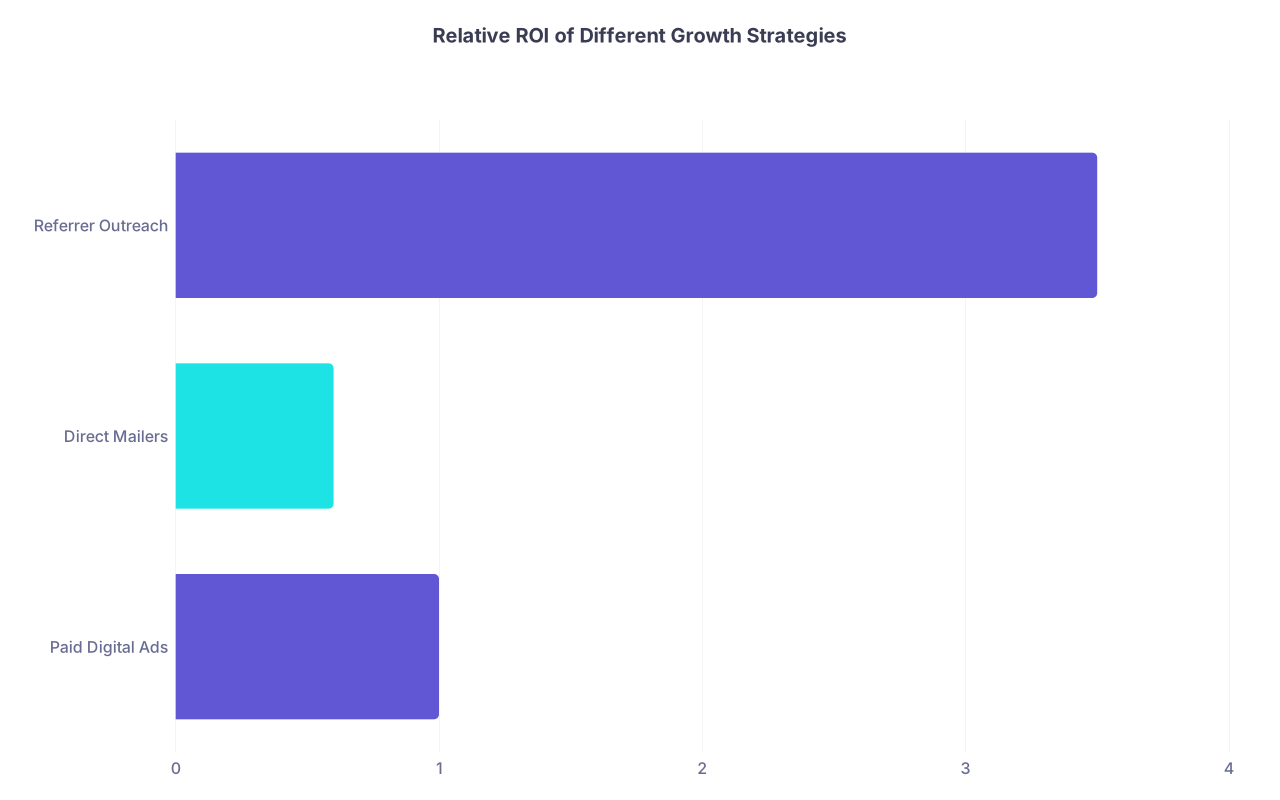
| Category | Value |
|---|---|
| Paid Digital Ads | 1 |
| Direct Mailers | 0.6 |
| Referrer Outreach | 3.5 |
They normalized digital ads to an ROI of 1. Direct mail was worse. But referrer outreach — lunch-and-learns, quick CME talks, consistent follow-up — was over three times more effective per dollar and per hour of physician time.
If you skip networking because you “have no time,” you’re probably spending that time on the wrong things.
What Effective Networking in Private Practice Actually Looks Like
Let’s strip this down to the behaviors. No fluff.
Being Obsessively Reliable to Referrers
Every survey of referrers who “switch” where they send patients says the same thing: communication and access beat prestige.
Referrers care about:
- How fast their patient can be seen
- Whether they get a useful note back
- Whether you’re reachable for a quick question
- Whether patients report that you listened
You can outperform a “top fellowship” competitor simply by:
- Providing a direct line for referrers or their MAs
- Having your staff triage referrer calls with priority
- Sending same-day or 24-hour summary notes on urgent consults
I’ve seen a GI doc who was “only” community-trained outcompete a prestigious academic rival in the same city for one reason: every PCP knew they could text him through a secure app and get a response within the hour.
That is networking that prints RVUs.
Being Physically Present
There’s something very unsexy but powerful about simple presence:
- Attending one local medical society or hospital council meeting per month
- Rounding in person on complex shared patients and calling the PCP after
- Swinging by the ED to introduce yourself when on call
You are memorable when you are visible. The “I see them around, they seem solid” effect is not mystical. It’s human psychology.
Playing the Long Game
Networking doesn’t pay off in a week. It usually pays off in 3–12 months.
That’s why a lot of doctors quit right before it gets good. They do two lunches, don’t see an immediate spike, and declare “it doesn’t work.”
The practices that win treat relationship-building like any other long-term investment:
- Consistent, low-drama, predictable contact
- No begging for referrals
- Just being the kind of colleague people feel good about sending patients to
Is Networking Selling Out? No. It’s Protecting Your Future Patients.
There’s a cynical take that networking in private practice is “selling out” or “being a business person instead of a doctor.”
That’s naive.
If you want:
- Enough volume to maintain your procedural skills
- Financial stability to avoid burnout and early exit
- The leverage to refuse unsafe contracts or abusive call schedules
…you need a healthy practice, not a starving one. Healthy practices are built on relationships.
Your future high-risk OB patient, your future brittle diabetic, your future complex spine case — they get to you because a web of humans decided you were trustworthy and reachable. That is networking.
Pretending otherwise just handicaps you and hands your future patients to someone else.
FAQs
1. I’m early in practice. What’s the single highest-yield networking move I can make?
Pick 5–10 local PCPs/APPs or core referrers and do two things: meet them once in person (coffee, lunch, quick clinic visit), and then prove you’re reliable with fast consult notes and easy access. You do not need dozens of referrers. A small core who really trust you can fill your schedule.
2. I hate self-promotion. How do I network without feeling fake?
Stop thinking of it as “promotion.” Frame it as: “How do I make it easier for colleagues to take good care of their patients with my help?” Ask what frustrates them about specialist referrals, then fix that in your process. Listening and solving problems is networking, and it does not require any bragging.
3. Does attending national conferences help private practice networking?
Only if you treat them as relationship hubs, not CME vacations. For private practice, local and regional connections usually matter more. National meetings can help if you’re building niche expertise, aligning with industry, or planning to expand multi-site — but they’re not the core referral engine for a typical community practice.
4. Can online reviews and social media replace traditional networking?
No. They complement it. Strong reviews make referrers more comfortable sending patients to you, and social media can amplify your expertise. But a 30-second positive impression in a hallway conversation with a PCP still converts more predictably than any number of likes on a post.
5. I’m already busy. Why should I care about networking if I’m booked out?
Because volume is not permanent. Contracts change, employers open in-house clinics, hospitals shift referral patterns, new competitors move in. A strong, diversified relationship network is your buffer. It also gives you more selective power: you can shape your case mix, negotiate better, and have an exit path if your current setup turns toxic.
Key points: Networking in medicine is not an academic luxury; it is the core growth mechanism for private practice. The data is clear that relationships with referrers, hospitals, and communities drive far more volume than prestige or advertising. If you ignore networking, you are not being “purely clinical” — you are quietly accepting weaker influence, lower revenue, and fewer options for yourself and your patients.


