
It is July 1st. You are wearing a new badge that says “PGY-1” and your inbox already has 27 unread emails from people whose names you do not recognize. You are trying to figure out how to enter an order without crashing the EMR, much less how to “network in medicine.”
This is exactly when most residents make their first big mistake: they assume networking is something they will deal with “later,” when things calm down. They do not. Things never calm down. The people who quietly start building relationships from day one are the ones who have options in three years—research, chief year, fellowships, jobs.
You have six critical months: Orientation through December. Here is what you should be doing, step by step.
Big Picture Timeline
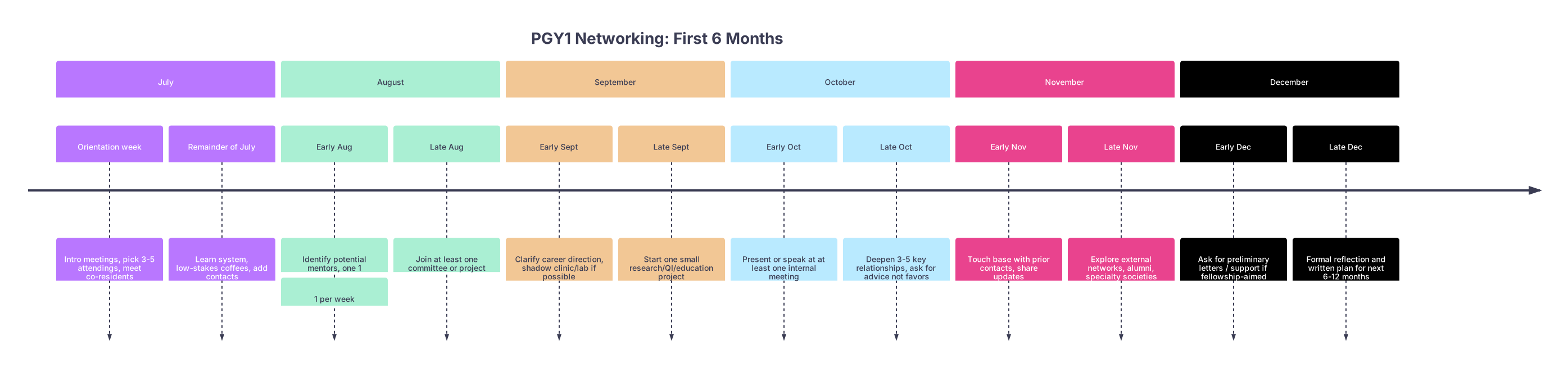
| Period | Event |
|---|---|
| title PGY1 Networking | First 6 Months |
| July - Orientation week | Intro meetings, pick 3-5 attendings, meet co-residents |
| July - Remainder of July | Learn system, low-stakes coffees, add contacts |
| August - Early Aug | Identify potential mentors, one 1 |
| August - Late Aug | Join at least one committee or project |
| September - Early Sept | Clarify career direction, shadow clinic/lab if possible |
| September - Late Sept | Start one small research/QI/education project |
| October - Early Oct | Present or speak at at least one internal meeting |
| October - Late Oct | Deepen 3-5 key relationships, ask for advice not favors |
| November - Early Nov | Touch base with prior contacts, share updates |
| November - Late Nov | Explore external networks, alumni, specialty societies |
| December - Early Dec | Ask for preliminary letters / support if fellowship-aimed |
| December - Late Dec | Formal reflection and written plan for next 6-12 months |
Orientation Month (July): Lay the Foundation Without Being Awkward
At this point you should not be “networking aggressively.” You should be getting your feet under you and simply not missing obvious opportunities.
Week 0–1: Orientation Week
Your goals are simple:
- Learn names.
- Be seen as competent and pleasant.
- Mark 3–5 people as “potential future mentors.”
Focus on:
-
- PD, APDs, chief residents.
After every talk, stay 60 seconds:- “Thank you, I am [Name], starting in [track]. Very excited to be here.”
- That 10-second introduction puts a face to your name. They will see you again at 5:30 am on rounds.
- PD, APDs, chief residents.
Your immediate co-resident cohort
- Intern class. Seniors you will work with monthly.
- Sit with different people each orientation lunch. Ask:
- Where they trained.
- What they think about fellowship.
- Any faculty they have heard are “great to work with.”
Early list of key faculty
- You are not picking a lifelong mentor yet. You are collecting names.
- Watch for:
- People who talk about teaching with enthusiasm.
- Faculty mentioned repeatedly as “amazing to work with” or “super supportive.”
Make a simple list in your notes app:
- “People to watch”: PD, APDs, chiefs, 5–10 faculty, 5–10 co-residents.
- That list will drive the next 3 months.
Weeks 2–4 (Rest of July): Become Easy to Work With + Light Touch Networking
At this point you should be focused 80% on clinical competence, 20% on relationship-building.
Clinical reputation first. No one wants to mentor the intern who loses notes, disappears on rounds, or has “that face” whenever a new admission hits at 4:45 pm.
Parallel to that, do three very concrete things:
Ask seniors one key networking question
- End of a shift, when it is quiet:
- “I am interested in [X / not sure yet]. Who here is really good to know in that area?”
- Write down every name they give you.
- End of a shift, when it is quiet:
Send 2–3 short follow-up emails
Anyone who said “Reach out if you ever want to talk more about [topic]” during orientation.
Template you can send in under 60 seconds:
Subject: Thank you and brief follow up
Dear Dr. [Last Name],
Thank you again for speaking with us during orientation. I am a new PGY-1 in [program], and your comments about [specific thing they said] really resonated with me.
I am early in residency and still exploring subspecialty interests, but I would appreciate the chance to hear more about your path at some point this year. No rush at all on timing.
Best regards,
[Name], PGY-1 [Department]You are not asking for a meeting yet. You are starting a thread. That matters later.
Connect with your PGY-2 and PGY-3 “informal mentors”
- Identify 1–2 seniors who:
- Do not yell.
- Actually teach.
- Know where things are.
- Say directly:
- “I really appreciate your teaching. I may bug you for advice sometimes this year if that is OK?”
- That is networking. Almost no one labels it that way, but those people will flag opportunities for you all year.
- Identify 1–2 seniors who:
August: Start Intentional 1:1s and Join One Thing
By now you should be less terrified of the EMR. This is when you shift from passive to mildly active networking.
Early August: One Intentional Conversation Per Week
Goal: four 20–30 minute conversations this month. That is it.
Target people:
- 1–2 faculty mentioned repeatedly as “great mentors.”
- 1 chief resident.
- 1 senior resident who is where you might want to be (e.g., planning cardiology fellowship, doing global health, etc.).
How to ask for a meeting without sounding needy:
Dear Dr. [Last Name],
I am a new PGY-1 in [program]. Several residents recommended you as someone who is particularly supportive of trainees interested in [field / type of work].
I am early in residency and still getting oriented, but I would appreciate 20–30 minutes at your convenience to ask about your path and how you would suggest I use the first year.
I am happy to meet in person or via Zoom and can work around your schedule.
Best regards,
[Name], PGY-1 [Department]
During the meeting:
- Ask about:
- Their path (how they chose X).
- What they wish they had done earlier in residency.
- Who else they think you should meet.
- End with:
- “Would it be OK if I checked in again later this year?”
Most will say yes.
- “Would it be OK if I checked in again later this year?”
Make brief bullet notes right after. Otherwise you will forget who said what.
Late August: Join Exactly One Thing
You need visibility outside the ward team.
Options:
- Residency program committees (wellness, curriculum, recruitment).
- A departmental research meeting.
- A hospital quality improvement committee.
- Interest group: ethics, global health, medical education.
Constraints:
- 1–2 hours per month. Anything more is a trap.
- In the room, speak once. You do not need to dominate. You just need people to know you exist and are thoughtful.
This is where you start meeting people from other services, allied health staff, and administrators—massively underrated for future jobs and QI projects.
September: Clarify Direction and Start One Small Project
By September, you are no longer “brand new.” People expect you to at least vaguely know what you want.
At this point you should be moving from generic “I want to do something academic” to “I am leaning toward X, Y, or still deciding between A and B.”
Early September: Narrow Your Focus (Even If It Is Temporary)
You do not need a lifetime plan. You need a direction for the next 6–12 months.
Three scenarios:
You already know your field (e.g., GI, EM, surgery subspecialty):
- Tell people that clearly.
- Attend that division’s conference consistently. Sit in the same general area. People notice.
You have 2–3 possible fields:
- Pick one to explore more deeply this fall.
- You are not committing forever. You are reducing noise so you can act.
You are genuinely undecided:
- Your “direction” can be skill-based:
- Medical education.
- QI / patient safety.
- Health services research.
- Network around those domains; they are portable across specialties.
- Your “direction” can be skill-based:
Mid–Late September: Start One Concrete Project
Networking in medicine works best when it is anchored in real work. Otherwise you are just having coffee forever.
You want one thing by end of September:
- A small QI project.
- A case report/series.
- A simple retrospective chart review with an existing dataset.
- An educational project (curriculum tweak, teaching session, etc.).
How to set this up:
Email the most promising potential mentor you met:
I appreciated our conversation earlier this month about [topic].
I am interested in getting involved in a small project this year that would be feasible as a PGY-1. If you have any ongoing work where you think an intern could be helpful, I would be very interested in contributing.
Or ask at a division conference:
- “Are there any ongoing QI or research projects that could use a PGY-1 level contribution?”
Whatever you say, avoid: “I want a first-author paper in a top journal.” You are not negotiating a contract; you are trying to get in the room.
October: Increase Visibility and Deepen 3–5 Key Relationships
By October, you should not still be invisible.
At this point you should have:
- Met with at least 2–3 faculty 1:1.
- Joined one group/committee.
- Attached yourself to one modest project.
Now the goal: be remembered.
Early October: Present Something (Even Small)
You are not waiting for a national conference. Internal presentations count:
- A 10-minute case presentation at morning report.
- A brief QI update at a committee meeting.
- Teaching 3–5 interns a specific task you just mastered.
What this does:
- Shows you are willing to stand up and speak.
- Gives faculty and seniors a mental tag: “Oh, that was the intern who presented the [X] case.”
Do not obsess about perfection. Clear, concise, on time beats flashy.
Mid–Late October: Identify Your “Core 3–5 People”
These are the people who will likely:
- Write your letters.
- Nominate you for awards.
- Connect you to opportunities.
They might include:
- 1–2 attendings in your likely field / interest area.
- 1 program leader (PD, APD, chief).
- 1–2 senior residents/fellows who actually answer your texts and pull you into things.
Your job in October:
Check in once with each of them.
Share a brief concrete update:
Quick update: I started working with Dr. [X] on a QI project about [topic]. We are looking at [brief description]. It has been a great learning experience so far.
You are training them to see you as someone going somewhere. People invest more in those residents.
November: Widen the Circle and Strengthen External Links
By November, the initial chaos has settled. This is the time to look beyond your immediate program.
At this point you should start thinking in terms of networks, not just individuals.
Early November: Reconnect and Update
You are playing a long game. Send 3–5 short emails to people you have not talked to since orientation or early fall:
- Former med school mentor.
- Someone who visited your program for Grand Rounds.
- A faculty you had an early 1:1 with but have not seen much.
Template:
Dear Dr. [Last Name],
I hope you are doing well. I wanted to send a brief update from my first few months of residency. I have been working on [brief project/role], and it has confirmed my interest in [field/area].
Thank you again for your earlier guidance. I plan to continue exploring [X] over the coming months and would appreciate staying in touch.
Best regards,
[Name]
Fifteen lines of text. That keeps the connection alive for years.
Mid–Late November: Look Outside Your Institution
This is where most residents are behind. They stay entirely inside their home program until fellowship application season, then panic.
You should:
Join at least one relevant national organization or section
- Example: For internal medicine:
- ACP, subspecialty society (ACC, ATS, AASLD, etc.).
- For EM: ACEP, SAEM.
- For surgery: ACS, specialty-specific societies.
- Example: For internal medicine:
Identify one external person to email before December
- Alumni from your med school or residency in your area of interest.
- A fellow or young faculty at another institution you met at a virtual talk.
Email content:
I am a PGY-1 in [program] interested in [field/area]. I heard your talk on [topic] / was referred to you by [X] and found your comments on [specific point] very helpful.
I am still early in residency, but I would appreciate any brief advice you have for residents in their first year who might be considering [field/area] down the line.
You are not asking for a letter. You are asking for perspective. That is how real networking works.
December: Convert Conversations into a Coherent Plan
By December, you have enough data to stop “just meeting people” and start structuring the next phase.
At this point you should sit down for an hour and write things out.
Early December: Formal Check-In with 1–2 Key Mentors
Schedule 30 minutes with:
- Your most engaged faculty mentor.
- Or your PD / APD if they are accessible and you feel comfortable.
Agenda:
Briefly summarize your first six months:
- Rotations.
- Early wins.
- Any struggles (within reason; do not trauma-dump).
Present your proposed next steps:
- “I am thinking about focusing on [field/area].”
- “I am working on [project] and could potentially expand it into [X] by next year.”
- “I would like to present [something] within the next 6–12 months (local poster, conference, grand rounds).”
Ask direct questions:
- “Given my interests, who else should I try to meet in the next 6 months?”
- “Are there any committees, working groups, or projects you think would be particularly valuable for me?”
You are not asking them to design your life. You are showing you can think and plan, and you want feedback.
Mid–Late December: Write a Simple 6–12 Month Networking Map
Yes, on paper or in a document. Not in your head.
Create three short lists:
Core mentors (3–5 names)
For each:- How often you will check in (e.g., every 3–4 months).
- What you are hoping to get from them (advice, project guidance, specialty perspective).
Active projects (1–3 items)
For each:- Your role.
- Concrete next step (data collection, abstract, presentation).
- Target venue if relevant (local QI day, regional meeting, national conference).
Target connections for next year (5–10 names)
Could include:- Known leaders in your interest area at your institution.
- Alumni or external faculty you want to meet.
- Program leadership if you have not interacted much yet.
You can track this in a simple table:
| Category | Example Entry |
|---|---|
| Core Mentor | Dr. Smith – cardiology |
| Active Project | Heart failure QI readmission rate |
| Target Contact | Dr. Lee – alumni in EP fellowship |
| Check-in Cadence | Every 3–4 months |
| Target Venue | Local QI day June |
Once you write this down, networking stops being random. It becomes a series of scheduled, manageable actions.
Common Pitfalls in the First Six Months (And What To Do Instead)
You will see your co-residents do these. Try not to.
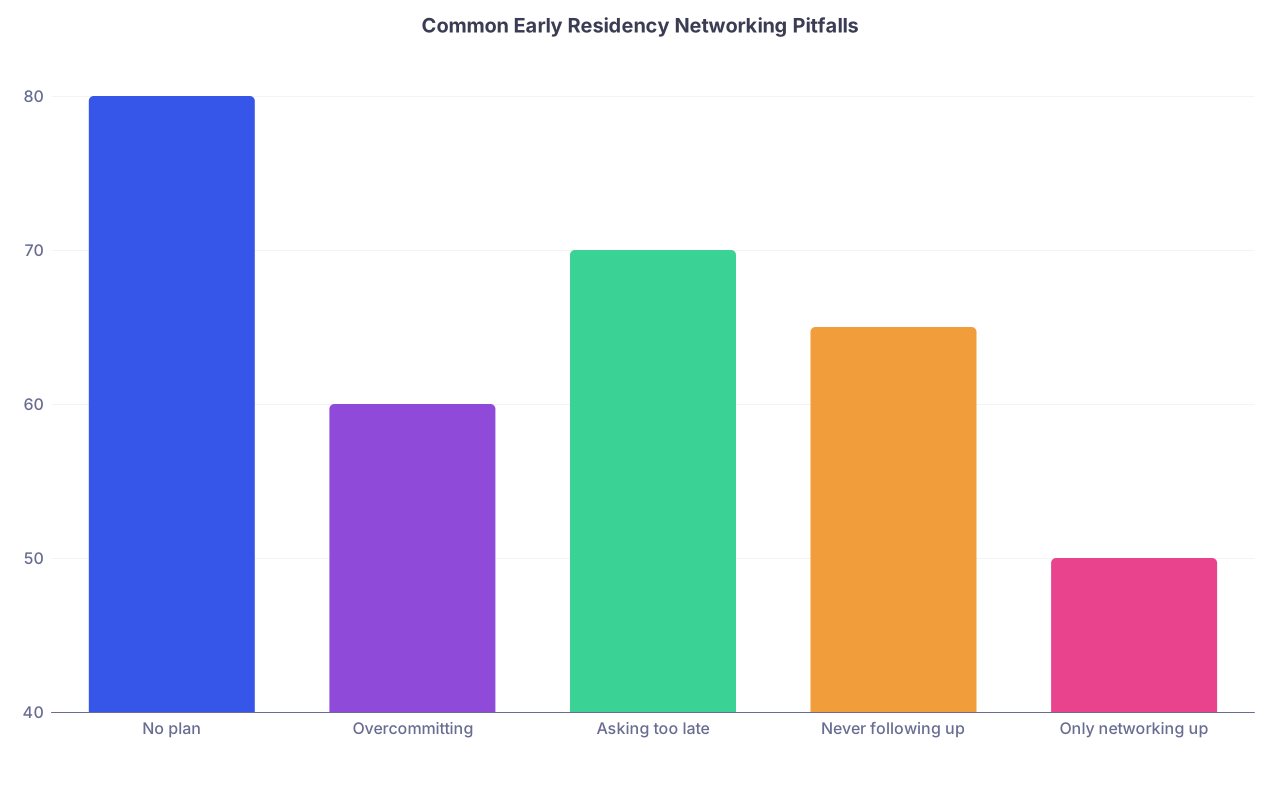
| Category | Value |
|---|---|
| No plan | 80 |
| Overcommitting | 60 |
| Asking too late | 70 |
| Never following up | 65 |
| Only networking up | 50 |
Having no plan at all
- Reality: 80% of interns just “see what happens.”
- Fix: This month-by-month structure is your floor, not your ceiling. Stick to it and you are already ahead.
Overcommitting to 5 projects in October
- You will see someone say yes to:
- Two research projects.
- A curriculum design idea.
- A QI project.
- A side gig tutoring for Step exams.
Then they drown.
- Fix: One main project through winter. A second only if the first is actually moving.
- You will see someone say yes to:
Asking for letters or favors too early or too late
- Too early: Week 2 of July, asking for a “strong letter someday” from someone who has never worked with you. Awkward.
- Too late: April of PGY-2, emailing “Dear Dr. LastName, I am applying to fellowship in 2 weeks, can you write a letter?”
- Fix: Use this first six months to be observed at work + build some history. Letters for fellowship usually get requested PGY-2/early-3—but the relationships start now.
Never following up
- Most missed opportunities are not from bad first impressions. They are from never being heard from again.
- Fix: 3–5 “light touch” updates per year to mentors. It takes 5 minutes.
Only “networking up”
- Some residents only chase famous attendings. They ignore nurses, APPs, admin staff, co-residents.
- Reality: I have seen jobs created because an NP vouched for a resident or a co-resident became faculty and pulled someone in.
- Fix: Be a decent colleague to your peers and the entire care team. That is networking too.
Two Quick Visuals: How Your Time Should Shift
Early months: mostly clinical + survival. By December: a small but real slice devoted to relationship-building and project work.
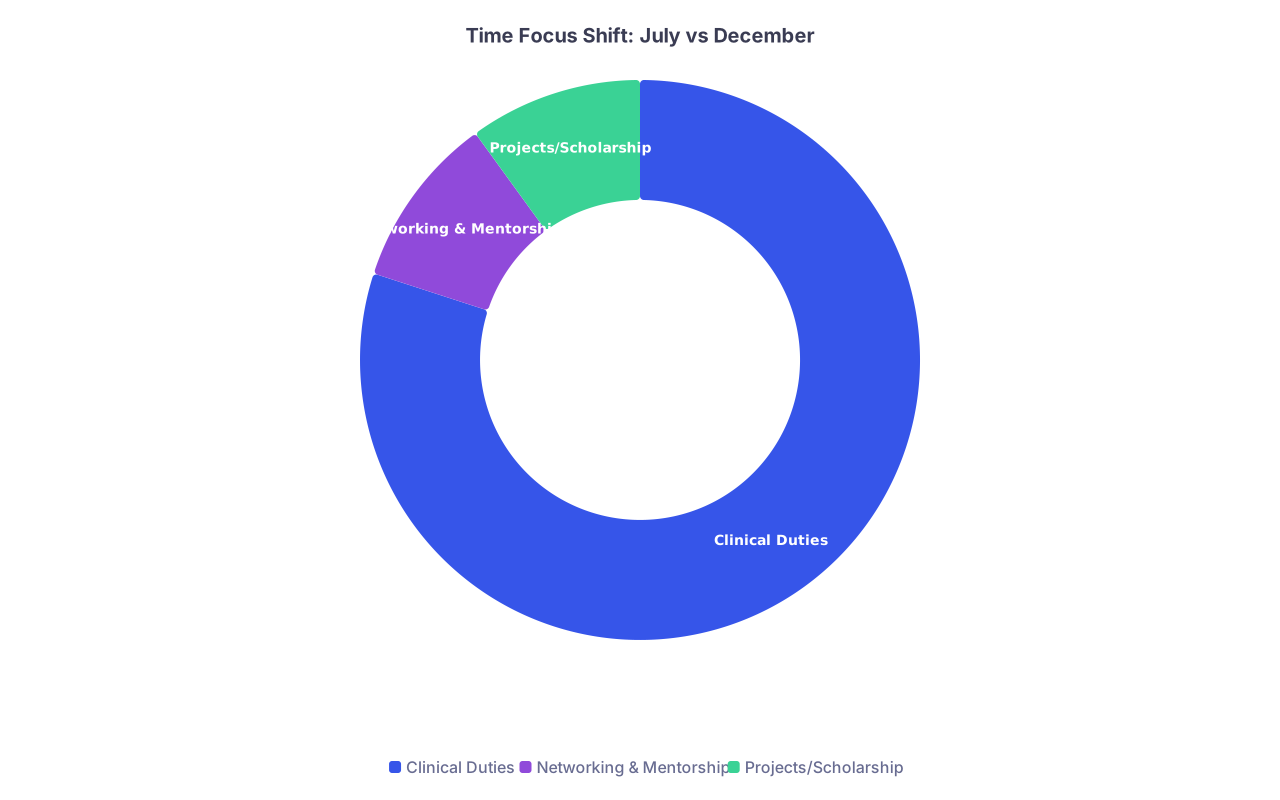
| Category | Value |
|---|---|
| Clinical Duties | 80 |
| Networking & Mentorship | 10 |
| Projects/Scholarship | 10 |
(That is July. By December, you might be closer to 70 / 15 / 15. Not 50 / 50. You are still a resident.)
Key Takeaways
- From orientation through December, your goal is not to collect business cards; it is to become known as a reliable resident with a small, solid network of 3–5 mentors and 1–3 real projects.
- One structured action per week—an email, a 20-minute coffee, a brief presentation—is enough to build serious momentum over six months.
- Write it down: who your core people are, what projects you are on, and who you want to meet next. If it is not on paper, it will not survive post-call brain.