
What if one awkward tweet or badly phrased post really does ruin your career before it even starts?
The Fear: “One Screenshot And I’m Done”
You’re not paranoid. You’ve heard the horror stories.
The resident who posted a slightly snarky comment about a patient situation and got dragged online. The med student who made what they thought was a harmless meme and suddenly had a professionalism committee meeting on their calendar. The attending in your hospital who said, “Just remember: screenshots are forever,” in that tone that makes your stomach drop.
So now you’re stuck in this tension:
You know social media could help with networking in medicine. People keep saying, “Twitter (X) is amazing for #MedTwitter,” “LinkedIn is great for connecting with mentors,” “You should be building your online presence early.”
But every time you even think about posting something, your brain goes:
- “Will a future PD see this and hate me?”
- “Is this unprofessional?”
- “Am I violating HIPAA without realizing it?”
- “Will this be taken the wrong way in 10 years?”
So you… don’t post. You lurk. You bookmark threads. You see other trainees getting invited to podcasts, collaborating on research, getting DM’d about opportunities, and you’re just quietly observing from the shadows.
Let me say this bluntly: yes, social media can absolutely help you. Even if you’re terrified to post. Even if you never become “that” loud, polished, super-online person.
But you need a way to use it that doesn’t keep you awake at 2 a.m. replaying every sentence you typed.
What You’re Actually Afraid Of (You’re Not Overreacting)
Let’s name the monsters, because vague fear is always worse.
Here are the big ones that usually sit in the back of your mind:
- “What if a residency program rejects me over a post?”
- “What if I accidentally violate HIPAA?”
- “What if attendings or classmates see my stuff and judge me?”
- “What if I say something clinically wrong and get roasted?”
- “What if I change my mind later and that old post looks stupid or problematic?”
All of these are real risks. Not guaranteed outcomes, but real.
I’ve seen programs quietly Google applicants. I’ve seen PDs talk about “concerning online behavior.” I’ve seen screen‑captured posts show up in professionalism discussions. I’ve also seen students get subtle bonuses in how people perceive them because of a thoughtful, professional online presence.
Social media, for trainees, is like walking into the hospital in your white coat. It can help you be seen as competent and engaged… or it can hurt you if you forget people are watching.
The goal isn’t “don’t ever post.” The goal is “post in a way that feels safe, controlled, and actually worth the risk.”
Step 1: Use Social Media Without Posting A Single Thing
Here’s the part nobody tells you: you can get a lot of the benefit of social media networking without posting publicly at all.
Lurking is not a failure. It’s a strategy.
You can:
- Follow attendings, residents, and researchers in your field.
- Learn what people in your specialty actually talk about day-to-day.
- See what conferences, rotations, and projects people recommend.
- Understand the culture of different programs (the subtle “vibes” are very real).
- DM people politely about specific questions or opportunities.
You don’t need a “brand” for this.
You just need a clean profile and decent judgment in DMs.

| Step | Description |
|---|---|
| Step 1 | Create professional account |
| Step 2 | Clean profile and bio |
| Step 3 | Follow mentors and programs |
| Step 4 | Lurk and learn |
| Step 5 | DM selectively and politely |
| Step 6 | Decide later if you want to post publicly |
That alone already makes social media useful for networking in medicine. No public tweets. No threads. No hot takes.
If your anxiety is at maximum, start there. Professional account, zero posts, maximum observation.
Step 2: Two-Account Strategy So You Can Breathe
If you’re scared of mixing “you as a trainee” with “you as a human being who has non-medical thoughts,” separate them.
Create:
- A professional account under your real name (or close to it).
- A private personal account under a non-identifiable handle for friends only.
On your professional account, you act like everything could be screenshotted and emailed to a PD. Because it can.
On your private account, you lock it down: private, no real name, no hospital, no identifiers, you’re picky about who you let in. And even then, you still don’t post anything that would destroy you if it leaked, because people fall out, devices get stolen, and nothing online is truly safe.
This two‑account setup lowers the psychological pressure. You’re not asking one profile to be both “serious future cardiologist” and “exhausted human who wants to tweet about crying after call.”
You can still choose never to post on the professional account. But now at least you’ve created a space for it.
Step 3: What Is Actually Safe To Post As A Trainee?
Let’s be concrete. Because the vague “be professional” advice is useless.
Here’s what’s generally low-risk and actually useful:
Sharing articles or guidelines with a short neutral comment:
“Interesting piece on new heart failure guidelines from ACC.”Conference stuff:
“Excited to attend #ACC2025 for the first time – any must-see sessions for trainees?”
(No photos of name badges with location details if you’re paranoid about privacy.)Study resources or tips that aren’t braggy:
“This Anki deck helped me organize cardiology topics.”Generic “I’m learning” reflections that don’t mention specific patients, hospitals, or details:
“Grateful for good teachers. Learning how to have hard conversations with families has been more emotionally intense than I expected.”Celebrating milestones in a humble way:
“Honored to have our abstract accepted to [Conference]. Grateful to mentors @Name and @Name.”
You’ll notice what’s missing: sarcasm, complaints about work, political wars, detailed clinical narratives, hospital gossip, screenshots of charts, and anything that sounds even a bit like making fun of patients, nurses, or colleagues.
That’s the stuff that gets people in trouble. Every time.
Step 4: The “Can This Ruin My Career?” Checklist
Before you post anything from your professional account, run it through a quick mental filter. I actually recommend saving this somewhere: Notes app, pinned doc, whatever.
Ask yourself:
Could this be seen as mocking a patient, colleague, nurse, or other group?
If yes or maybe → do not post.Is there any chance this could be linked to a real patient encounter?
Time, age, diagnosis, location, unique situations. If someone at your hospital could go, “Oh that’s Mrs. X from last week” → no.Would I be okay with this on a projector in a residency interview room with PDs and faculty staring at it in silence?
If that image makes you nauseous → probably not safe.Does it sound like I’m giving medical advice to strangers?
You’re not their doctor. Avoid it.Is this a “hot take” on a controversial topic?
You don’t need to carry that online at this stage. You can have opinions without blasting them publicly while you’re still so vulnerable in the hierarchy.
This isn’t about being fake. It’s about survival. Power dynamics in medicine are real. People with authority can absolutely judge you for a 2‑sentence tweet they don’t like.
How Social Media Actually Helps Networking (Even If You Post Very Little)
You might be thinking, “If I’m this careful, is there even a point?”
Yes. Because networking in medicine is not just about being loud. It’s about being present.
Social media can help you:
Find mentors you’d never meet locally.
Maybe you’re at a community program with no strong research in your dream subspecialty. But on X/LinkedIn, there are attendings and fellows posting about exactly that field. You can reply thoughtfully once in a while, then DM:
“Hi Dr. X, I’m a MS3 very interested in [field]. Your thread on [topic] was really helpful. If you ever have advice for trainees at smaller schools hoping to get involved, I’d be grateful.”See unfiltered specialty culture.
Anesthesiologists joking about call. Psych residents talking about burnout. Surgeons discussing OR teaching. You start to understand what people in that field care about, what annoys them, what they look for in trainees.Hear about opportunities early.
Research projects, multi-center collaborations, trainee essay contests, webinar invites. These float around social platforms constantly. Lurkers see them too.Be a tiny bit familiar to people before they see your application.
If you’ve liked and occasionally commented thoughtfully on a PD’s or faculty’s posts over a year, you might get:
“Oh, your name looks familiar from Twitter.”
That’s not magic. But in a huge pile of applications, even microscopic familiarity can help.
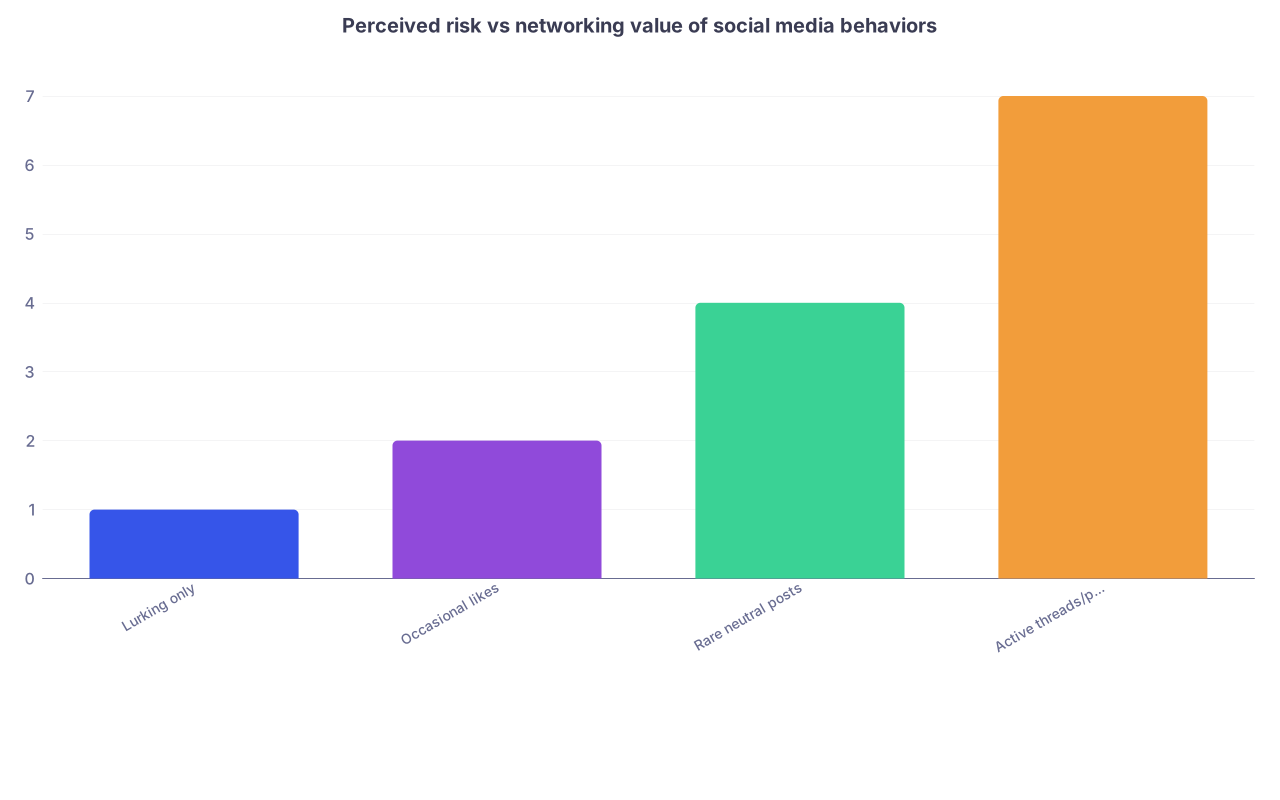
Here’s roughly the “value vs risk” for different levels of activity:
| Category | Value |
|---|---|
| Lurking only | 1 |
| Occasional likes | 2 |
| Rare neutral posts | 4 |
| Active threads/posts | 7 |
(1 = lowest, 10 = highest, for both risk and potential networking value; the point is: you get some value long before you get to high-risk behavior.)
HIPAA, Privacy, And The Stuff That Actually Gets People In Trouble
Since this is what keeps people up at night, let’s be painfully clear.
Things that really do sink people:
- Any details that could let someone who was there recognize a patient or case: not just name, but age + time frame + diagnosis + weird details.
- Posting screenshots of charts, EHR, schedules, messaging apps, even if “blurred.” People can unblur more than you think.
- Posting in real-time from the hospital with obvious background location details.
- Complaining about “annoying” patients or “difficult” families. No matter how vague, someone will decide it’s unprofessional.
- Getting into nasty arguments, swearing at people, or being openly hostile in threads.
If your goal is “no career-ending moves,” your line is simple: you don’t post about specific patients, you don’t post from the hospital, and you don’t post complaints about work or people.
If you absolutely feel compelled to reflect on something clinical and emotional: keep it abstract, delayed, and focused on you and what you learned, not what the patient did.
Quiet Ways To Build A Helpful Presence
You don’t have to become a content creator. You can still be “that quiet, reliable person online” that others see as thoughtful and safe to work with.
Some low-anxiety ways to be present:
- Once a month: share one article, podcast, or guideline with a short, neutral comment.
- Occasionally: reply “Thank you for posting this, really helpful perspective for trainees” to attendings whose posts you actually liked.
- Once in a while: share that you’re attending a conference, finishing a rotation, or grateful for mentors (without tagging your hospital unless you’re comfortable).
Over 1–2 years, that builds a pattern. When someone clicks on your profile, they don’t see chaos. They see:
Okay, this person is a trainee, they’re engaged, not unhinged, not reckless, not oversharing.
That’s honestly enough.
Picking Platforms (So You Don’t Spread Yourself Too Thin)
Different social platforms do different things for you.
| Platform | Best Use For Trainees |
|---|---|
| X (Twitter) | Specialty conversations, #MedTwitter, research, live conference chatter |
| Professional profile, CV-like presence, connecting with faculty and organizations | |
| Personal life, some med-IG education, but higher risk of oversharing photos | |
| Anonymous venting and advice, but not for real-name networking | |
| TikTok | High-risk for misinterpretation, only useful if you’re very deliberate |
If you’re already anxious, pick one main professional platform. Usually:
- X (Twitter) for academic/specialty networking
- or LinkedIn if you like cleaner, more professional vibes and less chaos
You don’t get extra points for being everywhere. You just multiply the ways something can go sideways.
The Ugly Truth: Some People Will Judge You
Let me not sugarcoat this.
Some attendings think trainees should not be visible online at all. Some PDs are hyper‑conservative. Some will absolutely stalk your socials and look for red flags.
But hiding completely has a cost too: fewer chances to connect, fewer ways to signal your interests, fewer opportunities.
So your goal becomes:
Minimize risk, but don’t paralyze yourself into nothingness.
You keep your online actions as defensible as possible. You imagine the most judgmental attending in your hospital reading your posts and still not having much to attack.
Is that frustrating? Yes. Is it unfair? Also yes. Is it the current reality? Mostly, yeah.
If You’ve Already Posted Things You Regret
Let’s say your stomach just dropped because you remembered some old posts.
You still have options:
- Delete obviously risky stuff now: patient-ish stories, complaints about work, unhinged political fights under your real name.
- Lock old accounts you don’t want tied to your professional identity.
- Going forward, behave in a way that, if someone did find an old post and raised an eyebrow, your recent online presence looks mature, restrained, and boring in the best way.
Medicine loves patterns. One dumb post from 5 years ago with 2 years of clean, thoughtful behavior after it is vastly less damaging than a constant stream of messy content.
The Real Question: What Do You Want From Social Media?
If you only see social media as a landmine field, you’ll never use it.
So ask yourself: what do you actually want out of this?
- To find one or two mentors?
- To hear about opportunities in your specialty?
- To understand the culture and issues of your field?
- To have a searchable, professional online footprint that doesn’t embarrass you?
You don’t need to be famous online for that.
You just need to be intentional and cautious.
And if your anxiety is loud, lean into the strategies that work with that: lurking, DMing, low‑frequency, low‑risk posting, two‑account separation.
You’re not behind because you’re not churning out threads. You’re just careful. That’s okay.
FAQ
1. Should I make my professional account private to feel safer?
You can, but you’ll lose a lot of networking value. PDs, faculty, and organizations are less likely to follow back or engage with a locked account. A better compromise: keep your professional account public but extremely tame and low-risk. If you want to say spicier or more personal things, that’s what a locked, non‑identifiable private account is for.
2. Do residency programs really check social media?
Some do. Some don’t. You won’t know which is which. I’ve heard PDs say openly, “If something seems off, I’ll Google them.” They’re mostly looking for glaring red flags: unprofessional rants, bigotry, clear HIPAA violations, obvious immaturity. They’re not hunting for minor awkward posts. But you should behave like they could look, just in case.
3. Is it okay to post about burnout or mental health as a trainee?
This is tricky. Many people do, and some PDs genuinely appreciate that honesty. Others silently worry you’re “not resilient” or “a problem.” Completely unfair, but real. If you’re early in training and anxious about consequences, I’d keep mental health posts very general and non-specific: more “medicine can be emotionally hard; I’m grateful for support” and less detailed blow-by-blow of your breakdown after call.
4. How do I start if I’m terrified of my first post?
Make your first few posts boring on purpose. Share a guideline, a conference you’re attending, a textbook you found helpful. No personal stories, no hot takes. Then leave it. Don’t obsessively reread it 20 times. Over a few weeks, your brain will realize, “Nothing exploded. No PD emailed me. I’m okay.” That’s when you can slowly decide if you want to keep going.
Open whatever social platform you’re considering using—X, LinkedIn, whatever—and do one concrete thing today: clean your profile photo and bio so they’d look fine on a projector in front of a residency selection committee. No posting, no threads, just that one small step toward a safer, more intentional online presence.


