
You are here
It’s late January of MS3. You’ve finally stopped confusing “SICU” with “CSICU,” you know which pager tone means trouble, and you’re starting to admit something to yourself:
You care a lot about where you match.
And some of the places you’re most excited about? They don’t exist yet. At least not on ERAS.
Some are brand‑new residencies just getting ACGME initial accreditation. Others are big-name hospitals announcing “we’re starting a program in 2026.” Your group chat keeps dropping rumors:
- “New EM program starting at XYZ in the suburbs.”
- “Hey, did you see that academic hospital in Austin is opening IM spots?”
- “My attending said their department is applying for a residency.”
You’re wondering:
When do I start tracking these new programs seriously?
When do they move from “interesting rumor” to “this might be on my rank list”?
Here’s the timeline. Month by month. What you should actually be doing, and when.
Big picture: How far ahead do new programs move?
Before we go month-by-month, zoom out one level.
New residency programs have three key time points relative to your application year:
Public whisper phase – “Our department is working on a residency.”
- No ACGME accreditation yet.
- May be on the hospital website as “coming soon.”
- You can’t apply. You can remember.
Initial accreditation granted – the real trigger.
- Program appears in ACGME’s public list.
- Often 6–18 months before they start their first residents.
- This is when they can participate in NRMP and ERAS for real.
ERAS / NRMP presence – now they’re in the game.
- They have an ACGME program ID and NRMP code.
- They might still be building clinic space and hiring faculty, but they can rank you and you can rank them.
At each of those phases, your year in school dictates what you should do.
MS2 – Early Awareness (Optional, But Smart)
If you’re still MS2, this part is short and painless.
Spring of MS2 (March–May)
At this point you should:
- Spend exactly one afternoon doing a high-altitude pass:
- Look up your target specialty on the ACGME public site.
- Bookmark it. That’s it.
- Start a simple tracking document, nothing fancy:
- Columns: Program name, City, State, Specialty, Notes, “New?” (Y/N).
- This is mostly for standard programs now. New ones will get added later.
Why now, and not earlier? Because before MS2 spring, you don’t even know your specialty for sure. Tracking new programs in MS1 is like planning your retirement on orientation day. Misplaced energy.
Your job at this stage is just to know where the official information lives so you’re not learning it from TikTok in MS4.
MS3 – The Real Timeline Starts
MS3 is where tracking newly accredited programs actually matters. Here’s your timeline anchored to a typical US student applying as an MS4 for the very next Match.
Assume you’ll apply in September of MS4. That means anything getting initial accreditation from now through early MS4 might be relevant.
Early MS3 (July–September): Light reconnaissance
You’re busy learning how to write an H&P that doesn’t sound like a ransom note. Fine. I’ll keep this layer thin.
At this point you should:
Pick your likely specialty by late MS3 fall.
Until then, don’t obsess about any specific new program. Your target might shift from EM to IM, or from OB to FM once you see call in person.Once you’re leaning toward a specialty (even 70% sure), do this:
- Add a tab in your spreadsheet:
“New or Recently Accredited Programs – [Specialty]” - Add these columns:
- Program name
- City/State
- ACGME ID
- First accredited year
- Status (rumor / planning / initial accreditation / active in ERAS)
- Notes (affiliated medical school? big system? community?)
- Personal interest level (High/Medium/Low)
- Add a tab in your spreadsheet:
This is passive tracking for now. No outreach. Just having a bucket ready for when data starts hitting.
Mid MS3 (October–December): Start real tracking
By mid MS3, your specialty choice should be >80% set. This is when “when to start tracking” becomes “start now.”
At this point (mid MS3) you should:
1. Set up a quarterly “new programs check” workflow
Pick one evening in October, then again in January and April.
Your checklist:
Check ACGME public site for your specialty:
- Filter by specialty.
- Sort by “effective date” or scan for recent years.
- Add any program with an initial accreditation date in the last 1–2 years to your spreadsheet.
Check specialty organization and listservs:
- EMRA for EM, AAIM for IM, AAFP for FM, etc.
- Many have newsletters that quietly announce “new residency approved at X.”
Check NRMP data for last cycle:
- Look for programs with “0 prior positions” in data tables — often new programs.
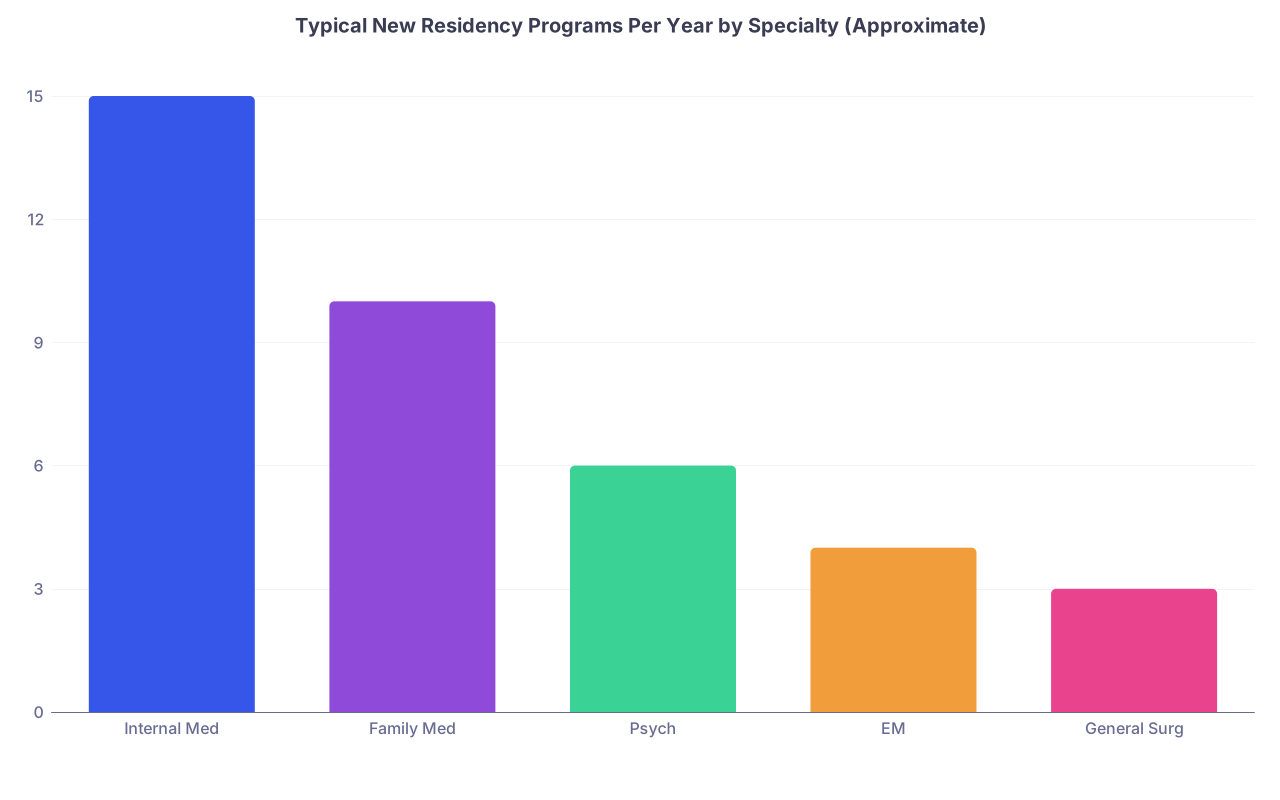
Create a quick snapshot of what’s happening:
| Category | Value |
|---|---|
| Internal Med | 15 |
| Family Med | 10 |
| Psych | 6 |
| EM | 4 |
| General Surg | 3 |
These aren’t exact numbers, but they show the pattern: IM and FM have more new programs on average. If you’re in those fields, tracking matters more.
2. Add a “Watch List” rule
Any new program that meets two or more of these criteria goes on your Watch List tab (a filtered view, or just mark them):
- In a city/region you’d realistically live in.
- Affiliated with a major academic center or big health system.
- In a state you know is expanding GME funding (Texas, Florida, some Midwest states).
- Has a name that matters (e.g., a satellite of a big-name institution).
Everyone else: park them on the main sheet, no emotional attachment yet.
Late MS3 (January–March): Serious tracking, low time cost
This is where most students are right now when they start asking this question.
At this point you should:
1. Move from quarterly to monthly checks
Once a month (pick a specific weekend, e.g., first Sunday):
- Open your spreadsheet.
- Open ACGME’s public list for your specialty.
- Filter/sort by “initial accreditation date” and add newcomers.
You’re not sending emails yet. You’re just making sure you don’t miss someone that appears 9–12 months before your application.
2. Add a “probable for my cycle” column
New programs can affect your application if:
- Initial accreditation is granted by late spring / early summer before your MS4 (roughly April–July), and
- They’re planning to recruit for the upcoming July residency start.
So add a column: “Likely in my ERAS cycle (Y/N/Maybe)”
Rules of thumb:
- Yes if:
- Initial accreditation date is ≥ March of your MS3 year,
and - Program website explicitly mentions “accepting applications for [your Match year].”
- Initial accreditation date is ≥ March of your MS3 year,
- Maybe if:
- Accredited in the last 12–18 months and unclear online about recruitment cycle.
- No if:
- Accredited years ago (they’re established) – track them on your general list, not your “new” list.
Your goal by end of MS3 is not to be perfect. It’s to have:
- A list of 5–20 programs that are either new or second/third-year and plausibly interesting.
- A sense for which ones might actually take applicants in your upcoming ERAS cycle.
MS4 Application Year: Month-by-Month Plan
Here’s where timing gets very real.
We’ll anchor this to a typical calendar:
- ERAS token available: late June
- ERAS submission: September
- Rank list: February
- Match: March
April of MS3 → June of MS3 (Right before MS4): Final “pre‑application” sweep
At this point you should:
- Do a focused ACGME pull for your specialty
Filter for any program with:
- Initial accreditation date within last 2 years, and
- Location in your realistic geo range.
Add them all to your “New and Recent” tab.
- Flag where they are in development
Use broad buckets:
- “Brand‑new – first class this year”
- “Second-year program”
- “Third-year program (still maturing)”
Why? Because brand‑new and second-year programs behave differently in the Match (more on that in a second).
July (Early MS4): Time to upgrade from tracking to strategy
Now ERAS is open. Vacation weeks are disappearing. This month is critical.
At this point you should:
1. Split your list into three groups
| Tier | Description | Typical Count |
|---|---|---|
| A | High-priority new/recent programs you’d be happy to rank top 10 | 3–8 |
| B | Medium interest; apply if fees/time allow | 5–15 |
| C | Low priority; only if you need geographic padding | 5–20 |
How to decide:
Tier A if:
- Location works for your life.
- You like their parent institution’s reputation or hospital system.
- They look serious: strong faculty, clear curriculum, not just “we needed cheap labor.”
Tier B if:
- You’d go if you had to, but it’s not dream-tier.
- Data is thin, and you’re not sure they’re stable, but you’re curious.
Tier C if:
- Pure backup, or you suspect they’re chaotic but might give interviews.
2. Start light outreach for Tier A
This is the first time outreach makes sense.
Your targets:
- Program Director (PD)
- Program Coordinator (PC)
Your timing:
- Late July to mid-August. Not later than that, or it ends up under a mountain of ERAS PDFs.
Your message (short version):
- Who you are (MS4 at X).
- Your planned specialty.
- That you’re particularly interested in new or developing programs because of X/Y reasons.
- A simple question:
- “Will you be participating in ERAS/NRMP for the upcoming [year] Match?”
- “Approximately how many positions will you offer?”
This isn’t begging for an interview. It’s confirming they exist in your cycle.
August: Lock in which new programs to actually apply to
You’ve collected answers (or silence). Now the decisions.
At this point you should:
- Mark each Tier A/B program with one of three labels:
- “Confirmed – recruiting this cycle”
- “Unclear – no response / vague”
- “Not recruiting this cycle”
- Adjust your ERAS application list accordingly:
- Always apply to Tier A that are “Confirmed – recruiting this cycle.”
- For “Unclear” programs:
- Check again on their website in late August.
- If there’s still no clear info and your budget is tight, consider dropping them.
- For “Not recruiting”:
- Move them to a separate tab titled “Future cycles / PGY2 possibilities.”
- Forget them for now; you’re not a PGY2 yet.
September (ERAS Submission): New programs strategy lock‑in
By the time you hit “submit,” here’s where you should be with new programs:
You have a realistic number of them in your list:
- Competitive specialty (e.g., Derm, Ortho): maybe 1–5 new programs max.
- Less competitive or expanding specialties (IM, FM, Psych): 5–15 new/recent is fine.
You accept that:
- Some new programs will appear in late September/October and you’ll never see them.
- That’s fine. Chasing ghosts after submission is a time suck and usually doesn’t move the needle.
At this point, tracking stops being proactive and becomes monitoring.
Once a month, max. No spreadsheet marathons during Sub‑I call.
October–January (Interview Season): How to use your tracking during invites
This is where new programs can surprise you.
At this point you should:
When you get an invite from a new program:
Open your spreadsheet entry.
Quickly Google:
- Core faculty – where did they train?
- Hospital system – busy enough? decent case mix?
- Call schedules and clinic structure if they’re posted.
Ask residents (if any yet):
- “What’s one thing you’d change in the program?”
- “How supported are you by the institution? Admin, nurses, consultants?”
If a new program offers only virtual interviews and little info:
- That’s not automatically bad. Many new programs run lean.
- Use your notes + questions you’ve pre‑written in your spreadsheet:
- “What institutional resources are guaranteed for the residency?”
- “What are your accreditation priorities for the next 2 years?”
Tracking earlier pays off here because you’re not trying to remember,
“Wait, is this the new program attached to the big academic center, or the one in the middle of nowhere with two attendings?”
February (Rank List): Final use of your “new program” tracking
This is where people panic and either over‑rank or under‑rank new programs.
At this point you should:
Re‑review three things for each new/recent program on your interview list:
- ACGME status: still initial accreditation, or already continued?
- Faculty depth: more than just one energetic PD and two friends?
- Institutional support: are they clearly building something real, or improvising?
Use a simple ranking rule:
- If you would not be comfortable being in their first or second class and dealing with growing pains →
Do not rank them above solid, established mid‑tier programs. - If you’re flexible, like leadership, and can tolerate some chaos →
New programs can be ranked aggressively after you’ve covered your must‑have geographic/fit options.
- If you would not be comfortable being in their first or second class and dealing with growing pains →
Your tracking sheet lets you compare new vs. established programs side by side without relying on vague vibes from interview day.
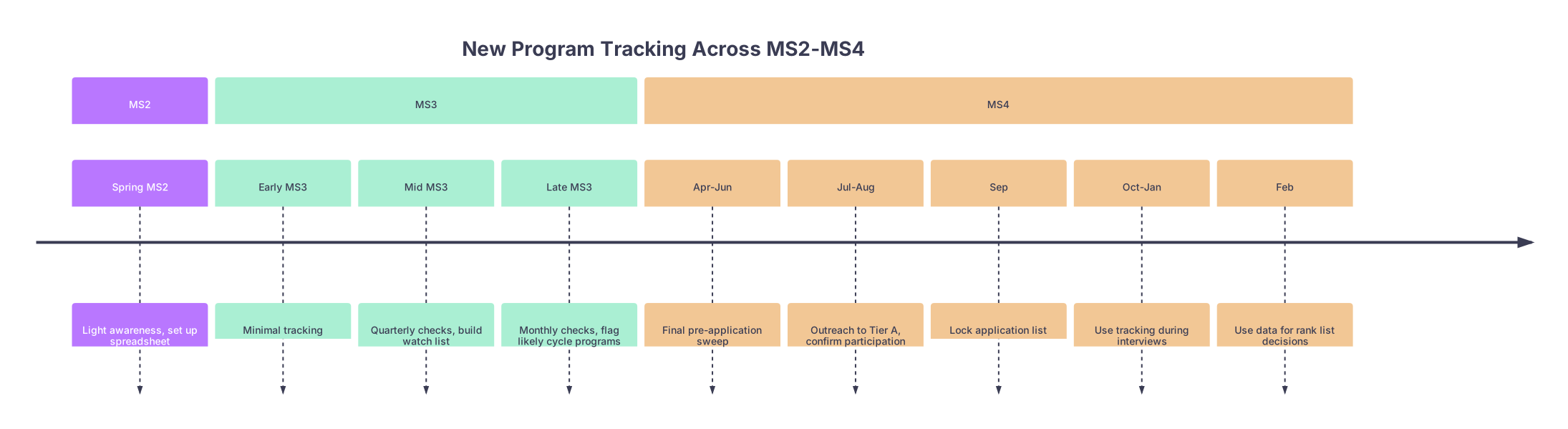
Quick visual: When your tracking intensity should spike
| Period | Event |
|---|---|
| MS2 - Spring MS2 | Light awareness, set up spreadsheet |
| MS3 - Early MS3 | Minimal tracking |
| MS3 - Mid MS3 | Quarterly checks, build watch list |
| MS3 - Late MS3 | Monthly checks, flag likely cycle programs |
| MS4 - Apr-Jun | Final pre-application sweep |
| MS4 - Jul-Aug | Outreach to Tier A, confirm participation |
| MS4 - Sep | Lock application list |
| MS4 - Oct-Jan | Use tracking during interviews |
| MS4 - Feb | Use data for rank list decisions |
How to keep it manageable (so this doesn’t eat your life)
You don’t need a research project. You need a 1–2 hour setup and 15–30 minutes a month.
A workable setup:
- Tool: Google Sheets or Notion table, shared with 1–2 classmates in your specialty.
- Tabs:
- Core program list
- New/recent programs
- Future cycles / PGY2
- Monthly routine:
- One recurring calendar event titled “15‑min new program check.”
- If nothing new appears, fine. Check the box and move on.
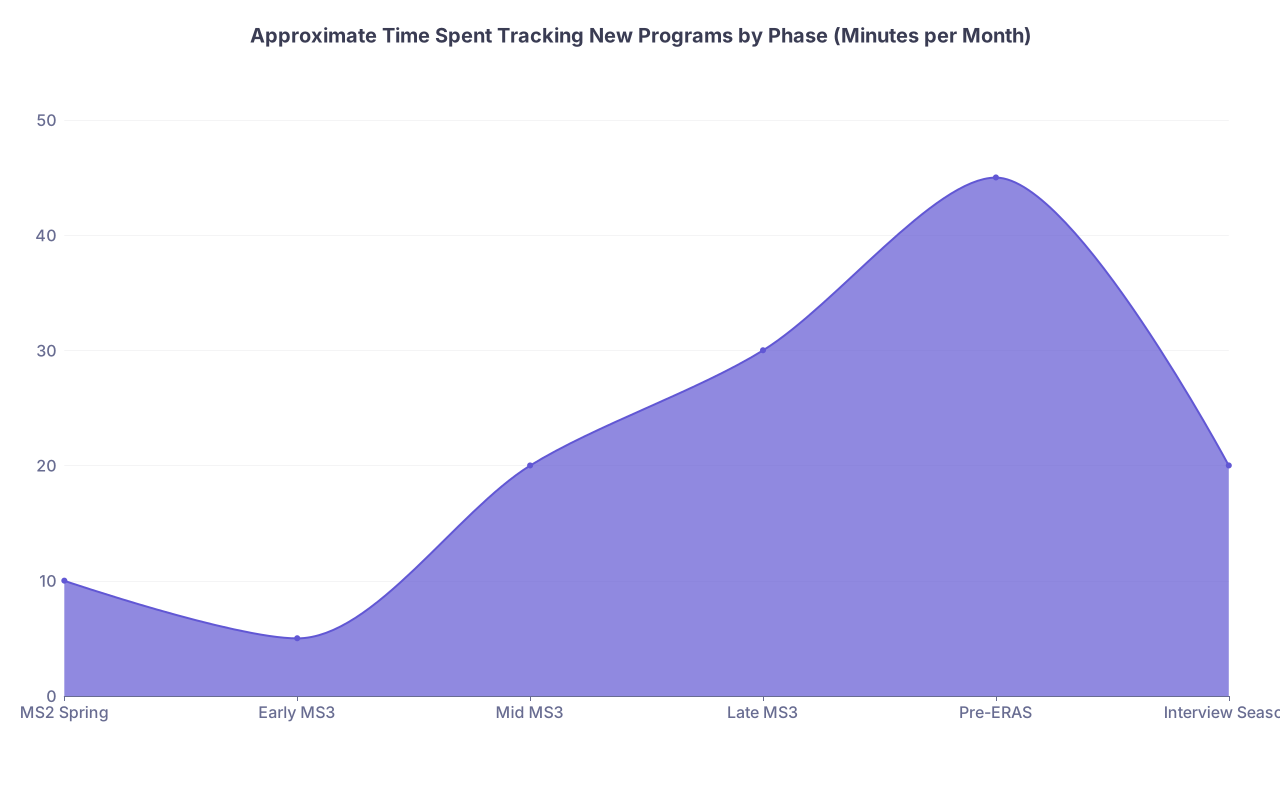
If you want to get slightly nerdy, you can even put yourself on a rough allocation schedule like this:
| Category | Value |
|---|---|
| MS2 Spring | 10 |
| Early MS3 | 5 |
| Mid MS3 | 20 |
| Late MS3 | 30 |
| Pre-ERAS | 45 |
| Interview Season | 20 |
Notice the spike from late MS3 through pre‑ERAS. That’s where tracking actually matters.
Final takeaways
Start real tracking in mid MS3.
Before that, just know where to look. After that, monthly checks keep you from missing programs that show up 6–12 months before your application.Upgrade from tracking to strategy by early MS4.
July–August is when you confirm which new programs are actually recruiting in your cycle and decide which ones to prioritize, then lock your ERAS list.Use the data twice: at interview selection and at rank list.
The spreadsheet isn’t a trophy; it’s a decision tool. It helps you tell the difference between a well-backed new program worth betting on and a shaky one you should rank cautiously—or not at all.