
The biggest mistake PGY‑1s in new programs make is acting like passengers instead of early architects.
You are not just surviving this year. You are quietly shaping a program that does not have muscle memory yet. That is an opportunity and a risk.
Below is a month‑by‑month timeline of what you should be doing: first to stay afloat, then to gain leverage, and finally to leave PGY‑1 as one of the people whose opinion actually matters in this brand‑new residency.
Big Picture: Your 12‑Month Arc
At a high level, your PGY‑1 in a new program breaks into three phases:
- Months 1–3: Survival and reconnaissance
- Months 4–8: Credibility and subtle influence
- Months 9–12: Strategic impact and legacy
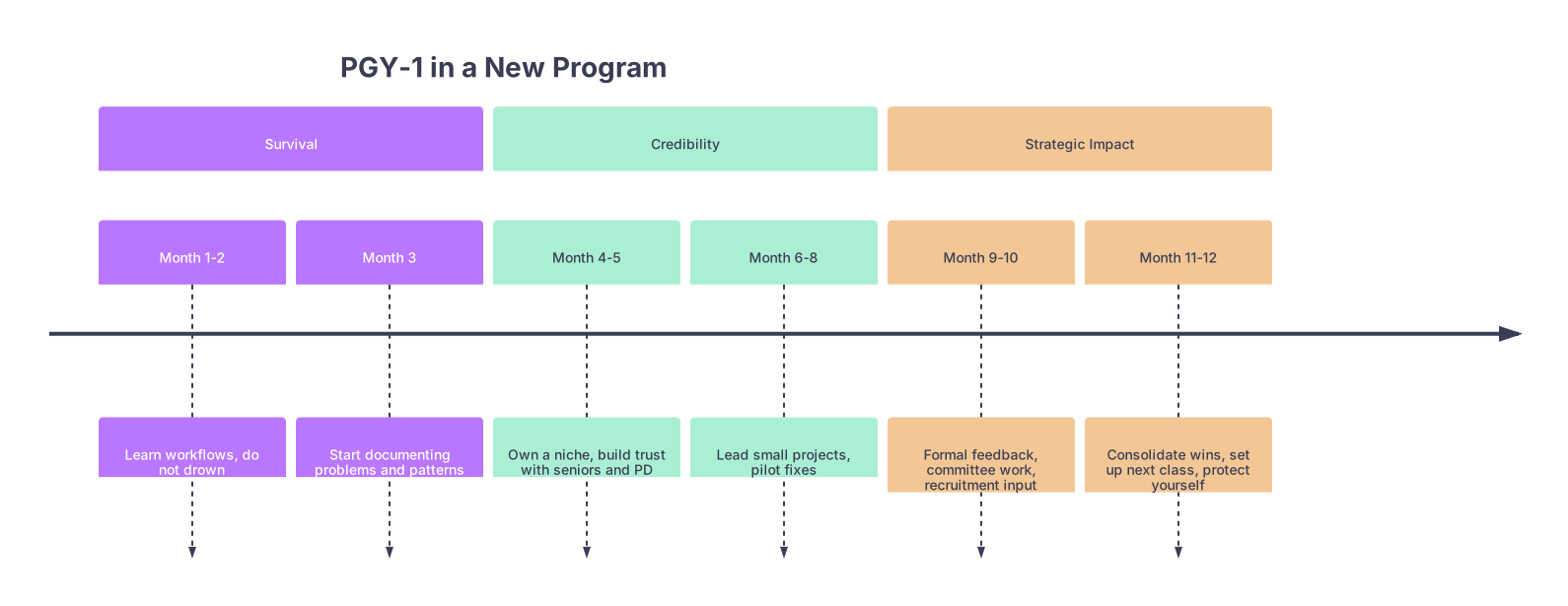
| Period | Event |
|---|---|
| Survival - Month 1-2 | Learn workflows, do not drown |
| Survival - Month 3 | Start documenting problems and patterns |
| Credibility - Month 4-5 | Own a niche, build trust with seniors and PD |
| Credibility - Month 6-8 | Lead small projects, pilot fixes |
| Strategic Impact - Month 9-10 | Formal feedback, committee work, recruitment input |
| Strategic Impact - Month 11-12 | Consolidate wins, set up next class, protect yourself |
Think of it as a gradual trade: hours of raw effort exchanged for political capital, then used—carefully—to make the program less chaotic for you and everyone after you.
Months 1–3: Controlled Survival and Quiet Data Collection
Month 1: Stay Alive, Take Notes, Say Little
At this point you should focus on three things only:
- Not harming patients.
- Learning the local game.
- Collecting information without trying to fix anything.
Day‑to‑day, weeks 1–4:
Clinical basics
- Show up 10–15 minutes earlier than you think you need. New programs run late and disorganized.
- Learn the EMR like it is Step 1 all over again: order sets, note templates, where old studies hide.
- Identify the “unofficial” workflow: who actually pages you, how consults really get done, whose approval you need to move a patient.
People map (this matters more than curriculum)
- Find:
- 1 attending who actually teaches.
- 1 senior resident or fellow who does not melt down on call.
- 1 nurse who has clearly been at the hospital 10+ years and knows where all the bodies are buried.
- Ask them blunt, focused questions:
- “What do new interns usually screw up here?”
- “Who do I call when X happens at 2 a.m.?”
- “What makes this place different from other hospitals?”
- Find:
Information logging (start now)
- Open a private, de‑identified note on your phone / cloud:
- “Things that are broken”
- “Things that strangely work well”
- “Policies that exist only in people’s heads”
- Do not pitch solutions yet. Just observe.
- Open a private, de‑identified note on your phone / cloud:
Checklist for end of Month 1:
- You can admit, discharge, and call a rapid response without freezing.
- You know at least 5 “go‑to” contacts (attendings, seniors, nurses, pharmacist).
- You have a running list of specific pain points with dates and examples.
Month 2: Learn Where the Power Actually Lives
At this point you should start mapping power, not titles.
Understand the program structure
- Who really pulls the strings:
- Program Director (PD) – vision and ACGME obligations.
- Associate PDs – day‑to‑day execution and schedule chaos control.
- Program Coordinator – quietly more powerful than almost everyone.
- GME office – rules, money, institutional politics.
- Learn what ACGME requires for your specialty. It will explain many of the weird decisions.
- Who really pulls the strings:
-
- New programs often have:
- Underdeveloped didactics (last‑minute lecture cancellations).
- Overloaded inpatient services with no caps “because we are still growing”.
- Rotations that exist only on paper (“we’re still working out that ICU month…”).
- Keep track of where your duty hours nearly break, or where supervision is thin. You will need concrete examples later.
- New programs often have:
Communication discipline
- You are observed constantly in a new program. Every misstep is remembered longer because there is no baseline cohort yet.
- Golden rule: Complain up, not out.
- Up: to a trusted senior, chief, or PD in a scheduled, calm setting.
- Not out: not on group chats, not at the nurse’s station, not on social media.
Checklist for end of Month 2:
- You can sketch the org chart of your program and GME on a scrap of paper.
- You have 2–3 real clinical “wins” (handled a sick patient, saved a near‑miss, took initiative).
- Your notes now include both problems and potential leverage points (places where small changes might help).
Month 3: Convert Observations into Patterns
Now you stop just surviving and start recognizing predictable failure modes.
Identify recurring failures
- Examples I have seen in new programs:
- Night cross‑cover with zero sign‑out structure.
- Admission notes that do not meet billing or documentation requirements.
- Clinics where follow‑up tracking is non‑existent.
- Categorize your issues:
- Safety
- Education
- Workflow / operations
- Culture / professionalism
- Examples I have seen in new programs:
Soft‑launch your feedback
- Do not walk into the PD’s office with a manifesto.
- Instead:
- Ask a chief: “Is there a process for interns to share what we are seeing on nights?”
- Ask seniors: “How have past suggestions been handled here?”
- Share 1–2 small, concrete problems with specific examples and a polite tone. Then shut up and see what they do.
Build your reputation
- Aim for this description: “Works hard, does not complain, brings up real issues thoughtfully.”
- That profile buys you freedom later when you start pushing harder.
Checklist for end of Month 3:
- You can name 3–5 repeating system problems with dates, examples, and approximate impact.
- You have tested the waters with minor feedback and noted who listens vs who brushes you off.
- At least one attending or senior knows you as reliable on busy days.
Months 4–8: Build Credibility and Quiet Influence
Now you move from “new intern” to “one of the people we can trust.” This is where you start to shape the program.
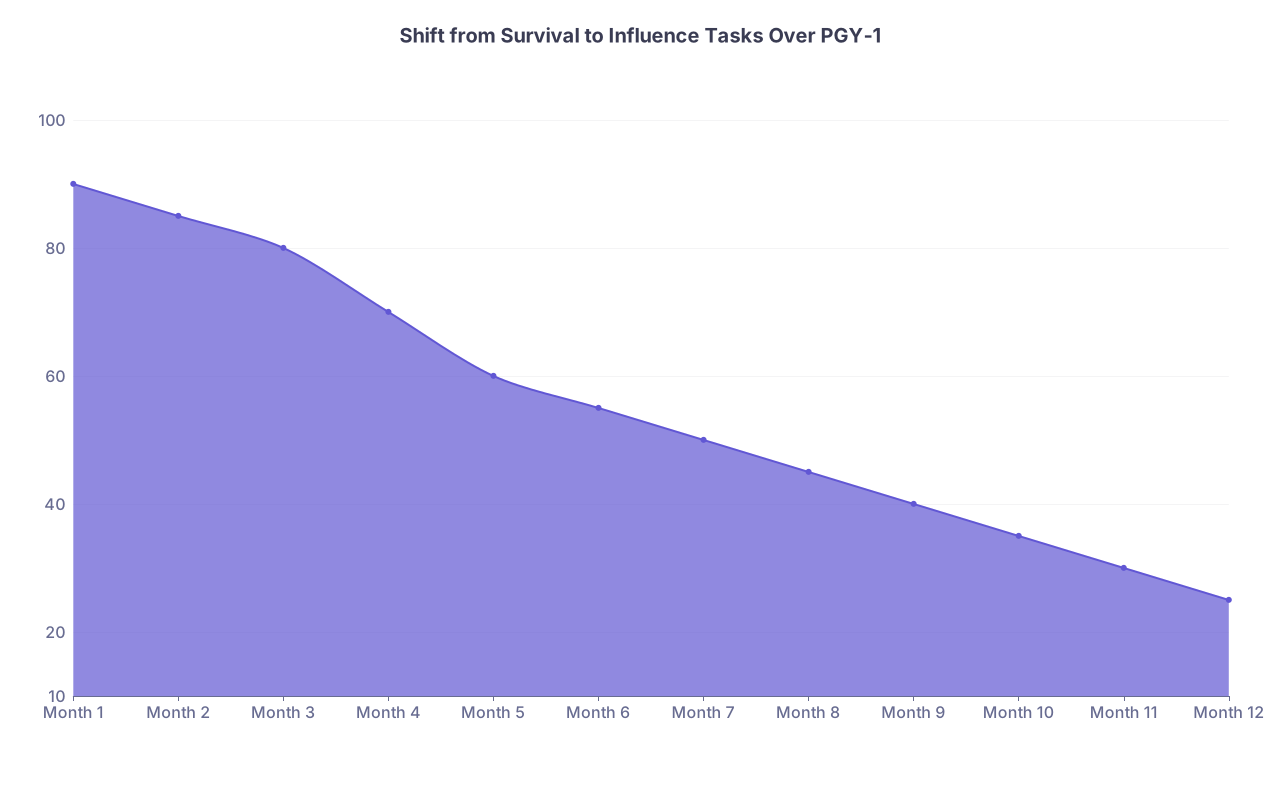
| Category | Value |
|---|---|
| Month 1 | 90 |
| Month 2 | 85 |
| Month 3 | 80 |
| Month 4 | 70 |
| Month 5 | 60 |
| Month 6 | 55 |
| Month 7 | 50 |
| Month 8 | 45 |
| Month 9 | 40 |
| Month 10 | 35 |
| Month 11 | 30 |
| Month 12 | 25 |
(Values represent percent of effort spent purely on “survival” tasks; the rest gradually becomes influence / improvement work.)
Months 4–5: Own a Niche
At this point you should become “the intern who is good at X.” Narrow is fine.
Pick a niche that actually matters in a new program:
- EMR tools and templates
- M&M case organization
- Orientation / on‑boarding checklists for rotators
- Duty hour tracking sanity checks
- Wellness logistics (call room issues, meal cards, post‑call rides)
Then:
- Volunteer for one small, visible responsibility:
- Helping build or refine an admission order set.
- Drafting a first‑pass intern orientation document for the next block.
- Tidying up a sign‑out template that everyone hates.
- Do it well and fast. Share broadly, without drama, and let others tweak.
This is your first “credit on the board” as someone who improves the program instead of just enduring it.
Checklist for end of Month 5:
- You are informally known for being good at 1–2 specific things.
- You have completed 1 small project that made other residents’ lives easier.
- You have not burned yourself out trying to fix everything.
Month 6: Mid‑Year Reality Check and Strategic Alignment
Mid‑year is when programs start panicking about ACGME surveys, case numbers, and resident morale.

At this point you should stop and reassess:
Your own position
- Are your evaluations stable or glowing? Good.
- Any professionalism flags or missed duty hours documentation? Fix that immediately.
- Do 2–3 faculty know you well enough to write a strong letter in future? If not, identify who you want and start showing up well on their services.
Program direction
- Ask directly in a check‑in:
- “What are the program’s biggest priorities over the next year?”
- “Where do you see interns contributing most?”
- Align your future projects to those themes. If the PD is obsessed with QI, do QI. If they care about recruitment, help with interview days.
- Ask directly in a check‑in:
Start thinking about committees
- New programs need:
- Clinical Competency Committee (CCC) members.
- Program Evaluation Committee (PEC) with resident voices.
- Wellness and recruitment committees.
- As a PGY‑1, you likely sit on the lowest‑stakes ones (wellness, recruitment). That is fine. Power often hides in “small” rooms.
- New programs need:
Checklist for end of Month 6:
- You have a clear read on how the PD views you.
- You have re‑aligned your efforts with what the program actually cares about.
- You are on the radar for at least one formal or semi‑formal role.
Months 7–8: Pilot Solutions and Lead Small Things
Now you stop merely pointing at problems and start quietly fixing some.
Pick 1–2 realistic interventions
- Examples that actually work at PGY‑1 level:
- A standardized sign‑out format that reduces 2 a.m. chaos.
- A shared “intern survival guide” with concrete, local tips.
- A streamlined way to page consultants with a pre‑filled, high‑yield script.
- A brief “rapid review” series for interns on nights: one‑page PDF of common cross‑cover issues.
- Do not propose “revamp the entire ICU rotation.” That is fantasy at your level.
- Examples that actually work at PGY‑1 level:
Run a mini‑pilot
- Try your change on:
- One team.
- One rotation.
- One month.
- Collect feedback:
- “Did this actually help you on call?”
- “Was anything confusing or annoying about this template?”
- Try your change on:
Communicate smartly
- Email or message chiefs / PD:
- 1 paragraph: problem statement.
- 1 paragraph: what you tried.
- 3–4 bullets: feedback / results.
- 1 line: “Happy to iterate or drop this if not aligned with program direction.”
- Email or message chiefs / PD:
You are not just being “helpful.” You are training them to see you as someone who notices, intervenes, and measures.
Checklist for end of Month 8:
- You have led at least one pilot change that affected other residents’ day‑to‑day work.
- You have documented before/after impact, even if small.
- Chiefs or PD have seen you as a problem‑solver at least once in writing or in a meeting.
Months 9–12: Strategic Impact and Long-Term Positioning
The last quarter of PGY‑1 is where you either become “just another intern” or one of the core voices in a young program.
| Quarter | Main Leverage Points |
|---|---|
| Q1 | Reliability, observation, trust |
| Q2 | Owning a niche, small projects |
| Q3 | Pilots, committee participation |
| Q4 | Recruitment, curriculum input |
Months 9–10: Formal Feedback, Committees, and Recruitment
At this point you should have enough social capital to be explicit about program improvement.
Formal feedback channels
- Program evaluation surveys, ACGME resident survey, town halls.
- Approach:
- Be specific: “Night float lacks a structured checklist, leading to missed tasks.”
- Be constructive: “We piloted X; with support we could scale it.”
- Avoid personal attacks. Systems, not personalities.
Committee work
- If you are on PEC, wellness, or recruitment:
- Show up prepared with your log of issues and pilot data.
- Offer to draft small pieces rather than just talking (e.g., sample schedule, sample checklist).
- Do not underestimate being the only intern voice in a room. Use it.
- If you are on PEC, wellness, or recruitment:
-
- New programs are often desperate to look functional. You can either:
- Whitewash everything and mislead applicants.
- Or be honest, measured, and impressive as a thoughtful insider.
- Script your message:
- Acknowledge growing pains.
- Highlight specific wins and things being actively fixed.
- Describe real support mechanisms (mentors, chiefs, attendings who go to bat for you).
- New programs are often desperate to look functional. You can either:

Checklist for end of Month 10:
- You have used at least one formal channel to share structured feedback.
- You have contributed meaningfully in at least one committee or working group.
- You have presented the program honestly but professionally to applicants.
Month 11: Consolidate Your Wins and Protect Yourself
This is where fatigue peaks, politics sharpen, and people start jockeying for PGY‑2 roles and electives.
Document, document, document
- Keep:
- A list of what you contributed (projects, pilots, committees).
- Copies or screenshots of tools you helped build (templates, guides, protocols).
- This matters later for:
- Fellowship and job applications.
- Internal promotion (chief resident, leadership roles).
- Protecting your contributions if someone tries to erase or co‑opt them.
- Keep:
Secure mentors and advocates
- Identify:
- 1–2 faculty who can speak to your clinical performance.
- 1 leader (PD/APD/chief) who can vouch for your systems/leadership work.
- Have explicit conversations:
- “I am interested in X (fellowship / leadership / QI). What else should I do over PGY‑2?”
- “Would you be comfortable supporting me for [chief / fellowship letters / committee work]?”
- Identify:
Guard against burnout and resentment
- New programs can chew up their early residents. If you feel yourself slipping into cynicism:
- Scale back extra work temporarily. Protect your floor: sleep, food, relationships.
- Delegate or share projects with co‑residents.
- Be strategic: one high‑impact project is better than five half‑finished ones.
- New programs can chew up their early residents. If you feel yourself slipping into cynicism:
Checklist for end of Month 11:
- You have a clear list of your contributions and approximate outcomes.
- You have at least 2 solid mentors who know you well.
- You have pruned or handed off low‑yield commitments.
Month 12: Hand Off, Set Up the Next Class, and Plan PGY‑2
The last month of PGY‑1 in a new program should not be quiet. It should be a controlled handoff of power and institutional memory.

At this point you should:
Create or refine a real “Intern Playbook”
- Contents:
- Service‑specific tips and pitfalls.
- Contact lists that actually reflect who responds at night.
- Common orders, workflows, and local “gotchas”.
- Survival strategies for the worst rotations.
- Put it somewhere accessible and editable (shared drive, secure institution tool).
- Contents:
Lock in structural changes
- For any pilot that worked:
- Get explicit buy‑in for making it “official.”
- That may mean:
- Adding it to orientation.
- Incorporating it into policy documents.
- Having a chief assign responsibility each year.
- Name a PGY‑1 or PGY‑2 successor to own each project. Do not leave orphans.
- For any pilot that worked:
Plan your PGY‑2 positioning
- Decide what you want to be known for going forward:
- Education / didactics
- QI / patient safety
- Wellness / culture
- Recruitment / branding
- Align your elective choices, committee roles, and projects with that identity.
- Decide what you want to be known for going forward:
Checklist for end of Month 12:
- Incoming interns will genuinely have an easier time because of something you built.
- At least one of your improvements is embedded enough to survive without you babysitting it.
- You have a clear PGY‑2 agenda that fits both your career goals and the program’s needs.
Micro‑Timeline: A Typical “Influence Week” in Late PGY‑1
Once you are in Months 9–12, a realistic week might look like this:

| Step | Description |
|---|---|
| Step 1 | Start of Week |
| Step 2 | Clinical Work Days 1-3 |
| Step 3 | Identify 1-2 problems encountered |
| Step 4 | Dedicated 30 min improvement block |
| Step 5 | Touch base with mentor or chief |
| Step 6 | Apply tweak or pilot on service |
| Step 7 | End of Week reflection note |
Core pattern:
- 90–95%: Routine patient care, notes, calls, and putting out fires.
- 5–10%: Focused, recurring time block to:
- Update your intern guide / templates.
- Email brief feedback with suggestions.
- Analyze one issue you saw 3 times that week and decide if it is worth tackling.
That small, consistent slice is what separates “overwhelmed intern” from “future chief / leader.”
FAQ (exactly 3 questions)
1. How much can a PGY‑1 in a new program realistically change?
More than you think, less than you want. You will not rewrite the entire rotation schedule or magically fix staffing, and trying will only burn you out and annoy leadership. But you absolutely can standardize sign‑out, clean up orientation, refine documentation workflows, and shape the culture of how residents talk to each other and to nurses. Focus on small, high‑friction pain points where a simple tool or habit change can save minutes or prevent errors daily. That stack of small wins is what makes you influential enough to eventually tackle bigger things.
2. What if my PD or chiefs seem defensive and ignore feedback?
Then you switch tactics, not to silence but to strategy. First, tighten your feedback: specific examples, patient‑centered framing, and at least one realistic suggestion. Second, find alternate routes: a trusted faculty mentor, the program coordinator, or the GME office. Third, work at the peer level—improving resident‑to‑resident workflows and culture does not require permission. I have seen programs where formal leadership was slow to change, but the resident body quietly standardized sign‑out, on‑call norms, and cross‑cover expectations anyway. Worst case: you document the issues clearly for ACGME surveys and for the next class, and you protect yourself.
3. How do I balance improving the program with preparing for boards and fellowship?
Treat program work like a focused elective, not a second job. One or two well‑chosen projects that align with your career path can double as research, QI, or leadership experience for applications. For example, a QI project on reducing sign‑out errors can turn into a poster, a systems‑based practice milestone, and a concrete interview story. The rule: if a program task neither improves your daily life nor advances your career narrative, think hard before saying yes. Your primary job is still becoming a competent, safe physician—PGY‑1 leadership should amplify that, not compete with it.
Key points:
- First 3 months: survive, observe, and build trust; do not try to “fix” the program yet.
- Middle months: own a niche, run small pilots, and start being the person who quietly makes things work better.
- Final quarter: formalize your impact, set up the next class, and align PGY‑2 with a clear leadership identity.