
If You Were Laid Off Mid‑Career and Are Eyeing Medicine, Start Here
What do you actually do the week after you get laid off and realize, “I think I want to become a doctor”?
Not in some vague “maybe one day” sense. I mean you’re 32, 38, 45, staring at a severance packet and a LinkedIn full of “sorry to hear this” comments, and medicine suddenly feels less like a fantasy and more like a door that might—might—still be open.
You’re not wrong. It might be. But you cannot afford to wander into this. You’ve already burned a decade or more in another career. The next moves need to be ruthlessly concrete.
Let’s walk through what you actually do from today forward.
Step 1: Stabilize Your Life Before You “Chase the Dream”
If you just lost your job, your brain is in survival mode, whether you admit it or not. That’s a terrible headspace for committing to an 8–12 year training pipeline.
So first: triage your real life.
Money.
Figure out runway. Not vibes. Numbers.Open a spreadsheet and list:
- Savings / severance
- Unemployment benefits (and duration)
- Monthly non‑negotiables (rent/mortgage, food, insurance, dependents)
- Debts and minimum payments
The number you’re looking for: “How many months of bare-minimum life can I cover without income?”
If that number is under 6 and you have dependents, you’re not in a position to immediately quit everything and go full‑time premed. That doesn’t mean “no.” It means “I need a bridge plan.”
Health insurance.
You’re talking about a career full of patients, so don’t be the idiot without coverage. Look at:- COBRA (expensive but fast)
- Spouse/partner’s plan
- ACA marketplace / subsidies
Temporary work.
A lot of mid‑career people want to “go all in.” That’s romantic. It’s also how you end up back in your old industry in 18 months because you ran out of money.Look for:
- Part‑time or contract work in your old field
- Remote roles that leave evenings free for classes
- Tutoring, consulting, short‑term teaching gigs
You stabilize first so you don’t have to make emotional, panicked decisions later. Once you have a 6–12 month plan, then you start seriously analyzing medicine.
Step 2: Get Brutally Honest About What Medicine Actually Requires
You’re not 21. You don’t have unlimited do‑overs. You have less margin for error, more obligations, and probably more skepticism from everyone around you.
So you need a clear map of what you’re walking into.

| Step | Description |
|---|---|
| Step 1 | Laid Off Mid-Career |
| Step 2 | Stabilize Finances |
| Step 3 | Evaluate Fit & Motivation |
| Step 4 | Assess Academic Record |
| Step 5 | Complete Prereqs/Post-bacc |
| Step 6 | Study for MCAT |
| Step 7 | Apply to Medical Schools |
| Step 8 | Matriculate & Train |
Here’s the stripped‑down version of the path:
- 1–3 years: Prereqs and academic repair (if needed)
- 6–12 months: MCAT prep
- 1 application cycle: 1 year
- 4 years: Medical school
- 3–7+ years: Residency (and maybe fellowship), with income but not “attending money”
So from “just laid off” to “fully trained and stable attending” you’re looking at:
- Best case (already have strong science, quick acceptance): ~8–10 years
- More typical nontrad path: 10–14 years
If that timeline makes you sick to your stomach, good. You need to feel the weight before you commit.
But now the punchline: if you’re 36 and thinking “I’d be 48 by the time I’m done,” I’ll say what I tell people all the time:
You’re going to be 48 anyway. The question is whether you’re 48 doing work that matters to you or 48 still trying to convince yourself your current lane is “fine.”
Step 3: Run a Cold, Data‑Driven Check on Your Academic Viability
This is where nontrad dreams usually collide with reality.
You need to know if your academic record can get you in the door or if you’re in academic rehab territory.
Pull every transcript you have. Undergrad. Grad. Community college. Random classes.
Then build this table for yourself:
| Component | Your Data | Competitive Range (MD) | Competitive Range (DO) |
|---|---|---|---|
| Cumulative GPA | ??.?? | 3.6+ | 3.4+ |
| Science GPA (BCPM) | ??.?? | 3.5+ | 3.3+ |
| Last 30–40 credits | ??.?? | 3.7+ strongly helps | 3.5+ helps |
| MCAT (target) | n/a yet | 510–520+ | 505–510+ |
Now, reality check:
- If your cumulative GPA is above ~3.4 and your science GPA isn’t a dumpster fire, you’re in repairable shape with a strong upward trend and a good MCAT.
- If your GPA is below 3.0, especially in science, you’re not picking electives. You’re doing structured academic repair: formal post‑bacc, DIY post‑bacc, or an SMP (special master’s program).
Do not guess about this. Talk to:
- A premed advisor at a local university or post‑bacc
- A physician who was a nontrad (they know the game)
- An admissions consultant if you can afford one (optional, but can be useful for complex records)
You want a clear, written plan like:
“Do 32 credits of upper‑division bio/chem at X school over 4 semesters, aim for 3.8+; then MCAT; apply MD+DO.”
Step 4: Choose the Right Academic Path (Post‑bacc, DIY, or SMP)
You have three realistic academic tools in your toolbox.
1. Formal Post‑bacc (Career‑changer or Academic‑enhancer)
Good if:
- You have little to no science background
- You want structure, advising, and sometimes linkage agreements
- You can attend mostly full‑time
These programs can be expensive, but they come with:
- Built‑in advising
- Committee letters
- Cohort of other nontrads (huge psychologically)
2. DIY Post‑bacc
Good if:
- You need flexibility, are watching money, or can’t relocate
- You’re disciplined enough to plan your own coursework
You enroll as a non‑degree or second‑degree student at a local college or university and take:
- Core prereqs you’re missing (Gen Chem, Org Chem, Physics, Bio)
- Upper‑division sciences (Physiology, Biochem, Microbio, etc.) to show you can handle med‑school‑level material
This is the route a lot of mid‑career people end up taking. Less hand‑holding, more control.
3. Special Master’s Program (SMP)
Good if:
- You already did the prereqs but your GPA is weak (often 2.8–3.2 range)
- You need to prove you can handle near‑med‑school level coursework
Risky because:
- They’re expensive
- If you do badly, it can permanently damage your chances
- They’re not magic; they don’t override years of bad grades unless you crush them
Bottom line:
If your GPA is 3.4+ with an upward trend, you probably do not need an SMP. That’s overkill. Most mid‑career people are better off with a focused, high‑performance DIY or formal post‑bacc.
Step 5: Do a Reality Check on Finances for the Long Haul
You got laid off. You may already be worried about money. You must do the long‑range math.
Typical med student debt load (US):
- Often $200k–$300k, sometimes more
- Interest accruing during school unless subsidized or special programs
Plus:
- 4 years of near‑zero earnings (maybe some side gigs)
- Opportunity cost of leaving your current earning potential
Here’s a rough view:
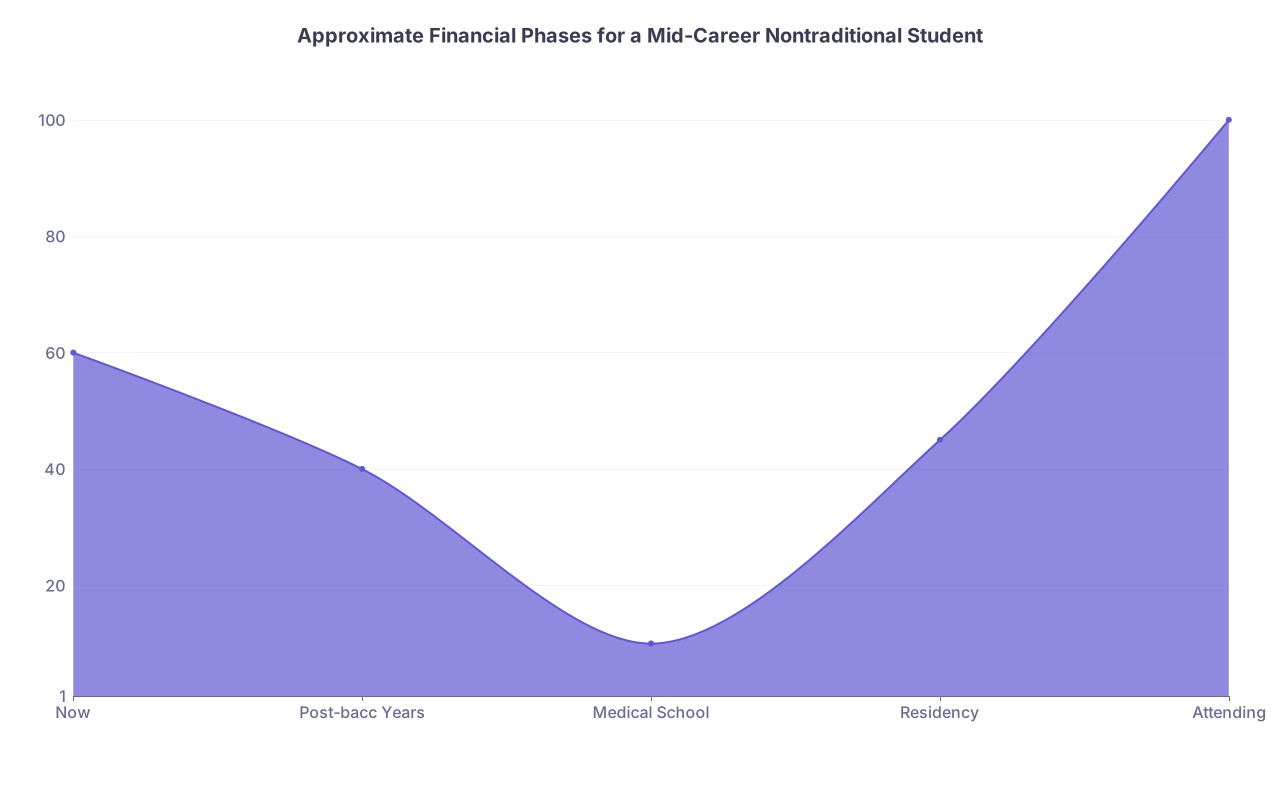
| Category | Value |
|---|---|
| Now | 60 |
| Post-bacc Years | 40 |
| Medical School | 10 |
| Residency | 45 |
| Attending | 100 |
(This isn’t dollars; think “relative financial comfort.” It dips hard before it climbs.)
So what do you do with this?
Clean up high‑interest debt now if possible
Credit cards at 25% interest and med school do not mix.Cut lifestyle burn
You don’t need to live like a monk, but if you’re used to mid‑career salary comforts, do not pretend you can keep all of them.Learn the loan landscape early
- Federal Direct Unsubsidized
- Grad PLUS
- Income‑driven repayment (IDR) options
- Public Service Loan Forgiveness (PSLF) if you work at non‑profit / academic centers
Involve your partner (if you have one) early
Do not “surprise” a spouse with “hey I might be broke for 10 years and never home, but I’ll be a doctor at the end.” That’s how marriages blow up mid‑residency.
Step 6: Test Your Interest Before You Rebuild Your Life Around It
You might be in love with the idea of medicine: helping people, respect, stability, being “Dr. ___”. That’s not the job.
The job is patients at 3 a.m., messy systems, bureaucracy, and sometimes ugly outcomes. It’s also deeply meaningful, but it’s not a prestige costume.
Before you commit, you need exposure.
Shadowing
Get in a room with actual patients and actual physicians.
Target:
- 20–40 hours minimum to start
- Mix of primary care and something else (hospital‑based, maybe EM or hospitalist)
Use your network:
- Friends of friends
- Your own doctors (“I’m considering med school after a layoff; do you ever let potential students shadow?”)
- Local hospitals’ volunteer/shadowing programs
Clinical Work
If you’re unemployed or part‑time now, leverage that.
Common routes:
- Scribe (ED, outpatient clinics, hospitalists) – fantastic exposure to clinical reasoning and documentation
- Medical assistant (if you can get trained/credentialed)
- CNA / PCT
- EMT (longer training on the front end, but real clinical patient contact)
2 birds, 1 stone:
- Confirms whether you like being near sick people all day
- Strengthens your eventual application
If you shadow for 40 hours and think, “absolutely not,” you just saved yourself a decade. That’s a win.
Step 7: Start Laying the MCAT Groundwork (Without Wasting Time)
Do not study for the MCAT before you’ve taken the core sciences. That’s just self‑harm.
But you can do early, smart prep:
Get familiar with the test structure
Sections, timing, types of passages. Look at AAMC’s official site. Download a practice outline.Read daily for CARS
CARS is about reading, not memorizing. If you’re rusty:- Read ~30 minutes/day of dense, boring writing (economics, philosophy, long‑form essays)
- Force yourself to summarize arguments and identify assumptions
Plan your timing
MCAT should be:- After: Gen Chem I & II, Org Chem I, Physics I, Bio I & II, Biochem preferably
- 4–6 months of serious prep for most full‑time adults, longer if part‑time around a job
You are better off delaying the MCAT to be fully prepared than taking it “on schedule” and scoring a 502 you now have to explain for the next 5 years.
Step 8: Position Your Mid‑Career Background as a Strength, Not a Liability
You being laid off in mid‑career is not a shameful secret. If you handle it well, it’s a feature.
Admissions committees are sick of copy‑paste 21‑year‑old narratives about “I shadowed a doctor in high school and knew since then.” You bring adult experience, resilience, and perspective.
Where nontrads screw up is pretending they’re just like everyone else.
You should be doing the opposite.
Translate your old world into “doctor skills”
Think concretely:
- Management or leadership → team coordination, conflict resolution, systems thinking
- Tech/data background → comfort with complex systems, quality improvement, informatics
- Teaching/training → patient education, resident/med student teaching
- Military/service work → discipline, handling stress, chain‑of‑command dynamics
During essays and interviews, you’re basically answering:
“How did you go from that world, through a layoff, to a serious, mature decision for medicine?”
If your answer sounds like “I always wanted to do this but was scared before,” that’s weak.
A stronger arc:
- Built a serious career in X
- Got laid off → forced to reassess long‑term meaning
- Intentionally explored medicine (shadowing, clinical work, courses)
- Found that your best skills and values fit in clinical care
- Took structured steps to pivot, even when it hurt financially and socially
That’s not a liability. That’s an adult.
Step 9: Build a 3–5 Year Plan You’d Actually Be Willing to Execute
At this point you’ve:
- Stabilized your immediate life
- Assessed your GPA situation
- Gotten some clinical exposure
- Understood the debt and time commitment at a basic level
Now you need an actual plan. Not a daydream.
Something like:
Year 0–1:
- Work part‑time in old field or clinical job
- Take Gen Chem I & II + Bio I & II at local university
- Start shadowing / volunteering 2–4 hrs/week
Year 1–2:
- Take Org Chem I & II, Physics I & II, Biochem
- Increase clinical hours
- Begin structured MCAT prep in last 6–9 months
Year 2–3:
- Take MCAT
- Finish any remaining upper‑level science
- Apply in early summer
- Continue working/clinical experience while waiting for interviews
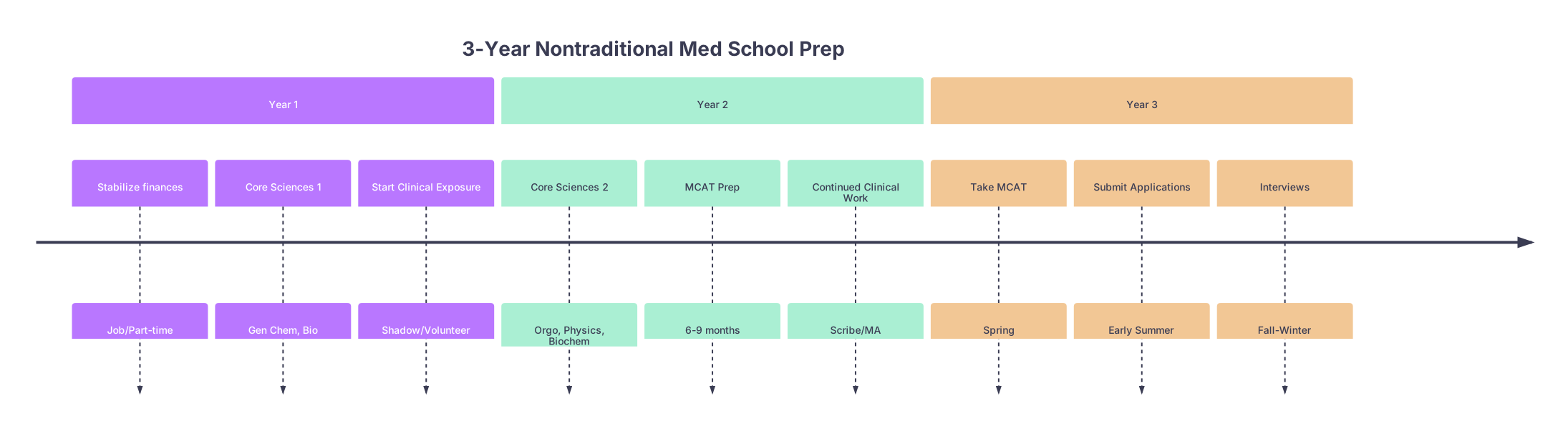
| Period | Event |
|---|---|
| Year 1 - Stabilize finances | Job/Part-time |
| Year 1 - Core Sciences 1 | Gen Chem, Bio |
| Year 1 - Start Clinical Exposure | Shadow/Volunteer |
| Year 2 - Core Sciences 2 | Orgo, Physics, Biochem |
| Year 2 - MCAT Prep | 6-9 months |
| Year 2 - Continued Clinical Work | Scribe/MA |
| Year 3 - Take MCAT | Spring |
| Year 3 - Submit Applications | Early Summer |
| Year 3 - Interviews | Fall-Winter |
You can adjust the years depending on your obligations, but you need some timeline. If you can’t picture what you’re doing 6 months from now to move this forward, you’re not serious yet.
Step 10: Decide on MD vs DO (and How Broadly You Need to Apply)
Nontrads love to argue MD vs DO online. Stop reading Reddit theology and look at actual competitiveness.
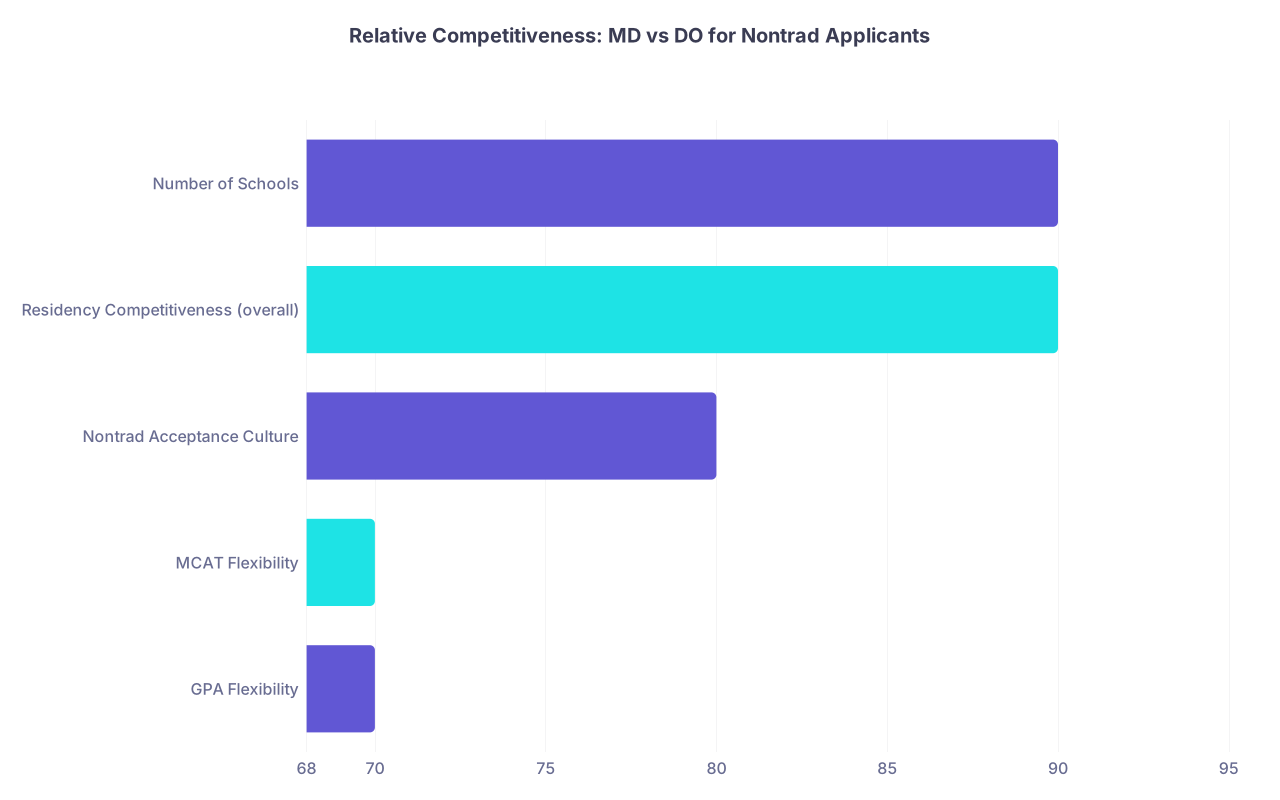
| Category | Value |
|---|---|
| GPA Flexibility | 70 |
| MCAT Flexibility | 70 |
| Nontrad Acceptance Culture | 80 |
| Residency Competitiveness (overall) | 90 |
| Number of Schools | 90 |
Very rough picture:
- MD schools: generally higher stats, more competition, but more schools and more name recognition internationally
- DO schools: often more open to nontrads, sometimes slightly lower average stats, strong for primary care and many specialties (though the most competitive specialties are still tougher)
As a laid‑off, mid‑career applicant:
- You should almost always consider both MD and DO unless you have stellar stats and some strong hook
- You should be prepared to apply widely (20–30+ schools is not insane nowadays)
Step 11: Protect Your Energy and Sanity
This path is long. You’re not 20. You probably have:
- Kids
- Aging parents
- A mortgage
- A partner who did not sign up for “hey let’s blow up our lives for a decade”
You need to be intentional about:
- Sleep. You cannot “all‑nighter” your way through this at 35 with two kids.
- Support. If you do not have at least 1–2 people in your life who think this is possible for you, find them. Online nontrad communities, other career‑changers, etc.
- Ego. You may go from leading projects to sitting in a 200‑level chemistry class next to 19‑year‑olds. That stings. Get over it.
One practical tip I’ve seen help a lot:
Set a formal check‑in point every 6–12 months where you ask, “Based on new information, do I still want to continue?” And be honest. If you learn you hate clinical medicine, the bravest move is stopping.
FAQs
1. Am I “too old” to start medicine if I’m in my late 30s or 40s?
No, you’re not automatically too old. I’ve seen people start med school at 40, 45, even a bit older. The real questions are:
- Are you healthy enough to work 60–80 hours/week in residency?
- Are you and your family willing to accept 8–12 years of training and financial hit?
- Will you still get enough years of practice afterwards to make this worthwhile to you?
Programs care more about: Can you handle the work? Are you committed? Do you have a realistic path? Age alone doesn’t kill your chances; a sloppy, delusional plan does.
2. Should I rush and apply as soon as possible to “make up for lost time”?
Usually no. Rushing is how you end up with:
- Half‑baked prereqs
- A mediocre MCAT
- A thin clinical record
…and then you’re reapplying at 40+ with a weaker position and more emotional baggage.
It’s almost always better to take an extra year to:
- Strengthen GPA with a clean upward trend
- Build solid clinical/shadowing
- Prepare properly for the MCAT
You’re not racing 22‑year‑olds. You’re building a credible second career.
3. What if I do all the exploration and realize medicine isn’t right—but I still want something meaningful?
Then the process still did its job. You:
- Stabilized your life
- Clarified what matters to you
- Tested a hard path and learned more about yourself
And there are adjacent roles that might fit better:
- PA, NP, clinical psychology, social work
- Health IT, quality improvement, hospital administration
- Public health, policy, medical education
The mistake is not “trying and pivoting.” The mistake is locking yourself into a decade‑long path you never really vetted.
Key points to walk away with:
- Stabilize first, then assess medicine with cold, hard data: GPA, finances, time, and family realities.
- Get real clinical exposure and a concrete 3–5 year academic plan before you torch your old career bridge.
- Use your mid‑career layoff and experience as fuel and credibility, not shame—if you commit, commit like an adult, not like a bored undergrad.