

What if you walk away from a decent salary, burn your bridges in your old career, grind through premed classes, MCAT, med school… and then you don’t match? What then?
That’s the fear, right? Not failing a test. Failing after you’ve already set your life on fire for this.
You’re not crazy for thinking about this. Honestly, you’re smarter than the people who pretend it can’t happen.
Let’s talk about it directly.
The Fear Behind “What If I Don’t Match?”
Here’s what’s really hiding under that question:
- “Did I just throw away a perfectly good career for a fantasy?”
- “Will I be an unemployed MD with loans bigger than a house?”
- “Will people secretly think I’m a failure who overreached?”
- “Am I too old to recover if this goes badly?”
When you’re nontraditional, the stakes feel higher. It’s not just, “Oh well, I’ll do a gap year.” It’s:
- You had a job title.
- You maybe had a 401k, savings, maybe even kids.
- You chose to step off a stable path and now you’re terrified you picked wrong.
And the match? It feels like this brutal, binary judgment: “Yes, you belong” or “No, you don’t.”
I’ve seen people in their 30s and 40s whisper in empty call rooms, “If I don’t match, I can’t go back. My old field moved on. No one’s waiting for me.”
Here’s the ugly truth: not matching is possible. It’s not some rare unicorn event. It happens every year. But the part everyone overlooks is this:
Not matching ≠ life is over.
Not matching ≠ you wasted everything.
Not matching ≠ no path forward.
But you don’t just want reassurance. You want receipts. Concrete: what does life look like if this goes sideways?
Let’s break it down like you’re planning for both the dream and the disaster.
How Likely Is Not Matching Really? (And For Who?)
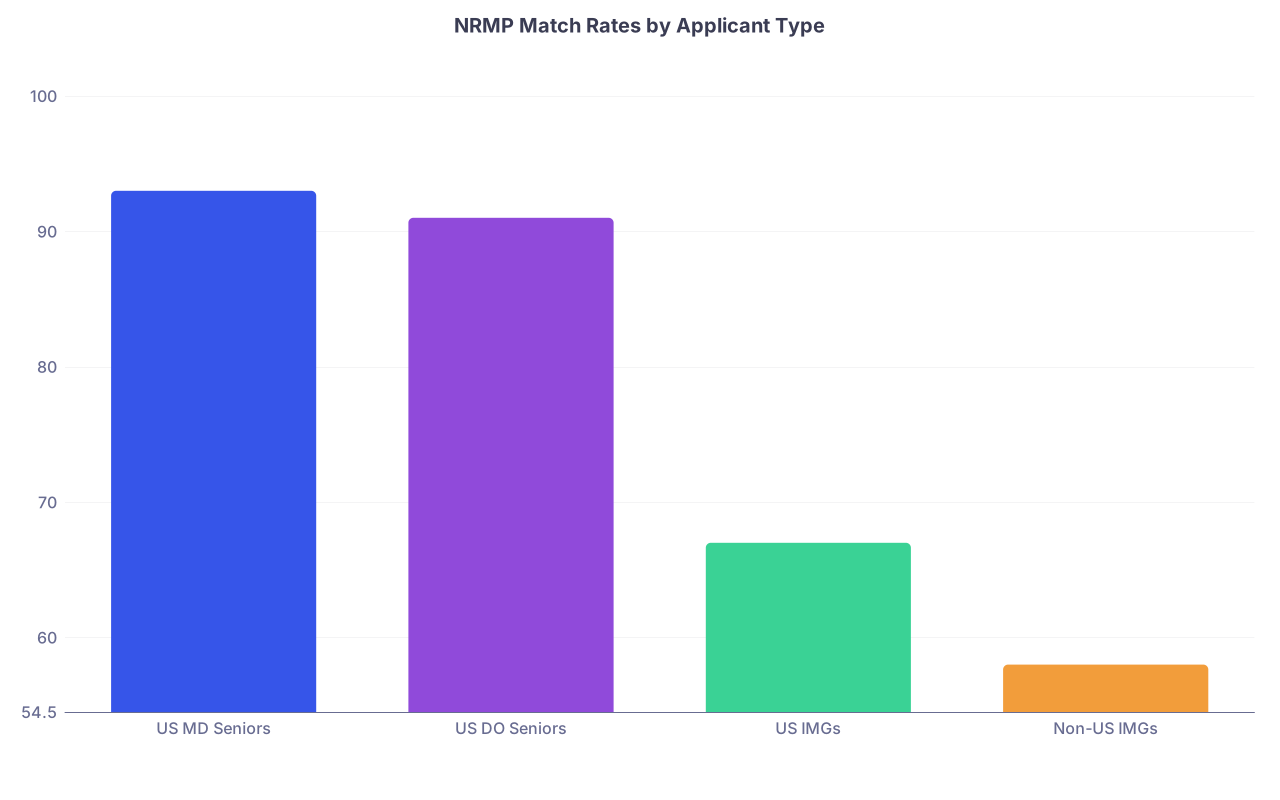
You’ve probably seen random numbers on Reddit but not really understood them, so here’s a simple snapshot.
| Category | Value |
|---|---|
| US MD Seniors | 93 |
| US DO Seniors | 91 |
| US IMGs | 67 |
| Non-US IMGs | 58 |
These are approximate match rates from recent NRMP data:
- US MD seniors: ~93% match
- US DO seniors: ~91% match
- US citizen IMGs: ~65–70% match
- Non-US IMGs: ~55–60% match
If you’re a nontraditional but you’re going US MD or DO, statistically, you’re more likely to match than not. Even with a couple of dings on your app.
But. There are patterns to who doesn’t match:
- People aiming only at hyper-competitive specialties (derm, ortho, plastics, neurosurg) with mid stats
- Very low Step scores / failed attempts with no backup plan
- Super limited geographic preferences (“I’ll only go to NYC or LA”)
- Weak or nonexistent clinical performance, professionalism issues
- Poor strategy: too few applications, no advisor input, overconfidence
Being nontraditional by itself? That’s not the death sentence. In some programs, they like the older folks with real-world experience. The problem is when people ignore risk management.
If you’re early in the process (premed / early med school), that’s actually a good thing: you still have time to build a safer trajectory.
What Actually Happens If You Don’t Match?
Let’s say worst case: It’s Match Day. The email hits. “We are sorry to inform you…”
You don’t match. What now?
There are basically a few lanes your life can go down.
| Path | Timeline | Main Focus |
|---|---|---|
| SOAP (same year) | 1 week | Scramble into open spots |
| Reapply Next Cycle | 1 year | Strengthen application + strategy |
| Pivot Within Medicine | 6–24 months | Consider research, non-clinical, alternate training |
| Exit to Other Careers | Variable | Leverage old + new skills outside residency |
1. SOAP (Same Year Salvage Operation)
SOAP = Supplemental Offer and Acceptance Program. The scramble.
You:
- See which unfilled positions exist
- Apply like mad
- Do rapid-fire remote interviews
- Hope for an offer
Reality check: SOAP spots are usually in less competitive fields and often in less desirable locations. But you know what they still are?
Residency positions. A path to becoming board-eligible. A way out of limbo.
For a lot of people, SOAP is how their “I didn’t match” story becomes “I still became a doctor, just not exactly the way I expected.”
2. Reapply Next Cycle
This one hurts. You sit in the gap year while classmates start intern year.
Your brain will say things like:
- “They’re all moving on and I’m stuck.”
- “I’m a year older and nothing to show for it.”
- “Did I throw my old life away and now I’m just… here?”
What people actually do in that year:
- Research positions (often paid modestly)
- Preliminary/transitional year if they matched prelim but not categorical
- Extra clinical experiences (sub-I’s, observerships, hospital jobs)
- Step 3 (to show improvement / commitment)
- Ongoing networking with PDs and faculty
I’ve seen nontrad applicants not match IM, then spend a year doing hospitalist research + Step 3, then match FM or psych the following year and end up… fine. Different specialty than they planned, yes. But employed, licensed, practicing.
3. Pivot Within Medicine (Non-Residency Clinical/Adjacent Paths)
This is the part people almost never talk about, but there are MD/DOs who don’t complete residency and still function in medical/adjacent roles.
Examples:
- Clinical research (industry or academic)
- Medical education (curriculum design, simulation, tutoring, course directing)
- Pharma/biotech (medical science liaison, clinical development associate)
- Health tech / digital health startups
- Medical writing, regulatory work, consulting
No, these are not all easy to get. Yes, you will have to hustle. But are they real? Yes. I’ve seen them.
There are MDs who realized in residency they were miserable and left, and then built careers in pharma or tech making more than their attending friends. It’s not automatic. It’s also not fantasy.
4. Exit Back to “The Real World”
This sounds like your nightmare: you left your old job and then crawl back, now older and weighed down with loans.
That scenario does exist… in a dramatic version. The real version is usually messier and less tragic:
- You lean on your previous career skills (coding, finance, teaching, engineering, nursing, business)
- You re-brand your story: “I pursued medicine, gained X, Y, Z, now I bring that to your company/field”
- You don’t land instantly in your old level; there might be a step sideways or down first. But then you climb.
I won’t lie to you: this path is hard emotionally. You’ll feel like you failed publicly. And you’ll be tempted to see your 30s or 40s as “wasted.”
But careers are 30–40 year arcs. A 5–10-year detour that changes how you think, how you see people, and how you handle pressure is not wasted. It just doesn’t fit the story you wanted. That’s different.
Did I Just Waste My Old Career If I Change or Don’t Match?
This is the part that eats nontrad people alive.
You: “I walked away from a good thing. If medicine doesn’t work out, then that entire past life was just… thrown away.”
No. And I’m not saying that as empty comfort. The job titles won’t transfer cleanly. The skills will.
Think of your pre-med life as a toolbox you’re carrying forward, not a chapter you burned.
Here’s how that actually looks.
| Old Field | Transferable Skill | How It Helps in Medicine |
|---|---|---|
| Business/Management | Team leadership | Running teams on the wards, QI projects |
| Teaching/Education | Explaining complex ideas | Patient education, teaching juniors |
| Engineering/IT | Systems thinking | Understanding workflows, EMR optimization |
| Nursing/Allied Health | Clinical familiarity | Communicating with staff, patient care insight |
| Finance/Consulting | Data + decision making | QI, admin roles, practice management |
If—worst case—you don’t match and decide you’re done chasing residency, you still have:
- A medical degree
- A brutal crash course in complexity, stress, and responsibility
- Your entire pre-med-career skill set
Is that combo niche and weird? Yes. But “niche and weird” is exactly what stands out in a resume stack.
How to Lower the Risk Now (Before You’re Trapped)
Your anxiety is screaming, “What if everything collapses?”
Fine. Let’s feed it with something useful: control what you can now.
As a Premed
Be realistic about your academic profile
If you’re starting from a 2.8 undergrad GPA and you’re 32, you need a methodical plan: strong post-bacc or SMP, stellar trend, MCAT that compensates. Otherwise yes, you are flirting with the “took on debt, no acceptance” scenario.Shadow and work clinically before you jump
Don’t quit your stable job after two YouTube videos. Actually spend time around residents, attendings, nurses. Watch the mess. If you’re going to burn your bridge, at least know what you’re jumping toward.Do a financial reality check
Real numbers: tuition, COL, lost income. Have you run the math? Or are you just kind of… hoping it works out? That quiet dread you feel at night is often just your brain knowing the numbers don’t add up yet.
In Med School
Don’t chase a specialty your application can’t support
If you’re a mid-pack student at a newer DO school with a failed Step attempt, and all you talk about is derm, ortho, or plastics… yeah, you are building the “I didn’t match and now I don’t know what to do” future.Get faculty who will tell you the truth
Not your friends, not random strangers online. Actual advisors and PDs who can say, “With this record, you are competitive for X and Y, not Z.” It stings. But it’s how you avoid catastrophe.Build a Plan B specialty early
Example: You’re drawn to anesthesia but know it’s moderately competitive. Cool. Be intentional about also exploring internal medicine or family med. Have letters, rotations, and a coherent story for both.Don’t bury red flags
Failed Step? Leave of absence? Bad evaluation? You don’t fix that by pretending it didn’t happen. You fix it by:- Improvement on later exams
- Mature, specific explanation
- Supportive letters showing growth, reliability
What About the Money? Massive Loans and No Match
This is the nightmare combo: no match + six-figure debt + no attending salary.
I won’t sugarcoat it: this is heavy. But it’s not “live under a bridge” heavy. There are actual levers you can pull.
| Category | Value |
|---|---|
| Standard | 10 |
| Graduated | 10 |
| PAYE/REPAYE/IDR | 20 |
| Forbearance/Deferment | 3 |
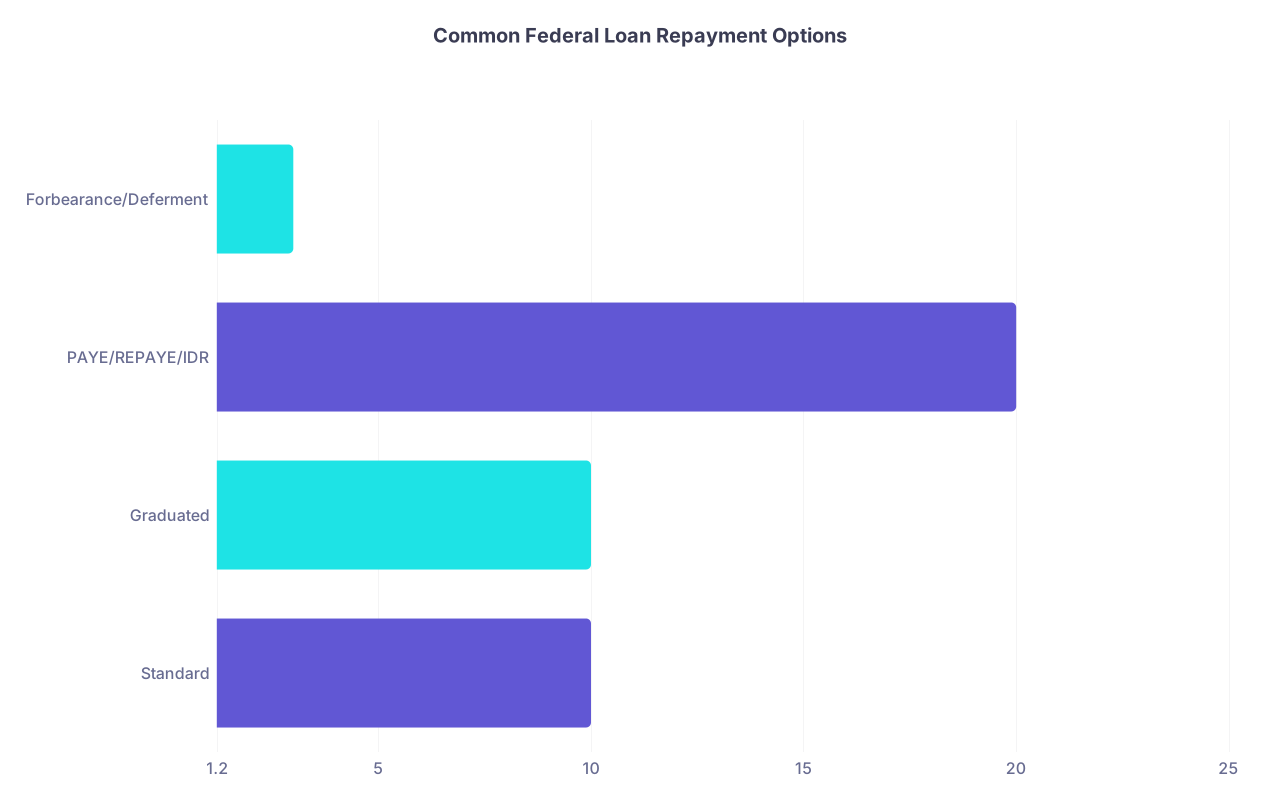
Rough translation of that chart:
- Standard / Graduated: 10-year payoff, higher monthly payments, requires higher income
- IDR (income-driven repayment): Payment is % of your discretionary income
- Forbearance/Deferment: Temporary pause but interest keeps growing
If you don’t match:
- IDR becomes your friend. Your payment drops with your income.
- You must avoid sticking your head in the sand. Ignoring loans is how you trash your credit and box yourself in.
Your old career skills help here too. Being able to pivot into industry, tech, consulting, or other roles can bump your income faster than random part-time work.
Loans are a problem. They’re just not an instant, irreversible death sentence.
How Do You Live With This Uncertainty Right Now?
You’re not looking for toxic positivity. You want to know: how do I keep going when this “what if” is always sitting in the back of my skull, whispering that I might be blowing up a perfectly decent life?
Here’s what actually helps:
Decide what level of risk you’re truly willing to accept
Don’t copy other people’s thresholds. Some are okay with, “If I don’t match, I’ll do research for years and keep trying.” Others are like, “If I don’t match once, I’m out.” Know your line.Make an exit plan before you need it
Sounds backwards, but it calms your brain. For example:
“If I don’t match after two attempts, I’ll pivot to pharma/clinical research, using my old [X] background and my MD.”
That way, your worst-case scenario isn’t “void.” It’s just Path B.Stop pretending you can control everything
You can control: effort, strategy, specialty choice, where you apply, how you present yourself.
You cannot fully control: the number of spots, other applicants’ choices, random PD preferences.Anchor back to why you started
If your only honest reason is “money, status, and validation,” then yeah, not matching will feel like full annihilation. But if your reason has any roots in actually liking patient care, problem-solving, or meaning—you’ll have more ways to land on your feet even if the path twists.
One Hard Question You Need to Answer
Before you go any further down this road, ask yourself this and be brutally, uncomfortably honest:
“If I give medicine my absolute best, stay flexible on specialty and location, and still don’t end up exactly where I want… will I still be able to live with myself? Or will I always feel like I destroyed my life?”
If your gut answer is, “I would rather take this swing and risk the bruise than stay where I am and always wonder,” then you’re the kind of person who can tolerate this path.
If your answer is, “No, I cannot accept that level of uncertainty,” that doesn’t make you weak. It means you’re finally being honest about your risk tolerance.
Your Next Step (Today, Not Someday)
Do this today, not “later when I have time”:
Open a blank document and write three short paragraphs:
- What I’m afraid will happen if I don’t match.
- What I would actually do in the first 12 months if that happened (jobs I’d apply for, people I’d contact, ways I’d use my old career).
- The conditions under which I would decide to keep trying vs. pivot out.
Don’t make it pretty. Just make it real.
Once your brain sees an actual survival plan on paper, the fear stops being this vague, endless monster. It becomes something you can plan around… while you still go all in on trying to match.


