
The myth that MD–PhDs automatically get paid more than MD-only physicians is wrong.
They usually don’t. And when they do, it’s rarely for the extra letters—it’s for the extra work (research, grants, leadership), not the degree itself.
Let me walk you through how this actually works inside hospital systems, because the reality is a lot more boring—and a lot more strategic—than premed Reddit makes it sound.
Short Answer: No, The Degree Alone Doesn’t Pay More
If you’re asking, “Do hospital systems by default pay MD–PhDs more than MD-only physicians in the same specialty and role?”
The honest answer: No, not in any systematic, guaranteed way.
In most hospital and academic systems:
- Base salary is tied to:
- Specialty (neuro > primary care, for example)
- Rank/years of experience (assistant vs associate vs full professor)
- Clinical productivity (RVUs or similar)
- MD–PhD vs MD-only is not a line item in the salary table.
If a hospital has a salary grid, it says things like “Assistant Professor of Medicine – Hospitalist” with a range. It doesn’t say “+$20,000 if PhD.”
So where does the confusion come from? MD–PhDs may end up making more in certain settings, but that’s because of:
- Protected research time supported by grants
- Leadership roles (division chief, research director)
- Extra income streams (industry consulting, patents, speaking)
- Negotiated packages at research-heavy institutions
That’s not “the system pays MD–PhDs more.” That’s “the system pays people who bring in money and prestige more,” and MD–PhDs are often positioned to do that.
How Hospital Compensation Actually Works
Let’s strip the fantasy out of this and talk mechanics.
Most physicians in hospital systems get paid from a mix of:
- Base salary
Your guaranteed amount tied to:- Specialty
- Academic rank (if applicable)
- Contracted FTE (full-time vs part-time)
- Productivity pay (often RVUs)
You generate RVUs by seeing patients, doing procedures, reading studies. More RVUs = more money. - Incentives/bonus
Quality metrics, patient satisfaction, citizenship bonuses, etc. - Research/administrative support
“Salary support” from:- Grants (NIH, foundation, etc.)
- Administrative roles (program director, committee chair)
- Endowed chairs or special titles
In a pure clinical job (say, community hospitalist):
- MD-only and MD–PhD in the same role and FTE will usually have:
- The same base
- The same RVU rate
- The same bonus structure
Meaning: if they work the same shifts and generate the same RVUs, they’re getting roughly the same paycheck.
In an academic job, it gets messier.
Academic Medical Centers: Where MD–PhDs Can Monetize the PhD
Academic hospitals care about three things from faculty:
- Clinical care
- Research
- Teaching / service
Compensation models usually reflect that mix. You’ll see contracts that look like:
- 0.6 FTE clinical (paid from the department/clinical revenue)
- 0.4 FTE research/other (paid from grants, institutional funds, or a “research commitment” pool)
Here’s the important point: MD-only faculty can have this exact setup too. There is no rule that you must have a PhD to be a physician–scientist.
But MD–PhDs:
- Are often recruited specifically for research-heavy roles
- Are more likely to have structured paths to grant-funded salary
- May be targeted for endowed positions or protected time earlier in their career
So what happens in practice?
Scenario: Two academic cardiologists:
- Cardiologist A – MD-only, 100% clinical
- Cardiologist B – MD–PhD, 60% clinical, 40% research, with 50% of that research time funded by an NIH K award
How they get paid:
- The department pays both for their clinical time
- Cardiologist B’s grant covers part of their non-clinical salary
- The institution may sweeten B’s package to attract/retain a research-oriented faculty member (startup funds, lab space, support staff)
Does B “earn more” than A? Sometimes no, sometimes yes. It depends on:
- How high the clinical pay is in that specialty
- How much grant salary support B has
- How much extra admin or leadership comp B gets over time
But again, the key is: it’s not a PhD premium baked into the pay scale. It’s role + funding.
Community and Private Practice: The PhD Usually Doesn’t Matter
If you go into:
- Private practice (derm, ortho, GI group, etc.)
- Community hospital employment (non-university)
- Large multispecialty groups focused on clinical care (Kaiser-type models, big regional systems)
Your PhD has almost no direct economic value.
These systems care about:
- How many patients you can see
- How many procedures you can safely and efficiently perform
- How your clinical outcomes and patient satisfaction look
They do not pay extra for:
- Extra letters after your name
- Time spent in basic science
- First-author Nature papers
I’ve seen MD–PhDs working as straight hospitalists in community systems making exactly the same as their MD-only colleagues. Sometimes less if they want fewer shifts or more “academic time” that’s not actually funded.
If your career ends up 95–100% clinical in a non-academic environment, the PhD is basically a sunk cost from an income perspective.
Where MD–PhDs Might Actually Make More
There are situations where an MD–PhD tends to out-earn an MD-only peer—but again, it’s about what they’re doing, not what they are.
Here are the common ones:
High-level physician–scientist roles
People who:- Run big labs
- Hold multiple R01s or program project grants
- Lead major research centers or institutes
These roles often come with: - Higher institutional base salary
- Admin stipends
- Endowed chairs (which can add $20–$100k+) Who fills these roles? Often MD–PhDs. But not exclusively.
Early-career recruitment packages
Some academic centers will:- Offer more startup funds to MD–PhDs
- Guarantee more protected time specific to research
- Provide bridge funding when grants lapse
That’s not direct “more salary,” but it can dramatically affect long-term career value.
Industry and hybrid roles
MD–PhDs can be very attractive to:- Pharma and biotech (clinical development, translational roles)
- Device companies
- AI/health tech startups
These roles can: - Pay more than traditional faculty jobs
- Value the dual training more explicitly
Intellectual property and commercialization
Rare, but real. If your research leads to:- Patents
- Licensed technology
- Equity in a spinout company
You can dwarf standard physician income. MD-only folks can do this too, but MD–PhDs are often more embedded in the pipelines that produce this kind of work.
So yes, there are paths where an MD–PhD background pays very well. But it’s not because the hospital payroll department says “PhD = +$X.” It’s because of what you leverage that training into.
Comparing Typical Compensation Paths
Let’s put some structure on this. Very simplified, but directionally accurate.
| Career Type | MD Only Pay Pattern | MD–PhD Pay Pattern |
|---|---|---|
| Community clinical | Same baseline | Usually same |
| Academic, mostly clinical | Same for same role | Same, unless extra roles |
| Academic, research heavy | Similar if similar grants | Often similar, sometimes higher if more research roles |
| Physician–scientist leadership | Possible but less common | More common, higher ceilings |
| Industry/biotech | Strong | Often strong or higher |
Again: role > degree.
The Hidden Cost Side: MD–PhD vs MD
You can’t talk about pay without mentioning time and opportunity cost.
MD–PhD path usually adds:
- 3–4 extra years of training compared with MD-only
- Often lower earning years as a junior faculty with lots of research time and lower clinical load
- Longer delay before hitting peak earning years compared with classmates who went straight into private or high-paying subspecialty practice
So even if an MD–PhD faculty member ends up with a higher salary at age 45 than an MD-only academic colleague, they may still lag far behind their MD-only classmate who went into:
- Private dermatology
- Orthopedic surgery in a high-volume group
- Interventional cardiology in a non-academic setting
You don’t do an MD–PhD because you want to “maximize physician income.” You do it because you want to seriously integrate research into your career and you’re okay trading raw salary for that.
How Hospitals Actually Think About MD–PhDs
Here’s the inside view from how chairs and hospital leaders talk:
They don’t say:
“We should pay MD–PhDs more because they’re smarter.”
They say things like:
- “We need someone who can build a translational research program in X.”
- “Can we afford to give this recruit 70% protected time for five years?”
- “What’s the return on investment for this lab build-out and startup package?”
An MD–PhD who:
- Publishes well
- Brings in grants
- Mentors trainees
- Builds programs
…is valuable to an academic system. That value can translate into:
- Stronger negotiation power
- Better retention packages
- Leadership roles
But again—none of this is automatic. There are plenty of MD–PhDs who:
- Burn out on research
- End up in full-time clinical roles
- Make the same as everyone else doing that job
When Does an MD–PhD Make Financial Sense?
Brutally honest answer: financially, it “makes sense” when:
- You plan to stay in academia long-term
AND - You truly want 40–80% of your time allocated to research
AND - You’re willing to chase grants and take on the stress that comes with them
Under those conditions, the MD–PhD:
- Can help you land better early-career offers at strong institutions
- Can make you more competitive for K and R-level grants
- Can set you up for leadership or high-impact roles that eventually pay well
If your likely outcome is:
- 80–100% clinical
- Minimal research beyond maybe QI projects
- Preference for community or private practice
Then in cold financial terms, the PhD is:
- Lost income from extra training years
- Zero salary premium in most clinical jobs
- Often a liability if you’re “overtrained” for what the employer needs
Practical Takeaways If You’re Deciding MD vs MD–PhD
Let me cut through the noise:
- No, hospital systems do not have a built-in “PhD bonus” for physicians.
- Yes, MD–PhDs can earn more in certain academic/research/industry paths.
- No, that upside is not guaranteed. It’s highly performance and role dependent.
- Yes, you sacrifice several years of attending-level pay and often delay financial security.
So if your main question is:
“Which one will pay me more as a doctor—MD or MD–PhD?”
The honest framework is:
- If you want maximum clinical earning power → MD, maybe plus a competitive, high-paying specialty.
- If you want a research-integrated career and you’re okay with:
- Less predictable income
- More time in training
- A more complex, patchwork salary
→ MD–PhD might be the right call.
But don’t do an MD–PhD because you think hospitals will just pay you more for the letters. They won’t.
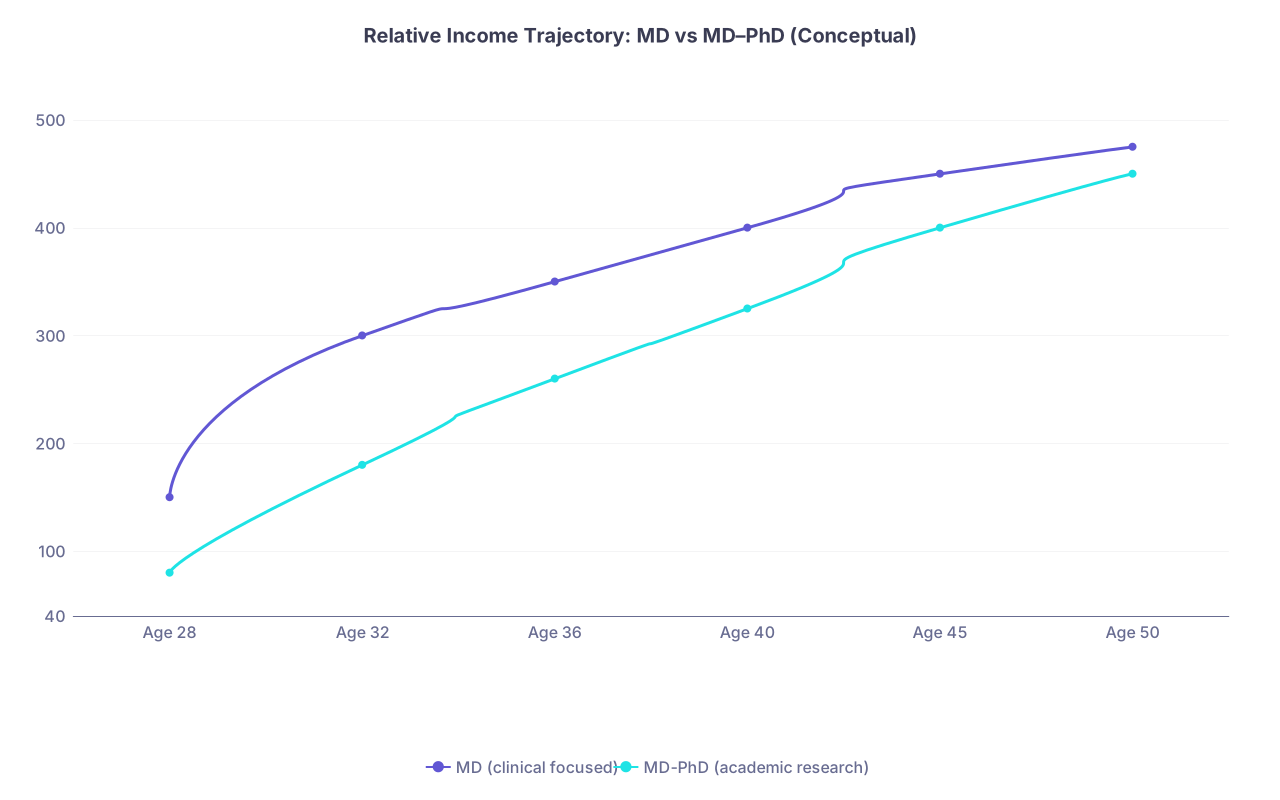
| Category | MD (clinical focused) | MD-PhD (academic research) |
|---|---|---|
| Age 28 | 150 | 80 |
| Age 32 | 300 | 180 |
| Age 36 | 350 | 260 |
| Age 40 | 400 | 325 |
| Age 45 | 450 | 400 |
| Age 50 | 475 | 450 |

FAQ: MD–PhD Pay vs MD-Only
Do academic hospitals have separate salary scales for MD–PhDs vs MD-only physicians?
Usually no. They have scales by rank (assistant/associate/full professor) and sometimes by specialty. MD–PhD vs MD-only almost never appears as a separate category. Any difference you see is usually due to role (e.g., more research, leadership positions, endowed roles), not the degree itself.Can MD–PhDs negotiate higher starting salaries than MD-only hires?
Occasionally, but not just for the letters. You’ll see better packages for MD–PhD candidates when the institution really wants a physician–scientist in a niche area and is competing with other major centers. That might look like more protected time and startup support, and sometimes a bit more salary—but the real value is in the resources, not the base pay.If I switch to full-time clinical work after an MD–PhD, will I be paid more than MD-only colleagues?
No. If you’re hired into a standard clinical role (hospitalist, outpatient internist, general surgeon) in the same system, you’ll typically be on the same pay scale and productivity model as everyone else. The PhD becomes essentially irrelevant to compensation in purely clinical environments.Do grants actually increase a physician–scientist’s salary, or just cover what the institution would’ve paid anyway?
Early on, many grants (like K awards) partially cover the salary that the institution would otherwise be subsidizing for your research time. They don’t always increase your take-home pay directly; they make you financially sustainable for the department. Later, with significant grant portfolios and leadership roles, you can see real salary increases linked to your research program’s value to the institution.If my goal is to maximize lifetime income as a physician, should I do an MD–PhD?
No. If money is the primary goal, an MD-only route into a high-paying specialty, especially in private or non-academic practice, almost always wins financially. MD–PhD is the right move if you care deeply about being a physician–scientist and you’re willing to trade some income and time for the ability to do serious research as a core part of your career.
Key points:
- Hospital systems do not routinely pay MD–PhDs more than MD-only physicians for the same job.
- MD–PhDs can earn more in certain research-heavy, leadership, or industry roles—but that’s about role and performance, not just the degree.
- Choose MD–PhD for the career you want, not for a presumed salary bump that doesn’t reliably exist.