

The civilian market will underpay you if you let them treat your military years like a cute side story instead of hard, billable experience.
If you are a physician coming out of the military and stepping into your first civilian attending job, you’re walking into a world that does not understand what you did, how hard you worked, or how much value you bring. That gap is exactly where money gets left on the table.
Let me walk you through how to fix that.
Step 1: Reset Your Own Mindset About Your Value
You cannot negotiate like someone who has been grateful for whatever the government gave them for the last decade.
In the military, you get: rank, time-in-service, a pay table, and zero real negotiation. COLAs, BAH, BAS, special pays. Maybe some bonuses. But mostly: “This is your pay, ma’am/sir.”
Civilian world? None of that matters automatically. And yet, all of it can be translated into value—if you do the work.
Here’s the blunt truth:
Most ex-military physicians I’ve seen make three mistakes in mindset:
- They underestimate how experienced they look to civilian employers.
- They overestimate how “special” their military background is (emotionally, not economically).
- They have no clue what their “all-in comp” was and therefore do not know what they’re actually trying to beat.
Let’s fix those one by one.
First, experience. If you’ve been staff for 4–10 years in the Navy, Army, or Air Force, you are not a “new grad.” You are an attending with years of independent practice, insane case mix in many specialties, and usually some additional leadership and admin.
You have to stop introducing yourself like: “Well, I’m just coming out of the military, so I’m kind of behind.” No. You’re not behind. You’re just new to this particular game. Very different.
Second, your military story. Yes, it’s honorable. Yes, people will say “Thank you for your service.” Do not confuse that with “We will therefore pay you more.” They won’t unless you show them why your experience is financially valuable. You must connect your background to revenue, productivity, reliability, and risk reduction.
Third, your prior compensation. You need to reconstruct your full military pay and benefits so you know your real baseline.
BAH, BAS, specialty pay, bonus, healthcare, retirement match equivalents—everything.
Then you compare. Not feelings. Numbers.
Step 2: Put a Dollar Value on Your Past to Set Your Floor
If you can’t write down your target number, you’re not ready to negotiate.
You need two numbers:
- The real “all-in” value of your last year in uniform
- The minimum “all-in” number you’re willing to accept as a civilian
Those are not the same number. The second should be higher.
Start with your last military year:
- Base pay (based on rank and years)
- BAH (housing)
- BAS (subsistence)
- Specialty pays and bonuses
- Incentive/special duty pays
- Leave, healthcare, retirement
For comparison to civilian jobs, you can roughly convert healthcare and retirement into a percentage add-on (for many military physicians, total comp is often effectively 15–30% higher than base+BAH+BAS once you include benefits).
Now do a rough tally.
Then look at what civilian jobs at your level are paying. Use MGMA, AMGA, specialty society data, or trusted recruiters. Not random Facebook posts.
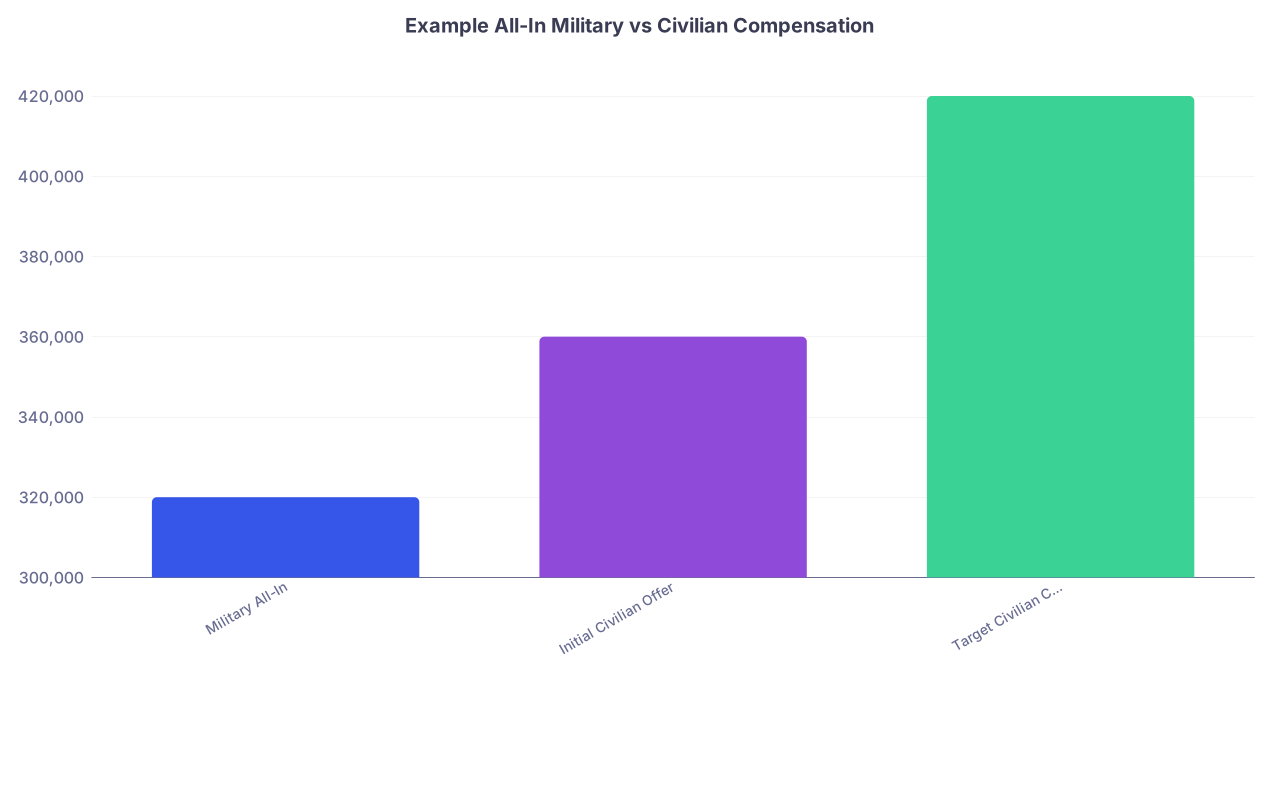
| Category | Value |
|---|---|
| Military All-In | 320000 |
| Initial Civilian Offer | 360000 |
| Target Civilian Comp | 420000 |
If your military all-in number was around $320k, and your first civilian offer is $360k but typical comp for your specialty and region runs $420–450k, that $360k is actually a lowball dressed up as a “raise.”
You’re not trying to “beat the military.” That bar is too low. You’re trying to land where an experienced attending in your specialty belongs.
Step 3: Translate Military Experience into Civilian Metrics
Civilian admins speak in three main dialects:
- RVUs (or collections)
- Coverage and reliability
- Risk and quality
They do not speak “O-4,” “battalion surgeon,” or “flight surgeon” natively. You have to translate.
RVU and volume translation
If you never tracked RVUs in the military (and most of you didn’t in any meaningful way), you need to reconstruct your productivity.
Examples:
- “I typically saw 12–16 inpatients on a standard medicine ward day and 18–24 in clinic.”
- “I averaged 6–8 OR cases per day, 3–4 days a week.”
- “On 24-hour OB call, I handled 5–10 deliveries, including high-risk and operative deliveries.”
Then convert that into civilian language: “Based on comparable civilian RVU tables, this volume is roughly equivalent to X RVUs per year.”
You won’t get it perfect. You do not need perfect. You need defendable.
If you can’t do the math yourself, talk to a colleague already in civilian practice in your specialty. Show them your typical week and ask what that would look like in RVUs or collections in their system.
Coverage and reliability
Civilian groups care about who will take the bad shifts and who can handle chaos without drama.
You’ve probably:
- Deployed
- Covered small understaffed facilities
- Worked with limited resources
- Done insane call schedules quietly
That translates into: “I can handle high-acuity, high-variance environments, and I show up.”
Be explicit:
- “I have been the solo anesthesiologist on call for a 100-bed facility with no in-house backup.”
- “I’ve routinely covered 24-hour trauma call with limited subspecialty support.”
- “I built and maintained a continuity clinic overseas with limited ancillary staff.”
When you negotiate, you connect this to pay:
“I’m willing to take on heavier call initially because this mirrors my military experience. But I want that reflected in the compensation structure.”
Risk and quality
Military physicians see extremes: trauma, infectious disease, mass casualty, limited imaging, limited specialty backup.
Translate:
- “I’m comfortable making high-stakes decisions without over-ordering tests.”
- “I’m trained to adhere tightly to protocols and quality metrics because I’ve lived under serious oversight and investigation systems.”
- “I’ve led morbidity and mortality reviews and implemented changes.”
Hospital leaders like hearing that you reduce risk and improve quality. They pay for that in two ways: better RVU rates, quality bonuses, and leadership stipends.
Use it.
Step 4: Stop Letting Employers Treat You as a New Grad
Here’s where many of you get quietly railroaded.
The recruiter says, “We usually bring all new-to-civilian physicians in at the same starting salary.”
They mean well. It’s easier for them if everyone in your cohort is on the same starting grid.
You are not on that grid.
You say:
“I’m not a new grad. I’ve been an independently practicing attending for 6 years, supervising residents and PAs, and running a service. I expect my offer to reflect that level of experience, both in base salary and RVU rate.”
If they push back: “We don’t give higher base for prior military.”
You respond:
“Then let’s talk about RVU rate, sign-on, and relocation. If you want me to start at a new-grad base, I’ll need an experienced-attending structure in the other components.”
You bargain somewhere:
- Higher base
- Or higher RVU rate
- Or bigger sign-on
- Or relocation/loan repayment
- Or leadership stipend
- Or reduced call/increased schedule flexibility
But you do not accept a pure new-grad package with no offset.
Step 5: Break Down the Civilian Offer Against Your Reality
You will usually see something like:
- Base salary (maybe guaranteed for 1–2 years)
- Productivity component (RVU or collections-based)
- Sign-on bonus
- Relocation assistance
- Benefits (health, disability, retirement)
- Call pay (maybe)
- CME, licensing, and dues
You need to compare apples to apples with your military comp and your market value.
Build a simple grid.
| Component | Last Military Year | Civilian Offer Year 1 |
|---|---|---|
| Base/Salary | $140,000 | $280,000 |
| Housing/BAH | $60,000 | Included in salary |
| Specialty/Bonus | $80,000 | RVU bonus est. $60,000 |
| Other Pays | $40,000 | Call pay $20,000 |
| Health/Retirement | Strong | Moderate |
| Total All-In | ~$320,000–340,000 | ~$360,000–380,000 |
If the gap between “what a 6-year attending in my specialty in this region should earn” and “what they’re offering” is big, you have concrete talking points.
You say:
“Based on my experience level and market data, I’d expect total comp in the low 400s once ramped up. Your structure appears to land me in the mid 300s, even with good productivity. That’s a significant delta for 6 years of attending-level practice.”
Then you propose:
“I’d be comfortable moving forward if:
- Year 1 base is $320k instead of $280k,
- RVU rate is $5 higher than what you’ve proposed,
- And the sign-on is increased by $20k to offset relocation and the lack of military housing benefit.”
Specific. Concrete. Defendable.
Step 6: Use Your Military Story as Leverage (The Right Way)
There’s a right and wrong way to wave the flag in these conversations.
Wrong way:
“I served our country for 10 years, I sacrificed a lot, I thought there’d be more appreciation in civilian medicine.”
Employers will nod, thank you for your service, and change nothing.
Right way:
“I’ve spent 10 years in an environment that demands reliability, flexibility, and leadership. I’ve run services with fewer resources than I’ll have here, and I’ve still hit high standards. That means I can ramp quickly, handle high volume safely, and be a stabilizing presence when things get busy or messy. That combination usually maps to the higher end of the pay range for my level of experience.”
Then you shut up and let them respond.
If they try to give you a “patriotic discount,” you move on. That’s not a serious employer.
Step 7: Anticipate Common Traps for Military Physicians
I’ve seen the same traps over and over again.
Trap 1: Underselling leadership and admin work
You probably:
- Served as department chief, OIC, flight commander, or staff lead
- Did scheduling, QI, credentialing, M&M, training
Most military docs list this like fluff: “Oh, yeah, I also did some admin stuff.”
In civilian contracts, that work is:
- Protected time
- A stipend
- Or a reason to bump your base
So you say:
“I’ve already done de facto medical director work—scheduling, process improvement, leading meetings. If you need leadership in this group or service line, I’m prepared to step into that with appropriate administrative stipend or protected time.”
It signals: I’m not just a worker bee. I’m infrastructure.
Trap 2: Ignoring value of your security/clearance/high-acuity practice
If you worked:
- At a military tertiary care center
- In deployed settings
- With trauma, burn, flight, overseas medicine
You are not “just” a clinic doc. You can handle complexity that many community physicians never touch.
That doesn’t mean you should underprice yourself because you “just want an easy clinic job now.” It means you can credibly say:
“I’m overqualified for a low-complexity primary care panel and can add value in higher-acuity or leadership roles. If you want to use me in a purely low-stress clinic setting, I’m still bringing premium experience and want to be compensated in the upper half of your range, not at the floor.”
Trap 3: Accepting vague promises about “future raises”
They’ll say, “We’ll start you at this number, then we can revisit in a year or two.”
You respond:
“Let’s put in writing what I can expect assuming I hit standard productivity—for example, base adjustment after year 1, or a defined RVU threshold that triggers a rate increase.”
If it’s not in the contract, it’s a wish, not a plan.
Step 8: Practice the Actual Negotiation Conversation
You probably haven’t negotiated pay in 10+ years. Or ever.
So you practice. Out loud.
Here’s a script skeleton you can adapt:
Open with appreciation but not desperation:
“I appreciate the offer and I’m excited about the practice setup. I do have some concerns about the compensation structure compared to my experience and market data.”Establish that you are experienced, not entry-level:
“I’ve been functioning as an independent attending for 7 years, including supervising residents and leading a service. I’m not a new graduate, and I’d expect my compensation to reflect that.”Anchor with data:
“For my specialty in this region, experienced attendings are typically in the $X–Y total comp range. Your offer appears to land me around $Z even if I’m productive.”Make a specific counter:
“If we can adjust the base to $, increase the RVU rate to $, and bump the sign-on by $___ to account for relocation and loss of housing allowance, I’d feel comfortable signing.”Stay quiet. Let them respond.
You are not begging. You’re stating terms.
Step 9: Use Visual Planning to Avoid Over- or Undershooting
Sometimes it helps to map your options, especially if you’re weighing academics vs private vs hospital employment.

| Step | Description |
|---|---|
| Step 1 | Finish Military Service |
| Step 2 | Negotiate as experienced attending |
| Step 3 | Negotiate as strong new grad |
| Step 4 | Higher base, lower autonomy |
| Step 5 | Lower base, higher upside |
| Step 6 | Lower pay, more teaching |
| Step 7 | Compare to military all in |
| Step 8 | Counter with data and specific asks |
| Step 9 | Experience 3+ years? |
| Step 10 | Practice Type |
You’re not just picking a job; you’re picking a comp structure. The military taught you to think in systems. Use that here.
Step 10: Do Not Forget the Non-Salary Levers
Sometimes the base won’t move much. Fine. Then you lean on everything else.
Things you, as a military doc, often undervalue but should absolutely negotiate:
- Call schedule and intensity (you’ve already done your time in the call trenches)
- Protected admin/teaching/research time with pay
- Guaranteed clinic support (MA, nurse, scribe)
- Ramp-up period productivity expectations
- Loan repayment (federal programs, employer-based, state programs)
- Flexibility in future FTE (drop to 0.8 after a couple years)
Use your past as justification:
“I’ve done years of heavy call and deployment. I’m happy to pull my weight on call, but I’m not willing to live at that tempo permanently. If we can agree to a reasonable call burden and clearly defined comp for call, I’m in.”
Step 11: Remember – You Can Walk Away
This is the part many former military docs struggle with.
In the military, you do not walk away. Orders are orders.
In civilian life, walking away from a bad offer is often the most powerful negotiation move you have.
You do not threaten dramatically. You just calmly say:
“I appreciate the time and effort you’ve put into this. The gap between this offer and my experience-based expectations is large enough that I don’t think it’s the right fit for me. If things change in the future, I’d be happy to reconnect.”
Sometimes they come back. Sometimes they don’t. Either way, you didn’t chain yourself to an underpaying job for 3–5 years.
Two Quick Extras You Should Actually Do
First, talk to at least two prior-military physicians already in civilian jobs in your specialty. Ask them:
- What was your first offer out of the military?
- What did you negotiate up to?
- What do you make now?
- What would you do differently if you were leaving again?
Second, seriously consider paying a physician contract attorney for a real review—preferably one who has seen multiple military-to-civilian transitions. They’ll catch the poison pills you’re not trained to see: repayment clauses, restrictive covenants, vague bonus language, and unilateral changes.

Big Picture: Where You’re Aiming
Your goal is not “get more than I made in the military.” That bar is too low.
Your real goals:
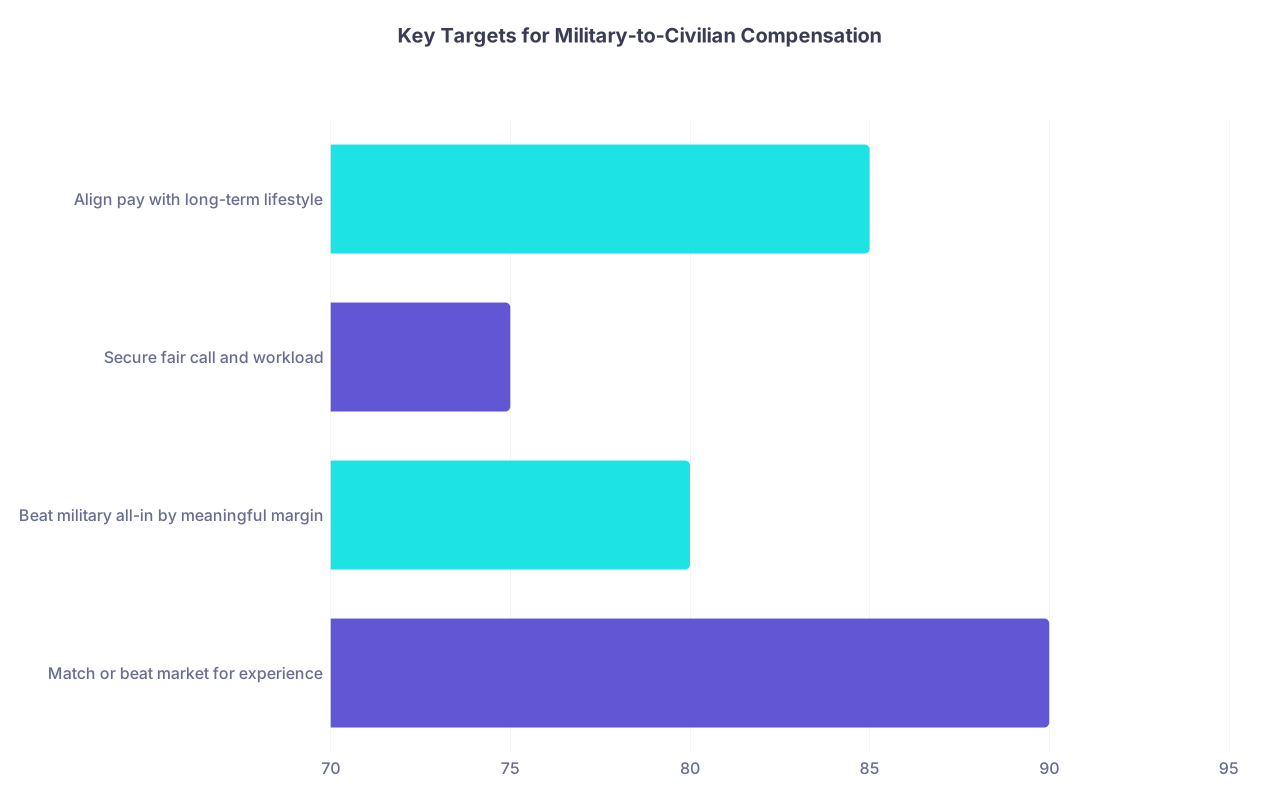
| Category | Value |
|---|---|
| Match or beat market for experience | 90 |
| Beat military all-in by meaningful margin | 80 |
| Secure fair call and workload | 75 |
| Align pay with long-term lifestyle | 85 |
- Land at or above market for an attending with your years of independent practice
- Beat your military all-in compensation by a meaningful amount, not a token
- Lock in a workload and call structure that doesn’t feel like a permanent deployment
If you keep those three targets in view, you’ll avoid a lot of mediocre offers.

Final Takeaways
- Your military years are real attending years. Refuse to let anyone classify you as a pure new grad.
- Translate your experience into civilian metrics—RVUs, volume, leadership, risk reduction—and negotiate off data, not gratitude.
- If the offer doesn’t respect your experience and market value, walk away. You already served your time; you do not owe civilian employers a discount.


