

The data shows something uncomfortable: most physicians are still signing contracts written for 2015 medicine in a 2025 labor market.
Post‑COVID, the clinical reality changed faster than the paperwork. Telehealth exploded, elective volumes whiplashed, burnout spiked, and administrators scrambled to redesign compensation around RVUs and coverage. But many contracts have not caught up—especially on remote work, flex time, and how RVUs are credited for nontraditional care.
You can either negotiate off outdated templates. Or use the numbers to force them into the current decade.
Let’s walk through the data.
1. The Big Post‑COVID Shifts in Physician Work
The change is not theoretical. It shows up clearly in utilization, compensation, and workforce data.
| Category | Value |
|---|---|
| 2019 | 1 |
| Q2 2020 | 35 |
| 2021 | 15 |
| 2022 | 12 |
| 2023 | 10 |
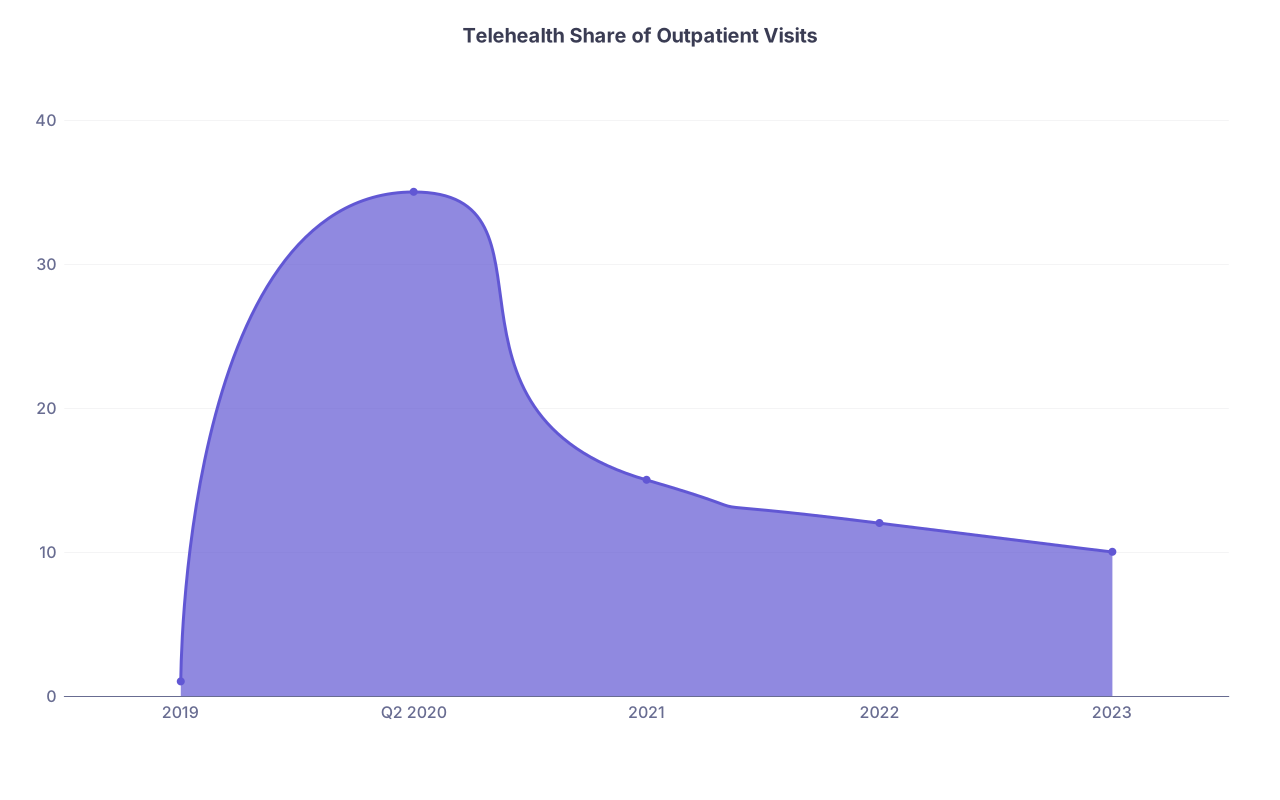
Before COVID, telehealth was about 1–2% of outpatient encounters. At the peak in Q2 2020, telehealth hit 30–40% of visits in many systems. It has since settled around 8–15% depending on specialty and market.
A few anchor numbers from major surveys and reports (MGMA, AMGA, Medscape, various health system datasets):
- Overall ambulatory telehealth stabilized around 10–12% of visits in 2023, higher in psychiatry (30–50%), endocrinology, and allergy, lower in procedural fields.
- Roughly 45–55% of physicians report some ability to work remotely at least part of the week post‑COVID, compared with under 10% pre‑COVID.
- Yet only about 20–25% of contracts explicitly codify remote/virtual work terms rather than leaving them as “at the discretion of administration.”
So the work migrated. The contracts lagged.
At the same time, productivity and compensation shifted:
- RVU‑based comp remains dominant: roughly 65–75% of employed physicians have a compensation model where wRVUs are a primary driver.
- Base salaries flattened, but RVU incentives and “at risk” portions increased. Multiple MGMA datasets show incentive/variable pay as a share of total comp climbing from the mid‑teens (percent) pre‑COVID to low‑20s percent in many systems.
- Burnout rates rose into the 50–60% range in multiple surveys. And physicians started using one of the few levers they have: demanding flex schedules, 0.8 FTE options, and control over call.
The short version: the post‑residency job market now has three pressure points that show up in contracts:
- Remote / telehealth provisions
- RVU definitions and crediting rules
- Flex time and coverage expectations
If your contract does not reflect those three, you are negotiating with a handicap.
2. Remote Work and Telehealth: What the Numbers Actually Support
Hospitals like to say, “We are not ready to commit telehealth in writing; volumes may change.” The data undercuts that argument.
Telehealth has already found its floor.
- Psychiatry: 40–60% of encounters are virtual in many systems, even after reopening.
- Endocrinology, rheumatology, allergy/immunology: 20–30% telehealth is common.
- Primary care: 10–20%, depending on payer mix and local regulations.
- Surgical subspecialties: lower for direct patient visits, but postoperative checks, pre‑op counseling, and group classes are often 10–15% virtual.

For you, the key is not abstract telehealth percentages. It is exactly how those visits are:
- Scheduled
- Credited to RVUs
- Counted toward FTE and panel expectations
I routinely see three failure modes in post‑COVID contracts:
Remote work is “allowed” but not guaranteed
Language like “Physician may be permitted to perform telehealth as determined by Employer.” Translation: they can revoke it unilaterally. You have zero leverage when leadership changes.Telehealth wRVU credit is ambiguous or discounted
I have seen contracts where virtual visits generate 70–80% of the wRVUs of an in‑person visit despite equal documentation and time. That is a quiet pay cut for remote sessions.No definition of “primary worksite” or home office
Malpractice, licensure, and IT support get messy when the contract assumes a single clinic address but you are logging in from home half the week.
You fix that with numbers and precision, not begging.
If your specialty realistically can support 20–40% telehealth long‑term, negotiate explicit ranges:
- “A minimum of 20% of scheduled outpatient visits shall be eligible to be performed via telehealth at the Physician’s discretion, subject to clinical appropriateness and payer rules.”
- “Telehealth visits shall be credited wRVUs based on the same CPT code‑specific values as in‑person visits, with no discounting or differential crediting.”
Tie this to actual CPT codes if you can. If the employer uses a specific RVU table (Medicare Physician Fee Schedule for a given year, or an internal table), reference that in the contract.
Do not accept “telehealth is subject to policy.” Policies change every quarter. Your contract does not.
3. RVUs Post‑COVID: Where Physicians Lose Money in the Fine Print
Most post‑residency physicians think they understand RVUs. Many do not understand how compensation contracts weaponize them.
Three data points:
- The median wRVU target for new internal medicine primary care hires in 2023 was roughly 4,500–5,000 wRVUs per year in many regions, with comp per wRVU anywhere from $40–$60+ depending on market.
- For hospitalists, annual targets in the 4,000–5,500 wRVU range are common, with more revenue tied to shift counts and nocturnist differentials.
- For procedural specialties, wRVU expectations routinely sit 20–40% above published “national median” benchmarks when you read contracts closely.
| Specialty | Typical New-Hire Target (wRVUs) | Common Pay per wRVU ($) |
|---|---|---|
| Primary Care | 4,500–5,000 | 40–60 |
| Outpt Psychiatry | 3,000–3,500 | 60–80 |
| Hospitalist | 4,000–5,500 | 30–45 |
| General Surgery | 6,500–8,000 | 50–70 |
| Cardiology | 9,000–11,000 | 55–80 |
The headline numbers do not bother me. The hidden edits do.
What changed post‑COVID is not the existence of RVUs. It is the complexity of what counts as “productivity”:
- Telehealth visits
- Asynchronous e‑consults
- Inbox and messaging work
- Care coordination
- Non‑visit chronic care management codes
If your RVU model does not recognize these, your effective hourly rate collapses.
Where contracts quietly strip RVUs
In the post‑COVID environment, I see at least five landmines in RVU language:
Discretionary credit for non‑visit work
Contracts say things like “Management may assign additional RVUs for administrative and care coordination activities.” That sounds generous. It usually means: “We will rarely, if ever, do this.”You want RVU credit to be formula‑driven, not discretionary.
Unclear telehealth CPT mapping
Some systems use different internal codes or credit telehealth at a lower level than in‑person visits. Over 1,000+ visits a year, that is thousands of wRVUs lost.High thresholds for incentive tiers
For example, base salary assumes 4,500 wRVUs. Incentive tiers only start at 110% or 120% of that number. Then the per‑wRVU bonus rate is low. You essentially donate first‑tier overproduction.Unilateral change clauses
Language that allows the employer to change compensation methodology or RVU tables during the contract term “to align with market or payer changes.” Post‑COVID, this has been used to quietly lower comp per wRVU when Medicare or commercial reimbursement shifts.No backstop when volumes crater
In 2020, physicians with 100% RVU‑based pay saw their incomes evaporate when elective procedures shut down. Some systems added “disaster floors”; many did not. That memory is still relevant.
Your counter is data‑driven language. Examples:
- Lock in the RVU schedule: “wRVUs shall be attributed based on the 2023 Medicare Physician Fee Schedule values for work RVUs, which shall not be reduced during the term of this Agreement.”
- Define how non‑visit work is captured: “The parties agree to implement billing for chronic care management and other non‑visit services, and wRVUs associated with such services shall be credited to Physician.”
- Prevent moving the goalposts: “Any change in compensation methodology or wRVU values that would reduce Physician’s total compensation potential shall require Physician’s written consent.”
One more thing: look at your comp per RVU in context. If your offer is $48 per wRVU in a market where current benchmarks show $60–65 for your specialty and region, you are leaving 20–30% on the table. Administrators know these numbers. You should too.
4. Flex Time, FTE, and Call: The New Currency of Retention
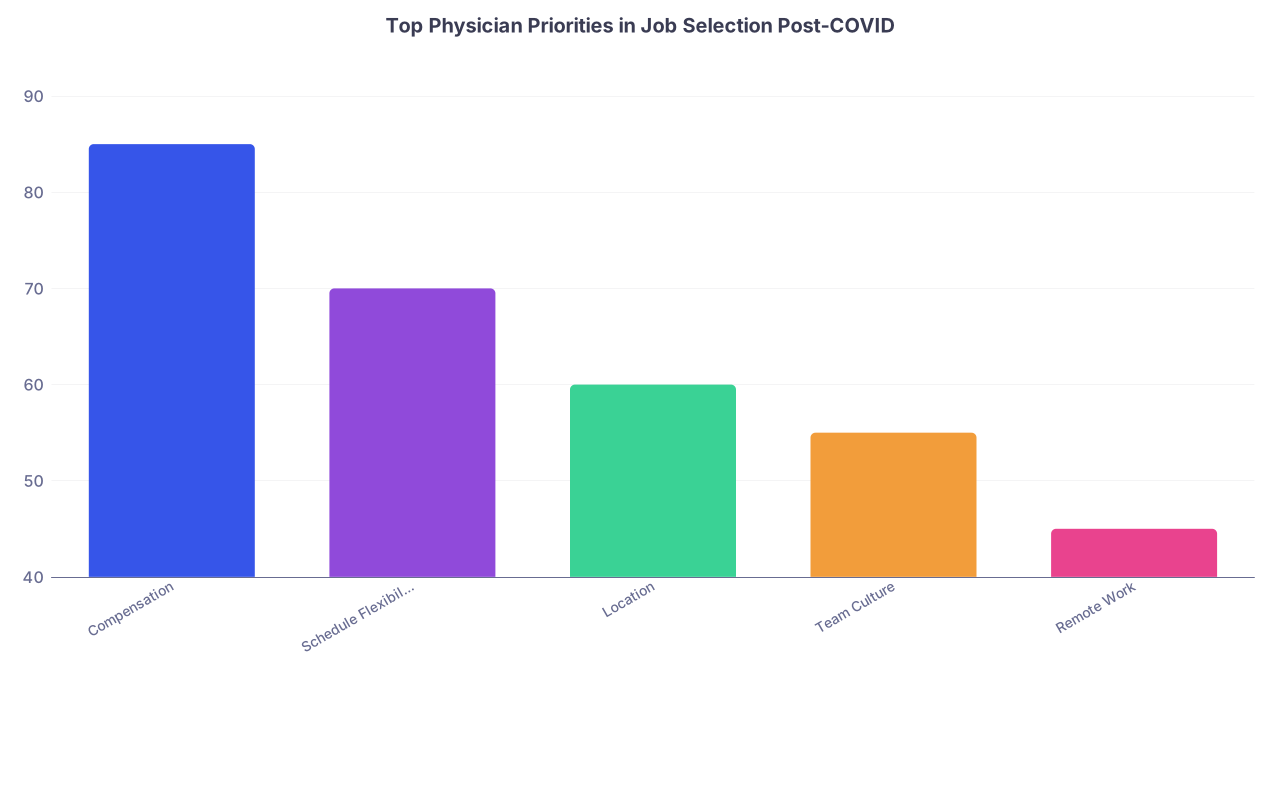
Money still matters. But post‑COVID burnout data is screaming a different signal: control over time is now as valuable as raw dollars for many physicians.
| Category | Value |
|---|---|
| Compensation | 85 |
| Schedule Flexibility | 70 |
| Location | 60 |
| Team Culture | 55 |
| Remote Work | 45 |
Various national surveys after 2021 all converge on a similar pattern:
- ~80–90% list compensation as “very important.”
- ~65–75% now list schedule flexibility and work‑life balance as “very important,” gaining ground every year.
- 40–50% explicitly want flexible or reduced FTE options at some point in the next 3–5 years.
The market response? Mixed.
I see contracts fall into three buckets:
Legacy full‑time only
FTE is defined as a fixed clinic session and call load. No pathway to 0.8 FTE, job sharing, or alternative schedules. This is increasingly out of sync with actual physician preferences.Informal flexibility
“We can work out 4‑day weeks later” or “We do not write that into contracts, but it should be fine.” That is not flexibility. That is a favor that disappears with a new chair.Structured flex
Contracts that explicitly define FTE scaling, pro‑rated compensation, and schedule arrangements. This is where you want to be.
You should be thinking about three quantifiable levers:
- FTE definition
- Clinic / shift time allocation
- Call burden
FTE and compensation scaling
If you accept a 1.0 FTE role now but suspect you will want to drop to 0.8 in a few years (kids, burnout, research, whatever), hard‑code the math:
- “Full‑time employment is defined as 10 half‑day clinic sessions per week and associated administrative time.”
- “Should Physician elect to reduce FTE to not less than 0.6 FTE, all compensation, RVU targets, and call obligations shall be pro‑rated linearly based on FTE, absent mutual written agreement to an alternative structure.”
Without that, you end up later with this classic line from administration: “We can reduce you to 0.8 FTE, but because call coverage must be maintained, your call will stay the same.” Which effectively cuts your hourly rate and increases stress.
Call as a numeric variable, not an afterthought
Call is where new attendings underestimate the impact most.
A few realistic figures:
- For hospital‑based specialties, 1:4 to 1:6 call is common. Night and weekend call significantly affects burnout and retention.
- For outpatient specialties with inpatient responsibilities, “backup call” or “phone‑only call” may look light on paper but still dominates evenings and weekends.
- Very few contracts tie any meaningful additional compensation to heavy call; those that do often underpay relative to market locums rates.
Negotiate call like a mathematician:
- Define maximum call frequency: “Physician shall not be required to take primary call more frequently than 1:5, averaged over a quarter, without Physician’s written consent.”
- Require compensation for additional call: “Any call coverage in excess of this ratio shall be compensated at a rate of $X per 24‑hour period, or a mutually agreed additional wRVU credit.”
- If nocturnist or weekend heavy, push for a differential: 10–30% more per wRVU or a shift stipend. You can benchmark this against locums rates—administration knows what they pay for coverage.
Flex time is not “trust me, we are flexible.” Flex time is numbers written in ink.
5. Pulling It Together: How to Negotiate Using the Data
You are not trying to win a debate. You are trying to anchor your contract around measurable realities that the employer’s own finance and recruiting teams already know.
Here is the approach I have seen work repeatedly.
Step 1: Benchmark your offer
Look at:
- Your specialty
- Your region (Midwest vs West Coast vs Southeast differ dramatically)
- Academic vs community vs private equity‑backed
You want to know:
- Median and 75th percentile total compensation
- Typical wRVU targets and comp per wRVU
- Typical call ratios and telehealth utilization
Then build a simple comparison.
| Metric | Market Median | Strong Offer Range | Your Offer |
|---|---|---|---|
| Total Comp ($/yr) | 260,000 | 270–300,000 | 255,000 |
| wRVU Target | 4,500 | 4,000–4,500 | 5,000 |
| Pay per wRVU ($) | 55 | 55–65 | 51 |
| Telehealth % Visits | 15% | 20–30% | Unspecified |
| Call Frequency | 1:5 | 1:6–1:7 | 1:4 |
This table is how you talk to administrators. Not “I feel this is unfair.” Instead: “Your offer implies an effective dollar‑per‑RVU and call burden well outside current market medians.”
Step 2: Target the high‑leverage clauses
You usually cannot change everything. Focus on:
- Compensation structure: per‑RVU rate, bonus tiers, target realism
- RVU definition language, including telehealth and non‑visit work
- Telehealth minimums and remote work conditions
- FTE flexibility and call maximums
Be explicit. For example:
- “Given current telehealth utilization in outpatient psychiatry (>50% virtual in multiple regional systems), I would like the contract to explicitly allow up to 3 of 5 clinic days to be virtual, with telehealth RVUs credited at full CPT values.”
- “The current wRVU target of 5,000 places this role at ~110% of current MGMA median. Coupled with pay per wRVU of $51, the effective compensation is below market. I propose either reducing the wRVU target to 4,500 or increasing the per‑RVU rate to $56.”

| Step | Description |
|---|---|
| Step 1 | Receive Offer |
| Step 2 | Collect Market Data |
| Step 3 | Compare Pay and RVUs |
| Step 4 | Identify 3-5 Key Changes |
| Step 5 | Focus on Flex and Call |
| Step 6 | Propose Data-Backed Revisions |
| Step 7 | Finalize Contract |
| Step 8 | Consider Other Offers |
| Step 9 | Below Market? |
| Step 10 | Employer Response |
Step 3: Tie flexibility to retention
Administrators are nervous about staffing. Use that.
The data on turnover is ugly:
- Replacing a physician costs $250,000–$1,000,000 when you include lost revenue, recruitment, onboarding, and coverage.
- Burnout and schedule inflexibility are consistently in the top reasons for leaving.
You do not need to recite white papers. A simple line works:
“Given current national turnover levels and the cost of replacing physicians, I would be comfortable accepting a slightly lower starting base if we can build in durable flex and remote capabilities—because that is what will keep me here 5+ years.”
Then translate that into contract language on FTE scaling, remote work, and call.
6. What to Expect the Employer to Push Back On
You will hear predictable objections. They are patterns, not surprises.
“We cannot guarantee telehealth; regulations and payer rules change.”
Response: “We can add ‘subject to payer and regulatory requirements’ but still define the default structure. If payers change, we can revisit. I just do not want this to be entirely discretionary.”“We use a standard RVU table and cannot change it for individuals.”
Response: “I am not asking to change your table, just to lock in the current values during the term. If you adjust systemwide, we can both revisit. Otherwise, I take on one‑sided risk.”“We need everyone at 1.0 FTE for coverage.”
Response: “Understood. Let us define a clear path for 0.8 or 0.9 FTE after two years if volumes and staffing allow, with pro‑rated expectations. That protects both of us and gives me a reason to stay.”“We treat call as part of base duties and do not pay extra.”
Response: “Then I would like to adjust the base to recognize the actual 1:4 frequency versus market norms closer to 1:6. Alternatively, we can structure a modest per‑call stipend that is budget neutral spread across the group.”
If they refuse every data‑driven adjustment, you have learned something critical: this employer is counting on your ignorance. That is not a great place to start your attending career.
7. The Bottom Line
Post‑COVID, physician contracts that ignore remote work, RVU nuance, and flex time are simply misaligned with reality.
Three key points:
The data shows entrenched changes in telehealth, burnout, and RVU‑based compensation. Contracts must explicitly address remote work terms, full RVU credit for virtual and non‑visit work, and realistic productivity targets.
Flex time and call are now core economic variables, not side perks. You should hard‑code FTE scaling, maximum call frequency, and pro‑rated compensation instead of relying on vague “we are flexible” assurances.
Your leverage comes from numbers, not emotion. Benchmark pay, RVUs, telehealth utilization, and call against market data, then use that to negotiate 3–5 high‑impact clauses. If the employer will not move at all, believe what that signals about your future there.


