

The biggest mistake young physicians make with partnership is trusting “the path” instead of writing the path.
If it is not in the contract, it is not real. It is a rumor. At best, a hope.
You are not just negotiating a first job. You are negotiating a 3–5 year sequence of milestones that decide whether you ever become an owner. So we are going to treat partnership as a multi‑year project, with explicit checkpoints that must be written into your agreement.
Below is a year‑by‑year, then quarter‑by‑quarter guide to what should be clearly defined in your contract for a partnership‑track job, starting from the month before you sign.
0–3 Months Before Signing: Lock the Timeline in Writing
At this point you should stop thinking “Is this a good salary?” and start asking “What exactly has to happen for me to become a partner, and when?”
Your contract (or a signed partnership-track addendum) should specify at least these elements:
- Target partnership decision date
- Objective performance metrics
- Governance process for the vote/decision
- Buy‑in structure and valuation method
- Non‑compete rules pre‑ and post‑partnership
If any of these are “we’ll figure it out later,” that is a red flag. You are being hired as cheap labor, not a future partner.
Minimum partnership language you want before signing
At this stage, insist on clauses that answer, in writing:
Timeline
- “The physician will be eligible for consideration for partnership after X months of full‑time employment, but no later than Y months.”
- Do not accept “typically” or “usually.” You want hard numbers.
Workload expectations
- Target:
- wRVUs per year or
- patient encounters per clinic day or
- call shifts per month
- And whether these are:
- benchmarks for bonus only, or
- requirements for partnership consideration.
- Target:
Evaluation criteria
- Exactly what is evaluated:
- Productivity metrics
- Quality metrics (e.g., readmission rates, patient satisfaction thresholds)
- Behavioral/professionalism criteria
- Who evaluates you and how often (quarterly, annually).
- Exactly what is evaluated:
Buy‑in basics
- “Upon election to partnership, the physician will purchase an equity interest for $X or for an amount calculated as [clear formula].”
- Payment method: lump sum, payroll deduction over X years, or bank financing.
- Whether there are different classes of partnership (senior vs junior; voting vs non‑voting).
Exit and non‑compete interplay
- You want to know:
- If you do not make partner, how long is your non‑compete?
- Does the non‑compete change once you become partner?
- What happens if the group decides not to offer partnership at the expected time?
- You want to know:
| Item | Contract Must Include |
|---|---|
| Timeline to eligibility | Specific month or year |
| Metrics for eligibility | Named metrics and thresholds |
| Decision process | Who votes, when, and how |
| Buy-in structure | Amount or formula plus terms |
| Non-compete interaction | Different pre vs post partnership |
If you cannot get clarity at this level, you do not have a partnership track. You have a handshake story.
Year 1: Orientation, Baseline, and Proving You Are Not Disposable
At this point you should be turning the contract’s vague language into concrete numbers and tracking them from day one.
First 90 days – Set your scoreboard
You need a written “Year 1 plan” that maps onto the contract’s expectations.
Insist on:
- A written productivity target for Year 1.
- A reporting schedule: how often you will see your stats (monthly dashboard, etc.).
- Named contact:
- Who explains your compensation formula?
- Who explains how wRVUs are counted (including split/shared, procedures, call credit)?
Then, every month, you should be able to see:
- wRVUs or equivalent productivity
- Collections (or at least charge capture)
- Call shifts taken
- New patients vs follow‑ups
- Any quality metrics tied to partnership
If the clinic “can’t give you those numbers,” that is not just sloppy. It makes later partnership “underperformance” easy to fabricate.
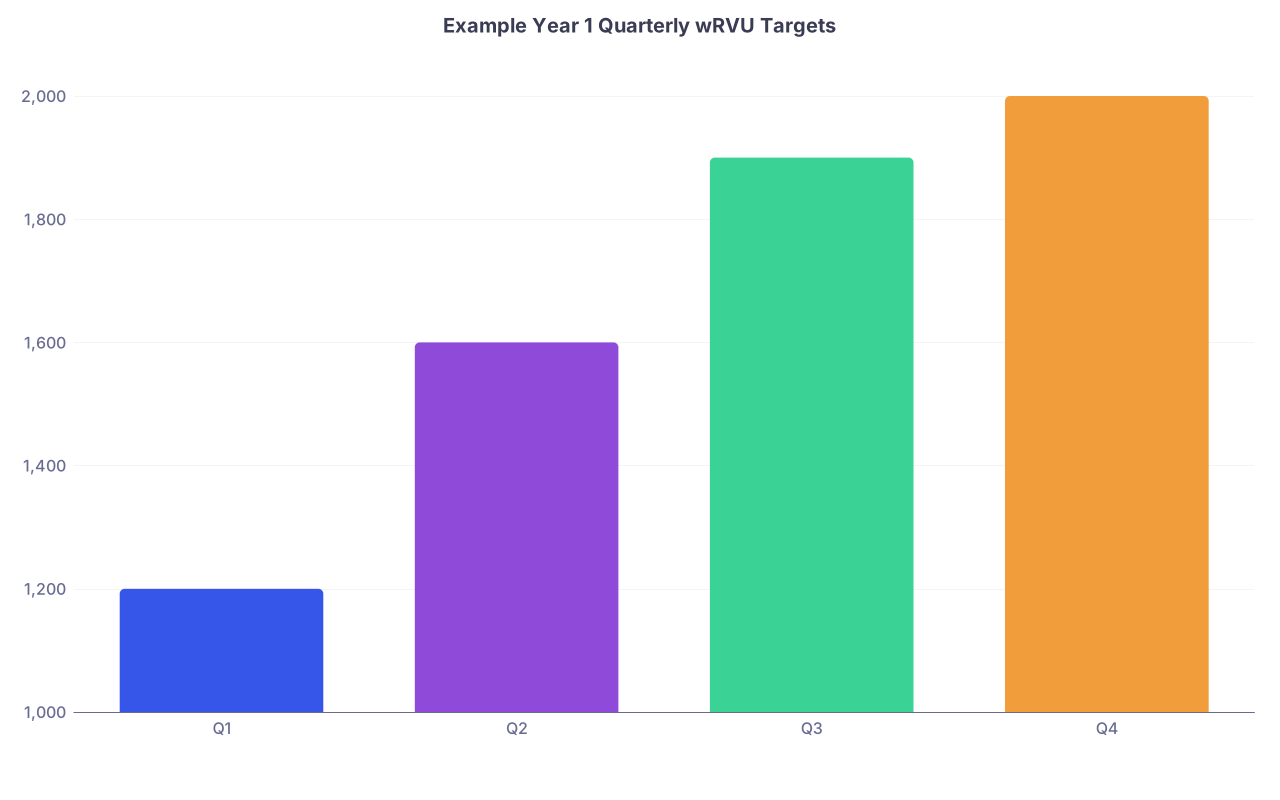
| Category | Value |
|---|---|
| Q1 | 1200 |
| Q2 | 1600 |
| Q3 | 1900 |
| Q4 | 2000 |
Months 4–12 – Hit sustainable productivity, not burnout‑hero numbers
Many groups quietly use Year 1 to see if you will tolerate abuse: stacked add‑ons, endless call, poor MA/NP support. Do not “prove” partnership potential by doing the work of two physicians.
Instead, by the end of Year 1, your goals should be:
- Hitting 70–80% of partner‑level productivity, without constant overtime.
- Documented, written feedback from your chief / managing partner at least twice:
- “On track for partnership expectations” or “Below expectations in X area.”
- Clarified timeline:
- “We still anticipate voting on your partnership in Month X of Year 3.”
You want that sentence in an email. Save it.
Year 2: Measurement, Midpoint Review, and Contract Reality Check
Year 2 is where the gap appears between what was promised and how the group actually treats you. This is when you either correct the trajectory or quietly plan your exit.
Q1–Q2 Year 2 – Midpoint review written into your contract
Ideally, your contract already says something like:
“The practice will provide a formal performance review at 18–24 months to discuss partnership eligibility status, including written feedback on progress toward metrics listed in Section X.”
If it does not, you still schedule that review. In writing. With an agenda.
At that meeting, you want:
Clear comparison to partners
- Your wRVUs vs minimum partner wRVUs.
- Your call burden vs partners.
- Your revenue/collections per FTE clinician vs partners.
Binary answer
- “Based on current trajectory, are you on track for partnership at the originally stated time, yes or no?”
If “no,” then what
- Written performance improvement plan (PIP) with:
- Specific, realistic targets.
- Timeframe (e.g., “Increase to 8,000 wRVUs by end of Year 2”).
- Concrete support (marketing, schedule changes, additional staff).
- Written performance improvement plan (PIP) with:
You are not a resident. You do not accept vague “you need to be more productive” without numbers.
Q3–Q4 Year 2 – Confirming partnership economics
At this point you should stop being shy about money. If you are 12–18 months from potential partnership, you need to know what you are buying.
You should obtain, at a minimum:
- Last 2–3 years of practice financial summaries:
- Total revenue
- Total expenses
- Partner compensation distribution (ranges are fine, but actual numbers are better)
- Written explanation of:
- How partner income is split (eat‑what‑you‑kill, hybrid, equal shares, service line–based).
- Whether ancillary/service line profits are shared (imaging, ASC, lab, etc.).
- How new partners are phased in:
- Do you get full share immediately or ramp up over 2–3 years?
You are looking for alignment: if you are being told “partnership will change your life,” but the actual partner compensation is only 10–20% higher than your current comp, a giant buy‑in is not logical.
Year 3: The Decision Year – Voting, Buy‑In, and Transition
Year 3 (or whatever year your contract cites) is when vague talk turns into concrete decisions. This is where groups play games if the contract is weak.
At this point you should be operating with a partnership timeline document that aligns with your original contract, something like:
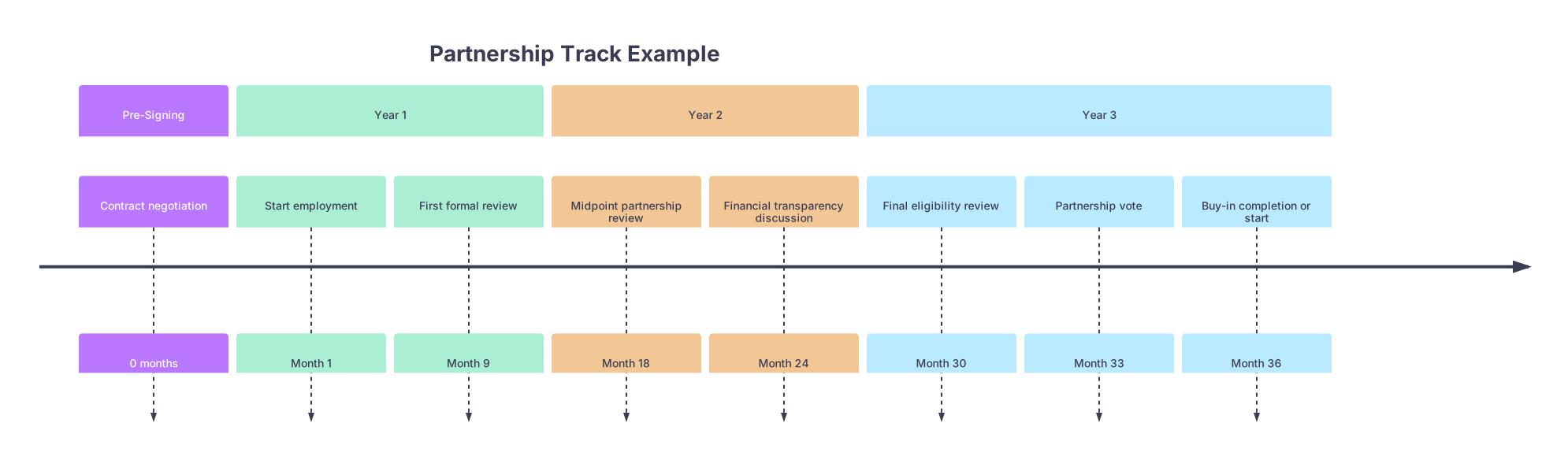
| Period | Event |
|---|---|
| Pre-Signing - Contract negotiation | 0 months |
| Year 1 - Start employment | Month 1 |
| Year 1 - First formal review | Month 9 |
| Year 2 - Midpoint partnership review | Month 18 |
| Year 2 - Financial transparency discussion | Month 24 |
| Year 3 - Final eligibility review | Month 30 |
| Year 3 - Partnership vote | Month 33 |
| Year 3 - Buy-in completion or start | Month 36 |
Q1–Q2 Decision Year – Lock down the actual partnership terms
Six to nine months before the expected partnership date, you should have in hand:
- A draft partnership agreement or operating agreement.
- A written buy‑in proposal specifying:
- Total amount or finite formula.
- Payment schedule.
- Interest rate if financed.
- A clear effective date of partnership if approved.
If they are “still working on the documents” this late, you are not actually in a real partnership track. You are in limbo.
Understanding the buy‑in math (before you say yes)
At this point you should verify that the numbers make sense. A simple sanity check:
- Estimate your current total comp as employed physician.
- Estimate average partner comp from actual group data.
- Look at difference per year and payback period of buy‑in.
Example:
- Current comp: $350k
- Partner comp: $550k
- Buy‑in: $250k over 3 years
Delta = $200k/year. Payback on buy‑in is almost 1.25 years. That makes sense.
If instead:
- Current comp: $350k
- Partner comp: $420k
- Buy‑in: $350k over 5 years
You are paying $350k for an extra $70k/year before taxes. That is a 5‑year payback, and that is with zero risk premium. Very poor deal.
The Vote: Process, Outcomes, and What Happens if You “Fail”
This is where many contracts are suspiciously silent. Your contract should have spelled out:
- Who votes (all partners, only senior partners, only your department).
- Required threshold:
- Simple majority (51%)
- Super‑majority (2/3)
- Unanimous (run from this unless the group is tiny and extremely stable).
- Whether abstentions count as “no.”
If the contract does not define this, demand it in writing well before the vote.
Three possible outcomes and what to do in each
Approved for partnership
- At this point you should:
- Get a written acceptance letter stating:
- Effective date of partnership.
- Equity percentage / unit allocation.
- Buy‑in schedule.
- Sign the partnership/operating agreement only after your attorney reviews it.
- Get a written acceptance letter stating:
- Make sure your old employment contract does not contradict the new agreement on:
- Termination
- Non‑compete
- Compensation
- At this point you should:
Deferred partnership (“not yet”)
- This is where many physicians get strung along for years.
- Your immediate response should be:
- Ask for written reasons for deferral, tied to specific metrics.
- Ask for a written, time‑limited plan:
- “We will re‑evaluate in 12 months based on X, Y, Z metrics.”
- If they cannot give you measurable reasons and a real timeline, start updating your CV. Quietly.
Denied partnership (no offer)
- Your non‑compete and severance clauses now matter a lot.
- You want the contract to have addressed this scenario before you ever started:
- For example:
“If the practice elects not to offer partnership after X years, either party may terminate this agreement with 90 days notice, and the restrictive covenant will be reduced to [smaller radius / shorter duration].”
- For example:
- If that clause does not exist, your leverage is low. You may be stuck in a region where you cannot work independently.
After You Make Partner: The “Second Contract” You Actually Work Under
Once you become a partner, your original employment contract usually becomes secondary. Now the partnership agreement or shareholder agreement rules your life.
At this point you should thoroughly understand:
- How profits are distributed:
- Straight pro‑rata shares
- Productivity weighting
- Seniority adjustments
- Capital calls:
- Can the group require you to put in more money if they buy new equipment/clinics?
- Exit:
- How is your equity valued if you leave?
- How many years of payout?
- Does your payout decrease if you go to a “competing” practice?
If you gloss over this, you can end up a “partner” who carries the risk but never truly shares in the upside.
Parallel Track: What To Track Each Year So You Are Never Gaslit
Partnership decisions often become conveniently “subjective” when the group wants flexibility. Your best defense is your own data trail.
Here is what I have seen smart physicians track from Day 1:

- Monthly:
- wRVUs / encounters
- Call shifts and weekend coverage
- Clinic templates (blocked vs open)
- Quarterly:
- Written summary of:
- Feedback from leadership
- Any verbal promises or changed expectations (emailed to yourself and, where appropriate, to leadership).
- Written summary of:
- Annually:
- Copy of:
- Bonus calculations
- Any updated productivity benchmarks
- Any change in partner compensation structure (if they share it)
- Copy of:
If, three years in, someone says, “We expected higher productivity,” you should be able to say:
- “I have been at or above the wRVU targets you stated in our 18‑month review and your email of [date]. Let us review those together.”
Gaslighting only works if you do not have receipts.
Quick Contract Checklist by Year
You wanted a timeline. Here is the stripped‑down version.
Before Signing
At this point you should be pushing for:
- Written:
- Partnership eligibility date range.
- Objective criteria (productivity, quality, citizenship).
- Decision process and voting threshold.
- Buy‑in structure or formula.
- Non‑compete adjustments if partnership is not offered.
If they “do not do that for anyone,” they also will not magically do partnership fairly for you.
Year 1
At this point you should:
- Get:
- Regular productivity reports.
- At least one written review with explicit phrase: “on track / not on track for partnership.”
- Confirm:
- The original partnership timeline is still the plan.
Year 2
At this point you should:
- Demand:
- A formal 18–24 month “partnership trajectory” review.
- Written, specific feedback and targets.
- Obtain:
- Practice financial snapshots.
- Preliminary explanation of partner compensation and buy‑in.
Year 3 (or Partnership Year)
At this point you should:
- Have:
- Draft partnership/operating agreement.
- Final buy‑in proposal.
- Scheduled vote or decision meeting with known rules.
- Decide:
- Accept partnership and sign the partner docs.
- Or, if delayed/denied without clear reason, start arranging your exit before the non‑compete boxes you in further.
Your Next Step Today
Open your current or proposed contract and do one thing:
Find every sentence that mentions “partnership” or “partner track.”
Now, for each one, ask: Does this sentence give me a date, a number, a process, or just a story?
Where you see stories instead of specifics, that is your to‑do list for your next negotiation call.


