
It is December 28th. Your first attending job contract went into effect eleven months ago. You are staring at your most recent productivity report, your call schedule for next quarter, and a vague memory that your contract “could be reviewed annually.”
You are underpaid. You are over-called. And you have no idea when you are actually supposed to push for changes without blowing up the relationship.
This is where a renegotiation calendar saves you.
You do not wait until you are furious, burned out, or holding another offer. You plan backward from key dates in your contract and your institution’s budget cycle, and you use those moments—systematically—to revisit salary, RVUs, and call.
Below is how I structure it for physicians in their first 3–5 years out of training.
Step 0: Before You Start – Build Your Renegotiation File (Month 0–3)
At this point you should still be in your first few months (or about to start) and not yet asking for anything. You are setting the trap. Calmly.
In your first 90 days:
Find the dates that matter. Pull out your contract and calendar all of the following with reminders:
- Contract effective date
- Contract end date
- Any stated “annual review” or “compensation review” date
- Probationary period end (often 6 or 12 months)
- Partnership eligibility date (if private group)
- Any RVU “true-up” or bonus payment dates
If your contract is vague (“annual review” but no date), ask admin or HR:
“When are annual comp reviews typically done for clinicians in my group?”Start a simple compensation tracker. One spreadsheet or folder with:
- Monthly RVUs
- Collections (if you have access)
- Work hours and call shifts
- Major added roles: committee work, new clinics, leadership tasks
Clarify the metrics. In the first month, ask—politely, once—until you get specific answers:
- RVU target and timeframe (per quarter? per year?)
- Bonus thresholds and caps
- Call requirements: baseline expectation per FTE
- What triggers a compensation “review” (RVUs? market survey? time?)
Document expectations in writing. After any meeting where someone says “once you get up to speed, we can adjust,” send a short summary email:
- “To summarize our discussion today…”
- Note the specific metric and the time frame.
You are not renegotiating yet. You are creating a paper trail so that in 12–18 months this is not a “request,” it is a follow-through.
Year 1: Survival, Data, and First Micro-Adjustments
Your first contract year is about collecting leverage, not burning it.
Months 3–6: Quiet Data, Visible Reliability
At this point you should:
- Be consistently on time.
- Do not be the person always asking for schedule favors.
- Avoid complaining about compensation in hallways.
Behind the scenes:
- Track every call shift (weekday vs weekend, in-house vs home, number of calls).
- Save any written praise: patient emails, admin thank-yous, quality metrics.
- Start comparing your RVUs to published benchmarks (MGMA, AAMC, etc.).
| Metric | National Median (Example) | Your Data |
|---|---|---|
| RVUs per year | 6,000 | 7,100 |
| Salary | $260,000 | $240,000 |
| Call shifts / month | 5 | 8 |
| Weekend call share | 1 in 4 | 1 in 3 |
You do not wave this around yet. You are building a baseline.
Month 6: First Checkpoint (NOT a Major Ask)
At the six-month mark (or end of any “probationary” period), schedule a short meeting with your division chief or medical director.
Timing: 2–3 weeks before month 6 ends.
Agenda:
- Ask for feedback on:
- Clinical performance
- Team fit
- Throughput and access
- Ask what “on track” looks like for you by the one-year mark.
Use a few lines like:
- “By the one-year point, what RVU range or panel size would you expect for someone in my role?”
- “How do you see call evolving as new hires come on?”
You are mining information. Take notes. Update your calendar with:
- Stated targets
- Any implication of future raises / RVU changes / call redistribution
Still no big renegotiation. Small ask only if low-friction, e.g.:
- “If there is an option to cluster some of my clinic days to improve access, I am open to adjusting.”
Month 9–10: Pre–Year-End Positioning
At this point you should be able to see your year-one trajectory.
Three questions:
- Are your RVUs at or above target?
- Are you taking more call than colleagues at similar FTE?
- Has your scope of work expanded (leadership roles, new services, teaching)?
If yes to any of those, you prepare for an end-of-year compensation discussion.
Four to six weeks before your contract anniversary:
- Pull:
- YTD RVU report
- Call schedule summary (with actual shifts worked)
- Any role descriptions (e.g., “Associate Medical Director of X”)
Draft a one-page summary with:
- Bullet list: your production vs target
- Market benchmarks (1–2 data points; do not bring a 20-page MGMA printout)
- Concrete contributions (e.g., started new clinic, covered chronic vacancies)
Year 1 Anniversary: First True Renegotiation Window
This is your first real shot. Do not waste it on vague grumbling.
Timing the Ask
Ideal timing:
- 3–6 weeks before your contract anniversary or their formal “annual review” date.
- Align with the group’s or hospital’s budget cycle if possible (many finalize next year’s comp in late summer / early fall).
If you are uncertain, ask admin directly:
- “When are compensation adjustments for next year typically finalized?”
Then back-time your meeting to land before that.
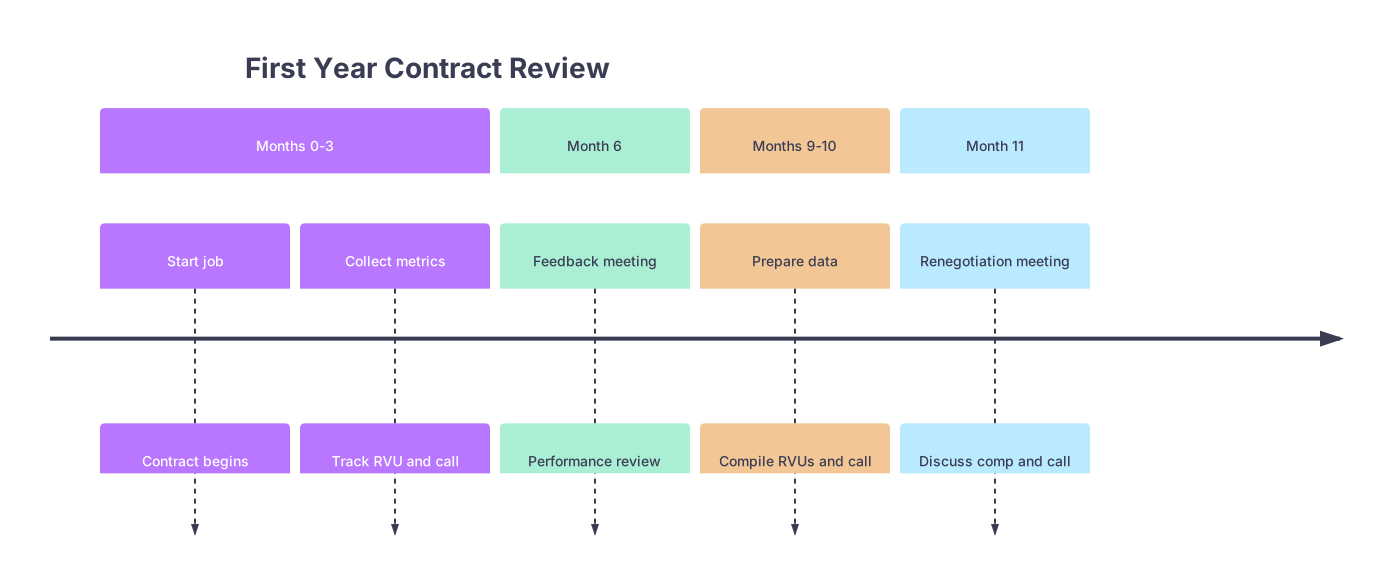
| Period | Event |
|---|---|
| Months 0-3 - Start job | Contract begins |
| Months 0-3 - Collect metrics | Track RVU and call |
| Month 6 - Feedback meeting | Performance review |
| Months 9-10 - Prepare data | Compile RVUs and call |
| Month 11 - Renegotiation meeting | Discuss comp and call |
What to Target at Year 1
At this point you should prioritize one main axis with a secondary “nice-to-have”:
- Salary / RVU rate
- RVU targets / bonus structure
- Call coverage / differentials
You rarely get major changes in all three after only one year, unless you are radically underpaid or wildly overproducing.
Option 1: Salary / RVU Rate
If your RVUs are >10–15% above target and your comp is below median:
You say something like:
- “Over the past year, I generated 7,100 RVUs compared to our target of 6,000. Based on MGMA data for our region, physicians at that level of productivity are typically in the $270–290k range; my current base is $240k. At this point I would like to adjust my base salary or RVU rate to better reflect my actual productivity.”
Ask for:
- A specific bump in base salary, or
- A higher RVU conversion factor, or
- A more generous tiered bonus above a certain RVU threshold.
Option 2: RVU Targets / Structure
If your compensation formula is rigid but the expectations are impossible or misaligned:
- “I am consistently hitting 120% of the RVU target, but the bonus structure is capped at a level that does not match my actual work. I would like to revisit the target and bonus tiers so that additional effort is appropriately recognized.”
Target a change in:
- Annual RVU target downward (if unrealistic)
- Bonus thresholds downward
- Cap removal or increase
Option 3: Call Coverage
If your call is clearly heavier than peers:
Bring a simple table showing call shifts per month per FTE for each physician.
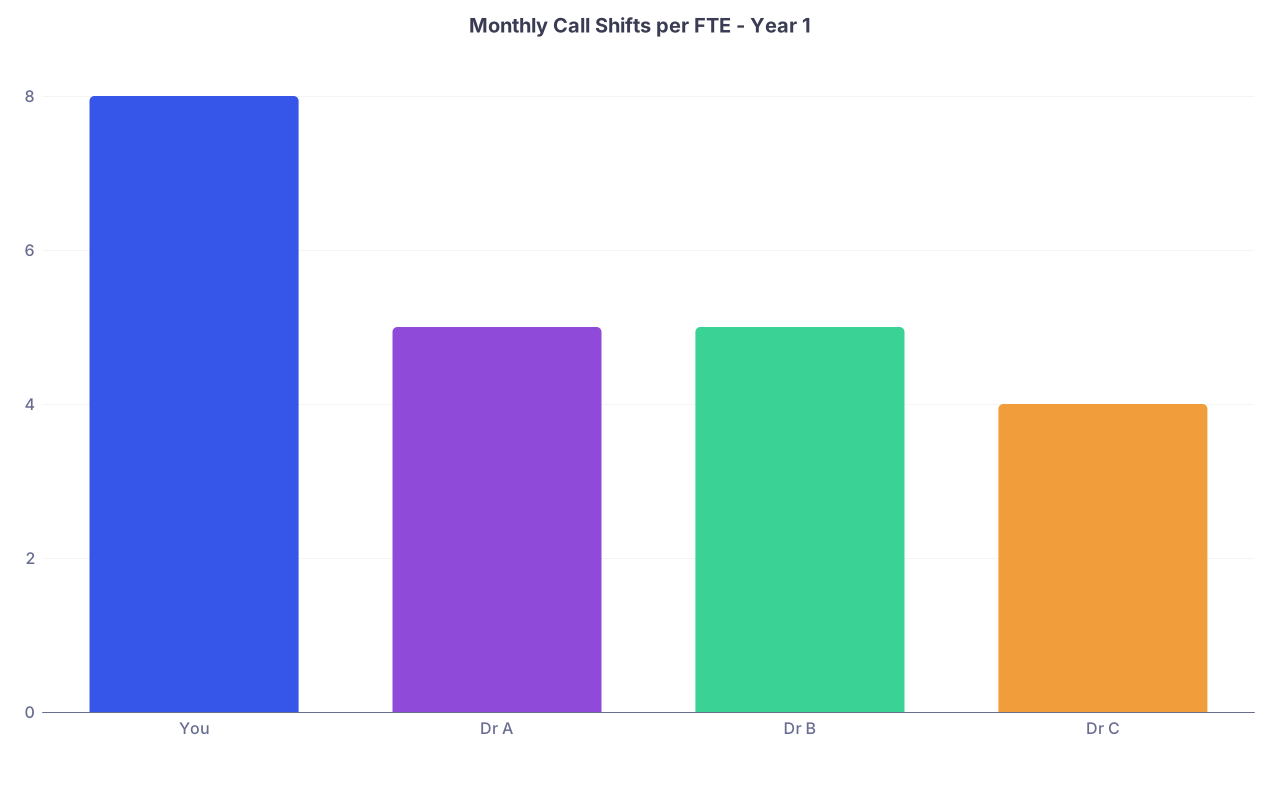
| Category | Value |
|---|---|
| You | 8 |
| Dr A | 5 |
| Dr B | 5 |
| Dr C | 4 |
Then say:
- “Over the past year I have averaged 8 calls per month, compared with 4–5 for other full-time colleagues. I am happy to be a team player, but this is a sustained discrepancy. I would like to either normalize the distribution or attach additional compensation for the excess call I am taking.”
Specific asks:
- Call pay per shift (if none exists)
- Higher differential for weekends / holidays
- Cap on maximum calls per month
- Structured rotation that levels the load
Year 2–3: Systematic Annual Renegotiation
Once you survive year one, your renegotiation calendar becomes a yearly loop.
At this point you should treat renegotiation as a standing process, not a crisis response.
Month-by-Month Pattern (Years 2–3)
Here is the rough calendar I recommend.
| Month Range | Focus |
|---|---|
| 1–2 | Debrief prior raise / changes |
| 3–4 | Monitor metrics, no big asks |
| 5–6 | Mid-year check-in, small tweaks |
| 7–8 | Prep data and benchmarks |
| 9–10 | Formal renegotiation meeting |
| 11–12 | Implement changes, reset goals |
Months 1–2: Debrief and Document
After any adjustment goes into effect:
- Save the updated compensation letter or addendum.
- Write down in your own notes:
- What they promised verbally that is not in writing.
- What they explicitly refused and why.
This keeps the history clear when leadership turns over (and they will).
Months 3–6: Mid-Year Checkpoint
At this point in the year you should:
- Re-run your RVU / call / comp comparison.
- Schedule a short “mid-year check-in” with your chief.
You are not always asking for money here. Use this to:
- Signal upcoming issues:
- “My panel is at 1,200; at what point should we discuss an APP or schedule adjustment?”
- Clarify expectations for bonus or promotion:
- “What would you want to see to support a request for X next year?”
This sets up your year-end renegotiation with no surprises.
Months 7–8: Assemble Your Case
Two to three months before the next budget / review cycle:
Update your:
- Productivity vs benchmarks
- Call vs peers
- New responsibilities (committees, leadership, quality projects)
Decide what matters most this cycle:
- Maybe last year you focused on call; this year you push RVU rate.
- Or you are angling for protected admin time for a new role.

Draft a one-page “Year in Review” summary:
- 3–5 bullet points: accomplishments
- 3–5 bullet points: metrics vs target / benchmark
- 1–2 clear requests: salary/RVUs, call, or role-specific changes
Months 9–10: Formal Renegotiation
You should now treat this as a standard annual business meeting.
At least 4–6 weeks before contracts or budgets renew:
- Request a dedicated meeting: 30–60 minutes, not tacked onto a random check-in.
- Send your one-pager in advance:
- “To make the best use of our time, I have summarized my metrics and proposed adjustments for next year.”
In the meeting:
- Open with data, not emotion.
- State specific proposed changes:
- “Increase my RVU rate from $45 to $50.”
- “Add $250 per weekday call and $500 per weekend call.”
- “Cap my call at 6 per month, with pay for any above that.”
If they resist, get clarity:
- “What metrics would you need to see over the next 12 months to support this change?”
- “Is this a budget constraint or a policy issue?”
Then calendar whatever they say (“if X, then Y in Z months”).
Special Windows: When to Renegotiate Outside the Annual Cycle
Sometimes you do not wait for year-end.
There are five common triggers that justify an off-cycle renegotiation.
1. Major Scope Expansion
Examples:
- You become section chief, medical director, or fellowship director.
- You start a new service line (e.g., hospitalist-run preop clinic).
- You take on a high-demand niche (procedures, subspecialty clinic).
At the point the new role is proposed:
- Do not agree verbally and “figure it out later.”
- Say: “I am very interested. Before I commit, I would like to understand the compensation and time allocation for this role.”
You ask for:
- Additional stipend
- Protected admin time
- RVU relief or adjusted targets
2. Sustained Excess Call
Call creep is real. You cover for vacancies, locum gaps, unexpected departures.
If you have done >3–6 months of significantly elevated call:
- Pull a simple graph showing call per month vs baseline:
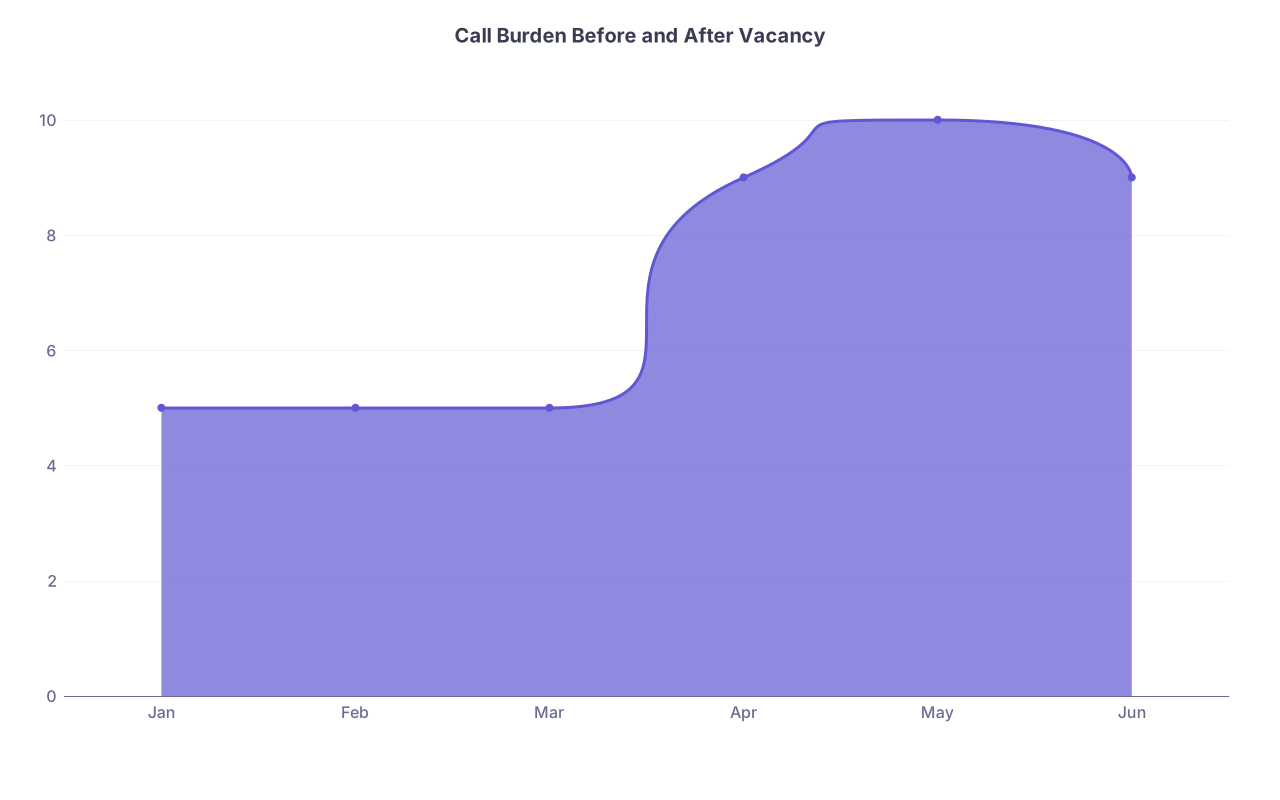
| Category | Value |
|---|---|
| Jan | 5 |
| Feb | 5 |
| Mar | 5 |
| Apr | 9 |
| May | 10 |
| Jun | 9 |
Then you say:
- “For the past 3 months I have carried nearly double the baseline call load due to vacancies. I am willing to help maintain coverage, but I would like to discuss either temporary call pay or a defined end-point for this level of coverage.”
You are drawing a line: temporary crisis ≠ permanent new normal.
3. Market Shock
If you discover (with credible data) that your comp is significantly below market—usually >15–20%—and your productivity is solid, you do not need to wait a whole year.
You bring:
Updated MGMA/AMGA/AAMC data
Your RVUs and collections
A calm but direct ask:
- “Given my current productivity at 7,500 RVUs and the latest MGMA data for our region, my compensation is about 20% below median. I value this position and would like to see a plan to bring my salary into an appropriate range over the next contract cycle.”
You can accept a phased correction (e.g., half now, half next year), but do not let it drift indefinitely.
4. New Job Offer (Handled Carefully)
I am not a fan of using outside offers as a blunt weapon. But they are leverage.
If you go this route:
You must be genuinely willing to leave.
You present it as:
- “Another group has offered X (details). I would prefer to stay here. Is there a way to make my situation here competitive, especially regarding salary and call expectations?”
Use it once. Maybe twice in an entire career. Not yearly.
5. Structural Changes: Ownership, Buy-in, RVU Model Shift
If your group gets bought, merges, or radically changes the comp model, that is a renegotiation moment—not a memo you just sign.
Slow down. Ask for:
- Written details of the new structure
- Side-by-side comparison of:
- Base salary
- RVU rate
- Benefits
- Call expectations
Then decide if you need to counter, negotiate an exit, or secure guarantees during the transition.
Call Coverage: A Separate, Parallel Calendar
Call deserves its own track because it is where resentment accumulates fastest.
At this point you should treat call like its own contract:
Quarterly:
- Review actual call taken vs schedule.
- Tally:
- Weekday vs weekend
- Holidays
- Backup / second call (if applicable)
Every 6 Months:
- Compare with peers at same FTE.
- Meet briefly with scheduler or chief if:
- You are consistently out of line.
- The distribution is “temporarily” skewed for more than one quarter.
Annually (alongside comp review):
- Propose:
- Formal call differential
- Caps on call
- Rotation redesign if chronically unfair
- Propose:

Do not wait until you are burned out and snapping at staff. By that point you are negotiating from emotion, not facts.
RVUs: True-Up and Retrospective Adjustments
If your contract has an RVU “true-up” or annual bonus payout:
Mark that date in your calendar.
One to two months before the true-up:
- Request a current RVU report.
- Verify:
- All encounters captured.
- High-level procedures coded correctly.
- No missing months.
If you are significantly above target at true-up time:
- Use that meeting to push for prospective changes:
- Higher RVU rate going forward.
- Lower baseline target with higher bonus tiers.
- Support staff or scheduling changes to sustain volume safely.
You do not just smile, cash the bonus check, and keep quietly overproducing.
Final Day-by-Day Before a Renegotiation Meeting
Three days before:
- Rehearse your main points out loud once. Not a script. Just the key phrases.
- Print your one-page summary and any clean charts.
One day before:
- Email a short reminder and attach your summary if you have not already:
- “Looking forward to our discussion tomorrow. I have attached a brief summary of my productivity and proposed adjustments.”
Day of:
- Go in with:
- One main ask
- One backup option
- One “I appreciate X that is already working well here” statement
After:
- Send a follow-up email summarizing:
- What was agreed.
- Any future metrics or time frames for revisiting unfinished items.
Then put those dates back on your calendar.
Three Things to Remember
- Renegotiation is not a one-time showdown. It is an annual process you build into your calendar, tied to contract anniversaries, budget cycles, true-up dates, and clear metrics.
- Salary, RVUs, and call are related but distinct levers. Each year, decide which one matters most and go after that with data and specific proposals.
- The physicians who end up with fair, sustainable careers are not the loudest. They are the most systematic. They track, they time their asks, and they treat compensation like the business arrangement it is.


