
Should Dual‑Physician Couples File Taxes Jointly or Separately?
What actually changes on your tax bill when two attendings both earning $300–400k decide to file separately instead of jointly?
Let me be direct: for most dual‑physician couples, filing jointly is the right answer. But in some specific, high‑income, high‑student‑loan situations, filing separately can save tens of thousands of dollars—if it unlocks better student loan strategies.
You do not guess on this. You run the numbers. Here’s how to think through it like a grown‑up with a W‑2 and a lot on the line.
Step 1: Understand What “Married Filing Jointly” vs “Separately” Actually Does
Forget the vague advice you’ve heard in the resident lounge. Mechanically, here’s what changes.
When you file Married Filing Jointly (MFJ):
- You combine incomes and deductions on one return.
- You usually get:
- Lower tax brackets for the same total income vs filing single
- Better access to credits and deductions
- You are both fully responsible for the whole tax bill (joint and several liability).
When you file Married Filing Separately (MFS):
- Each spouse files their own return with their own income, deductions, and some split items.
- You usually get:
- Higher effective tax rates on the same combined income
- Limited or lost access to many credits and deductions
- Each spouse is only liable for the tax on their own return.
For physicians, this isn’t theoretical. With your income, the marginal rates pile up fast.
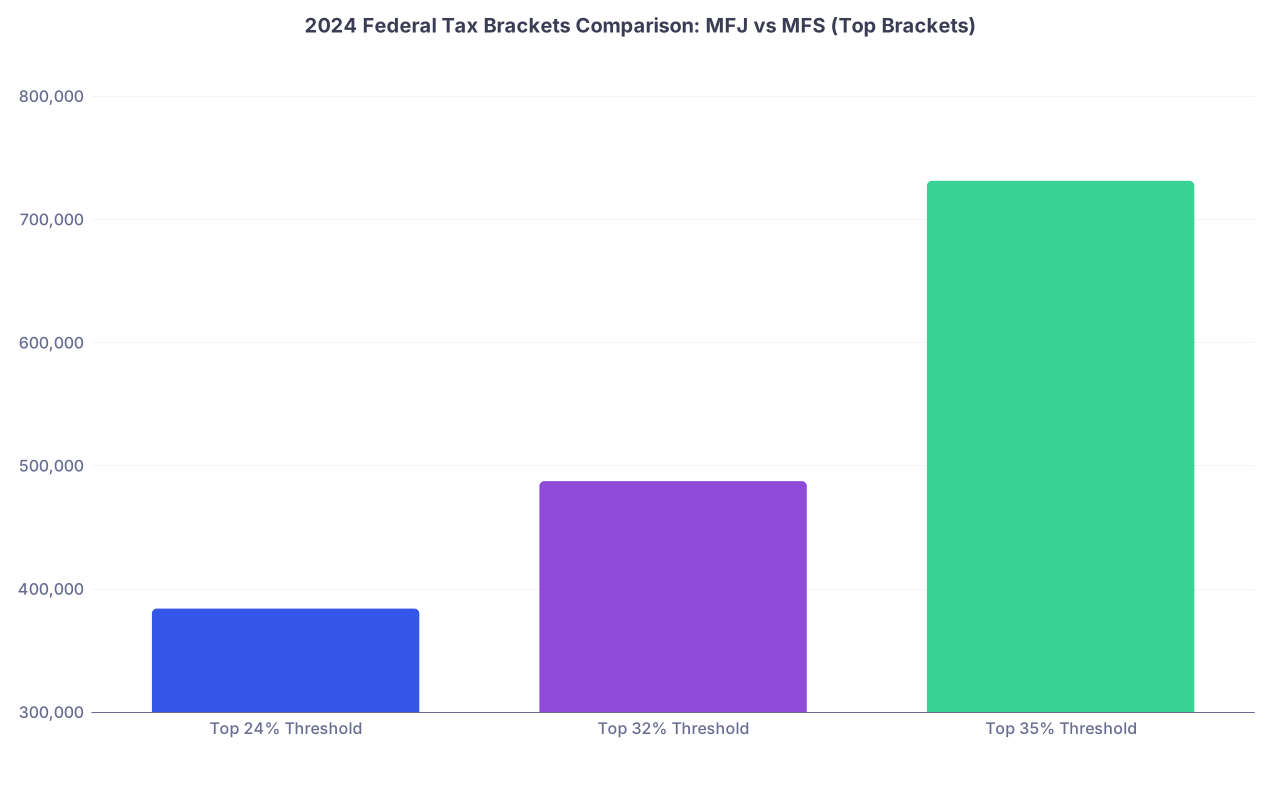
| Category | Value |
|---|---|
| Top 24% Threshold | 383900 |
| Top 32% Threshold | 487450 |
| Top 35% Threshold | 731200 |
(Above are sample MFJ thresholds; for MFS they’re about half. So you hit higher brackets faster when separate.)
Bottom line: From a pure tax‑brackets standpoint, MFJ almost always wins.
So why does anyone in medicine file separately? Two words: student loans.
Step 2: The One Big Reason Many Dual‑Physician Couples File Separately
The main legitimate reason dual‑physician couples file MFS is to optimize income‑driven repayment (IDR) plans and PSLF.
Key point: Some loan plans calculate your payment using only your own income if you file MFS. Others count both spouses’ income no matter how you file.
Here’s the distinction that actually matters:
- PAYE / old IBR: Usually can use borrower’s income only with MFS
- SAVE / REPAYE (and some others): Use household income even if you file MFS
So imagine this very common setup:
- Spouse A: Hospitalist, $320k, minimal loans
- Spouse B: Pediatrician with $350k federal loans, on a PSLF‑compatible IDR plan, working at a 501(c)(3) hospital, $220k income
If they file MFJ, student loan servicer might see $540k+ of combined income and set a huge IDR payment.
If Spouse B can use just their $220k income instead (by filing MFS), their annual IDR payment can be dramatically lower, and more principal gets forgiven under PSLF.
That can easily be a five‑ or six‑figure delta over 10 years.
So the real question is not “Which status is better?”
The real question is:
“Does the student loan savings from MFS beat the extra tax cost of MFS?”
Let’s quantify that.
Step 3: What You Lose When You File Separately
The IRS doesn’t like MFS. So they make it painful.
Here’s what dual‑physician couples commonly lose or limit by filing MFS:
| Item | MFJ Benefit | MFS Impact |
|---|---|---|
| Tax brackets | Wider, more favorable | Narrower, hit higher sooner |
| Student loan IDR planning | Usually worse | Sometimes much better |
| Child Tax Credit | Allowed (with income limits) | Often disallowed |
| Education credits | Allowed (with income limits) | Generally disallowed |
| IRA deduction/ROTH access | Often allowed | Severely restricted |
| AMT & certain deductions | Generally more favorable | Often worse |
For many dual‑physician couples, some of this doesn’t matter. You may already phase out of certain credits due to high income. But the bracket compression and loss of some deductions absolutely matter.
You need to assume:
- Federal income tax is usually thousands to tens of thousands higher with MFS at your income level.
- State tax may also change—some states treat MFS harshly, others don’t.
So if the only thing you’re chasing is a few hundred dollars of difference, MFS is not worth the hassle.
If you can save $20k/year on student loans and only pay $5k more in tax? That’s a different story.
Step 4: When Filing Jointly Is Clearly Better for Dual‑Physician Couples
Let me simplify. Filing jointly is almost always the right choice in these scenarios:
Both of you have similar incomes and similar loan situations
- Two attendings both around $300k with similar federal debt, both doing PSLF or both refinancing privately.
- There’s no big asymmetry to exploit with MFS.
You’re not using PSLF / IDR anymore
- You refinanced all loans to private lenders.
- Or you aggressively paid them off.
- Then MFS is just a more expensive, more annoying way to file taxes.
You’re in a high‑tax state where MFS is punished
- Example: Community property states and certain high‑tax states have very specific, sometimes messy, MFS rules.
- The administrative headache + higher taxes usually outweigh minor loan benefits.
You need access to credits/deductions that MFS destroys
- Adoption credit, certain education benefits, some IRA/ROTH options.
- For many high‑earning physicians, these are phased out anyway—but if they’re still in play, MFJ matters.
So if you’re two attendings, high earners, mostly done with federal loans, working in private practice or non‑PSLF eligible jobs, the answer is simple: file jointly. Run a quick paired return if you want confirmation, but I’ve yet to see a case in that setup where MFS beats MFJ.
Step 5: When Filing Separately Can Actually Make Sense
Now let’s talk about where MFS starts to look smart.
1. One Spouse Has Huge Federal Loans + PSLF Track
This is the classic scenario where I’ve seen MFS save real money.
Example structure:
- Spouse A: $400k ortho attending, $50k loans, private group, income $550k
- Spouse B: $350k med‑peds attending, $450k federal loans, working at academic hospital, IDR + PSLF track, income $240k
If they file MFJ:
- IDR payment for Spouse B is based on $790k household income.
- Payments might become so high that very little gets forgiven at PSLF.
If they file MFS and the repayment plan allows using only Spouse B’s income:
- Payments are based on $240k, not $790k. Often a difference of several thousand per month.
- Over 10 years, forgiven amount could be well into six figures, even after the extra tax cost.
The math you run:
- Get official IDR payment estimates for:
- MFJ (household income)
- MFS (individual income)
- Multiply monthly payment difference × remaining years to PSLF.
- Compare that total to:
- Extra annual federal + state tax from filing MFS vs MFJ
- Multiply over the same 10‑year horizon.
If extra tax comes to $10k/year for 10 years ($100k), but PSLF optimization saves $250k in total payments, MFS is absolutely the right move.
2. Big Income Gap + One Spouse Has No Loans or Private Loans
Another use case:
- High‑earning spouse with no federal loans
- Lower‑earning spouse with federal loans on a plan that can ignore spousal income using MFS
Even with both as physicians, I’ve seen this where one is in a lower‑paid academic gig and the other in a high‑pay specialty or leadership role. The same math applies: loan savings must beat extra tax.
3. Serious Liability Concerns
Less common, but it happens:
- You strongly suspect your spouse is under‑withholding, running side income off the books, or playing games.
- Filing MFJ makes you jointly liable for that mess.
In that case, you might eat some extra tax cost to protect yourself legally. It’s rare in physician households, but not unheard of, especially when one spouse mixes clinical work with entrepreneurial income and “creative” accounting.
Step 6: A Simple Decision Flow You Can Actually Use
Here’s the practical decision path.

| Step | Description |
|---|---|
| Step 1 | Married dual physicians |
| Step 2 | File MFJ |
| Step 3 | Estimate IDR payments MFJ vs MFS |
| Step 4 | Estimate extra tax MFJ vs MFS |
| Step 5 | Strong case for MFS |
| Step 6 | Any federal loans on IDR or PSLF track? |
| Step 7 | Can MFS use borrower income only? |
| Step 8 | Loan savings > extra tax? |
If you skip those “estimate” steps and just guess, you’re gambling with tens of thousands of dollars.
Use actual numbers:
- Last pay stub for each of you
- Last year’s return as a template
- Loan servicer’s IDR estimator or a PSLF‑aware calculator (or a competent student loan professional)
Have a CPA or financial planner run paired scenarios in real software: one MFJ, one MFS + the loan impact. That’s the adult way to decide.
Step 7: Don’t Forget State Taxes and Community Property Rules
Physicians love to ignore state tax until it bites them.
Some states:
- Don’t recognize MFS the same way as federal
- Force weird income splitting under community property rules
- Make use of MFS far more complicated and less beneficial
If you’re in CA, TX, WA, AZ, or other community property states, MFS + IDR can get tricky because half the community income may be attributed to each spouse on state returns and sometimes for IDR calculations, depending on how servicers interpret it.
Translation: You need someone who knows both:
- Tax law in your state
- Student loan rules for your specific repayment plan
If your “tax person” says, “We don’t really see this often in physician households,” that’s a warning sign. Dual‑physician + PSLF + community property is its own beast.
Step 8: A Quick Example With Realistic Numbers
Let’s sketch a rough, simplified case. Numbers approximate but realistic.
- Spouse A: $450k income, $50k private loans (not PSLF)
- Spouse B: $250k income, $400k federal loans, eligible for PSLF, 8 years left
Scenario 1: MFJ
- Household AGI: $700k
- IDR payment: based on $700k → say $4,000/month = $48,000/year
- Over 8 years: $384,000 total
Scenario 2: MFS, IDR uses borrower income only
- Spouse B income only: $250k
- IDR payment: say $1,800/month = $21,600/year
- Over 8 years: $172,800 total
Loan savings: $384,000 − $172,800 = $211,200 saved in payments, with more forgiven at PSLF.
Now tax:
- Extra federal and state tax from MFS vs MFJ: say $10,000/year (not crazy at this income)
- Over 8 years: $80,000 extra tax.
Comparison:
- Pay $80k more in tax to save $211k in loan payments = net $131k ahead by filing MFS.
This is exactly why you never answer this question “in general.” You only answer it with your actual numbers.
Step 9: How to Do This Right in Practice
Here’s the clean way to decide, as a dual‑physician couple:
Map your situation
- Each spouse’s income
- Each spouse’s loan balance, type (federal vs private), and current plan
- Whether PSLF is realistic for either of you
Clarify your loan strategy first
- Are you going for PSLF?
- For how many more years?
- Which exact plan (SAVE, PAYE, IBR, etc.)?
Have a pro run paired returns
- MFJ scenario
- MFS scenario
- Include state returns
- Layer in the IDR/PSLF impact for each scenario
Decide based on total 5–10 year impact
- Not just this year’s refund.
- Look at cumulative tax + loan payments + projected forgiveness.
If your CPA “doesn’t do student loans,” pair them with a student loan specialist who actually understands physician PSLF strategies. Both are needed.
Key Takeaways
- For most dual‑physician couples without complex federal loan/PSLF issues, Married Filing Jointly is simply better—lower combined tax, fewer headaches, and minimal downside.
- Married Filing Separately only makes sense when it unlocks major student loan savings, usually for one spouse on an IDR + PSLF path where using their income alone dramatically cuts payments.
- You do not decide this by feel. You run two full tax scenarios plus loan projections and pick the one that wins financially over 5–10 years, not just on this year’s refund.