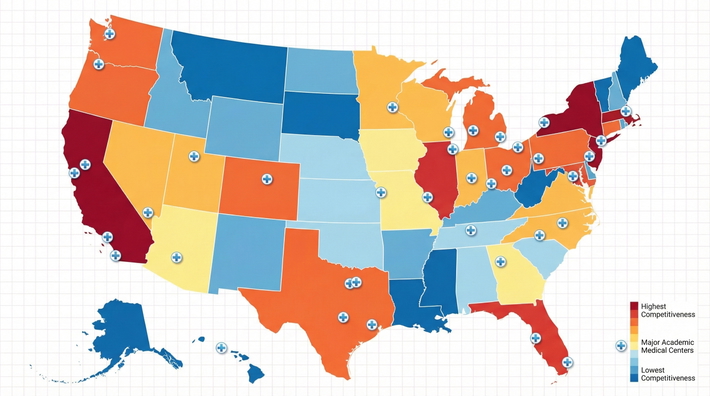
You’re sitting in your tiny coastal apartment, traffic noise leaking through the window, scrolling through residency lists. Somehow, the program that keeps popping up as your best shot is… in Mississippi. Or Alabama. Or rural Georgia. And your chest tightens because you’re not just imagining a new hospital—you’re imagining an entirely different planet.
That’s the fear under everything, right? Not “Will I match?” but “What if I match somewhere I don’t fit at all—and I’m trapped there for 3+ years?”
The quiet fear: “What if I don’t belong there?”
Let me just say the worst-case scenario out loud the way it actually lives in your head:
You match to a program in the Deep South. You arrive from your coastal bubble—New York, Boston, SF, LA, Seattle, whatever. On day one, everyone immediately clocks that you’re “not from around here.” You feel watched. Judged. Slightly out of step with every conversation. You misread social cues. You say something “normal” for your coastal world and watch the room tense. You wonder if you just tanked your whole residency happiness because you ranked this place too high for the training stats and ignored your gut about the culture.
That’s the loop, isn’t it?
You’re not just worried about barbecue versus vegan restaurants. You’re worried about:
- Politics
- Diversity (race, gender, sexuality, religion)
- Religion in daily life
- Attitudes toward patients, reproductive care, trans care
- Being openly yourself without constantly scanning the room for safety
And underneath all of that: “Will I be alone in this? Or will there be people like me?”
Let’s slow this down and separate the real risks from the horror stories.
First reality check: The hospital ≠ the state
The thing a lot of coastal applicants miss is that hospitals are their own ecosystems. Even in very conservative states, academic centers often feel like little blue (or at least purple) islands in a red ocean.
I’m not going to sugarcoat it and tell you every Deep South program is a progressive utopia. That’d be a lie. But I’ve also seen:
- A queer resident from Boston feel more supported at UAB (Birmingham) than they did at a supposedly “liberal” coastal community program.
- A hijabi resident love her time at a big academic center in Texas because her department had multiple international attendings and admin actually backed her when a patient refused care.
- A Black resident from Philly feel genuinely safer running at 9 pm in a smaller Southern city than she did in her own neighborhood back home.
Then I’ve also seen:
- Someone match in a small Southern town program clearly not set up for diversity, get repeatedly misgendered, hear “jokes,” and spend 3 years counting down days.
Both realities exist. That’s why you’re anxious. Because which one you land in matters.
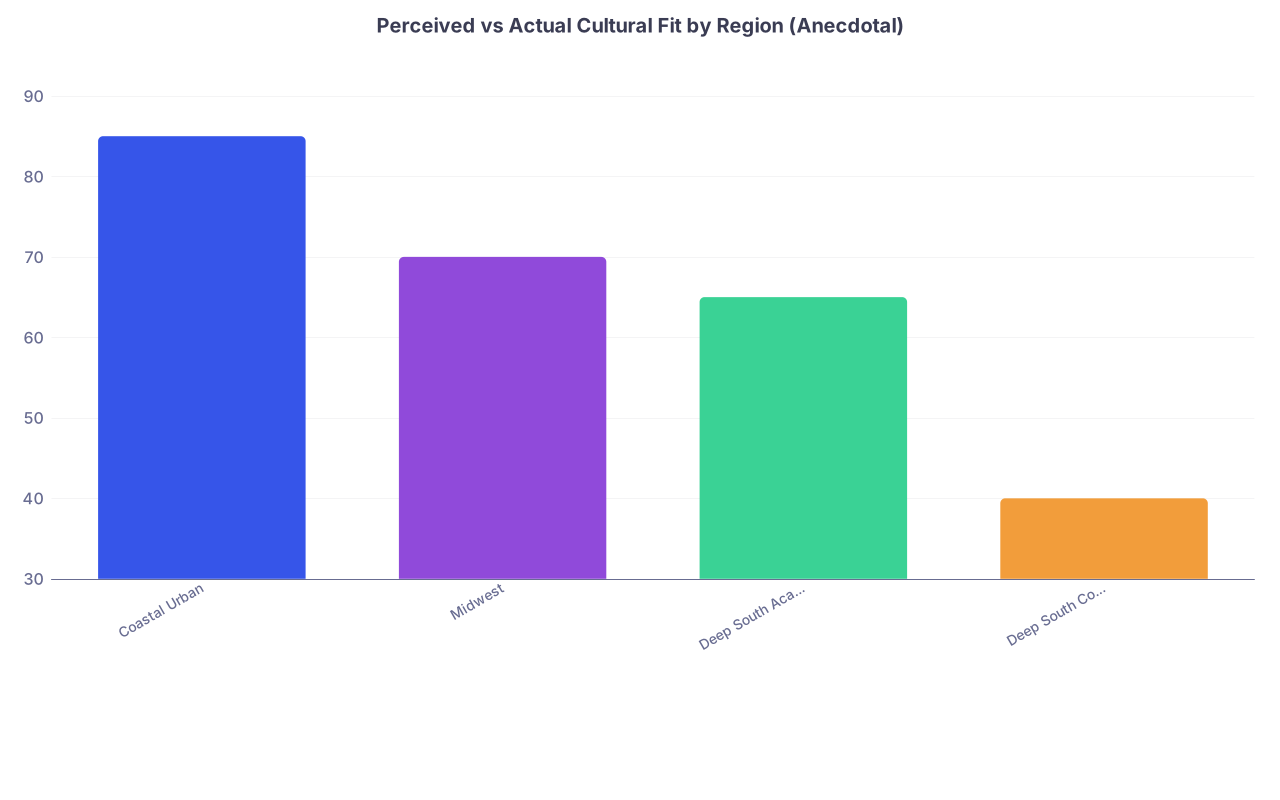
| Category | Value |
|---|---|
| Coastal Urban | 85 |
| Midwest | 70 |
| Deep South Academic | 65 |
| Deep South Community | 40 |
(Think of those numbers as “average perceived cultural fit” out of 100 from stories I’ve heard—not real data, but very real experiences.)
What “cultural mismatch” actually looks like day-to-day
When people say “culture,” their brain goes to big issues—abortion laws, LGBTQ+ rights, politics. And yes, those matter. But a lot of cultural mismatch shows up in smaller, grinding ways that add up.
- Humor: You make a dry, sarcastic comment that would kill in Boston and get blank stares or “bless your heart” in Georgia. You feel unfunny and strange.
- Social life: Everyone from your intern class seems bonded by church groups, hunting, college football, and you’re… none of those. You start making excuses to avoid events because it’s exhausting to be the odd one out.
- Politics at work: You sit silently in the workroom while someone makes a casual political remark that makes your stomach flip. Do you speak up? Laugh it off? Change the subject? None of the options feel good.
- Patient interactions: A patient asks where you’re from and when you say “San Francisco,” their face shifts. You can’t tell if it’s curiosity or judgment. You’re suddenly hyper-aware of every word you say.
That’s the stuff your brain is rehearsing at 2 am.
But here’s the harsh but reassuring truth: you will feel like an outsider somewhere no matter what. Even if you stay on the coast. Different political bubble. Different class background. Different religion. Different language. Or just different personality.
So the useful question is not: “Will I ever feel out of place?”
It’s: “Is this a place where I can find enough of a bubble to breathe and survive training?”
How to tell if a Deep South program is actually a bad fit for you
Programs accidentally tell on themselves all the time, if you know what to look for.
Ask yourself:
What do the residents actually look like?
Go stare at the resident photos page. Not for marketing diversity shots—actual class composites.- Do you see anyone who looks like you?
- Any visible religious diversity? (hijab, etc.)
- Any hint of queer representation, even subtly?
- International grads? Mixed ages? Different backgrounds?
If the entire program looks like one copy-paste template, that’s data.
How do they talk about diversity and inclusion?
On interview day, almost every program claims to care. I pay more attention to:- Do they name specific initiatives? Or just say “we value diversity”?
- Is there an actual DEI committee, and are residents on it?
- Has anyone been willing to say, “We’ve had issues, and here’s what we did”? That honesty is gold.
What happens when you ask a pointed question?
You’re allowed to be specific. For example:- “How supported would a queer or gender-nonconforming resident be here, socially and institutionally?”
- “What happens if a patient refuses care from a doctor because of race/religion/accent?”
- “How does the program handle political or ethical disagreements among staff about things like reproductive care?”
Watch the body language. The pause before they answer. If someone gets defensive or vague, that’s telling.
Resident-only chatter
In the resident-only Q&A, ask: “What’s something about living here that surprised you in a bad way?”
If everyone suddenly goes mute or dodges, that’s another data point.

| Step | Description |
|---|---|
| Step 1 | Identify Southern Program |
| Step 2 | Check Website Photos |
| Step 3 | Note as Possible Fit |
| Step 4 | Proceed with Caution |
| Step 5 | Ask Direct Culture Questions |
| Step 6 | Resident Only Session Questions |
| Step 7 | Consider Ranking |
| Step 8 | Lower or Remove from Rank List |
| Step 9 | See people like you? |
| Step 10 | Honest answers? |
Hard truth: The state politics might clash with your values
You’re not imagining this part. Abortion restrictions. Trans care bans. Book bans. Open carry. Hostile state legislatures. That’s real, and it bleeds into healthcare.
You might be afraid of:
- Having to turn away patients you want to help because state law says no.
- Watching OB/GYN colleagues practice with one hand tied behind their backs.
- Wondering if you are safe being openly yourself in that state.
That’s not melodramatic. That’s practical.
For some people, that’s a complete deal-breaker. And that’s valid. If you know you’ll be morally wrecked watching that up close for three years, you don’t owe any program your emotional sacrifice.
But there’s another side people don’t talk about: some residents find deep meaning training in those areas, especially in academic centers that push back as much as they can within the law.
I’ve heard things like:
- “I’m angry all the time, but I also feel like the work we do here matters in a way it maybe doesn’t in [coastal city]. Our patients literally have no one else.”
- “We quietly help patients find resources out of state. It’s not perfect. But it’s something.”
You need to decide which camp you belong to:
- “I want to be in a place aligned with my politics because residency itself is already hard enough,”
or - “I can tolerate political mismatch if I feel safe and supported inside the hospital and the program.”
Only you know your tolerance. Your anxiety is trying to protect you by assuming it’s zero. It might not actually be.
The social part: Will I be lonely and weird for 3 years?
The classic coastal-to-Deep-South terror: “Everyone’s going to church, married, pregnant, and I’m the single, atheist, queer/leftist, coffee-shop-intellectual misfit.”
Sometimes… yes. You might be the odd one out in your class.
But residency is also:
- International fellows
- Hospitalists from everywhere
- Nurses who are shockingly progressive
- EM docs who look conservative and then casually mention their husband
- A random D.O. attending from Brooklyn who becomes your person
Your friend group may not be your entire class. And that’s okay. You really just need 2–3 people you can exhale around.
I’ve watched:
- A vegan Californian and a gun-owning Texan become best friends because they trauma-bonded over nights in the ICU.
- A secular Jewish resident in Alabama find her people through a local improv group, not the hospital.
- An introvert from Seattle decide he actually liked how low-key the social expectations were in his small Southern city—less FOMO, more time to sleep.
Lonely patches are possible anywhere. On the flip side, “I stayed near home and still felt completely isolated” is a story I’ve heard too many times.

Coping if you do end up in a place that feels off
Let’s go all the way to the nightmare scenario: you match in a Deep South program, it’s more conservative than you expected, and you feel off from day one.
Then what?
You’re not helpless. You have levers:
Find your micro-bubble fast
Hunt aggressively for:- The one attending who casually mentions time in New York.
- The nurse with a Pride badge on her lanyard.
- The pharmacy resident reading a book you recognize.
- The social worker who knows every community resource.
Those are your people. You don’t need a whole parallel universe. You need a small one.
Set boundaries around political talk
You’re allowed to shut down conversations gently:- “Honestly I’m too tired for politics today.”
- “I try to keep work as neutral as I can—this job already drains me.”
You don’t have to debate ethics at 3 am on night float to prove anything.
Use geography to your advantage
Look at a map. Can you drive 1–2 hours to a bigger city occasionally? Weekend trips to places with more “you” energy can keep you sane. Some residents basically live half-in, half-out of their town.Be quietly, stubbornly yourself
You don’t owe anyone camouflage. You do owe yourself safety. So you might calibrate what you share and where. That’s not selling out. That’s strategy.If it’s truly toxic—there are escape valves
Transfers are rare but not impossible. More realistically, you can:- Switch fellowships later to a more aligned place
- Use electives away from home institution
- Treat this as a finite, ugly chapter, not a life sentence

Little-known upside: Training in the Deep South can be incredible… professionally
Your anxiety is 100% focused on emotional fit. But let’s be blunt about why these programs stay on your list: the training.
Deep South academic centers often mean:
- Sick, underserved patient populations.
- Procedures hell of a lot earlier.
- Less competition from multiple fellowships stealing your cases.
- Faculty used to training people from everywhere.
I’ve seen residents leave places like UAB, UT Houston, LSU, UTHSC, etc., with skill sets that beat some big coastal names. That doesn’t erase cultural mismatch. But it does explain why people choose to go there on purpose.
| Factor | Coastal City Program | Deep South Academic Center |
|---|---|---|
| Social/political fit | Usually higher | Very program-dependent |
| Cost of living | Often brutal | Usually much lower |
| Procedural volume | Can be diluted by fellows | Often very high |
| Diversity of patients | High, but insured-heavy | High, often more uninsured |
| Lifestyle outside work | More options, expensive | Fewer options, cheaper |
Again, that’s generalized. There are exceptions everywhere.
How to figure out your real risk tolerance (not your 2 am catastrophe brain)
Your late-night brain says: “I will absolutely shatter if I feel even slightly out of place.”
Your daytime self might be more nuanced.
Ask yourself, honestly:
- Have I ever lived somewhere that didn’t match my values and still found pockets of joy?
- Am I okay being the “weird one” if I feel respected, not mocked or harassed?
- Which thing will haunt me more in 5 years: a slightly miserable-but-high-yield training environment, or a culturally comfy program where I feel undertrained?
There’s no right answer. But you need your answer before rank lists.
One exercise that helps anxious brains: write two mini future stories.
- “I ranked mostly ‘safe’ coastal-ish places and matched at a program that’s fine but not amazing clinically. Here’s what that looks like day-to-day.”
- “I ranked some Deep South academic places high and matched there. Here’s what that looks like day-to-day.”
Not the dramatic parts. The actual: commute, hospital, call room, who you text at lunch, what you do on a Sunday.
Your gut usually speaks more clearly when you get concrete like that.

You’re not crazy for worrying
You’re not being dramatic. Culture mismatch can absolutely make or break a residency experience. There really are programs where a queer, brown, secular, or left-leaning resident would be miserable and unsafe. Those exist.
But the Deep South is not a monolith. There are progressive pockets, diverse programs, quietly subversive departments, attendings who will go to war for you, and co-residents you’d never expect to align with you who end up becoming your closest allies.
The goal isn’t to eliminate all risk. You can’t. The goal is to lower the odds of a truly toxic mismatch and to trust that future-you will be more adaptable, more resourceful, and less fragile than your anxious brain insists you are right now.
Years from now, you probably won’t remember which city made you panic during interview season. You’ll remember who had your back—and how you showed up for yourself when you were scared.