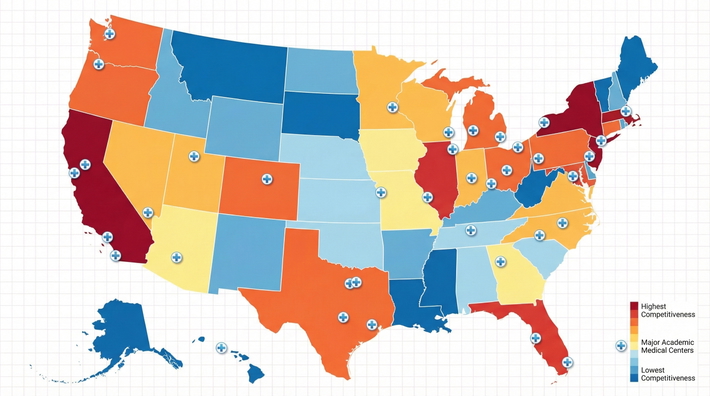
The fantasy that you’ll magically fall in love with whatever city you match in is a lie people tell applicants so they don’t panic.
Let me say the quiet part out loud: you might match somewhere and hate it. The city. The weather. The politics. The culture. The call rooms. Your co-residents. All of it. And you’re not crazy or ungrateful if that happens.
You’re just… stuck. Or at least it feels that way.
This is the stuff people don’t talk about on interview day. Or in those cheesy program videos with drone shots of the skyline and smiling residents in matching fleeces. But you’re here because your brain is already going there:
What if I hate the region I match in? Can I leave? Will I ruin my career? Is it better to suffer through three to seven years than risk being “that resident who bailed”?
Let’s pull that apart properly.
The ugly truth: yes, hating the region happens. A lot.
You are absolutely not the first (or the hundredth) person to land in a place and think, “What have I done?”
Real versions of this I’ve heard or seen:
- The California kid who matched IM in upstate New York and didn’t see the sun for six months. Seasonal depression hit so hard they stopped going to the grocery store and lived on DoorDash.
- The resident who was deeply progressive matching into a very conservative Southern town where patients told them, “You people are what’s wrong with this country” in the ED.
- The introvert who matched in a party city (think Miami, Vegas, New Orleans) and felt like the only person in the program who didn’t want to go out after every call.
- The Black resident who matched somewhere with almost no diversity, and the microaggressions were not “micro.” Constant comments about their hair, assumptions about their role, security following them in the cafeteria.
- The IMG who matched in a rural Midwest town where the nearest mosque, Asian grocery store, or real community was hours away, and loneliness hit like a truck.
People do cry in their cars. People Google “can I transfer residency” at 3 a.m. People seriously consider quitting and doing something else entirely.
So if you’re already running these scenarios in your head: that’s not catastrophizing. That’s… realistic risk assessment.
The good news: hating the region is not an automatic doom sentence for your life or career. It just closes some doors and opens others you may not like as much.
First: what “hating the region” usually means
“Region” sounds abstract. But what actually eats away at you are specific things:
- Weather (long winters, heat, humidity, lack of sun)
- Social environment (no friends, no family, culture shock)
- Politics and values mismatch (LGBTQ+ rights, reproductive rights, COVID attitudes, etc.)
- Safety (crime, harassment, racism, being visibly “other”)
- Isolation (rural, no airport, can’t easily leave)
- Cost of living (either too expensive to enjoy life or so low it feels like “nowhere”)
- Program culture interacting with the above (no time off, toxic leadership, no support)
You’re not just hating a map. You’re hating how where you live interacts with the most stressful period of your life.
And that’s why it feels suffocating: you can’t “just move.” Your license. Your training. Your board eligibility. All tied to that place.
Real stories: what actually happens when people hate their match
I’m going to lay out some composite stories based on patterns that repeat over and over. Details changed, but the emotional arc is the same.
Story 1: The “this city is killing me but the program is good” resident
Matched: Solid academic IM program in a midwestern city
Problem: Hates weather, misses family, feels socially isolated
Thought spiral: “If I leave, I’ll never match again. If I stay, I’ll be miserable and burn out.”
Year 1: Breaks down around December. Mentions to chief that they’re “not sure they can do this.” Chief listens, suggests therapy. Program helps them get a therapist and light box for seasonal depression.
Year 2: Still doesn’t love the city. But has a small friend group, a regular gym, and scheduled visits home every 3–4 months. They start focusing on fellowship applications.
Outcome: They finish. Never move back to that region again. They look back at it as “those three awful winters I survived,” not “the mistake that ruined my life.”
This is common. You hate it. You stay. You survive. You leave. It’s not romantic. It’s just… what people do.
Story 2: The “wrong region AND wrong program” resident who transfers
Matched: Community program in a conservative Southern town
Problem: Serious culture mismatch, plus malignant program leadership, no support, open hostility about politics and identity
Thought spiral: “I can’t last three years here. But if I try to transfer, programs will blacklist me.”
Year 1: Keeps a written record of incidents (harassment, unsafe staffing, retaliation for raising concerns). Talks confidentially with a trusted faculty member and a mentor from med school.
They start quietly asking about open PGY-2 positions in similar specialties through:
- Old attendings
- Med school dean’s office
- Word of mouth / listservs
They don’t blast it on social media. It’s all quiet, back-channel.
Spring of PGY-1: They find an unfilled PGY-2 spot at a program in a different state after someone else dropped out. They apply with strong letters that frame it as “poor regional fit plus program culture concerns” without trashing anyone by name.
Outcome: They transfer. It’s not smooth. They repeat some rotations. They lose a few months of seniority. But they finish somewhere that doesn’t make them feel physically ill walking into the hospital.
Transfers are rare but real. People DO leave programs that are the wrong fit regionally and culturally, not just academically.
Story 3: The “I actually quit” resident
Matched: Surgical specialty in a high-powered coastal city
Problem: Cost of living insane, family thousands of miles away, constant call, mental health crumbling
Thought spiral: “If I quit, I’m a failure. If I stay, I don’t know if I’ll be alive to see PGY-3.”
PGY-1: Tries to stick it out. Panic attacks. Insomnia. Thoughts get dark. Starts seeing psychiatry. Realizes the issue isn’t just the program; it’s the whole life structure.
Middle of PGY-1: They sit with GME and program director and say the thing nobody wants to say: “I don’t want to continue in this specialty, and I don’t want to be here.” They negotiate a clean separation with a neutral letter (“completed PGY-1 year in good standing”).
Outcome: They take time off. Later, they re-enter medicine through a prelim year plus FM or IM in a more livable region. Or they leave medicine entirely and go into consulting, pharma, or tech.
Career? Not dead. Messier? Yes. Socially awkward to explain? Absolutely. But not a death sentence.
Exit paths if you truly hate where you landed
Hating the region doesn’t mean you must immediately blow up your life. There’s a spectrum of options, from “change nothing” to “start over.”
| Option | Disruption Level | Career Impact |
|---|---|---|
| Stay and cope better | Low | None |
| Moonlight / travel after residency | Low-Med | None |
| Try to transfer programs | Med-High | Mild |
| Switch specialties / reapply | High | Moderate |
| Leave clinical medicine | Very High | Major redirection |
1. Staying put, but changing how you live there
This is honestly what most people do, even if they’re miserable at first.
You can:
- Treat it as a bounded sentence: “X more months until graduation” becomes your mantra.
- Engineer tiny things that make the region less awful (gym, hobby, therapy, friend group, church/temple/mosque, weekly FaceTime with people who actually know you).
- Use your vacation strategically: cluster trips back “home” or in cities you do like.
- Stop pretending you need to love the city. You just need it to be survivable.
Is this ideal? Of course not. But it’s reality for a lot of residents who are too far in to restart.
2. Planning your escape AFTER residency
You can also accept, “This region sucks for me,” without doing anything dramatic during training.
Then your full energy goes into making sure you never get trapped there long-term.
That means:
- Choosing electives or research that make you marketable in regions you actually want (West Coast hospitalist jobs, Northeast academic IM, etc.).
- Networking aggressively in your target region during PGY-2/3 (conferences, virtual meetings, old med school contacts).
- Being honest with yourself in job search: you don’t “owe” the residency region anything. You gave them your 3–7 years. You can leave.
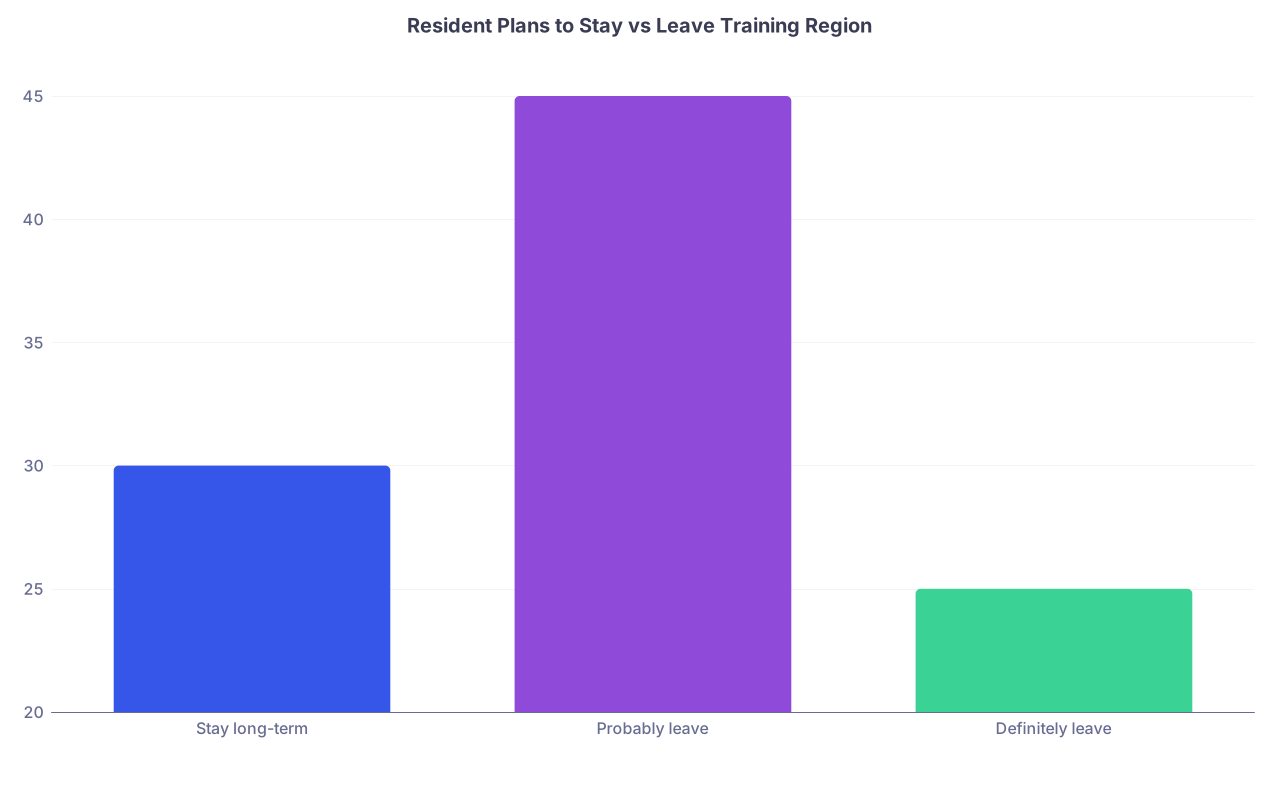
| Category | Value |
|---|---|
| Stay long-term | 30 |
| Probably leave | 45 |
| Definitely leave | 25 |
A huge chunk of residents don’t stay where they train. You’re allowed to use your residency city as a temporary necessary evil.
3. Transferring to another residency
This is the big scary one everyone whispers about.
Quick reality check:
- Transfers DO happen every year.
- They are easier in IM, FM, psych, peds, and harder in derm, ortho, neurosurg, etc.
- Programs don’t love it, but they also often need bodies when someone else leaves.
How transfers actually happen:
- You complete at least part (or all) of PGY-1 in good standing.
- You quietly let mentors know you’re seeking an open PGY-2 spot elsewhere.
- You apply as a transfer with updated CV, strong letters, and a clear story.
Your story cannot be: “I hate your region.”
Your story must be something like: “I’m seeking training closer to my support system / in a region better aligned with my long-term goals and family needs.”
You do NOT:
- Trash your current program.
- Put everything in writing that could be forwarded around.
- Assume you’re guaranteed any spot.
You DO:
- Assume it will be stressful.
- Have a backup plan of “I’ll finish where I am if this doesn’t work out.”
4. Switching specialty or reapplying from scratch
Sometimes “I hate this region” is tangled up with “I’m in the wrong specialty” or “This training environment is annihilating my mental health.”
At that point you might:
- Finish a prelim year (intern year) and reapply to a different specialty elsewhere.
- Leave a categorical spot after PGY-1 and try to match again into something else.
Risks:
- No guarantee you match again.
- You might need to explain gaps and past resignations over and over.
- Visa issues for IMGs can be huge if you leave a program.
But people do this. I’ve seen an unhappy surgical intern switch to anesthesiology in a different state. A psych intern switch to IM. A malignant program refugee land in FM and be actually happy.
5. Leaving clinical medicine entirely
This is the nuclear option everyone is secretly terrified of thinking about.
Yes, it happens. For many reasons:
- Burnout so bad they physically can’t do nights/weekends/call anymore.
- Family needs that can’t be met in current location or schedule.
- Realizing they hate the entire job, not just the region.
Where do they go?
- Pharma / biotech (medical affairs, drug safety)
- Consulting (healthcare advisory, strategy)
- Public health / policy
- Tech (clinical informatics, product roles with a medical angle)
- Education, writing, content, startups
You don’t have to love that idea. Just know it exists. The story is not: “Hate my region → stuck forever → die here.” There are exit ramps, even if they’re messy and painful.
The emotional part nobody prepares you for
The hardest piece isn’t logistics. It’s the shame and fear.
Because once the excitement of Match Day wears off, admitting you’re miserable feels like betrayal:
- “People would kill to be in my position.”
- “I should just be grateful I matched at all.”
- “If I complain, I’m weak. Everybody else is surviving.”
No. Other residents are:
- Drinking too much.
- Scrolling Zillow in other states at 2 a.m.
- Counting days until graduation like they’re in prison.
And a lot of them are convincing themselves that this is just what they signed up for.
Hating your region doesn’t make you soft. It just means you’re human and location-dependent like everyone else.
You will need:
- One or two people you can be brutally honest with (a friend, therapist, or mentor).
- Permission to say, “I don’t like where I am,” without immediately jumping to, “So I must quit everything.”
- Time. The first 3–6 months feel different from month 12. Some people acclimate; some don’t.

How to protect your future self before you match
You’re probably thinking, “Okay, but what do I do now, before Match, so I don’t end up in the absolute worst-case?”
Here’s the blunt version.
1. Stop pretending region doesn’t matter
All the “just focus on program quality” advice is incomplete. Program quality matters. So does not being crushed by your environment.
Rank lists where people ignore:
- Weather that historically wrecks their mood
- Distance from every support person
- States with laws that threaten their existence (LGBTQ+, reproductive care, etc.)
…tend to turn into regret posts later.
2. Be honest about your non-negotiables
Not preferences. Non-negotiables.
For example:
- “I cannot safely live in a place openly hostile to LGBTQ+ people.”
- “My mental health tanks with long, gray winters and no sun.”
- “I must be within X hours of my aging parents or partner.”
If a program or region violates those, it should be very, very low on your rank list, even if the name is shiny.
3. Assume some degree of discomfort is unavoidable
You are not going to find “perfect city, perfect program, perfect everything.” Something will be off:
- Good program, meh city
- Great city, chaotic program
- Fine everything, terrible salary and cost of living
The point of thinking about worst case now is not to eliminate all risk. It’s to decide which kind of misery you’re willing to tolerate for a few years.
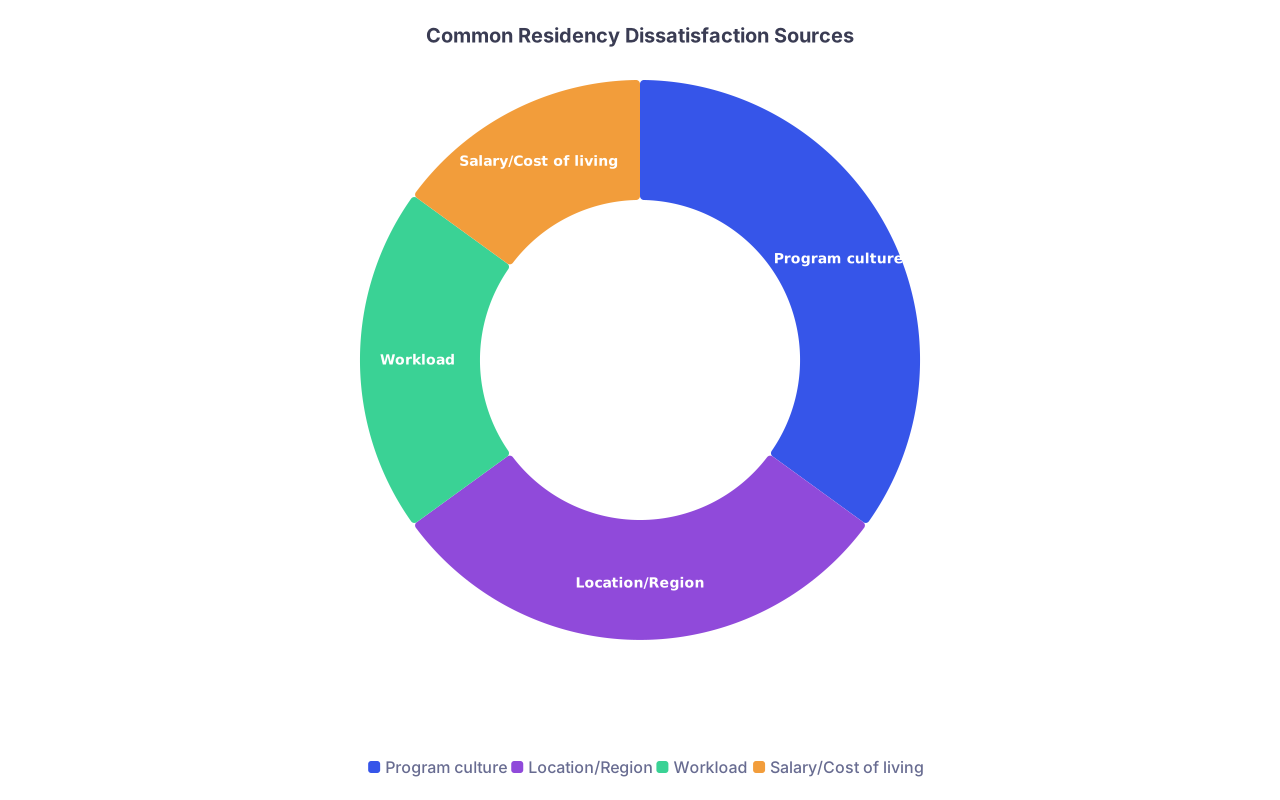
| Category | Value |
|---|---|
| Program culture | 35 |
| Location/Region | 30 |
| Workload | 20 |
| Salary/Cost of living | 15 |
A lot of people do cite region as a major stressor. You’re not being irrational if you care about it deeply.
If you end up somewhere you hate: a survival blueprint
Let’s say the worst happens. You open your Match email and your stomach drops. Wrong city. Wrong region. Maybe wrong everything.
Here’s what you do in that first year, instead of burning your life down in a panic:

| Step | Description |
|---|---|
| Step 1 | Match in disliked region |
| Step 2 | Give it 6-12 months |
| Step 3 | Stay and plan post-residency move |
| Step 4 | Talk to mentor and GME |
| Step 5 | Explore transfer or specialty switch |
| Step 6 | Apply quietly |
| Step 7 | Stay temporarily and protect mental health |
| Step 8 | Still unbearable? |
| Step 9 | Options available? |
- Give it real time. The first 2–3 months of residency are hell everywhere. Don’t make irreversible decisions based only on July–September.
- Monitor your mental health like it’s a vital sign. Therapy, meds if needed, sleep hygiene, small joys that tether you to yourself.
- Start collecting data, not just vibes.
- Is it the region?
- The program?
- The specialty?
- All of the above?
- Loop in people who have institutional knowledge. Med school advisors, prior attendings, maybe a trusted chief. Ask them about realistic options, not Reddit fantasies.
- Decide: am I surviving this and leaving after graduation, or do I need to attempt an earlier exit? Neither choice makes you morally better. It’s just about what keeps you alive and functional.
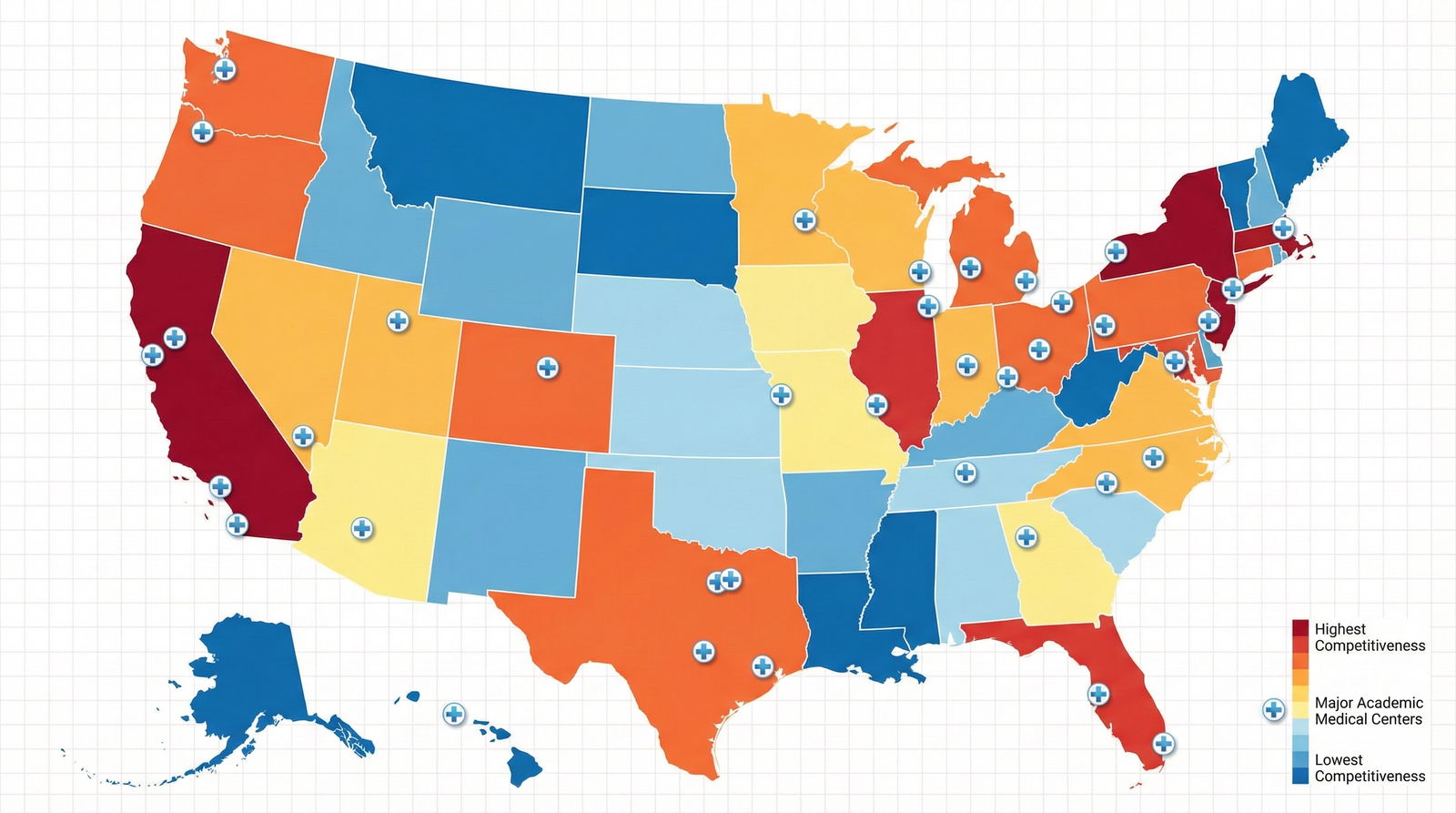
The thing you probably need to hear most
You are allowed to be scared of matching somewhere you might hate. That fear is not a sign you’re not cut out for medicine.
You’re not signing away your entire future to one geographic region at age 26.
Residency is:
- Time-limited
- Painful
- Deeply formative
- Often in a place you’d never choose to live long-term
But it is not a permanent sentence. It’s a stage. And stages end.
You can:
- Endure a place you don’t like for a few years and then leave.
- Try to shift your training if the mismatch is truly unbearable.
- Change specialties or paths if the whole thing is wrong.
- Walk away from clinical medicine if staying would destroy you.
None of those options are fun. All of them are survivable.
Today, do one concrete thing: open your rank list (or your mental one) and mark every program with a star, a circle, or an X based ONLY on region fit—weather, politics, distance from support, culture. Then ask yourself: “If I woke up there on July 1, could I survive 3–7 years, even if I didn’t love it?” Adjust at least one rank based on that honest answer.