The biggest lie people tell big‑city med students is that “rural training is basically the same, just with more trees.”
It’s not.
And that’s exactly why you’re scared.
You’re not just asking, “Is it safe?”
You’re actually asking a whole tangled mess of questions:
Will I be alone?
Will I kill someone because I don’t have backup?
Will I be stuck in a town with nothing to do, no friends, and no one who looks like me?
Will I be less competitive for fellowship later?
Will I be safe as a woman / person of color / LGBTQ+ trainee in a politically different area?
Let’s drag all of that out into the light instead of pretending “rural” just means “cute sunsets and continuity of care.”
What “Safe” Actually Means in Rural Training
When you say “safe,” you probably mean four different things at once:
- Clinical safety (Will I be in over my head?)
- Personal physical safety (Crime, being alone at night, driving, on‑call)
- Social/emotional safety (Isolation, culture shock, bias)
- Career safety (Will this screw up my future plans?)
They’re all valid. And they don’t all have the same answer.
Let me start with the part that keeps people up at 2 a.m.: clinical safety.
Clinical Reality: “You’re It” vs “You’re Supported”
In a big academic hospital, if you freeze, there’s always someone bigger behind you.
Senior resident. Fellow. Attending. Rapid response team. Intensivist on the unit.
In rural training, the horror scenario your brain runs is: “It’s 2 a.m., I’m the only doctor in the building, a crashing patient rolls in, and everyone is staring at me.”
That scenario does exist in some tiny critical access hospitals. But here’s the thing: most ACGME‑accredited rural residency programs are not throwing a PGY‑1 solo into the abyss and hoping for the best. They literally can’t. It violates accreditation and malpractice sanity.
But the culture feels different, and that’s what freaks people out.
You may see:
- Fewer subspecialists in‑house
- More transfer decisions (helicopter or ground)
- Older equipment, slower imaging turnaround
- More “do the best with what you have” medicine
You’re right that the stakes feel higher because there’s less “instant backup.” That doesn’t mean there’s no backup. It just means:
- Attending backup might be from home, not down the hall
- ICU might be managed by hospitalists with remote intensivist tele‑support
- You’ll call flight teams more than you ever did in your big tertiary center
The question you should actually ask programs is not “Are you rural?” but:
- “Who is physically in the hospital at night?”
- “What level of responsibility does an intern have on nights?”
- “What’s the escalation structure at 2 a.m. when things go south?”
- “How often are residents the most senior physician on site?”
A decent rural program will give some version of: “Interns are never alone. Seniors and attendings are available, even if from home. You’re not practicing independently.”
If they dance around those questions or act like you’re weak for asking? Red flag. You’re not being dramatic. You’re asking if you’re going to be put in an unsafe learning environment.
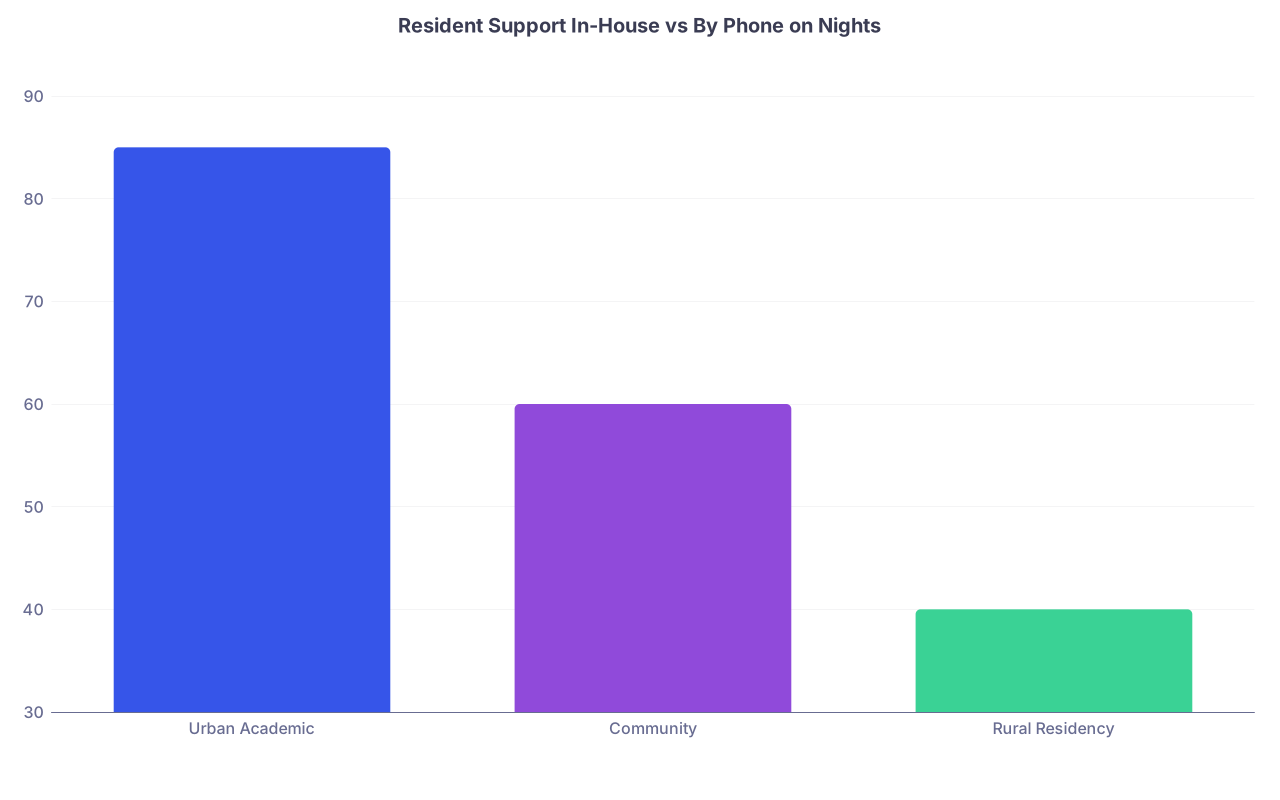
| Category | Value |
|---|---|
| Urban Academic | 85 |
| Community | 60 |
| Rural Residency | 40 |
(Example: rough percentage of nights with in‑house attending/fellow presence. The number goes down as you get more rural—but it’s not zero.)
Personal Safety: Crime, Night Shifts, and Those Empty Parking Lots
Here’s the honest thing no one from your big city wants to admit:
Statistically, a lot of rural areas have lower violent crime than major cities.
But that’s not the whole story.
You’re going to be:
- Walking to your car alone at night
- Driving long stretches of dark roads post‑call
- Sometimes living in housing that’s not exactly luxury high‑rise with 24/7 security
So your brain pictures every horror‑movie scenario. Especially if you’re used to well‑lit, crowded sidewalks and hospital security everywhere.
What I’ve heard from residents actually doing rural training:
- “I felt weird at first leaving the hospital at 3 a.m. because it was dead quiet. But quiet is different from dangerous.”
- “Biggest risk was honestly deer in the road on the 15‑minute drive home.”
- “We had security, but it was like one guy for the whole hospital instead of a whole department.”
The safety questions you should directly ask programs (yes, even on interview day; you’re allowed):
- “Is there 24/7 hospital security on site?”
- “What’s the parking situation like at night for residents?”
- “Do residents ever sleep in the hospital instead of driving home after long shifts?”
- “Have there been any safety concerns for trainees in the past few years?”
If they can’t answer that without getting weirdly defensive, that’s… concerning.
What nobody tells you: driving home post‑call on rural roads when you’re exhausted is probably a bigger safety issue than random crime. Many residents choose to nap in call rooms for a reason. Ask if that’s an option.
Social & Cultural Safety: “Will I Be the Only One Like Me?”
This is the piece that gets brushed aside the most. And it’s the one that hurts the most when people ignore it.
If you’re from a big city med school—diverse classmates, multiple cultural communities, queer spaces, your own language spoken around you—and you imagine landing in a town with one Walmart, three churches, and a bar… yeah. Your chest tightens a little.
This isn’t about being “too soft for rural.” It’s about:
- Will I be misgendered all the time?
- Will I hear racist comments from patients or staff?
- Will my partner feel safe walking around town?
- Will I be able to get my hair done, find my food, find my community?
You’re not overreacting. I’ve heard variations of all of these from people who actually went rural:
- A Black resident who had to drive 2+ hours for a barber who understood their hair
- An LGBTQ+ resident who was out at work but stayed closeted in town
- A hijabi resident who got a lot of staring at the grocery store but was loved by her patients
- An Asian resident who was literally the only non‑white person in the cafeteria most days
None of that makes the training worthless. But pretending it’s not a factor is dishonest.
Things you can do before committing:
- Stalk the resident photos on the program website. If every class photo looks like a copy‑paste of the same person, ask yourself how that’s going to feel at 3 a.m. on a bad day.
- On interview day, straight‑up ask, “How have you supported residents from underrepresented backgrounds?” and then shut up and watch their faces.
- Ask for a one‑on‑one with a resident who shares some piece of your identity (race, gender, orientation, parental status). Programs that genuinely care will try to make that happen.
And then be honest with yourself. Some people can handle being “the only one” for a few years. Others know that would break them. Neither is wrong. It’s not weakness to say, “I need some level of community to stay sane.”

Career Safety: Will Rural Training Hurt Me Later?
This is the quieter panic. The one you don’t say out loud because it sounds snobby.
“Am I throwing away my shot at a competitive fellowship by going rural?”
“Will people look down on my program name?”
“Will my research opportunities vanish?”
Let’s be blunt: if your dream is derm at UCSF or neurosurgery at Mass General, you’re probably not looking at rural primary care residencies. You know that already.
But for IM, FM, peds, psych, EM? A rural residency does not automatically tank your career. That’s outdated thinking.
Where rural training can sometimes hurt:
- If you want a highly subspecialized fellowship and your program sends almost no one into that field.
- If there’s almost no research infrastructure and you need publications for your next step.
- If mentoring for academic careers is basically nonexistent.
Where rural training can absolutely help:
- If you want to be an extremely independent generalist—hospitalist, full‑scope FM, EM, rural surgery.
- If you want to stand out as someone who can manage high acuity without eight layers of backup.
- If you’re going into primary care and want deep, broad comfort with “everything that walks in.”
Look at actual data if you can:
| Program Type | Percent to Fellowship | Common Fellowships |
|---|---|---|
| Big Urban Academic | 60% | Cards, GI, Heme/Onc, Pulm |
| Urban Community | 35% | Cards, Endo, ID |
| Rural IM Program | 20% | Cards, GI, Pulm |
This is the trade: higher likelihood of being funneled into generalist roles vs fewer but still possible subspecialty routes.
If you’re panicking because your plan is “maybe cardiology, maybe rural hospitalist, I don’t know,” then yeah, it feels risky. But remember: most of the US healthcare system doesn’t live in shiny academic towers. Doing residency where the actual needs are can be a strength, not a stain.
The Mental Health Piece Nobody Warned You About
You’re thinking about safety like codes and trauma bays. Your nervous system is thinking about safety like:
- “Who will I decompress with after a brutal shift?”
- “What happens when I’m lonely and exhausted and it’s snowing and my friends are all hundreds of miles away?”
- “What if I hate it and feel trapped because it’s Match, not Airbnb, and I can’t just leave?”
The isolation can be real.
Some rural residents do great because:
- The cohort is tight. Like family.
- They find comfort in routine—same coffee shop, same trails, same faces.
- They like being a big fish in a small pond.
Others feel themselves slowly unravel:
- Long dark winters
- Few social outlets beyond bar + Walmart
- Political/social climate that clashes with who they are
You’re allowed to make choices that protect your mental health. That’s not softness; that’s survival. Especially given resident depression and burnout rates are already brutal.
On any program visit, urban or rural, but especially rural, ask residents without faculty present:
- “What do you do for fun on your days off?”
- “Has anyone ever seriously considered leaving the program?”
- “How does the program respond when someone is struggling?”
- “Where do people live, and do they like it?”
If everyone dodges eye contact at that last question… your brain is not being dramatic. Listen to it.

| Step | Description |
|---|---|
| Step 1 | Interested in Rural Program |
| Step 2 | Check fellowship match list |
| Step 3 | Focus on clinical training |
| Step 4 | Consider ranking high |
| Step 5 | Drop lower or off list |
| Step 6 | Need strong fellowship chances? |
| Step 7 | Strong fellowship track record? |
| Step 8 | OK with small town life? |
Concrete Red Flags and Green Flags for Safety
Since your brain is going to worst‑case scenarios anyway, give it some structure.
Red‑flag vibes:
- “Here we push our residents to act like attendings early on” = code for you being left alone with too much responsibility.
- No clear answer on night coverage or escalation.
- Residents joke about “sink or swim” culture and look only half‑joking.
- No diversity in resident photos for years and nobody mentions it until you ask.
- Hand‑waving your concerns: “You’ll be fine, everyone survives.” Great, thanks.
Green‑flag vibes:
- They volunteer details about backup, telemedicine support, and transfer protocols.
- Residents describe seniors and attendings as truly approachable at 2 a.m.
- There’s explicit support for underrepresented residents—mentoring, communities, explicit DEI efforts that aren’t just a line on a website.
- Recent grads went to the kinds of jobs or fellowships you might actually want.
None of this guarantees safety. But it tilts the odds away from your nightmares.
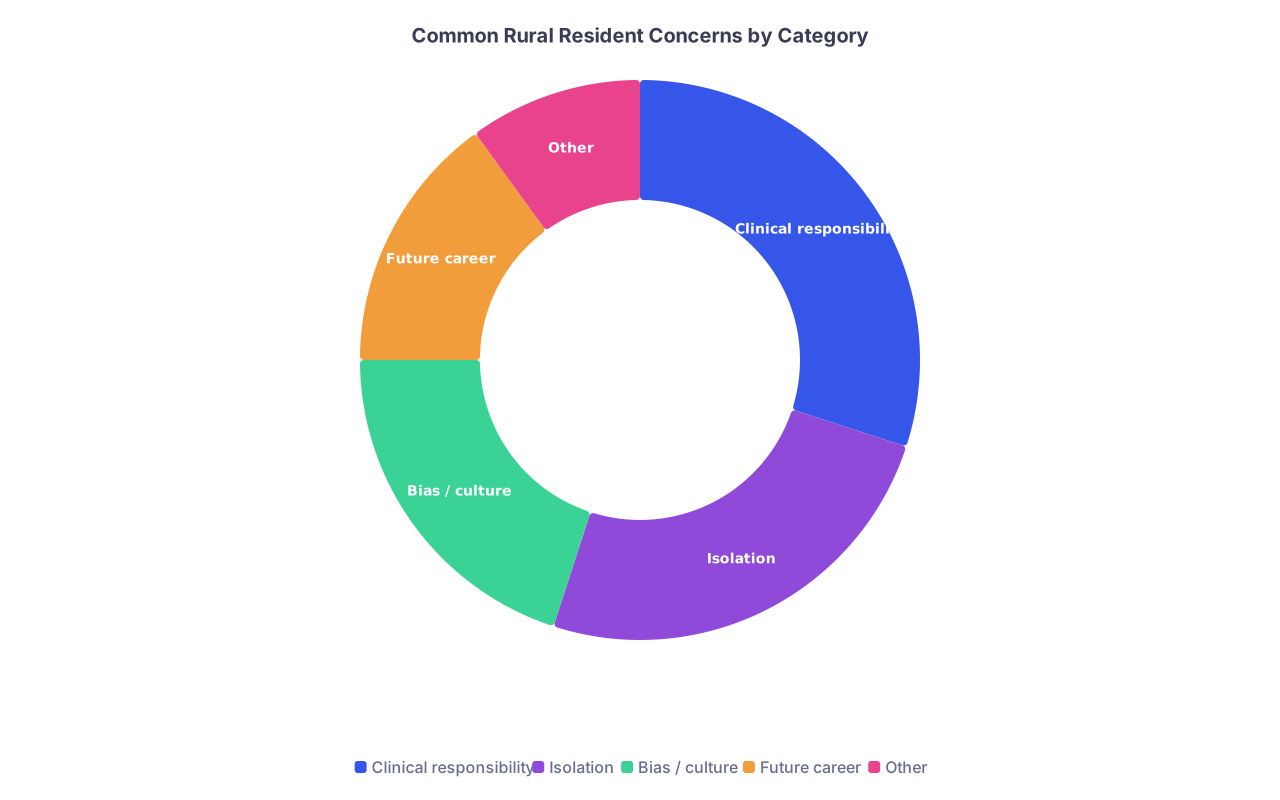
| Category | Value |
|---|---|
| Clinical responsibility | 30 |
| Isolation | 25 |
| Bias / culture | 20 |
| Future career | 15 |
| Other | 10 |
So… Is It Safe?
Here’s the messy, unsatisfying answer that’s still true:
Rural training can be incredibly safe, supported, and transformative.
Rural training can also be isolating, under‑resourced, and emotionally brutal.
It depends far less on “rural vs city” and far more on the specific program, the specific town, and your specific needs and limits.
You’re not weak for worrying. You’re not dramatic for caring about being the only person of your identity in a 50‑mile radius. You’re not selfish for worrying more about loneliness than about helicopter transfer protocols.
You’re doing risk assessment on your own life. As you should.
If you take nothing else from this, take this:
You are allowed to say, “I want to serve rural communities, but I need a program that won’t wreck me in the process.” Those two things are not mutually exclusive.
Years from now, you won’t remember the exact wording of the program website or the stats you agonized over. You’ll remember whether you felt seen, supported, and safe enough to grow into the kind of physician you actually want to be.