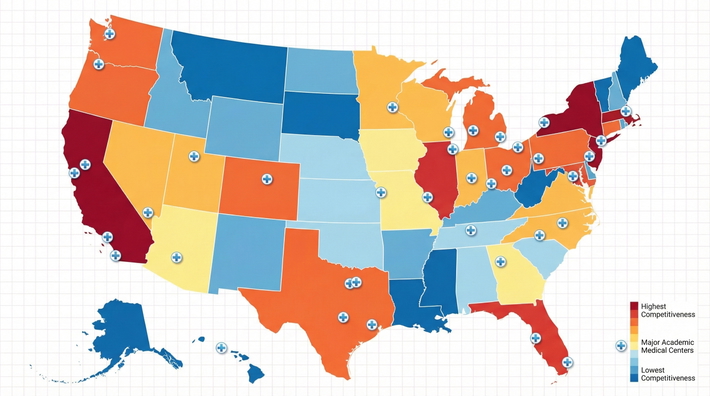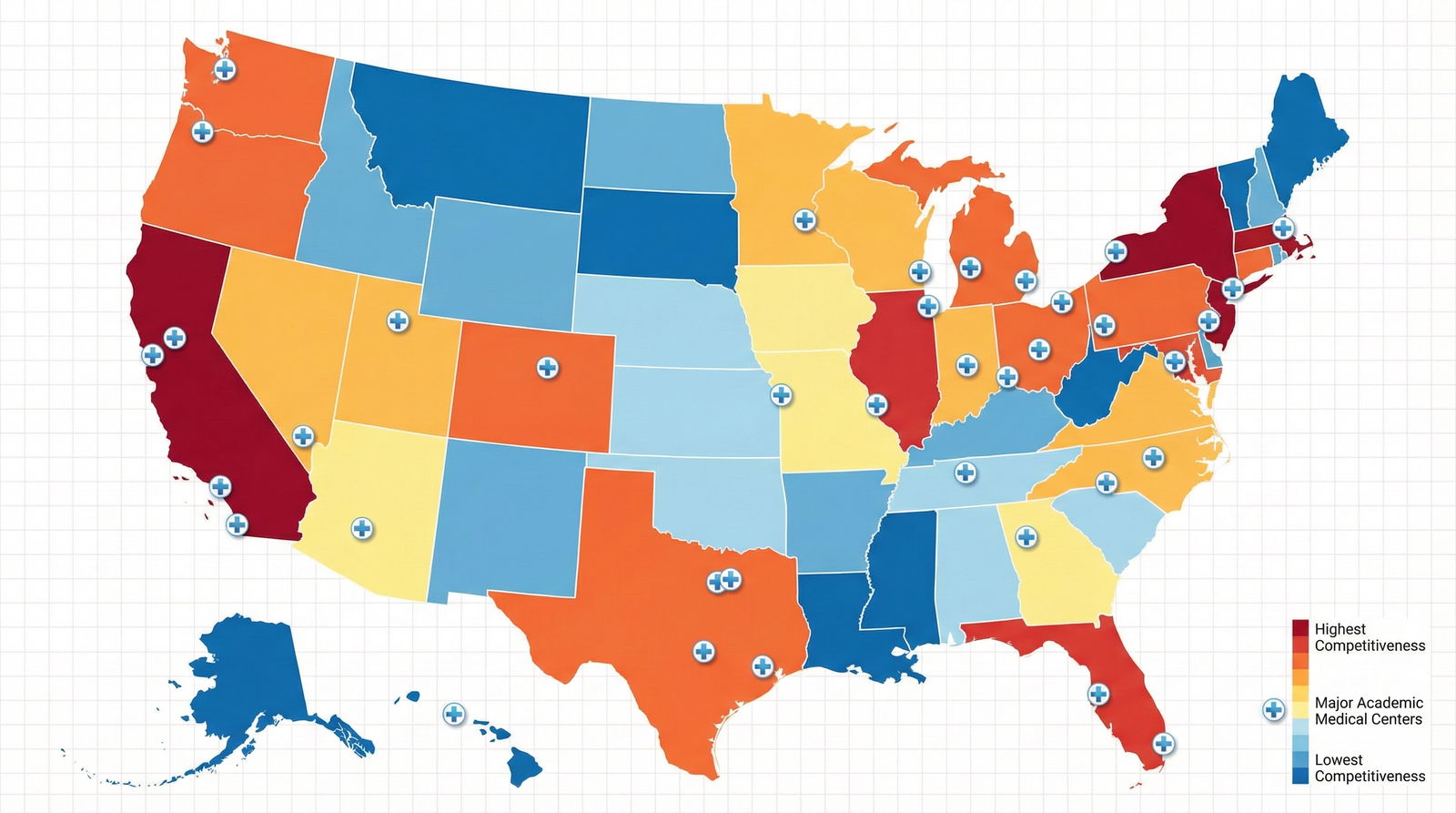
You’re sitting there with your ERAS list open, zoomed all the way out on the map, and you realize something awful: almost every single program you applied to is in one region. Maybe all of them are. Northeast only. Or just the West Coast. Or only Texas. And now the pit in your stomach is like, “Did I just sabotage my own Match?”
You start replaying every decision: “I filtered by driving distance… I picked where friends are… my partner’s job… my family…” and suddenly you’re reading Reddit threads about “geographic bias” and “regional preference” and spiraling into:
What if I get zero interviews because I’m too regional?
What if they assume I won’t move?
What if I’ve already tanked my chances and just don’t know it yet?
Let’s walk through this like someone who is also freaking out (hi) but has watched a lot of people still match after making “dumb” geographic choices.
First: Did You Actually Tank Your Chances?
Let me be blunt: you might have hurt your odds. You probably didn’t destroy them.
You only really “tank” your match chances when two things happen together:
- You apply narrowly (geographically or in number of programs)
- You’re not a very strong applicant relative to your specialty
If your situation is:
- Mid-tier stats
- Applied to a competitive specialty
- Only picked one region
- And you didn’t apply very broadly even within that region
…then yes, you’ve made things harder for yourself.
But programs don’t sit there saying, “Oh, they only like the Midwest, instant reject.” They care about:
- Do you meet their screening cutoffs?
- Do you look like you’ll show up, work hard, not be a nightmare?
- Do you have some logical tie to them or their city/region?
So no, “one region” isn’t an automatic death sentence. Dumb? Sometimes. Recoverable? Almost always—if you’re willing to adjust.
How Bad Is “One Region”? It Depends On These 5 Things
The panic level really depends on this mix.
| Factor | Safer Side | Higher Risk Side |
|---|---|---|
| Specialty | Primary care, psych, peds | Derm, ortho, ENT, plastics |
| Region | Large, dense (Northeast, CA, Texas) | Sparse, rural-heavy |
| Applicant Strength | Above-average, home program | Below-average, red flags |
| Program Count | 40–60+ applications | <25 in total |
| Ties to Region | Lived/trained there | No real connection |
If you’re:
- Applying IM/FM/Peds/Psych
- In a dense region with lots of programs
- With decent scores and no major red flags
Then “one region” is more like “suboptimal” than “disastrous.”
If you’re:
- Applying ortho, derm, neurosurg, ENT, plastics, ophtho
- Only in one region
- And you’re not top-of-the-pile strong
Then yeah, I’d be nervous in a more realistic way, not just a catastrophizing way.
The Real Problem: Region + Fit Signals
Here’s the part people underestimate: programs try to predict who will actually come.
You applied only to one region. Programs will read that as:
- You’re geographically constrained
- You might be desperate to stay close
- Or you just didn’t apply that broadly
Some PDs like that. You’re less likely to rank them low and disappear. Some will worry you’re too inflexible or that you’re only using them as a backup to some dream program nearby.
What helps is when your application screams, “I belong here,” not just “I randomly filtered by distance.”
Things that signal genuine regional ties:
- You went to med school there
- College or hometown there
- Family in the area (and you mention it somewhere)
- Prior jobs, military service, or long-term living in that region
- Rotations / away electives / research at institutions in that region
If your situation is: “I go to school in the Midwest, applied only to Midwest, family is there” — that’s not bad targeting, that’s focus.
If your situation is: “I go to school in the South, applied only to the West Coast with zero ties” — that’s where programs might hesitate, especially in competitive specialties.
What If I Already Submitted ERAS Like This?
This is the part that’s making you sick: you already hit submit.
You can’t un-send. But you can add.
Here’s roughly how your options look:
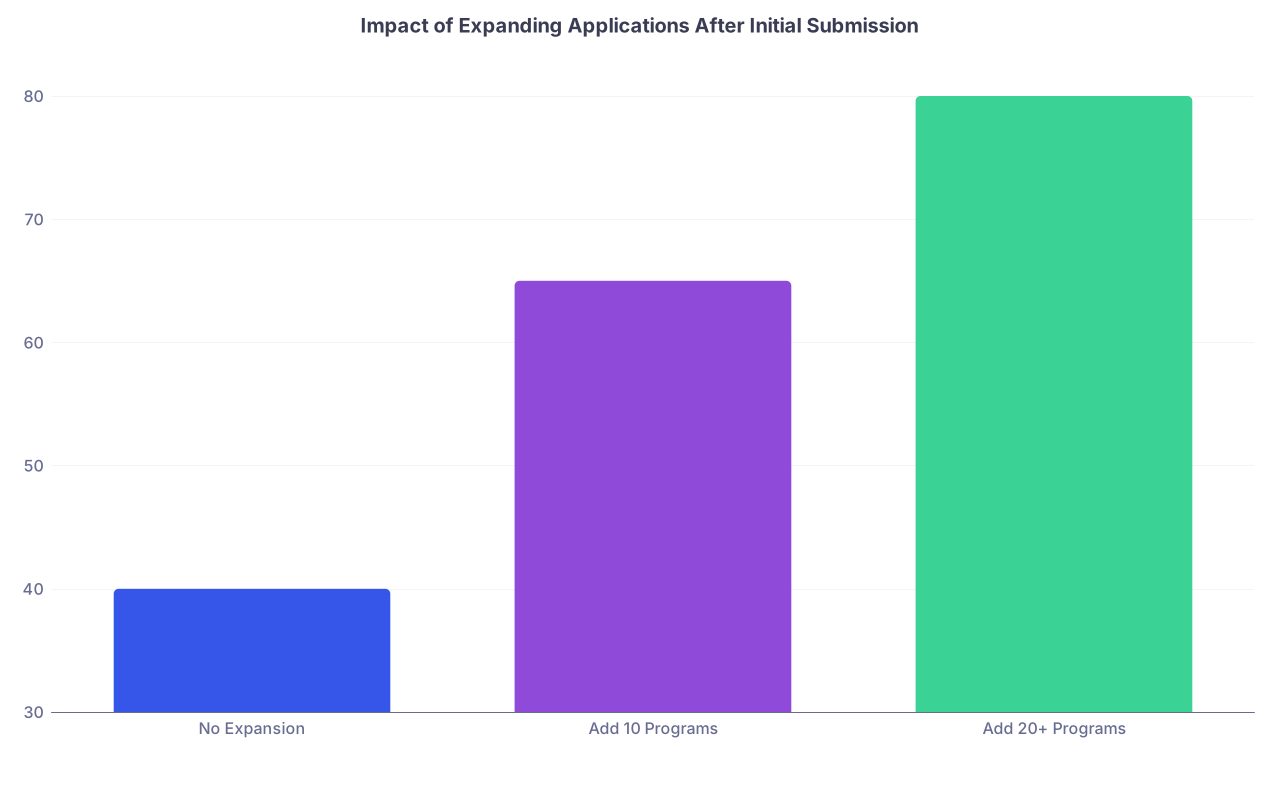
| Category | Value |
|---|---|
| No Expansion | 40 |
| Add 10 Programs | 65 |
| Add 20+ Programs | 80 |
(Think of those numbers as “relative chance of getting at least some interviews,” not exact percentages.)
If it’s still early in the cycle and you:
- Only applied to one region
- Are feeling a pit in your stomach
Then my honest recommendation: add programs in 1–2 additional regions that you’d actually consider living in. Not 20 random places you’d be miserable in. But enough that you’re not betting your entire career on one geographic slice.
If it’s later in the season and interviews already started going out, your moves are more limited, but not zero:
- You can add a few extra programs now (some interview late, especially community ones)
- You can start quietly planning a SOAP safety net if needed
- You can prep your email templates and “interest” statements for programs in your current region so you don’t miss any cracks of light
You’re not stuck. Just less flexible than you would’ve been a month ago.
Region Choice: Some Regions Give You More Cushion Than Others
Some regions are like safety nets. Others are like tightropes.
| Region | Program Density | Relative Safety for One-Region Strategy |
|---|---|---|
| Northeast (NY/MA/PA/NJ) | Very high | Safer for most non-ultra-competitive |
| Midwest (IL/OH/MI/MN) | High | Reasonably safe if open to community |
| South (TX/FL/GA/NC) | Moderate-high | Depends on specialty and visa issues |
| West Coast (CA/WA/OR) | Medium | Risky for competitive specialties |
| Mountain/Plains | Low | Risky if you only picked a few programs |
If your “one region” is:
- Just California
- Just the Pacific Northwest
- Just New England without NY/NJ/PA
That’s a lot less forgiving than “the entire Midwest” or “all of Texas + nearby states.”
Be honest: Did you choose a region… or did you basically choose one state and call it a region?
Competitive Specialty + One Region = Read This Twice
If you’re in a competitive field (derm, ortho, ENT, neurosurg, plastics, urology, ophtho, rad onc, sometimes anesthesia and EM in certain years), one-region strategies are brutal unless:
- You have ridiculous stats / research / letters
- In a region that’s dense with your specialty
- With home / away programs backing you
I’ve watched:
- A derm applicant with multiple publications, 260+ Step 2, applied mostly in one region, still didn’t match derm. Ended up scrambling into prelim then re-applying broader.
- An ortho applicant who applied almost exclusively in one state because of a partner… unmatched. Reapplied the next year after opening up geographically and matched fine.
Not to scare you, but to say: this isn’t an imaginary risk. It happens.
But I’ve also seen:
- A psych applicant who only applied to the Northeast but cast a wide net across community + academic programs and matched into a very chill city program.
- A FM applicant who only applied in the South near family and matched easily because primary care is desperate and they were clearly rooted in the area.
So: specialty matters. A lot.
What Can I Do Right Now To Help Myself?
Panic is not a strategy. Here’s what is.
1. Expand your list if you still can
If the deadline hasn’t passed and interview season isn’t over:
- Add 10–20 programs in at least one more region
- Prioritize community programs, newer programs, and less “name-brand” institutions
- Make sure you’d actually consider living there—you don’t need to love it, just tolerate it for a few years
2. Strengthen your “why this region” signal
If you’re truly tied to that one region:
- Mention it in your personal statement (if honest and not forced)
- Use any supplemental ERAS responses or program-specific questions to say: “My family is here,” “My partner works here,” “I’ve lived here for X years and want to stay.”
- For interviews you do get, be very clear: “This is where I see myself long term.”
Programs don’t hate regionally focused applicants. They hate applicants who look like they might bail.
3. Go hard on every single interview
Once invites start rolling in (and they will for most people, even with one-region setups):
- Don’t treat any interview as “below you”
- Don’t cancel early interviews thinking “better ones are coming” if your situation is already precarious
- Rank every place you’d be willing to survive three years at
You can always move after residency. You can’t match a program you never ranked.
A Different Way To Think About It: Is This a Career Risk or a Life Choice?
There’s a question nobody asks out loud: Did you choose one region because of real life?
Like:
- Partner can’t move
- Visa issues
- Health, caregiving, kids, or other family constraints
- Financial limits
- Trauma tied to leaving your support system
Then you’re not making a dumb career move. You’re making a human one.
Could it reduce your match probability? Yes.
Could it still be the right decision for you as a person? Also yes.
But if you went one-region because:
- “I just really love this city”
- “I hate cold weather”
- “I can’t imagine living anywhere else”
…then you have to decide: are you willing to be unmatched over that? Some people are. Most aren’t, once it gets real.
How Programs Actually View Regional Applicants
Here’s what I’ve actually heard PDs and attendings say over the years:
- “This applicant has strong ties here, they’re more likely to stay.”
- “Why is this California student only applying to New England with zero ties? Red flag or just random?”
- “I like seeing they have roots in the area; we invest a lot in residents who stay.”
They’re not hunting for some magical “balanced geographic distribution.” They just don’t want:
- People who clearly hate the city/region
- People who are obviously using them as a backup and will rank them last
- People who might flake or be miserable because they never wanted to be there
Your job is to make your one region look intentional and grounded, not like you filtered by “shortest distance from my favorite coffee shop.”
If Worst-Case Happens (Unmatched Fear Talk)
You probably won’t like this section, but your brain is already there, so let’s at least be realistic.
Worst case:
- You get very few or no interviews
- You don’t match in March
Does that suck? Completely. Is it the end? No.
Realistic next-step options:
- SOAP into prelim/TY/less competitive categorical spots
- Spend a year in research or a non-clinical role, then reapply broader
- Open up geography entirely on the second attempt and treat it as “career first, preferences second”
A lot of the “I applied too narrowly and didn’t match” stories I know turned into “I reapplied smarter and matched fine” stories a year later. Not fun. But not permanent failure.
Quick Reality Check: What You Should Actually Do Today
You don’t need a 50-point plan. You need like… three decisions.
If you’ve already applied to one region:
- Decide if you’re willing to add another region. If yes, list out 10–20 programs you’d tolerate and add them.
- Draft 2–3 sentences explaining your tie to your main region that you can reuse in emails and interviews.
- Make peace with the trade-off: you chose comfort or necessity over maximal odds. That doesn’t make you stupid. It just means you’re human.
FAQ (Exactly 4 Questions)
1. I only applied to programs in my home state. Is that the same as “one region” risk?
Sort of, but it depends on the state. If you’re in a big state with lots of programs (Texas, New York, California, Florida), it can be workable—especially for less competitive specialties. If you’re in a smaller state with only a handful of programs, that’s more like playing the residency lottery. You should strongly consider expanding to neighboring states or at least adding some programs in a nearby region that you could live in without hating your life.
2. I have no family or personal ties to the region I applied in. Am I doomed?
No, but you’ll need a story that isn’t “I just like it here.” Programs are totally fine with people moving in from elsewhere, but they want some reason to believe you’ll actually come and won’t be miserable. Think long-term fit: lifestyle in that region, training opportunities, cost of living, academic interests that align there. You can frame it as a deliberate choice—“I want to build my life here because…”—instead of random chance.
3. Is it better to apply broadly to places I really don’t want, or stay regional and risk not matching?
That’s a real trade-off, not a trick question. If your priority is “match somewhere in this specialty no matter what,” then yes, applying broadly (even to unappealing places) is safer. If your priority is “I will not move away from X for personal reasons, even if that means not matching,” then a regional strategy is consistent with your values. The problem is when people say they’ll accept the risk but secretly won’t. Be brutally honest with yourself now, not on Match Monday.
4. I realized this late—interviews already started. Is there any point in adding new regions now?
Sometimes yes. Some programs send late invites, some have cancellations, and some community programs interview well into the season. You’re unlikely to massively change your odds late in the game, but even 1–2 extra interviews can be the difference between matching and not. I’d still add a modest number of realistic programs in other regions, and then focus heavily on prepping for any interviews you do have so you don’t waste a single opportunity.
Open your ERAS list right now and count: how many total programs, and in how many distinct regions or states? If it’s basically “one bubble,” pick at least 5–10 programs outside that bubble you’d actually tolerate and add them today. Don’t overthink it for another week and lose time—you can always wish you’d done less, but you really don’t want to wish you’d done more.