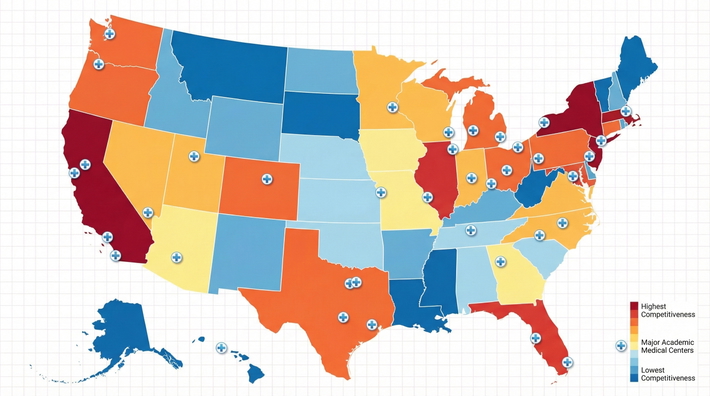
It’s 1:37 a.m. You’re on your couch, laptop open to Google Maps. One pin is where your dream program is. Another pin is where their best option is. The driving time says 9 hours, one way. Your stomach drops.
Your brain is already sprinting:
“If I rank this program #1, am I basically choosing to break up? Do long-distance relationships in residency ever actually work? What if we match in opposite corners of the country? What if I ruin both my career and my relationship trying to keep us together?”
Yeah. This is that article.
I’m not going to sugarcoat it: long-distance across regions in residency is brutal. But it’s not an automatic death sentence. The problem is, right now, all you can see are worst-case scenarios and vague Instagram success stories that feel fake.
Let’s make this concrete.
What You’re Actually Afraid Of (And You’re Not Wrong)
You’re not just afraid of “distance.” You’re afraid of:
- Different time zones and call schedules that never line up
- Never having days off that match
- Missing “normal couple stuff” for years
- One of you resenting the other for career choices
- Waking up at 32, fellowship applications due, realizing you’ve drifted apart
And on top of that, there’s the regional chaos: East Coast vs West Coast. Midwest vs South. City vs rural. Plane vs car vs “this literally isn’t drivable.”
Here’s the ugly truth I’ve seen:
- Same-region distance (like Boston–NYC) is hard.
- Cross-region distance (like Chicago–Seattle, Miami–Denver) is another level.
- Throw in oppositely intense specialties (like surgery + EM) and it can get…dark.
But “hard” does not equal “impossible.” The danger is pretending it’s either totally fine or totally doomed. It’s neither. It’s math, logistics, and priorities.
The Regional Reality Check: Distance Is Not Just Miles
Let’s get specific. A 6-hour drive and a 4-hour flight are not the same. Time zones and airports matter way more than raw distance.
| Pairing | Transit Type | Realistic Visit Frequency |
|---|---|---|
| Boston–NYC | Train/Bus | Every 2–4 weeks |
| Chicago–NYC | Flight | Every 4–6 weeks |
| LA–SF | Flight/Drive | Every 4–6 weeks |
| Chicago–Seattle | Flight | Every 2–3 months |
| Miami–Denver | Flight | Every 2–3 months |
Now layer on call, golden weekends, and time zones.
- East Coast + West Coast = 3-hour time difference
That 10 p.m. call from them is your 1 a.m. - Flights mean:
- Buying tickets months in advance
- Spending half your “together time” in airports
- Praying flights aren’t cancelled after a 28-hour call
Here’s the part people underestimate: it’s not just “we see each other less.” It’s the mental load of planning. Every tiny decision—who travels, when, whose vacation gets sacrificed—feels like a referendum on “who cares more.”
You’re not crazy for being scared of that.
How Residency Schedules Actually Collide With Distance
On paper, everyone says: “Oh, we’ll visit on weekends and vacations!”
On the ground? Let me show you residency’s version of a horror movie.

| Step | Description |
|---|---|
| Step 1 | You - IM Resident |
| Step 2 | Q4 call month |
| Step 3 | Clinic heavy month |
| Step 4 | Partner - Surgery Resident |
| Step 5 | Q3 call month |
| Step 6 | Nights |
| Step 7 | No visit |
| Step 8 | Golden weekend |
| Step 9 | Post nights fatigue |
| Step 10 | Possible visit |
| Step 11 | Weekend off? |
| Step 12 | Weekend off? |
Most couples in different programs, different regions deal with:
- Months where neither vacation weeks line up
- “Golden weekends” that are not actually golden because one of you is post-call zombie mode
- Last-minute call coverage changes that nuke carefully planned visits
And that’s before we talk about cost. Flights. Ubers. Eating out because neither of you has time to cook when you finally see each other.
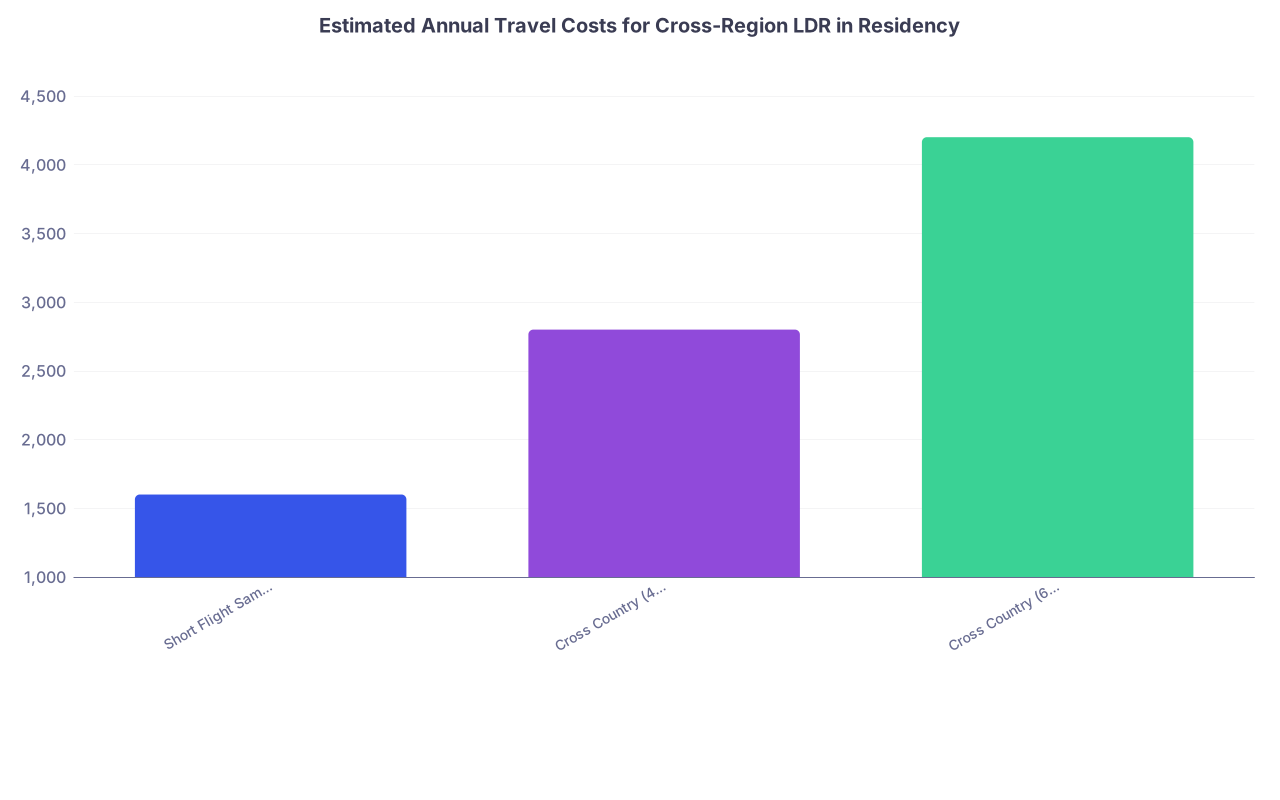
| Category | Value |
|---|---|
| Short Flight Same Region (4/yr) | 1600 |
| Cross Country (4/yr) | 2800 |
| Cross Country (6/yr) | 4200 |
Numbers are rough, but you get the point: you’re not just juggling time, you’re juggling money you don’t really have.
Honest Pros and Cons: Staying Together Across Regions
Let me be blunt. Long-distance across regions in residency can work, but it is not neutral. There are very real tradeoffs.
Potential Upsides (Yes, There Are Some)
- You both get to prioritize strong training without immediately sacrificing your careers
- You avoid the resentment of “I tanked my career for you”
- Visits can feel really intense and focused—no arguing over laundry, just actual time together
- You both have built-in independence and support systems locally
And there’s a weird benefit: if you do make it through this gauntlet, you come out knowing your relationship isn’t just convenience.
The Downsides (The Ones Keeping You Up at Night)
- Chronic loneliness—coming home after codes or a bad patient outcome to an empty apartment, again
- Feeling like you’re living two separate lives, with your partner as a FaceTime bubble, not part of your real world
- The guilt triangle:
- Guilt for not visiting enough
- Guilt for not studying enough
- Guilt for not sleeping enough
- Pressure to “make every visit perfect,” which is impossible when you’re both exhausted
- Real risk that by PGY3, you’re more roommates-who-text than actual partners
None of this means it’s doomed. It means: don’t go in blind.
Questions You Have to Answer Before Ranking Across Regions
This is where people mess up. They rank like they’re single, then panic like they’re married.
You and your partner need to answer these, in specific terms—not vibes.
What is our time horizon?
- Are we talking 3 years (short IM program), 5 years (general surgery), 7+ with fellowship?
- Are you both okay with that number?
What is the eventual plan to reunite?
- Same city for fellowship?
- One person switching programs (extremely hard, not guaranteed)?
- One person being flexible on job location later?
Who is traveling most of the time?
- “We’ll just split it” sounds fair but often doesn’t survive real schedules.
- If one of you is in a road-trip distance region and the other isn’t, does that change the math?
What are the non-negotiables?
Examples:- “We must see each other at least once every 2 months.”
- “We always spend Christmas together, no matter what.”
- “If we go more than X months without seeing each other, we re-evaluate.”
Are we okay breaking up if this doesn’t work?
I know. Awful question. But pretending that’s not on the table just makes everything scarier.
The couples I’ve seen survive this were not the ones who “trusted it would work out.” They were the ones who sat down with Google Calendar, looked at real flight schedules, and made an actual plan.
Picking Regions Strategically (Not Romantically)
You’re probably stuck in the “my dream program vs my relationship” false dichotomy. That’s too simplistic.
The smarter question is: Which regions give us the most realistic chance to see each other without destroying ourselves?
Some examples:
Cluster regions instead of extremes
- Boston–NYC–Philly corridor
- Chicago–Detroit–Cleveland
- LA–San Diego–SF (though SF is kind of its own planet)
Avoid mutually terrible combos if possible
- East Coast vs Pacific Northwest
- Deep South vs Pacific Coast with no direct flights
- Any pairing that requires a connection + 2+ hour drive
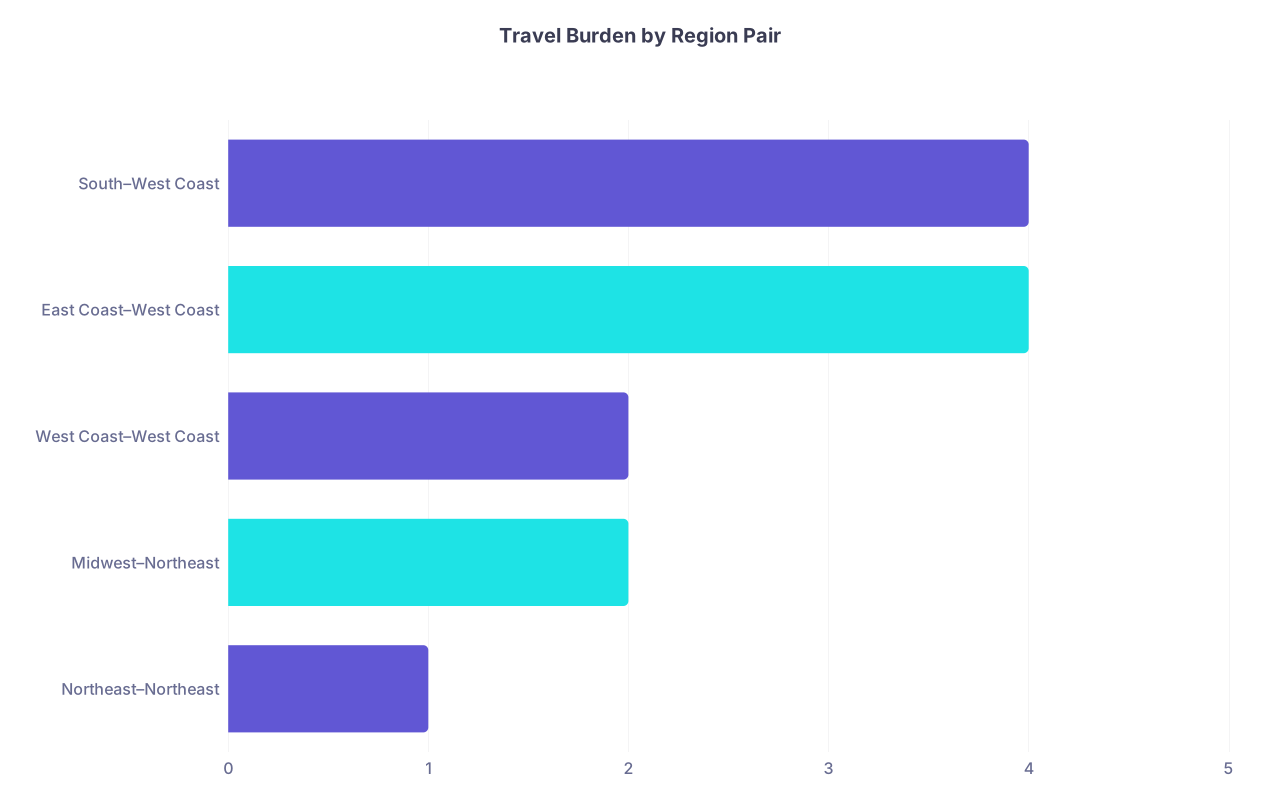
| Category | Value |
|---|---|
| Northeast–Northeast | 1 |
| Midwest–Northeast | 2 |
| West Coast–West Coast | 2 |
| East Coast–West Coast | 4 |
| South–West Coast | 4 |
Scale 1–4 is basically:
1 = drivable or short train, easy weekends
2 = short flights, somewhat doable
4 = time zones + long flights = pain
If you can skew your rank list to at least keep you in adjacent regions instead of opposite coasts, do that. It’s not selling out. It’s being realistic about the life you want for the next 3–7 years.
Things That Actually Help Long-Distance in Residency (Beyond “Communicate”)
Everyone says “communicate” like that’s a plan. It’s not. It’s a slogan. Here’s what people I’ve seen actually do that works.
1. Treat Your Relationship Like Another Rotation
Not in a gross way. In a “it gets scheduled” way.
- Put protected call times in your calendar
- Agree on “anchor” times: e.g., every Sunday morning, 30 minutes, non-negotiable unless you’re literally coding someone
- Decide how you’ll text when one is on nights, so no one freaks out if there’s silence
2. Plan Visits Like You Plan Step Studying
You cannot wing this. If you both just “try to visit when we can,” you end up seeing each other twice a year.
- As soon as vacation schedules drop, hop on FaceTime + Google Flights
- Book at least the first 2–3 trips early, even if you adjust later
- Accept that some trips will be “I visit and sleep on your couch while you work nights just to be in the same city”
3. Build Real Lives Locally
The most miserable residents in LDRs are the ones whose entire emotional center is a person in another time zone.
Make friends in your program. Join something small but consistent (gym class, running club, church, whatever). Have humans nearby who know you’re in a long-distance relationship and can drag you out of your apartment when you’re spiraling.
4. Be Honest About When It’s Hurting More Than Helping
You’re allowed to realize 18 months in: “This version of distance is breaking me.”
That doesn’t mean you failed. It means the system you’re in is inhumane, which…yeah.
Give each other explicit permission to say:
- “I love you, but I’m drowning”
- “Can we change the plan? Less visits, more FaceTime? Or the opposite?”
- “Do we need to have a serious talk about whether this still makes sense?”
That’s not weakness. That’s the only way you don’t quietly burn out and then explode.
If You’re Still Pre-Match: How to Rank Without Losing Your Mind
Here’s a rough sanity framework. Not perfect, but better than pure panic.
Ask yourself:
If we broke up tomorrow, how would I rank these programs?
That’s your “career-prioritized list.”If my only goal was staying as close as possible to them, how would I rank?
That’s your “relationship-prioritized list.”Now find the overlap that doesn’t make you sick.
Which programs feel like:- “Good enough for training”
- “Good enough for our relationship”
Not perfect. Not ideal. Just not a disaster.
Then decide your personal rule. For example:
- “I will not rank a program that’s more than one flight + long drive away if there is a reasonable program closer.”
- “I will not tank my entire career for relationship proximity, but I will accept slightly less ‘prestige’ to be in a cluster region.”
Write the rule down. When your brain starts spinning at 2 a.m., come back to it.
If You’ve Already Matched Far Apart: Now What?
So worst-case in your head happened. You’re in the Midwest, they’re on the West Coast. Or you’re in the South, they’re in New England. You feel sick reading your own Match email.
Breathe. It’s not game over. But it is game changed.
Your first moves:
Have one brutally honest conversation about:
- How long you’re willing to try this
- How often you realistically can see each other
- Where you both want to end up after residency/fellowship
Accept the first 6–12 months might just be survival mode.
Intern year + long distance = chaos. You’re not failing if it feels awful.Give yourselves a checkpoint:
“We’ll reevaluate at 12 months and 24 months. If one of us is miserable beyond repair, we’ll talk about changing the plan—even if that means breaking up.”
It sounds harsh. But having that safety valve weirdly makes it easier to show up fully now, instead of living in constant fear.
Quick Reality Snapshot: Do Long-Distance Residency Relationships Survive?
Nobody publishes clean stats on this. But anecdotally, here’s what I’ve seen (and what PDs quietly say):
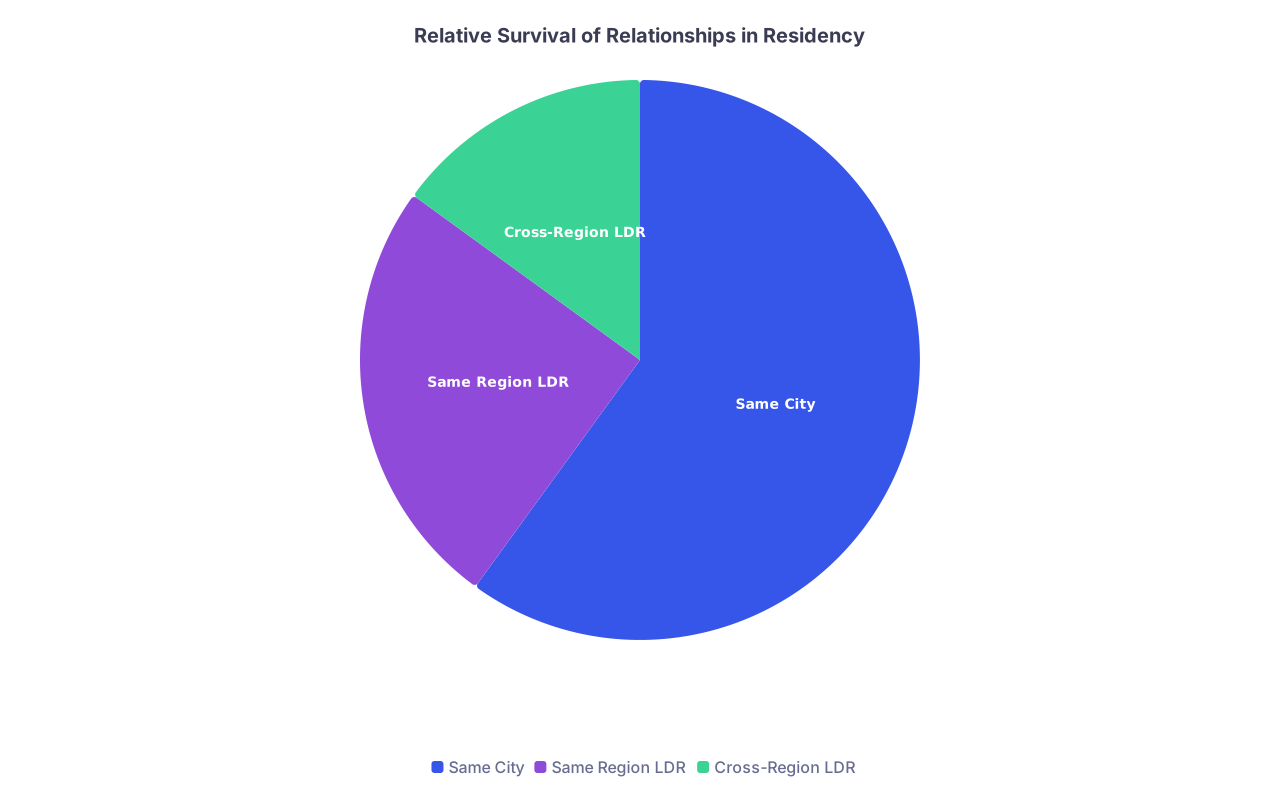
| Category | Value |
|---|---|
| Same City | 60 |
| Same Region LDR | 25 |
| Cross-Region LDR | 15 |
Very rough, not scientific, but the pattern holds:
- Same city relationships: still take hits, but obviously highest survival
- Same region but different cities: some strain, moderate survival with effort
- Cross-region, different time zones + flights: the hardest, but not zero
People do make it. But the ones who do:
- Didn’t romanticize the distance
- Didn’t martyr themselves career-wise or relationship-wise
- Treated this like a time-limited, purpose-driven phase, not a vague “we’ll see”
FAQ (Exactly 4 Questions)
1. Should I ever choose a worse program just to be in the same region as my partner?
Sometimes, yes—and that does not mean you’re unserious about your career. There’s a difference between “worse but still solid training” and “toxic program with awful outcomes.” If you’re choosing between a top-10 and a mid-tier but solid academic program in a cluster region with your partner, picking the mid-tier can be totally rational. Where I draw the line: don’t choose a malignant, unaccredited, or clearly dysfunctional program just for proximity. You can recover from being “less fancy.” It’s much harder to recover from three years of burnout and bad training.
2. Are some specialties basically incompatible with cross-region long-distance?
They’re not impossible, but some are absolutely harder. Surgical fields (general surgery, ortho, neurosurg), EM with crazy shifts, and IM with heavy inpatient months make travel and stable call times more painful. Two high-intensity specialties on opposite coasts? That’s the final boss. Easier combos are one intense specialty + one more flexible one (psych, pathology, some outpatient-heavy fields), and/or same time zone. But I’ve seen even two surgeons make it work if they’re strategic and stubborn enough.
3. How often do we “need” to see each other for this to work?
There’s no magic number, but here’s the pattern: less than every 3 months starts to feel like you’re dating a memory, not a person. Most surviving couples I’ve seen manage some kind of in-person time every 4–8 weeks—though sometimes that’s one person crashing in the other’s apartment while they’re on nights. The key is not just frequency but predictability. Knowing “I’ll see you in 6 weeks” is mentally different from “I have no idea when we’ll line things up again.”
4. Does breaking up to prioritize my training make me selfish?
No. It makes you honest. Staying in a relationship you secretly resent, or trying to do an impossible cross-country LDR out of guilt, isn’t more noble—it’s just quieter misery. If you know in your gut that you can’t give both your relationship and your training what they deserve in a cross-region situation, it’s more compassionate to say that out loud now than to slowly ghost emotionally over years. You’re allowed to choose yourself. You’re also allowed to choose the relationship. What you can’t do is pretend there’s no choice being made.
Close the 15 Google Maps tabs.
Open your rank list (or your already-matched emails) and answer one concrete question:
What’s the maximum level of distance (region + travel type + time zone) I’m actually willing to accept for the next 3–7 years?
Write that down—one sentence. That’s your anchor. Everything else you’re spiraling about has to pass that test.