The belief that any early research in MS1–MS2 guarantees a better Match is wrong. The data show a more specific story: research productivity and relevance matter, timing alone does not.
You are not trying to collect “research participation” points. You are building a measurable profile that programs use as a filter when competition tightens. So let’s talk numbers.
What the National Data Actually Show
Look at the most basic question: do applicants who match have more research than those who do not?
Using NRMP Charting Outcomes in the Match (specialty-specific PDFs, 2022) and AAMC data as the backbone, the pattern is consistent:
- Matched applicants in competitive specialties have more research experiences and more publications/abstracts/presentations than unmatched applicants.
- The gap is not subtle in the historically research-heavy fields.
Here is a simplified comparison (data approximated from recent NRMP reports—exact numbers vary slightly by year but the pattern is stable):
| Specialty | Status | Mean Research Experiences | Mean Presentations/Publications |
|---|---|---|---|
| Dermatology | Matched | ~6–7 | ~18–20 |
| Dermatology | Unmatched | ~5 | ~10–12 |
| Plastic Surgery | Matched | ~8 | ~22–25 |
| Plastic Surgery | Unmatched | ~6 | ~14–16 |
| Internal Med | Matched | ~3 | ~4–6 |
| Internal Med | Unmatched | ~2 | ~2–3 |
The direction is unequivocal: more tangible output correlates with matching, especially where competition is brutal.
Now, what does this have to do with MS1–MS2?
Early years matter because research output in medicine is not instantaneous. From joining a project to having a PubMed ID can take:
- 6–12 months for a simple case report
- 12–24 months for a retrospective study
- 18–36+ months for prospective work
If you begin at the end of MS3, your chances of having a serious body of work by ERAS submission are mathematically low. Early research is not magic. It is just more time for the pipeline.
Timing: Why MS1–MS2 Gives You a Structural Advantage
Think of your research output as a delayed-return function. Start earlier, shift the whole curve left.
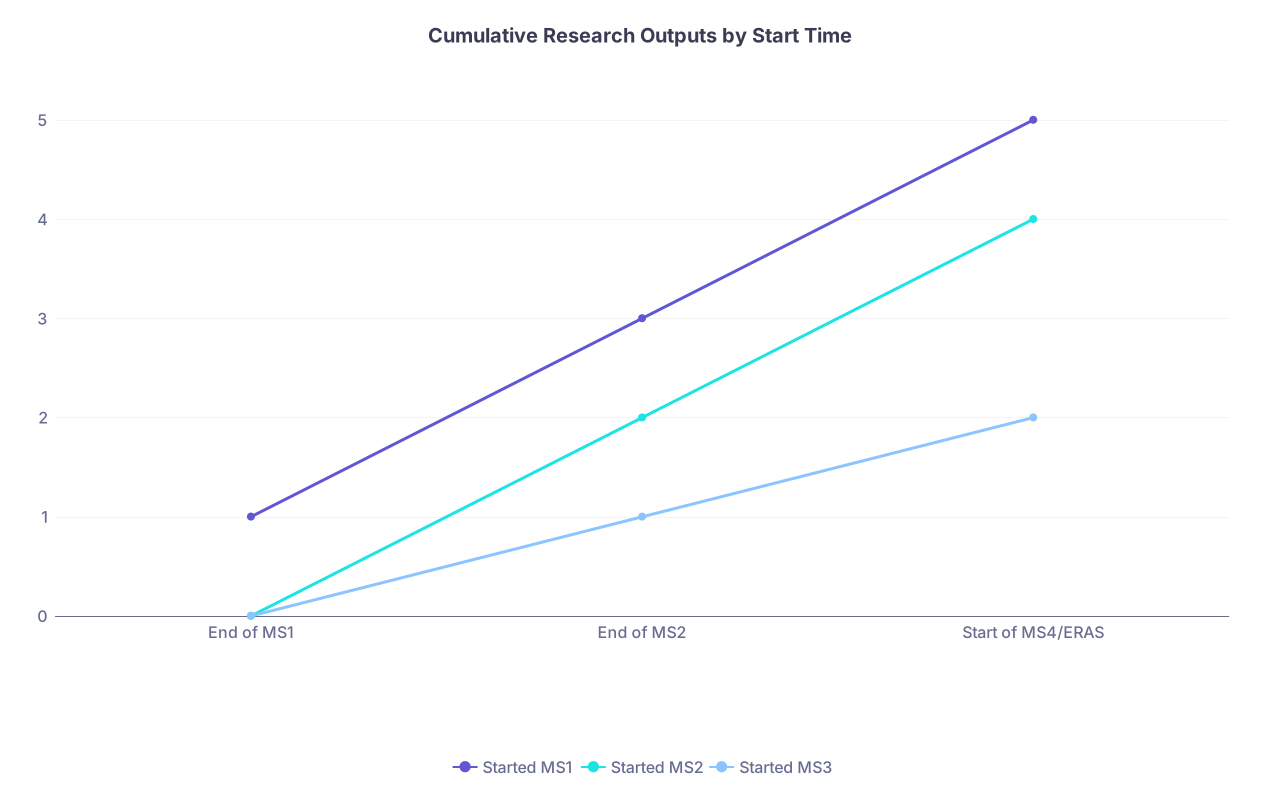
| Category | Started MS1 | Started MS2 | Started MS3 |
|---|---|---|---|
| End of MS1 | 1 | 0 | 0 |
| End of MS2 | 3 | 2 | 1 |
| Start of MS4/ERAS | 5 | 4 | 2 |
That stylized chart reflects what I have seen repeatedly reading CVs:
- MS1 starters: by ERAS, often 3–6+ outputs (mix of posters, abstracts, a couple of manuscripts; sometimes multi-center collaborations).
- MS2 starters: by ERAS, often 2–4 outputs.
- Late MS3 starters: often 0–2 outputs unless they were extremely lucky, extremely efficient, or worked insane hours.
So does early research predict better Match results? Indirectly, yes, by enabling:
- A higher count of presentations/publications by MS4.
- Stronger letters from research mentors who know you longer.
- A more coherent specialty narrative (especially if your research aligns with your target field).
Programs do not care that the project began in MS1. They care that, by September of your application year, you have evidence of productivity and commitment. Early work is just a time investment that pays in that window.
Specialty Differences: Where Early Research Really Moves the Needle
Early research does not pay off equally across all specialties. The gradient is clear.
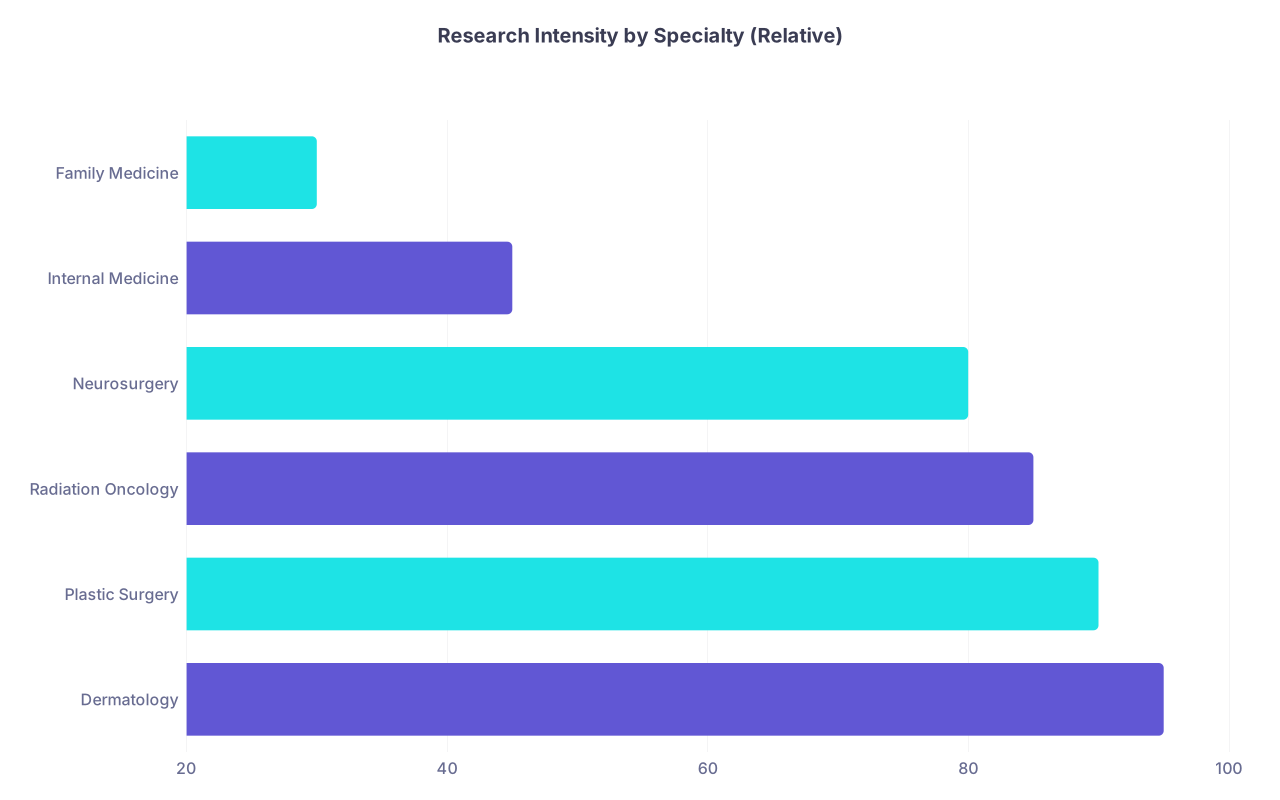
| Category | Value |
|---|---|
| Dermatology | 95 |
| Plastic Surgery | 90 |
| Radiation Oncology | 85 |
| Neurosurgery | 80 |
| Internal Medicine | 45 |
| Family Medicine | 30 |
Scale: 0–100 = relative research “expectation” intensity based on NRMP research numbers and program culture.
Here is how that translates into actual odds and incentives.
High-research specialties
Dermatology, plastics, neurosurgery, radiation oncology, ENT, ophthalmology.
Patterns in Charting Outcomes data:
Matched applicants often report:
- 5–10+ distinct research experiences.
- 15–25+ presentations/publications/abstracts.
Unmatched:
- Fewer experiences.
- Often single-digit outputs or poorly aligned research (e.g., pure basic science in an unrelated area, no clinical relevance to the specialty).
Early MS1–MS2 research here is almost a prerequisite if you did not come in with a “gap year research fellow” background. If you start in MS3, you are trying to compress 3–4 years of work into 12–18 months. The math is ugly.
Moderate-research specialties
Internal medicine (especially academic IM, cards/onc GI tracks), general surgery, orthopedics, EM.
Competitive IM programs (big-name academic centers) often see:
- 4–8 outputs for matched U.S. MDs.
- 6–10+ for IMGs and very top-tier applicants.
Surgery/ortho:
- Significant emphasis on specialty-specific output.
- I regularly see matched ortho applicants with 8–15+ total items, but not all started in MS1—it’s often a mix of MS2–MS3 plus dedicated research blocks.
Here, early research is a strong advantage, not always an absolute requirement. You can still be competitive starting late MS2 or early MS3, especially if your school gives dedicated research time. But that assumes you are efficient and guided well.
Lower-research-pressure specialties
Family medicine, psych (outside of ultra-competitive programs), many community-based programs across fields.
Research still helps. But the marginal return on an extra 3 posters compared with better clinical grades, stronger Step 2, or more targeted electives is smaller.
For these fields, MS1–MS2 research predicts better Match outcomes only weakly, and usually through secondary effects: scholarship mindset, stronger mentorship, better letters, and higher odds of landing at more academic programs.
The Real Predictor: Output Density, Not Just Early Start
There is a lazy misinterpretation: “Start any research in MS1 and you’ll be fine.” That is not what the numbers support.
The better predictor is output density by ERAS submission: publications + abstracts + presentations per year of actual engagement.
| Applicant Type | Start Time | Total Outputs by ERAS | Density (per year) | Competitiveness for Derm/Plastics |
|---|---|---|---|---|
| A: Early & Productive | Early MS1 | 10 | ~3.3 | Strong |
| B: Early & Low Output | Early MS1 | 2 | ~0.7 | Weak/Borderline |
| C: Late & Intense | Late MS2 | 6 | ~3.0 | Moderate–Strong |
| D: Late & Minimal | MS3 | 1 | ~0.5 | Very Weak |
Applicant B is the cautionary case I see often:
- Joined a basic science lab MS1.
- Came to lab sporadically.
- Project stalled.
- One poster at a local medical student day.
- No manuscript. PI barely remembers them.
On ERAS, this is “1 research experience, 1 local abstract.” That does not separate you in dermatology or plastics. It barely registers.
Applicant C, who started in late MS2 but joined a PI running multiple ongoing retrospective projects, may generate 4–6 abstracts/posters and 1–2 manuscripts quickly. That profile is stronger than B’s, even though B started “early.”
So early research is only predictive if it translates into:
- Multiple completed projects, not endless “data collection ongoing.”
- At least some peer-reviewed output, not just “manuscript in preparation.”
- Evidence that you actually did work: first-author items, clear role descriptions, PI-backed letters.
Mechanisms: How Early Research Translates Into Match Strength
Strip away the mythology. Early research helps because it drives specific, measurable advantages, not because programs reward MS1 effort sentimentally.
1. More time for the full research lifecycle
A realistic timeline from idea to publication:
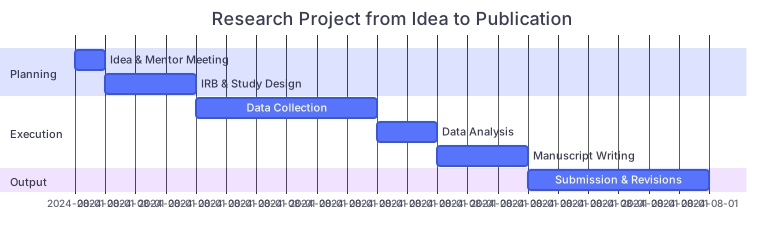
| Task | Details |
|---|---|
| Planning: Idea & Mentor Meeting | a1, 2024-08, 1m |
| Planning: IRB & Study Design | a2, after a1, 3m |
| Execution: Data Collection | a3, after a2, 6m |
| Execution: Data Analysis | a4, after a3, 2m |
| Execution: Manuscript Writing | a5, after a4, 3m |
| Output: Submission & Revisions | a6, after a5, 6m |
From first email to PubMed ID, you often need 18+ months. Sometimes 24–30. Starting in MS1 means some of those outputs can be published by ERAS, not just “submitted” or “in preparation,” which programs do discount mentally.
2. Signal of consistent academic interest
I have sat in rooms where faculty say, almost verbatim:
“They’ve been with our lab since first year and have 4 papers with us. That’s not a tourist.”
Longevity counts. When a PI can say, “I have known this student for three years, through 2–3 projects, and they followed through,” that letter carries more weight than a one-off 3-month summer rotation.
3. Better letters and networking
Strong research mentors do two things that directly influence Match outcomes:
- Write unusually detailed, specific letters (“She designed the analysis, wrote the first draft, and presented at national [X] meeting.”).
- Call or email programs on your behalf, particularly in that specialty.
Those relationships rarely form from a single summer. They often form from MS1–MS3 continuity.
Quantifying How Much Research is “Enough” by Target Field
No single number guarantees success, but trends from NRMP data and what I see in actual CVs can be translated into working targets.
| Specialty Tier | Outputs by ERAS (Reasonable Target) |
|---|---|
| Ultra-competitive (Derm, Plast) | 10–20+ total; ≥3–5 specialty-focused |
| Competitive surgical (ENT, Ortho, NSG) | 8–15 total; ≥3–4 specialty-specific |
| Academic IM / Cards / GI track | 5–10 total; ≥2–3 IM-focused |
| General Surgery / EM | 4–8 total |
| Psych / FM (academic focus) | 3–6 total |
| Psych / FM (community-oriented) | 1–3 total helpful, not mandatory |
Without an early start, hitting the top end of those ranges is hard unless:
- You take a dedicated research year.
- You have prior significant research (pre-med, master’s, PhD) that translates into publications.
- You enter medical school with ongoing collaborations.
For a standard MS1 entering with minimal research background, starting in MS1–MS2 dramatically increases the probability of landing in these ranges by MS4. That is the real predictive effect.
When Early Research Does Not Predict Better Match Outcomes
There are clear failure modes where early research does almost nothing for you.
1. Poor alignment with your eventual specialty
If you spend MS1–MS2 doing bench neuroscience, then decide in late MS3 on dermatology, your early work still helps, but at a discount.
Program directors consistently prefer:
- Specialty-relevant clinical or translational research.
- Or at least clearly medically oriented projects (outcomes, QI, clinical epidemiology).
If your CV shows:
- 5 basic science papers in a niche field unrelated to your applied specialty.
- Zero derm/plastics/ortho/etc. work.
You will look research-strong but specialty-agnostic. That may help you land at academic programs, but it does not fully substitute for even a couple of well-targeted projects in your chosen field.
2. “Name on a poster” syndrome
I have seen applicants list 8–10 posters, then when asked:
“What was the hypothesis? What did you actually find?”
They cannot answer cleanly. That is a red flag.
Programs distinguish between:
- Real work: you participated in study design, data cleaning, analysis, or serious writing.
- Peripheral involvement: you enrolled two patients, your name was added as 12th author.
On paper, both count as “research outputs.” In interview, only one survives scrutiny.
3. Neglecting everything else
A heavy research load can correlate with higher Step scores and better clinical performance for some students. For others, it correlates with burnout and mediocre grades.
Match decisions are multi-variable. Step 2 CK, clerkship performance, letters from clinical rotations, interview impressions—these carry more weight in most fields than squeezing out one more poster from an MS1 project.
If your early research leads to:
- Lower Step 2 because you split focus.
- Weak clerkship comments (“frequently distracted by research emails during patient care”).
Then the early research has backfired.
Practical Strategy: Using Data to Decide Your MS1–MS2 Research Approach
Let me be very direct: you should not blindly jump into research MS1 just because “people say it helps.” Use a simple decision framework.
Step 1: Estimate your specialty competitiveness needs
Roughly place yourself on this spectrum:
- “I am strongly leaning toward derm/plastics/ENT/NSG/ophtho/rad onc.”
- “I am leaning toward ortho, gen surg, academic IM, or EM.”
- “I am open to FM, psych, peds, or community IM.”
If you are in the first group, early MS1 research plus sustained productivity is almost mandatory unless you plan a dedicated research year. For group two, early MS1 or early MS2 gives you breathing room. For group three, early research is optional but beneficial for top academic programs.
Step 2: Choose for output probability, not “coolness”
Project selection should be cold-blooded:
- Does this PI have a track record of publishing with students?
- Are there ongoing projects where I can plug in quickly, rather than waiting 6 months for IRB?
- Is there a clear path to at least posters/abstracts within 6–12 months?
I have watched too many MS1s disappear into glamorous-sounding basic science labs where nothing ever reaches publication during med school.
If the choice is:
- “Nobel laureate PI, zero student-first-author history, fresh R01, no clear student plan.”
- Versus
- “Mid-career clinical faculty in your target specialty running 3 ongoing chart-review studies and a QI project.”
The second one almost always wins for Match outcomes.
Step 3: Aim for a steady, not heroic, time allocation
A sustainable research schedule during MS1–MS2 often looks like:
- 4–6 hours per week during semesters.
- 10–20 hours per week in summers or lighter blocks.
That is enough to:
- Clean datasets.
- Build simple REDCap surveys.
- Run basic stats with supervision.
- Draft sections of manuscripts.
It is not glamorous. But over 18–24 months, that steady weekly investment reliably builds 3–6 outputs. That is the compounding effect programs actually see.
The Bottom Line: What the Data Say about Early Research and the Match
Condense everything to three points.
Early research in MS1–MS2 predicts better Match results only insofar as it increases your final research output and depth of mentorship by ERAS. The timing is a leverage tool, not a standalone asset.
The predictive value is strongest in research-heavy specialties (derm, plastics, neurosurgery, etc.), where double-digit outputs are common among matched applicants. In these fields, starting late without a research year almost mathematically caps your competitiveness.
The real metric that matters is not “Did you do research in MS1?” but “How many meaningful, specialty-relevant outputs and strong letters did that early start ultimately generate?” If the answer is “very few,” the early start, by itself, does not rescue your application.