
It’s 11:47 p.m. Your Step 2 score report is open in one tab, and your ERAS draft is open in another. Your score is solid. Actually… it’s good. Maybe even “wow” for some programs.
But every time your eyes drift down to the “Scholarly Activities” section, your stomach drops. One poster from M3 that you barely remember. Maybe a case report that’s “in progress” and has been “in progress” since last year. PubMed? You type your name and get… nothing.
And then the spiral starts:
“I’m dead for academic places.”
“Everyone else has like 7 publications.”
“I should’ve taken a research year.”
“Did I just ruin my chances at my dream program because I chose to actually sleep instead of pipetting at midnight?”
Let me say the thing you’re too scared to believe right now:
Yes, you can still match where you want with good scores and weak research.
But not everywhere. And not without being smart about it.
Let’s walk through this without sugarcoating, but without the melodramatic doom your brain is feeding you at 2 a.m.
How Much Does Research Actually Matter By Specialty?
Here’s the part nobody tells you clearly: “Research” isn’t one universal requirement. Its importance swings wildly depending on what you’re applying to and what type of program you’re aiming at.
| Specialty Type | Research Importance | Comments |
|---|---|---|
| Community Internal Medicine | Low–Moderate | Nice to have, not required |
| Academic Internal Medicine (top-tier) | High | Especially for fellowship |
| Competitive Surgical (Derm, Plastics) | Very High | Research = expected |
| Mid-tier Pediatrics / FM | Low | Fit > research |
| Academic Neuro / Rad Onc / IR | High | Serious red flag if absent |
If you’re applying Family Med at a community-heavy list with a 250+ Step 2 and minimal research? You’re fine. More than fine.
If you’re applying integrated plastics at brand-name academic programs with one poster and nothing else? That’s almost a hard “no” from most of them, regardless of scores.
So you can’t just ask, “Can I match where I want?”
You have to define “where I want” in painful detail.
Your Brain vs Reality: The Research Panic Gap
Let me guess how your inner monologue goes:
“I saw someone on Reddit matching at MGH with 18 publications and an R01-PI mentor. I have… one poster and a sad case report graveyard. I’m done.”
Here’s the reality I’ve seen over and over looking at actual match lists and talking to PDs:
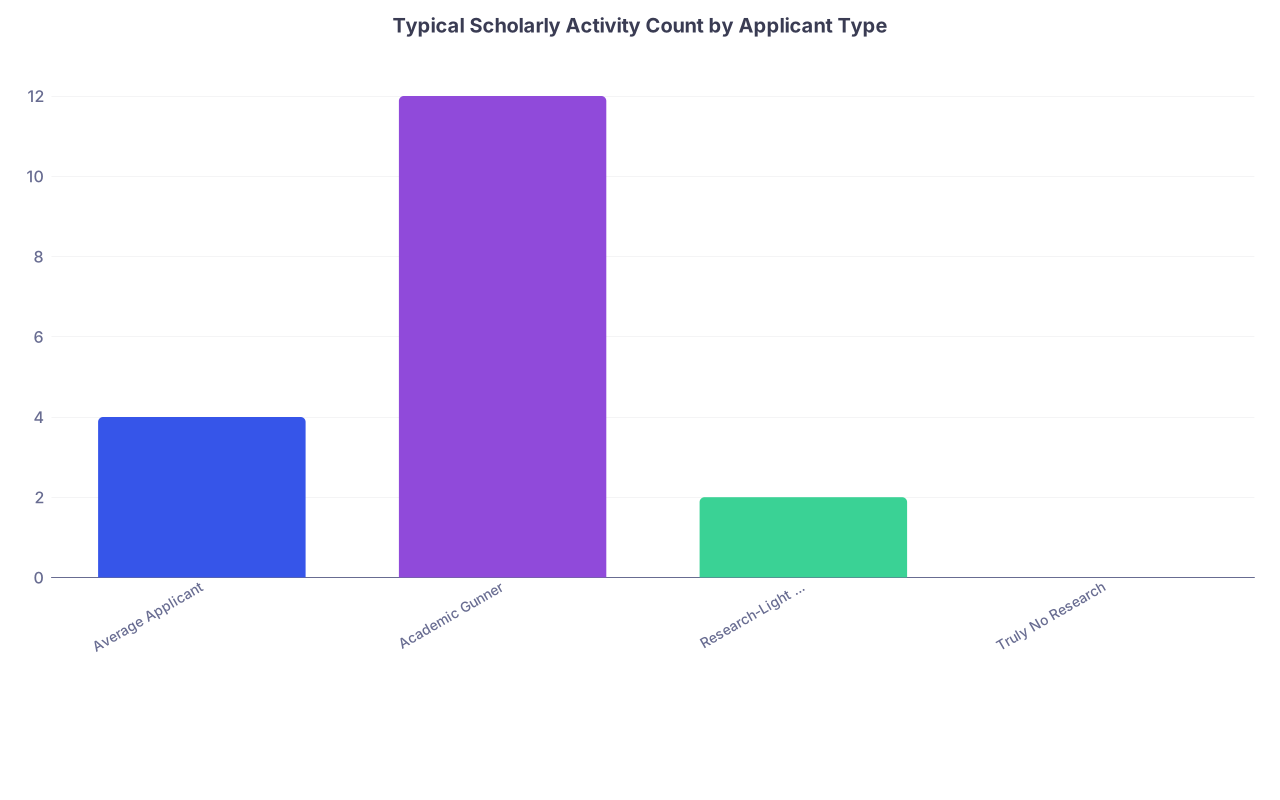
Most applicants do not have 10+ meaningful pubs.
They might have “10 items” but that’s abstracts, posters, submitted stuff, low-impact case reports, random QI.Program directors care more about:
“Did you show some evidence of academic curiosity?” than “Are you an NIH-funded prodigy at 26?”There is a massive difference between:
- Zero research, zero attempts, zero story
vs - Limited research, but you can explain what you did and why
- Zero research, zero attempts, zero story
| Category | Value |
|---|---|
| Average Applicant | 4 |
| Academic Gunner | 12 |
| Research-Light But Solid | 2 |
| Truly No Research | 0 |
You’re probably in that third category: “Research-light but solid.”
Your anxiety keeps telling you you’re in the “truly no research = doomed” camp. That’s not accurate.
Where Weak Research Actually Hurts You (Blunt Version)
Let’s just be direct about this, because pretending everything is fine doesn’t help.
Research weakness is a real problem if:
You’re going for highly academic, name-brand programs in competitive specialties
Think Derm at UCSF. Or Ortho at HSS. Or Rad Onc basically anywhere big. Those places are flooded with MD/PhDs and research-year kids with 10–20+ items.Your school is not well-known and you don’t have a strong network
If they don’t know your school, research is sometimes the “objective” signal they fall back on to differentiate you.Your letters can’t compensate
For research-heavy programs, strong letters from researchers in the field can soften a thin CV. If you don’t have those, it stings more.
On the other hand, you’re probably not in existential danger if:
- You’re applying to a mix of community and mid-tier academic programs
- Your Step 2 is strong for your specialty
- You’re actually decent on rotation and can get “would take again” letters
- You can talk about the work you did do like an adult, not like you’re apologizing for existing
So the question becomes: Are you misaligning your application with your profile?
Or are you just catastrophizing?
Program Fit: Academic vs Community, And Why It Matters For You
Here’s where people screw themselves: they build a rank list that doesn’t match their file, then act shocked when results hurt.
If your research is weak but your scores and clinical performance are strong, your sweet spot is often:
- Strong community programs
- Hybrid academic-community programs (university-affiliated, but not super research intense)
- Regional academic centers that care about teaching and service more than pure publication counts
These programs often like:
- Residents who want to show up on time, do the work, treat patients well
- People who maybe aren’t trying to bounce after PGY-2 to go “full-time research”
- Applicants who aren’t obsessed with their h-index and will actually help run the floors
They don’t say this on the website, but I’ve heard versions of it from faculty:
“I can train someone to do research. I cannot train someone to be less entitled.”
You are not poison because you don’t have a Nature paper.
You’re just a better fit for different kinds of programs than your anxiety is letting you see.
Can You “Make Up” For Weak Research Late?
You’re probably wondering: “Is there anything I can cram in now?”
Depends where you are:
If You’re At Least 6–12 Months From Applying
You still have time to build something credible. Not massive, but not nothing.
This is where low-hanging fruit matters:
- Join an ongoing project where most of the hard work is already done and they need help with data cleaning, chart review, references
- Find QI projects that actually turn into posters at your local/regional meeting
- Case reports that actually get submitted and accepted, not just endlessly “in preparation”
You don’t need 5 RCTs. Even 1–2 additional concrete outputs (poster, abstract, small paper) changes the optics from “no research” to “some research.”
If You’re Months Away Or Already In Application Season
No, you’re not going to suddenly become a research star in October of your M4 year. That ship sailed. For this cycle.
But you can:
- Clarify your existing work so it doesn’t look like fluff
- Make sure every project that’s even remotely presentable is listed correctly (submitted vs accepted vs in progress)
- Have a tight, coherent way of talking about your research interest, even if your CV doesn’t look deep
And you can absolutely say in interviews, if asked:
“I realized a little later that I enjoy the scholarly side more than I expected, so I’ve started working on X/Y. It’s in progress, but I’m excited to develop this further in residency.”
That’s not a lie. That’s you owning your path without sounding like you’re begging for forgiveness.
How To Talk About Weak Research Without Sounding Defensive
This is the part that actually trips people up more than the raw CV. Programs can smell shame and overcompensation a mile away.
If they ask about your research, your tone should be:
- Honest about the scope
- Clear on what you learned
- Forward-looking instead of apologetic
Bad version:
“Yeah, I know my research is really lacking. I just never had the chance. Our school didn’t really support us, and my mentor left, so…”
Good version:
“I’ve had limited formal research so far – mainly a poster on X and a case report in Y – but those experiences taught me A, B, and C. Going forward, I’m particularly interested in [clinical question] and would love to work with faculty here who are doing that kind of work.”
One sounds like you’re waving a red flag and making excuses.
The other sounds realistic but motivated.
Where Your Strong Scores Actually Save You
Your brain keeps zooming in on the weak part of your app. That’s what our brains do. But the things you do have matter:
- Strong Step 2 score says: I can handle the knowledge load. I can pass boards. I won’t be the person everyone’s panicking about in March of PGY-1.
- Strong shelf/clinical comments say: I function on the team. I show up. I’m not scary with patients.
- Strong letters say: A real attending trusted you enough to write something substantial.
Some programs would rather take the solid clinician with good scores and mild research than the research superstar who’s a black box on the wards.
You don’t see that trade-off on spreadsheets. PDs do.
| Category | Value |
|---|---|
| Clinical Performance & Letters | 40 |
| Board Scores | 30 |
| Research | 15 |
| Other (Leadership, Service, etc.) | 15 |
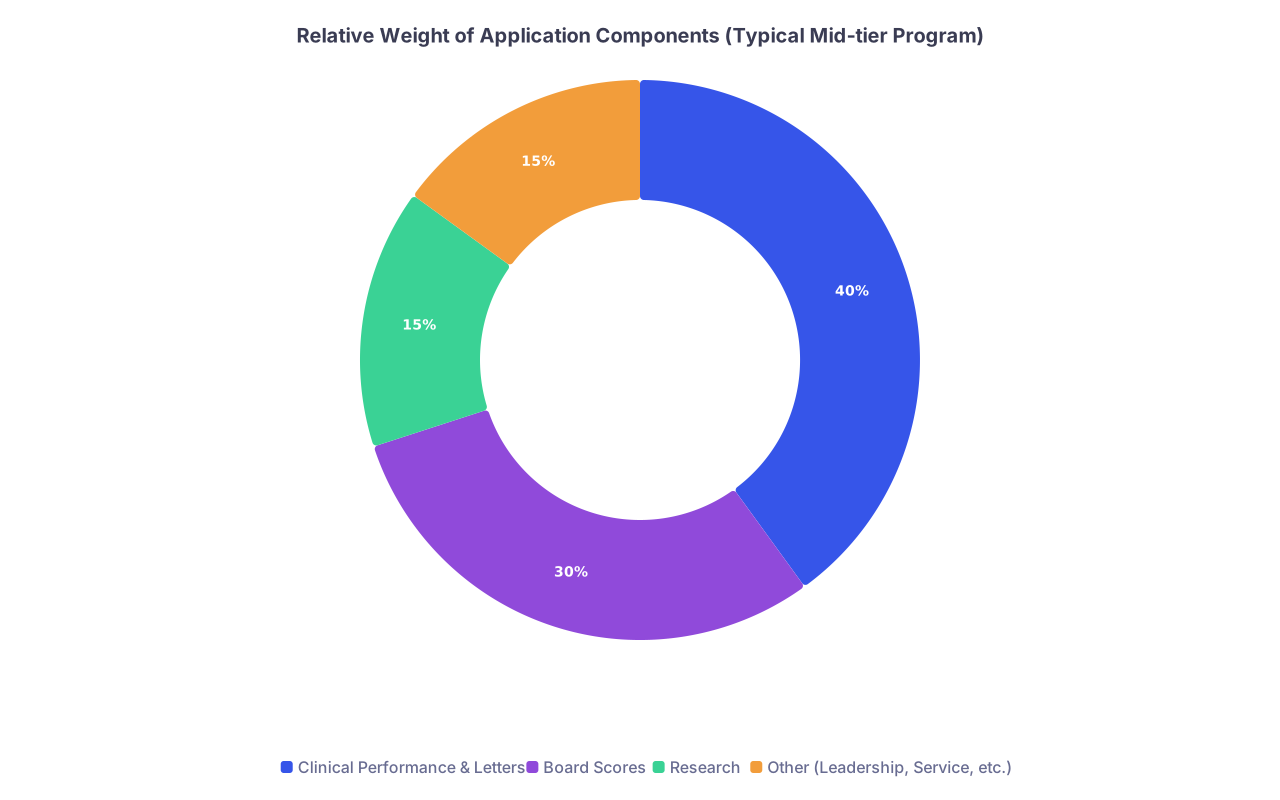
That 15% for research is not zero. But it’s not 70% either. And this is where most applicants completely misjudge things.
How To Build a Target List That Matches You (Not Your Anxiety)
This is the concrete part you can control, even if your CV is “done” for this cycle.
You want a list with:
- A mix of program types (some academic, some hybrid, some community)
- Regions where your school / med network already has a track record
- Enough total applications that you’re not all-in on research-obsessed places
If you insist your rank list must be: “Top-10 academic center only, in one coastal city, in an ultra-competitive field, with my current research,” then yeah. That’s not research anxiety. That’s misalignment with reality.
You don’t have to give up ambition. You might just need to adjust the type of prestige you’re chasing.
Academic prestige is one flavor.
Clinical volume / autonomy / reputation in a region is another.

| Step | Description |
|---|---|
| Step 1 | Good Scores, Weak Research |
| Step 2 | Focus on Fit, Geography, Clinical Strength |
| Step 3 | Build Mixed List: Academic + Community |
| Step 4 | Consider Research Year or Adjust Expectations |
| Step 5 | Highlight Clinical Strengths |
| Step 6 | Specialty Highly Competitive? |
| Step 7 | Willing to Choose More Community Programs? |
Reality Check: Can You Still Match Where You Want?
So… back to the original fear.
“I have good scores but weak research. Can I still match where I want?”
My honest answer:
- If “where I want” = ultra-elite, top-10, name-brand research factory in a hyper-competitive field → probably not, unless your “weak” research is actually better than you think and you’ve got monster letters.
- If “where I want” = a solid, respected program where you’ll become a good doctor, maybe still academics, in a reasonable city → absolutely, yes. All the time. I’ve seen it.
You’re not out of the game. You’re just not playing with the exact stat profile you’d fantasized about in M2.
And that’s uncomfortable. But it’s not fatal.
What You Should Do Today To Stop the Spiral
Pick one of these and actually do it today, not just think about it:
Pull up 5 programs you’re interested in and actually read their residents’ bios.
Count how many have tons of research vs “normal” levels. You’ll realize most are not robotic publication machines.Email one faculty member or mentor and ask bluntly:
“Given my current research and scores, what range of programs do you think is realistic, and where should I aim high vs safe?”Open your ERAS research section and clean it up.
Make sure everything is formatted, honest, and not underselling what you did.Draft 3–4 sentences answering:
“Can you tell me about your research experience?”
Practice saying it in a way that doesn’t sound like an apology.
Do one. Today. Not later.
Waiting doesn’t make the anxiety better. Taking one small concrete action usually does.
FAQ (Exactly 4 Questions)
1. Do I need publications to match at all?
No. Plenty of people match every year with zero actual publications, especially in primary care, psych, peds, and less research-heavy IM/FM programs. Having something helps, but “no publications = automatic rejection” is just not true outside of a few specific competitive niches and top-tier academic centers. Programs have matched tons of residents over the years who wanted to be clinicians first and researchers second (or never).
2. Should I delay graduation or take a research year just to boost my chances?
Only if your dream is a research-heavy, very competitive specialty/program and literally every mentor you trust is telling you, “You won’t be competitive for these places without more research.” A research year is a big cost: money, time, mental energy, and it’s not a magic key. Doing a half-baked research year with weak output won’t fix things. If you’re aiming at solid mid-tier or community programs, a research year is usually overkill and unnecessary.
3. I’m already in M4 and my research is weak. Is there anything still worth starting now?
You’re not going to create a whole portfolio before rank lists, but you can jump into small, realistic projects: chart-review helping on a senior resident’s paper, a quick QI project, or a case report that might at least be “submitted” by the time interviews roll around. The bigger impact, though, will be organizing what you already have, getting your mentors to reference your academic curiosity in letters, and being able to talk coherently about your interests rather than trying to frantically pad your CV last-minute.
4. Will my weak research close doors for fellowships later?
It might close doors at the most research-intense fellowship programs if you never build any research during residency. But residency is a reset button in a lot of ways. If you match at a place with decent academic infrastructure and later decide, “I really do want cards/onc/GI/etc,” you can get involved in projects then. Fellowship PDs care what you did in residency at least as much as what you did in med school. Weak med school research isn’t a permanent sentence unless you never address it.
Open your ERAS CV right now and scroll to “Scholarly Activities.” Instead of counting what’s missing, ask yourself: “Given what’s here, which types of programs would actually value the rest of my application?”
Then write down 3 program types that fit you as you are today—not the version of you your anxiety thinks you had to be.