

It’s September of your application year. Your ERAS is basically done. You finally admitted to yourself that you do not want to do surgery / OB / neurology / [insert old specialty here]. You switched—late—to psych, FM, radiology, EM, whatever.
And now you’re staring at your CV thinking:
“My entire research portfolio is in the wrong field. Am I screwed?”
You’re not. But if you handle this lazily, you will look scattered or, worse, dishonest. If you handle it well, you can actually look thoughtful and multidimensional.
Let’s go step by step.
1. Get Real About Your Starting Point
Before you can “rebrand” anything, you need to know exactly what you have.
Grab your CV and list every research item on a blank sheet (or doc). For each, write:
- Project title (in your own words, not just the formal title)
- Specialty / department it sits in
- Your actual role (be brutally honest)
- Product: abstract, poster, oral, publication, QI project, database work
- The core skills you used
Something like:
- “Surgical outcomes in elderly hip fracture patients – Gen surg/ortho – data extraction, chart review, created REDCap database – poster at regional meeting – stats: basic logistic regression, ORs, CIs”
- “OB hemorrhage QI bundle – OB/GYN – helped design checklist, did PDSA cycles, run charts – internal QI presentation”
- “Neuroimaging in stroke – neurology/radiology – mainly image labeling + inter-rater reliability – abstract submission pending”
You’re trying to see what’s under the content area. Because that’s what you’ll sell.
Now be clear where you’re headed:
“I am now applying to: ___”
Write the new specialty at the top of the page. That’s your anchor.
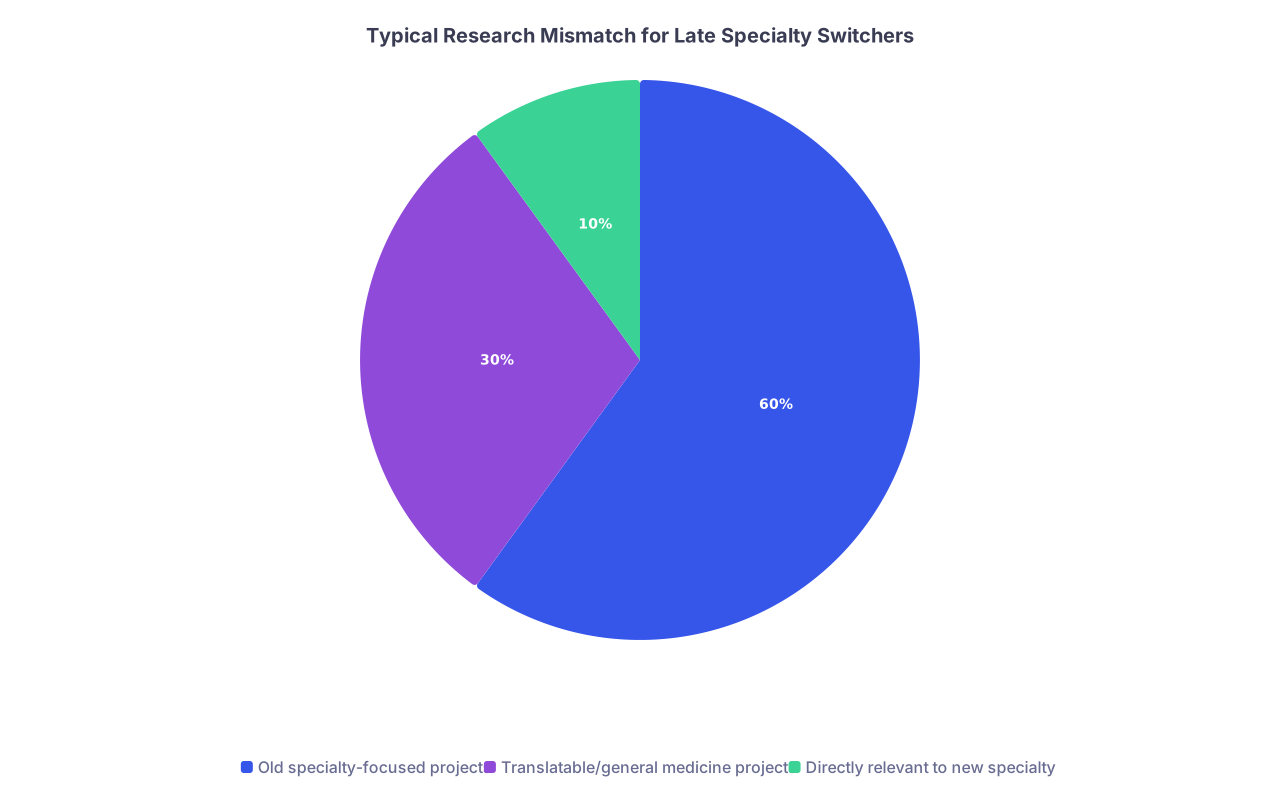
| Category | Value |
|---|---|
| Old specialty-focused projects | 60 |
| Translatable/general medicine projects | 30 |
| Directly relevant to new specialty | 10 |
Most late switchers are about 60–70% “wrong-field” projects, 20–30% semi-relevant, 0–10% directly relevant. So your situation is normal.
Your goal is not to pretend the old field never existed. Your goal is to:
- Reframe old work in terms of skills and themes relevant to the new field.
- Connect a believable story arc from Old You to New You.
- Avoid sounding like a professional chameleon who’ll switch again next year.
2. Translate Content → Skills → Themes
Programs don’t care that you did a project on “laparoscopic vs open appendectomy” per se. They care what that says about how you think and work.
Pick one “wrong-field” project and walk it through three levels:
Level 1: Raw Content (old specialty)
Example:
“Surgical site infections after colorectal surgery.”
If you leave it here, it just screams: “Why aren’t you applying to surgery?”
Level 2: Skills
What did you actually do?
- Data cleaning and management
- Chart review and standardized data abstraction
- IRB submission or modification
- Basic stats (chi-square, logistic regression, Kaplan-Meier, whatever)
- Creating figures/tables
- Presenting at meetings
- Working in a multidisciplinary team
- QI methods (PDSA, run charts, control charts, pathways)
These skills are field-agnostic. EM, IM, psych, path, radiology—all of them care about people who can run a project from A to Z.
Level 3: Themes that map to your new field
This is where you make it relevant.
You’re switching to psychiatry? Infection risk → health disparities, adherence, complex comorbid patients, quality of care.
To EM? Infection risk → acute surgical abdominal pain, ED decision-making, disposition, perioperative risk assessment.
To radiology? Perioperative complications → pre‑op imaging indications, quality of imaging interpretation, correlation between imaging and outcomes.
You’re not lying. You’re highlighting the parts that connect.
3. Rewrite Your Research Descriptions for ERAS
You don’t change the truth. You change the framing.
Take your ERAS “experience description” from this:
Retrospective cohort study evaluating risk factors for surgical site infections in colorectal surgery patients. Performed chart review and data entry. Created tables and figures for manuscript.
To this (for someone switching to Internal Medicine or EM):
Retrospective cohort study of 600+ adults undergoing colorectal surgery, examining patient-level risk factors for postoperative infections and readmissions. Led standardized chart abstraction, coordinated with infection control and anesthesia, and worked with the statistician on multivariable models. Experience reinforced my interest in caring for medically complex adults and understanding how pre‑existing comorbidities and perioperative decisions drive longer-term outcomes.
Same facts. Different emphasis.
Or for a switch to Psychiatry:
Retrospective cohort study of 600+ adults undergoing colorectal surgery, focused on patient-level predictors of postoperative infections and readmissions. Used standardized chart abstraction to capture not only medical comorbidities but also psychosocial factors and adherence-related variables discussed in visit notes. Working on this project heightened my interest in how mental health, social support, and health behaviors influence medical outcomes, which I later pursued more directly in psychiatry.
That last sentence is the pivot. It tells the reader: this is not random; this led somewhere.
Do this for every project:
- Keep the first line honest about the project’s actual focus.
- Use the middle to showcase transferable skills.
- Use the last 1–2 lines to tie to a theme that lives inside your new specialty: complex chronic disease, communication, systems of care, vulnerable populations, imaging accuracy, procedural safety, whatever fits.
4. Fix the Big Three: Personal Statement, Experiences, Interviews
You have three main storytelling surfaces where this rebrand has to be tight and consistent.
A. Personal Statement: Explain the Shift Without Sounding Flaky
The worst version is: “I loved surgery until fourth year, then I tried psych and loved it more.” That reads like: “I fall in love with whoever I’m currently dating.”
You need a coherent arc. One that makes prior research look like a stage, not a mistake.
Template you can adapt:
- Start with a moment or pattern that reflects your new specialty mindset (patient interaction, way of thinking, clinical scenario).
- Briefly acknowledge your initial path and related research.
- Show how that work exposed you to questions that belong more naturally to your new field.
- Describe specific experiences in the new field that “clicked” with those questions.
- End with where you’re headed and how your prior work prepares you to contribute.
Example for surgery → psychiatry switcher:
- You might open with a patient on the surgical floor whose post-op course was dominated more by underlying depression and substance use than by their incision.
- Then: “I entered medical school convinced I’d be a surgeon. My early research followed that path: outcomes in older adults, surgical complications, QI initiatives in the OR.”
- Transition: “But even in those settings, I kept being drawn to the choices patients made before they ever reached the OR, their fears, their histories with trauma and addiction. That curiosity led me to seek more time in psychiatry, where the questions I’d been circling finally had a home.”
- Close tying research skills (study design, outcomes thinking) to future interest in psychiatric outcomes, health services, or quality of care.
Your research is part of the backstory. Not something you hide in a footnote.
B. Experiences Section: Audit for Consistency
Look at your entire ERAS experiences section:
- Clinical work
- Teaching
- Leadership
- Research
- Volunteering
Ask: If a stranger read only this, would they guess your specialty?
You don’t need perfect alignment. You do need enough threads pointing in the same direction that your change looks like evolution, not a hard 180.
Sometimes that means:
- Putting your more relevant research higher in the list (yes, order matters psychologically).
- Expanding descriptions for experiences that fit your new field.
- Tightening or shortening descriptions that scream your old field, still honest but not the star of the show.
C. Interviews: Your 15‑Second “Why the Switch?” Script
You’ll get this question in some form:
“So, you did a lot of [old specialty] research. What led you to apply to [new specialty]?”
You need a clean, practiced, non-defensive answer. Structure it:
- Acknowledge the original interest and what you liked.
- Describe what you gradually realized was missing.
- Connect that realization to concrete experiences in the new field.
- Show how your past research gives you useful tools now.
Example:
“I came into med school very procedure-oriented, and surgery gave me that hands-on, high-acuity environment I thought I wanted. My early research in surgical outcomes taught me to think systematically about complications and readmissions.
Over time, though, I realized the parts that stuck with me were the patients whose courses were shaped more by their chronic illness, social support, and follow‑up than by the operation itself. When I spent more time on the medicine wards and in clinic, I recognized that I wanted to own that longitudinal piece. So now, applying in IM, I see my prior research as a foundation for thinking critically about outcomes and systems of care on the medical side instead.”
Short. Direct. Not apologizing.

| Step | Description |
|---|---|
| Step 1 | List All Research |
| Step 2 | Extract Skills & Methods |
| Step 3 | Identify Themes Relevant to New Field |
| Step 4 | Rewrite ERAS Descriptions |
| Step 5 | Integrate into Personal Statement |
| Step 6 | Prepare Interview Story |
5. Specialty-Specific Rebranding Moves
Let’s get concrete. Here’s how I’ve seen people successfully reframe “wrong” research into various “right” fields.
| Old Research Type | New Specialty Target | How to Reframe Main Theme |
|---|---|---|
| Surgical outcomes | Internal Medicine | Complex comorbidities, readmissions |
| OB hemorrhage QI | Emergency Medicine | Acute resuscitation, protocols |
| Neuroimaging in stroke | Radiology | Imaging accuracy, interpretation |
| Oncology chemo complications | Palliative Care/IM | Symptom burden, quality of life |
| ICU sedation protocols | Psychiatry | Delirium, cognition, psychopharm |
A few common lanes:
To Psychiatry
From almost anything, you lean into:
- Psychosocial factors documented in charts.
- Adherence and follow-up issues.
- Substance use, trauma histories, chronic pain, coping.
- Communication with anxious or distressed patients.
Even if your project never said “depression,” you can say:
“During data abstraction, I was struck by how often mental health, substance use, or social isolation showed up in provider notes as unstructured comments but clearly influenced outcomes…”
That’s not spin. That’s pattern recognition.
To Radiology
You focus on:
- Imaging utilization (who got scans, when, and why).
- Correlation between imaging findings and outcomes.
- Interdisciplinary communication (surgery–radiology, neuro–radiology).
- Diagnostic uncertainty and the role of imaging in clarifying or complicating decisions.
Example shift:
“Neurosurgery outcomes in subdural hematoma” → “I became very attuned to how CT and MRI findings—small differences in midline shift or density—drove huge differences in management. That’s what pulled me toward a field where that interpretive step is central.”
To EM
You sell:
- Acute presentations and triage.
- Time-sensitive decisions.
- Protocols and bundles (sepsis, hemorrhage, MI, stroke).
- Systems and flow, especially front-end of care.
Any inpatient complications can be reconnected back to that first ED visit: when decisions were made, what information was (or wasn’t) available.
To IM / FM
You highlight:
- Chronic disease management.
- Multimorbidity.
- Transitions of care, readmissions, discharge planning.
- Follow-up, adherence, social determinants of health.
If your old work was “niche procedural,” zoom out to the patient’s overall course across settings, not just in the OR.
To Anesthesiology / Critical Care
You pivot to:
- Perioperative risk, hemodynamics, ICU complications.
- Sedation, ventilation, delirium.
- Protocol implementation and safety.
Again, outcomes language fits beautifully here.

6. What You Should NOT Do
This is where people blow it.
Do not rewrite history.
Don’t change titles. Don’t imply psych patients were part of your appendectomy study if they weren’t. Don’t invent a “mental health angle” you never actually studied. You reframe, you don’t fabricate.Do not pretend you always wanted the new field.
Program directors can read your CV. They see 4 surgery projects, 2 surgery honor society awards, and then suddenly: “I’ve always been passionate about psychiatry.” No. Own the evolution.Do not trash your old specialty.
Saying “I hated being in the OR” to a PD who values professionalism is dumb. You can say, “I realized I missed X,” not “surgery people were awful.”Do not over‑index on research to prove commitment.
You can’t fully compensate for late clinical exposure with one hastily started research project in September. They know the timelines. It’s okay that most of your work is old-field. You just need the story to make sense.Do not leave it to the reader to connect dots.
If the specialty connection is obvious in your head but nowhere in your writing, it doesn’t count. Spell it out.
7. Quick Scripts for Common Awkward Moments
“Why is all your research in X if you’re applying to Y?”
“I started medical school very focused on X, so naturally my mentors and projects were in that world. As I progressed clinically, I realized the questions that kept me up at night were more aligned with Y—[give specific examples]. The research I’ve done gave me a strong foundation in study design and outcomes, and I’m excited to bring that mindset into Y going forward.”
“Are you sure you won’t change again?”
“I understand the concern. For me, this wasn’t a snap decision. It came after [specific rotations, mentors, experiences]. This past year, every time I was on a Y service, I felt like, ‘These are my people and my patients.’ I’ve been honest with my mentors about it, and they’re fully supportive of this direction.”
“Do you regret spending so much time on your old path?”
“Not at all. Those experiences taught me a lot about myself and how different parts of the system work. They’re also why I’m so confident now—because I’ve seen the alternative up close and can say, ‘Y is where I fit best.’”
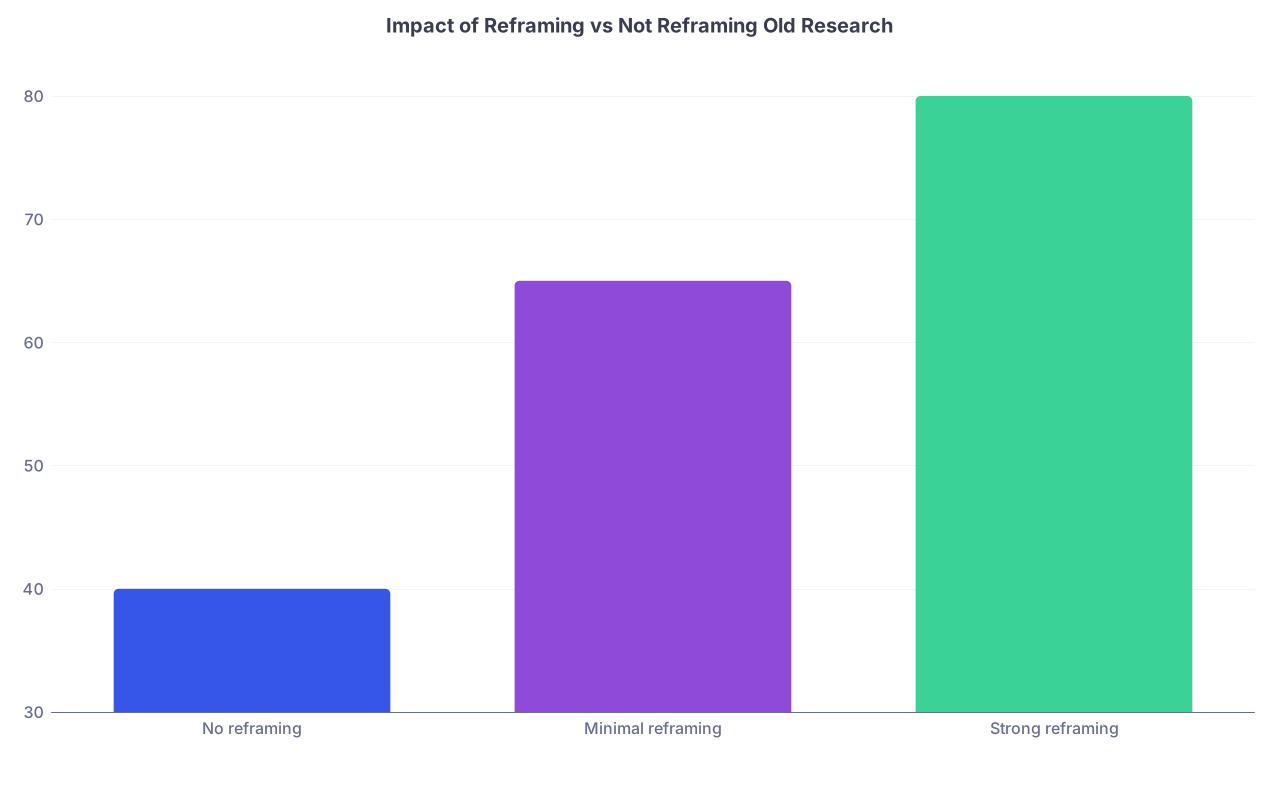
| Category | Value |
|---|---|
| No reframing | 40 |
| Minimal reframing | 65 |
| Strong reframing | 80 |
(Think of those “values” as your odds—qualitatively—of coming across as coherent and convincing. Strong reframing isn’t fluff. It changes how your whole file reads.)
8. If You Still Have a Little Time Left
If you’re not right up against deadlines, there are a few smart, targeted moves:
Get one small, clearly aligned project started in the new field.
Even a modest chart review, case series, or QI project can serve as a “bridge.” You won’t finish it before interviews, but you can list it as “ongoing” and talk about it.Ask your old mentor to explicitly support your new direction in a letter.
A surgery attending writing, “I fully support their choice to pursue psychiatry; they have the temperament and curiosity for it” is powerful and disarms concerns.Join a section or interest group in the new specialty.
Present a poster at their regional or national meeting—even if it’s repurposed data reframed to fit. The submission itself forces you to practice the rebranding.

FAQ (Exactly 4 Questions)
1. Should I leave off my old-specialty research so I do not look unfocused?
No. Hiding significant research is worse than showing it. Program directors know people change their minds. Omitting solid scholarship makes your CV look thin. Keep it, but reframe descriptions to highlight skills and themes that fit your new field. The only things to cut are very minor, redundant, or low-quality projects that don’t add anything.
2. How many projects do I need that are directly in my new specialty to be “credible”?
There’s no magic number. I’ve seen people match solidly with zero fully-completed projects in the new field, as long as they had: 1) strong clinical performance and letters in the new specialty, 2) a believable narrative about the switch, and 3) research that clearly showed translatable skills. One ongoing project in the new field helps a lot but isn’t mandatory in many specialties.
3. Can I change the listed project title on ERAS to sound more aligned with my new specialty?
You can simplify or clarify a title, but you should not materially change what the project was. If the original IRB title was “Postoperative Outcomes in Colorectal Surgery,” don’t rename it “Psychosocial Predictors of Postoperative Outcomes.” That’s misleading. You can say “Colorectal Surgery Outcomes and Patient‑Level Predictors” and then use the description to highlight the psychosocial angle you actually collected.
4. What if my old mentor is offended that I switched specialties—will that hurt my application?
It can be awkward, but it’s rarely fatal. Most attendings have seen this before. Be direct and professional: thank them for their mentorship, explain your reasoning without blaming their field, and ask whether they still feel comfortable supporting you. Many will. If one doesn’t, prioritize letters from people who fully back your new path. A lukewarm letter tied to your old field is less valuable than a strong one from a newer mentor in your new specialty.
Key points:
- You’re not erasing your old research—you’re translating it into skills and themes that match your new specialty.
- Every surface—ERAS descriptions, personal statement, interviews—has to tell the same coherent “evolution, not flake” story.
- Honesty plus smart framing beats panic-driven reinvention. Rebrand the work you’ve done, don’t rewrite who you are.


