

It is 1:12 a.m. You are in the call room, half-asleep in scrubs, scrolling through your ERAS draft. You get to the “Scholarly Activity” and “Experiences” sections and freeze.
You keep seeing the same problem:
- The QI project that never made it past data collection.
- The clinical trial where your intervention did nothing.
- The chart review you poured six months into that ended with: “No significant difference between groups.”
In your head: “Why would any program care about this? It failed. I have nothing impressive to show.”
Let me be direct. This is fixable. And if you handle it correctly, those “failed” or negative studies can become some of the strongest, most mature parts of your residency application.
Below is exactly how you do that.
Step 1: Stop Mislabeling the Problem
Before you can reframe anything, you have to stop calling everything a “failure.”
There are three different categories here, and programs view them very differently:
| Type | What It Actually Is |
|---|---|
| Negative but valid result | A real study that found no difference |
| Incomplete project | Work that did not reach planned end |
| True failure | Poor planning / follow-through |
Negative but valid result
- Example: Your QI project to reduce ED length-of-stay showed no statistically significant change.
- This is not a failure. It is literally how most research ends. Programs know this.
Incomplete project
- Example: Data collection is done, analysis half-done, attending left, IRB expired.
- This is neutral. Could be framed well, could be framed badly.
True failure
- Example: You agreed to do a chart review, never followed through, stopped answering emails, burned a bridge.
- This is a problem, but even this can sometimes be salvaged if you actually fixed the behavior.
Your first task: Sort your projects into these three buckets.
Do it on paper:
- List every scholarly activity.
- Label each: “Negative result,” “Incomplete,” or “True failure.”
Once you sort them, your strategy becomes obvious:
- Negative result → highlight as legitimate research.
- Incomplete → show process, learning, and next steps.
- True failure → use very selectively and only if you can demonstrate growth and repair.
Step 2: Understand What Programs Actually Want From Research
You keep thinking programs want:
- Big-name journals
- First-author on RCTs
- R01-level grants
No. That is not the bar for 95% of residency programs.
Most PDs and selection committees are trying to answer four questions from your research section:
- Can you stick with something over time?
- Do you understand basic scientific thinking and data limitations?
- How do you handle frustration and ambiguity?
- Are you someone they can trust on a research or QI team?
A “failed” project can answer these questions extremely well if you frame it correctly.
Keep that frame in your head for everything that follows. You are not writing a defense of your work. You are writing evidence that you are:
- Reliable
- Thoughtful
- Honest
- Coachable
Step 3: Convert Each “Failure” Into a Structured Story
You need a concrete template. Otherwise you will ramble or apologize your way through the description.
Use a simple 4-part structure for each project:
- Context – What was the problem and your role?
- Process – What exactly did you do?
- Outcome – What happened (even if negative)?
- Reflection + Next Step – What changed because of it?
Example 1: Negative Study, No Significant Result
Original (bad) version in an ERAS description:
“Worked on a QI project to decrease 30-day readmissions. Unfortunately, no significant difference was found. Project did not get published.”
Reframed version:
Context:
“Prospective QI project on 30-day readmissions for CHF patients at a county hospital; served as student co-lead under Dr. Smith (Hospital Medicine). Our goal was a 10% reduction in readmissions over 6 months.”Process:
“Developed inclusion criteria; performed chart review of 260 admissions; coordinated multidisciplinary meetings among nursing, case management, and pharmacy; designed and piloted a discharge checklist.”Outcome:
“Analysis showed no statistically significant change in readmission rates (26% pre vs 25% post, p=0.73), but subgroup analysis suggested improved follow-up rates among patients with primary care appointments scheduled before discharge.”Reflection + Next Step:
“Used these findings to refine the checklist and helped draft a short internal report presented at Medicine Grand Rounds, focusing on why the intervention may not have affected readmissions and how to better target high-risk patients. Learned to interpret ‘negative’ results as data about system complexity, not personal failure.”
That last sentence is the money line. That is the maturity programs want to see.
Example 2: Incomplete Project
Original (bad) version:
“Started a retrospective study on diabetic ketoacidosis management but the project fell apart because my attending moved and I did not have access to data anymore.”
Reframed version:
Context:
“Retrospective study on adherence to a standardized DKA protocol in the ED; I was responsible for data abstraction and preliminary analysis.”Process:
“Created REDCap database; piloted data collection on 30 patients to refine variables; met with ED leadership to align project with ongoing protocol changes.”Outcome:
“Project halted when the PI accepted an out-of-state position and IRB approval lapsed before full data collection. We were unable to complete the original study.”Reflection + Next Step:
“I summarized the pilot data and handed off a cleaned database and written protocol to the ED QI lead, who is using it for a simplified internal audit. This experience taught me to clarify contingency plans at the start of new projects and to document workflows so others can continue the work if leadership changes.”
You are not pretending it succeeded. You are showing you did not disappear when there was friction.
Step 4: Turn One “Failure” Into a Primary Essay Anchor
You should not write your entire personal statement as a tragedy about failed research. But one well-chosen negative or incomplete project can be an anchor story that shows your professional growth.
Use this only if:
- The story ends with clear behavioral change.
- You were not simply careless. Or, if you were, you fixed it.
Structure for a primary essay or secondary paragraph
- Setup – Short context of the project.
- The problem / setback – What went wrong.
- Your response – Concrete actions, not feelings only.
- What changed in you – Specific new behavior or habit.
- How that carries into residency – Connect the dot clearly.
Concrete example (for an Internal Medicine applicant)
During my second year, I joined a retrospective study on inpatient glycemic control that I thought would be “quick” and “simple.” I underestimated everything. The chart abstraction tool was vague, the inclusion criteria kept changing, and I agreed to deadlines that were not realistic while on surgery. After missing two major deadlines and almost losing my attending’s trust, I asked to meet specifically to repair the project.
I spent that weekend rewriting the data abstraction guide, creating a shared spreadsheet with locked definitions, and building a realistic three-month timeline around my clerkships. I also owned the missed deadlines and apologized without blaming my schedule. We ultimately completed data collection on 400 patients and presented our findings as a poster at the regional ACP meeting. The study did not show improvement after our institution’s protocol change, but the process fundamentally changed how I commit to new projects.
Since then, I have said “no” more often, but when I say “yes,” I map out time blocks on my calendar exactly like I would for clinical shifts. For residency, that experience matters more to me than the poster itself. I know what it takes to complete work amid competing demands, and I am willing to have uncomfortable conversations early rather than let projects silently fail.
No drama. No self-pity. Just adult behavior and learning.
Step 5: Be Strategic About Where Each Story Lives
You have several “slots” in a residency application:
- ERAS “Experiences” entries
- ERAS “Scholarly Activity” entries
- Personal statement
- Program-specific supplemental questions
- Interview answers
You do not need to air every failed or negative project in every space. You should select and position them.
General rules
ERAS Experiences / Scholarly Activity
- List any project where you:
- Invested sustained effort, and
- Have something concrete to show: poster, abstract, presentation, protocol, internal report, or a clear workflow product.
- Negative results are absolutely listable and fair game.
- List any project where you:
Personal Statement
- Use one main story of struggle or failure, not five.
- Make sure it connects to why you will be a strong resident, not just an interesting storyteller.
Supplemental Questions
- Many programs now ask for “a time you faced a setback” or “an obstacle in your academic journey.”
- One of your “failed” research projects can fit perfectly here.
Interviews
- You will almost certainly get: “Tell me about a project that did not go as planned.”
- You should have a polished, honest answer ready based on the framework above.
Step 6: Learn to Talk Numbers Without Hiding
Nothing looks more suspicious than vague language around results.
Compare:
- “Our intervention did not show clear benefit, but we learned a lot.”
vs. - “Readmission rates changed from 26% to 25% (p=0.73), indicating no statistically significant improvement in our primary outcome.”
Programs expect you to understand basic outcomes:
- n (sample size)
- p-values or confidence intervals
- Direction of effect
- Primary vs secondary outcomes
You do not need to be a statistician. You do need to avoid hand-waving.
Here is a simple guideline for describing negative or null results:
- State the primary endpoint explicitly.
- Give the pre and post or group A vs group B values.
- State that the difference was not statistically significant.
Example lines you can drop into ERAS or your CV:
- “No significant difference in complication rates (7.2% vs 7.8%, p=0.64).”
- “Adjusted analysis showed no association between X and Y (OR 1.03, 95% CI 0.89–1.18).”
- “Despite improved process measures, 30-day mortality remained unchanged (12% vs 11%, p=0.58).”
Owning the numbers signals honesty and competence. That is exactly what you want.
Step 7: Use One Project to Show Longitudinal Growth
Negative or incomplete projects become powerful if you can link them forward.
Programs love to see:
- You did something.
- It did not fully succeed.
- You changed your approach.
- The next project went better.
You can show this visually over time.
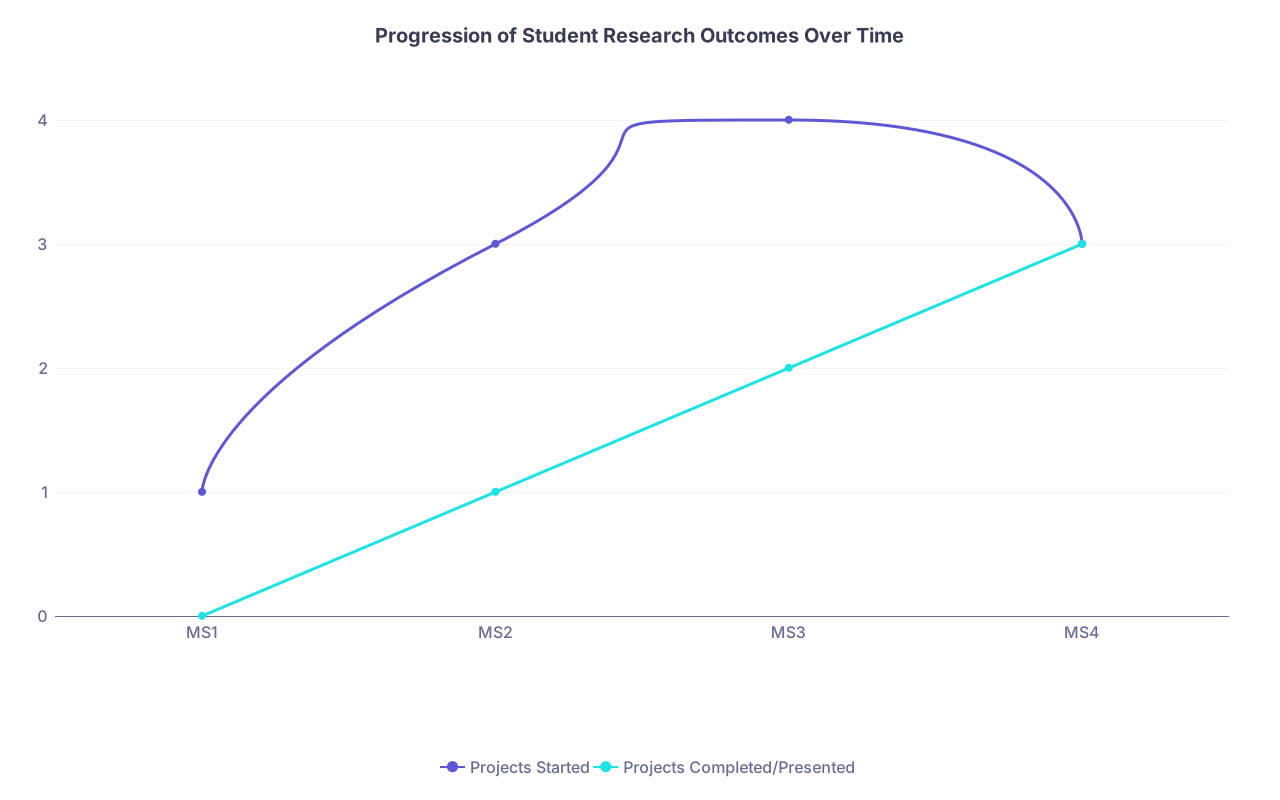
| Category | Projects Started | Projects Completed/Presented |
|---|---|---|
| MS1 | 1 | 0 |
| MS2 | 3 | 1 |
| MS3 | 4 | 2 |
| MS4 | 3 | 3 |
How to narrate this:
My first project in MS1 never moved beyond IRB submission because I underestimated the time required for data extraction. On my second project, I built a more realistic timeline and we made it to a local poster. By my third and fourth projects, I was mapping out roles, deadlines, and backup plans from the beginning. That is why I now have three completed posters and a manuscript in progress by the end of MS4, despite starting slowly.
This sort of trajectory is far more compelling than one lucky early publication.
Step 8: Anticipate and Control the Interview Narrative
You cannot control what your interviewer asks. But you can absolutely control how you answer.
Let’s build one specific, ready-to-use script and then you can adapt it.
Common question: “Tell me about a time a project did not go as planned.”
Structure your answer like this:
- Brief context (1–2 sentences)
- The problem or failure (1–2 sentences)
- Your response (2–3 sentences)
- What you learned + how you apply it now (2–3 sentences)
Example answer:
In my third year, I joined a QI project aiming to reduce CT use for uncomplicated renal colic in the ED. I was responsible for data collection and provider feedback reports. Halfway through, we realized our inclusion criteria were too broad, and our educational intervention barely changed ordering patterns.
I met with our QI director to review where we misstepped. We refined the criteria to focus on low-risk patients, re-ran our analysis, and shifted to one-on-one feedback for high utilizers instead of mass emails. We still saw only a modest decrease in CT scans, but we identified clear workflow barriers that we presented at our hospital’s QI conference.
The experience taught me that changing provider behavior is more complex than sending guidelines, and that it is better to detect and correct design flaws early than to push a weak intervention to completion. I now build “mid-point audits” into any project I help design, so we have permission to pivot before investing months in the wrong plan.
Notice: you are not begging for sympathy. You are demonstrating process-minded thinking.
Step 9: Clean Up the Paper Trail (CV, ERAS, and Letters)
If you are going to reframe these projects, your written records must be clean and consistent.
1. Standardize how you list “in progress” or unpublished work
Avoid over-selling. Do this instead:
- “Manuscript in preparation” → only if an actual draft exists.
- “Data collection completed; analysis in progress.”
- “Internal report presented to department leadership; no external publication planned.”
Programs hate vaporware. Be conservative and clear about status.
2. Titles and roles
Make sure:
- The title matches across CV, ERAS, and letters.
- Your role is realistic: “student co-investigator,” “data abstractor,” “project coordinator.”
If an attending will mention the project in a letter, email them your preferred 2–3 sentence description so their language aligns with yours.
3. Ask for letters that explicitly address the “failure” well
For a project that did not publish or had negative results, your ideal letter says something like:
“Although the project ultimately revealed no significant difference in our primary outcome and has not yet been submitted for publication, [Name] demonstrated persistence and maturity in revising our protocol, re-running analyses, and preparing a clear presentation of our results for our departmental conference.”
That single sentence converts a potential liability into a strength.
Step 10: Decide What Not To Use
Some things should not be highlighted. You are allowed to leave them in the past.
Skip or minimize:
- Projects where you ghosted the PI and never repaired the relationship.
- Sloppy work that, if questioned in detail, you could not defend.
- Anything ethically questionable, even if it eventually got cleaned up.
If you are asked directly about a project that imploded:
- Be brief.
- Take responsibility.
- Show the correction.
Example:
On one early project, I overcommitted and did not communicate well when my schedule changed. I missed deadlines, and my mentor understandably moved on without me. Since then I have been more conservative about how much I take on and much more proactive in updating supervisors. It was a difficult lesson, but it changed how I handle commitments now.
Do not over-feature this story unless you have nothing else. Use it as backup, not as your primary theme.
Step 11: Practice Out Loud, Not In Your Head
Internal rehearsing is a trap. You will ramble in the real interview.
Do this instead:
Open a blank document.
For each key “failed” or negative project, write:
- A 2–3 sentence ERAS-style description.
- A 6–8 sentence interview answer.
Then read them out loud. Record yourself for at least one or two.
Cross out filler words and apologies:
- “Unfortunately…”
- “Sadly…”
- “I know this is not that impressive, but…”
Replace those with factual language:
- “The intervention did not change X.”
- “We identified…”
- “From this, I learned…”
The goal is to sound like a junior colleague discussing a QI project at noon conference. Calm, honest, analytical.
Step 12: Concrete Templates You Can Steal
Here are some plug-and-play sentence structures you can adapt.
For ERAS / CV descriptions
- “Retrospective review of [condition] at [institution]; identified no significant change in [outcome] following [intervention], prompting a revised protocol now under review by [committee].”
- “Prospective QI project to [goal]; although [primary outcome] did not improve, [process measure] increased from X% to Y%, informing the hospital’s subsequent [policy/guideline].”
- “Project halted at [stage] due to [reason]; I summarized existing work and transitioned materials to [person/role] to support continuation beyond my involvement.”
For personal statement / essays
- “At first, I interpreted the lack of significant results as personal failure. Over time, I realized it reflected the complexity of the system more than my effort, and I shifted my focus to designing tighter interventions and more realistic timelines.”
- “The most valuable part of that project was not the abstract; it was learning how to deliver disappointing results transparently to a team that had invested months of work.”
For interviews
- “In hindsight, I would have built in earlier checkpoints and been more aggressive about simplifying the intervention instead of trying to fix everything at once.”
- “The experience has made me much more comfortable with the idea that not every project needs a publication to be worthwhile; if it changes how a team thinks or practices, that is still a win.”
Use these, tweak them, make them sound like you. But stay in this lane: clear, specific, un-dramatic.
Your Next Step Today
Do one focused task:
Open your ERAS or CV and pick one “failed” or negative project. Rewrite that single entry using the 4-part structure: Context – Process – Outcome – Reflection/Next Step.
Do not touch anything else until that one entry is clean, specific, and honest.
Once you see how different it feels, you will know exactly how to fix the rest.


