

The way most people handle authorship disputes is weak, emotional, and self-sabotaging. You cannot afford that if you are applying to residency.
You’re not just fighting over a line on PubMed. You’re dealing with:
- your reputation in a small academic world
- your letters of recommendation
- and your credibility on ERAS when you list research
So if your name is missing from a paper—or you’ve been shoved down the author list in a way that feels shady—here’s exactly how to handle it without blowing up your career.
Step 1: Get Clear on What Actually Happened
Before you accuse anyone of anything, you need facts, not feelings.
Start with this: what exactly is the problem?
- You did substantial work and were left off completely
- You were promised first/second author and ended up buried as middle author
- Your name is on the paper, but your role is misrepresented
- The paper was submitted or published without you even being told
Pull everything you have:
- emails where authorship was discussed
- early drafts where you’re listed
- texts/Slack messages like “I’ll put you as second author”
- protocol or IRB listing your name
- your version history on the manuscript or figures
Do not just “remember” what was said. Go find receipts.
Then, check the journal’s authorship guidelines and the ICMJE criteria (most legit journals follow this). In short, authorship usually requires:
- Substantial contributions to conception/design or data acquisition or analysis/interpretation
- Drafting or critically revising the manuscript
- Final approval of the version to be published
- Agreement to be accountable for the work
If you clearly meet 1–2 of these but were completely left off? That’s a real authorship problem.
If you did three chart reviews and a couple of literature searches months ago and then disappeared? That’s weaker. Still frustrating, but a different category.
Be brutally honest with yourself about your contribution. Interviewers and PDs can smell inflated victim stories a mile away.
Step 2: Do a Cold Risk Assessment Before You Move
You’re not just a wronged researcher. You’re a residency applicant with very limited power and a short timeline.
Ask yourself four hard questions:
Who’s involved?
Is the PI a big name in your specialty? Does this person control a key letter of recommendation you need? Are you up against a petty fellow or a co-resident with less power?Where’s the project in the pipeline?
- Not submitted yet
- Under review
- Provisionally accepted
- Published
The earlier it is, the more leverage you have and the fewer external systems you have to involve.
What do you actually need out of this?
- Any authorship at all?
- Specific author position?
- Just the ability to list your contribution accurately on ERAS?
- Or do you want to escalate misconduct (very different path)?
How close are you to ERAS deadlines / interviews?
Right before applications or interview season is not always the time to go nuclear—unless the behavior is egregious.
You’re making a strategy decision, not just an emotional one.
Step 3: First Move – A Calm, Professional Conversation
Your first step is almost always a private, non-accusatory conversation. Start at the lowest level with the person most directly involved:
- If a resident/fellow removed your name: talk to them first.
- If decisions came from the PI: go to the PI.
- If you’re not sure who changed the list: ask the person who is clearly leading the project.
Use email to set up the conversation, but have the main discussion in person or over Zoom. Then follow up in writing.
Sample email to request a meeting:
Subject: Quick meeting re: [Project Title] authorship
Hi Dr. [Name],
I saw the recent submission/publication of our [project title] manuscript. I had thought I’d be included in the authorship based on my earlier work on [briefly specify: data collection, analysis, drafting sections].
Could we find 15 minutes this week to go over the authorship decisions and clarify expectations? I want to make sure I understand how my contributions fit into the final paper and how to represent this work accurately on my residency applications.
Best,
[Your Name]
Notice what’s missing: “unfair,” “disrespectful,” “you promised.” Save that for your group chat, not your PI.
In the meeting:
- Stay factual. “I completed XYZ” not “I feel like…”
- Reference specific contributions, with dates and outputs.
- Ask open questions: “Can you walk me through how authorship decisions were made?”
- Tie it to your residency applications: “I’m trying to make sure I present my research record accurately for ERAS.”
You’re giving them a clean exit ramp to fix this without losing face.
Step 4: Decide What to Push For (and What to Let Go)
Not every injustice must be fully corrected for you to win the long game.
Here’s the reality of how program directors view this stuff:
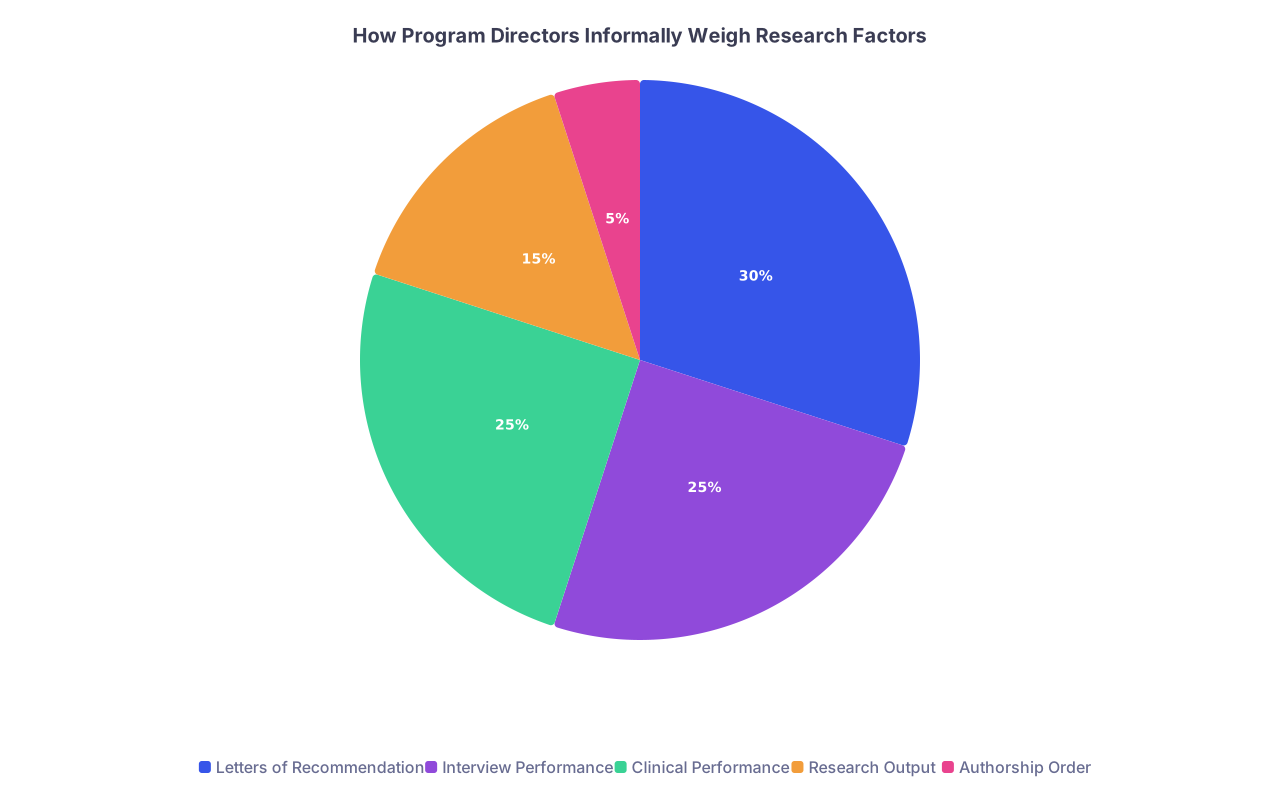
| Category | Value |
|---|---|
| Letters of Recommendation | 30 |
| Interview Performance | 25 |
| Clinical Performance | 25 |
| Research Output | 15 |
| Authorship Order | 5 |
Authorship order barely moves the needle compared to:
- a strong, specific letter from the PI
- you being able to confidently explain your role
- your overall pattern of productivity
So, you choose what you’re actually going after:
If you’re completely missing from a paper you worked heavily on
This is worth pushing. Calmly, but firmly. Being added late as a middle author is still better than nothing.If you got bumped from 2nd to 4th author, but you’re still on the paper
That sucks, and yes, people play politics. But going to war over exact author order as an MS4 or PGY-1 rarely pays off unless you were clearly promised first author and did the bulk of the work.If your name is there but the acknowledgments/authorship description is vague
You can often negotiate language like: “X contributed to data analysis and drafting sections of the manuscript.”
If the PI or lead author is at least somewhat reasonable, you may walk away with:
- authorship added
- authorship preserved but order unchanged
- at minimum, permission to list the project and your role clearly on ERAS (even if your name isn’t on the final paper)
Step 5: What To Do If They Stonewall You
Sometimes the conversation goes badly. You hear things like:
- “We decided you didn’t meet authorship criteria.”
- “You were just helping out a bit; that doesn’t make you an author.”
- “It’s already submitted, we can’t change anything.” (Not true. Revisions happen.)
- Or worst: they get defensive and hostile.
Now you have to choose: swallow it, or escalate.
Option A: Swallow it, but document and pivot
This is the “protect the big picture” move.
You do this when:
- You need this PI’s letter
- You’re in a small department where word spreads fast
- The behavior is crappy, but not fraudulent
- Match is near and you can’t afford drama
If you choose this path:
- Save all documentation of your contributions anyway
- Quietly deprioritize working with these people again
- Build your research credibility with someone who doesn’t play games
- Be ready to explain the project in interviews as “work in progress” or “manuscript under preparation” rather than a published paper with your name
Is it fair? No. Is it sometimes the smart move? Absolutely.
Option B: Escalate – carefully and professionally
You escalate when:
- Your contribution was major and clearly meets authorship criteria
- The PI or lead author refuses to even discuss it professionally
- This is part of a pattern of academic misconduct
- You’re willing to accept some fallout
Your next level, in order:
- A senior mentor not involved in the project (someone who knows the politics but doesn’t depend on this PI)
- Program director or clerkship director you trust (if you’re a med student or resident)
- Department research director or vice chair for research
- The institution’s research integrity office if there’s clear misconduct
Your message to a mentor might look like:
I’d like your advice on an authorship situation.
I contributed to [specific project: title, PI] by doing [list concrete tasks with rough hours/time period]. The paper was recently [submitted/published], and my name was not included. I asked Dr. [PI] for clarification and was told [briefly summarize].
I’m unsure whether this aligns with authorship standards and how hard I should push given that I’m applying to residency in [specialty] this cycle. I’m not looking to escalate recklessly, but I do want to understand my options and how to protect my reputation.
Key point: you’re asking for guidance, not marching in demanding justice. Let someone with more political capital advise you on how far to go.
Step 6: How to Handle This on Your Residency Application Itself
Once the dust settles—even if you lost the authorship fight—you still have to deal with ERAS.
Here’s how to play it.
Scenario 1: The paper is published and you are on it
Great. List it under “Publications” in proper citation format. Do not exaggerate your author position.
On interviews, when asked about it:
- Briefly describe your exact role (data collection, analysis, wrote methods, etc.)
- If your contribution was big but your author position is low, you can say:
“I joined the project after the design phase, so my author position reflects that, but I led the [X] part of the work.”
Program directors care more that you can explain the project intelligently than where your name sits in the middle cluster.
Scenario 2: The paper is published and you are not on it
You do not list it as a publication. That’s not a gray area. That’s lying.
But you have two legitimate options:
List the project as ‘Research Experience’ with your specific role
Example:
“Retrospective review on [topic], PI: Dr. Smith. Contributed to data abstraction and initial analysis. Project later resulted in a publication by the core team.”If you contributed partially but did not follow through (and that’s why they dropped you), then just own roughly that story without whining.
On an interview, if someone from your institution knows the paper and asks “Were you an author on that?” say calmly:
I contributed to the early data collection and some preliminary analyses, but the final manuscript was completed by the core group and I wasn’t included as an author. I still count it as a learning experience in [what you learned].
No drama. No long explanation. Move on.
Scenario 3: The paper is under review/submitted and your authorship is unresolved
This is tricky but manageable.
You can:
- List it as “Manuscript in preparation” or “Project in progress” under Research Experience
- Do not claim “Submitted to [Journal]” if you aren’t actually on the author list
In descriptions, focus on:
- What you did
- What the project is asking
- Skills you gained
If by interview season it gets published without you, you’re still safe because you never claimed authorship.
Step 7: How to Talk About a Bad Authorship Experience in Interviews
Sometimes the story follows you. A PD asks about a project you clearly worked heavily on: “Did that ever get published?” You know it did—and your name’s missing.
Here’s how to handle it without sounding bitter or evasive.
Use this structure:
- Brief fact
- Your role
- What happened
- What you learned / how you adjusted
Example:
We did submit that work eventually and it was published by the core group. I contributed mainly to the data collection and preliminary analysis, but by the time the manuscript was finalized I had already moved on to other responsibilities and wasn’t included as an author.
It was frustrating at the time, but it pushed me to be much clearer upfront about expectations, timelines, and what counts for authorship. On my later projects, I made sure we discussed this early and put roles in writing, and those experiences were much smoother.
You’re allowed to acknowledge disappointment. You’re not allowed (if you want to be taken seriously) to spiral into a five-minute blame monologue.
Step 8: Protect Yourself on All Future Projects
You only need to get burned badly once to start acting like a professional about authorship.
Here’s what you do from now on every time you join a project:
At the start, ask:
“How are we thinking about authorship for this project? What would I need to do to qualify, and what kind of position would be realistic if I take on [X responsibilities]?”Send a follow-up email summarizing what was said. Something like:
Thanks again for looping me into the [topic] project. As we discussed, I’ll be handling [tasks], with the goal of qualifying for authorship, likely in the [first/second/middle] author range depending on how the project evolves.
Keep a running log of:
- tasks you completed
- dates/hours (roughly)
- versions of documents you edited
- figures/tables you built
Revisit authorship before submission. Not after.
Is this extra work? Yes. Does it save your sanity and your CV? Also yes.

| Step | Description |
|---|---|
| Step 1 | Join Project |
| Step 2 | Clarify Roles & Authorship Expectations |
| Step 3 | Send Summary Email |
| Step 4 | Track Contributions |
| Step 5 | Review Authorship Before Submission |
| Step 6 | Address Discrepancies Calmly |
| Step 7 | Decide: Accept, Negotiate, or Escalate |
Step 9: When It’s Truly Misconduct (and Not Just Politics)
Most authorship fights are about expectations, egos, and poor communication. Some are worse.
Red flags for more serious issues:
- Your data/figures are used in a paper where you’re not listed anywhere
- You’re told explicitly, “We don’t put students/residents on papers” after you did substantial work
- Someone reuses your text/analysis in multiple papers without credit
- Multiple trainees tell you the same PI has done this to them
In those cases, you have two parallel jobs:
- Protect your own immediate interests (letters, applications)
- Decide if you’re willing to be the person who brings this to an institutional level
If you go that route:
- Collect and organize documentation
- Talk to a trusted senior mentor first
- Expect slowness. Institutions move like molasses.
- Accept that you may not see justice in time for your own application cycle
You’re no longer just trying to get your name on a paper. You’re addressing a culture problem. That’s a different fight.
A Quick Reality Check Before You Act
Here’s the harsh but accurate hierarchy of what matters most for your match odds:
| Factor | Relative Impact |
|---|---|
| Strength of clinical letters | Very High |
| Interview performance | Very High |
| Overall research productivity | Moderate |
| Having any publications at all | Moderate |
| Exact authorship order on a paper | Low |
So yes, get your due when you reasonably can. But don’t blow up the relationships that write your letters over whether you’re 3rd vs 5th author.
Your goal is not to win every skirmish. Your goal is to walk into interview season with:
- a clean, accurate ERAS
- credible research stories you can discuss well
- mentors who still pick up the phone when PDs call
What You Should Do Today
Open your email and pick one project where you’re even slightly worried about credit. Send one short message to the lead or PI:
“Can we quickly clarify expected roles and authorship for this project so I can plan my time and understand how to represent it on my residency applications?”
That one email—sent before something blows up—is how you avoid reading your name not being there on PubMed six months from now.


