

If You’re an Intern Who Already Regrets Matching Here: Next Steps
Did you seriously google some version of “I hate my residency, did I ruin my life?” on a post-call morning?
Good. That means you’re still thinking clearly enough to ask the right question.
Let me be blunt: you’re not the first intern who regretted their match by August. Or July. Or orientation week. I’ve watched people cry in stairwells at MGH, think about quitting during their first month of nights, and quietly start plotting a transfer before they’d even learned the EMR shortcuts.
So let’s deal with your situation the way it actually is—not the sugar-coated “it gets better” nonsense:
- You’re here now.
- You’re exhausted and emotionally flooded.
- You’re wondering if you made a huge mistake.
Here’s how to figure out what’s real, what’s fixable, and what your actual options are.
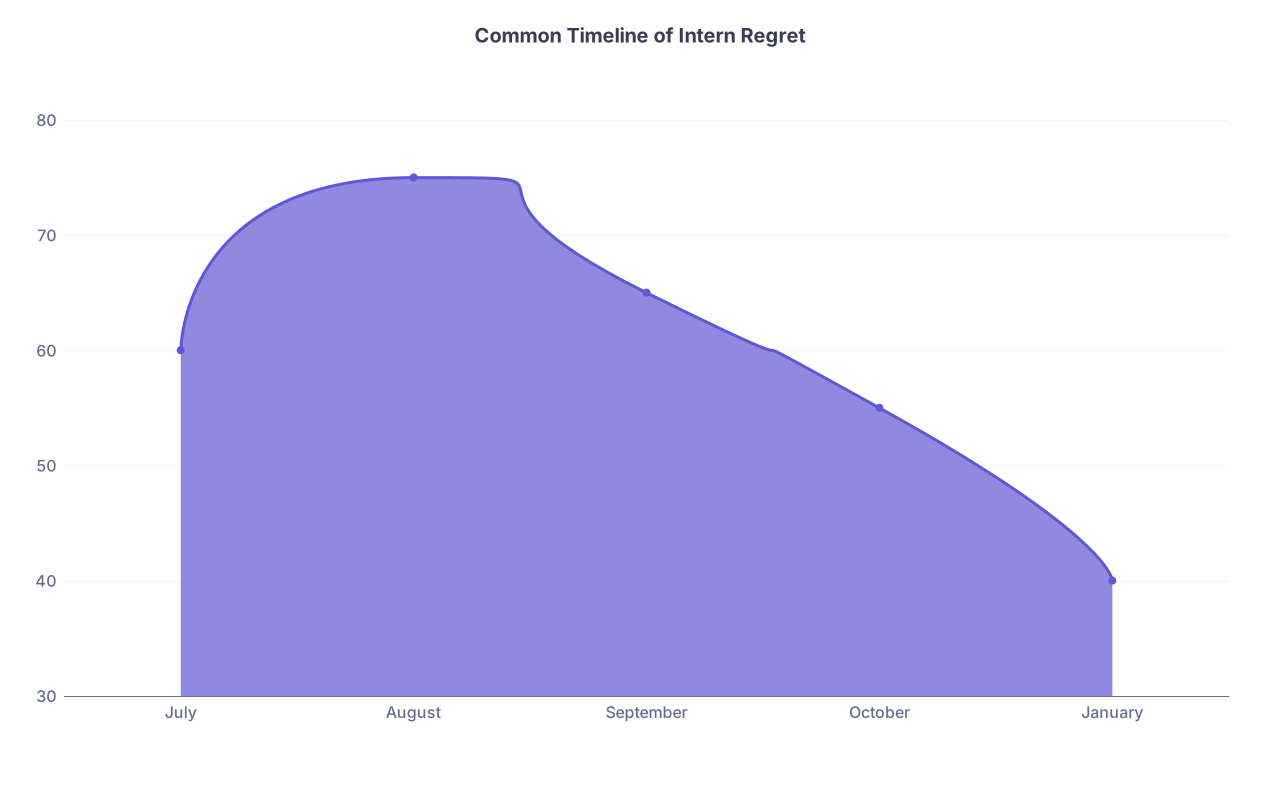
| Category | Value |
|---|---|
| July | 60 |
| August | 75 |
| September | 65 |
| October | 55 |
| January | 40 |
(Values = rough % of interns I’ve seen who say they regret their match at that time point. Not scientific. Very real.)
Step 1: Separate “Normal Intern Misery” From True Mismatch
First thing: not every “I hate this” means “I picked the wrong program.”
Intern year is engineered to make almost anyone question their choices. But there’s a difference between:
- “This is brutal but meaningful,” and
- “This is fundamentally toxic or wrong for me.”
Ask yourself a few specific questions, and write the answers down when you’re not post-call delirious.
A. Is it the job of being an intern, or this particular program?
List out what’s bothering you, and tag each item:
- N = Normal intern hell
- P = Program-specific problem
- M = Maybe medicine isn’t for me
Examples:
- “I feel stupid all the time, like I know nothing.” → N
- “Attendings regularly humiliate residents in front of patients.” → P
- “I don’t find any meaning in patient care, even on my best days.” → M
- “The workload is insane everywhere, but here nobody helps each other.” → P
- “Cross-cover nights terrify me.” → N (for almost everyone at first)
If 80% of your list is “N,” you may hate intern year, but not necessarily your match.
If a lot is “P” or “M,” then we’re dealing with either a bad fit program or deeper misalignment with medicine.
B. How do your co-interns seem?
Look closely at the “vibe.”
If everyone is:
- Fried but laughing sometimes,
- Complaining but also showing support,
- Talking about future plans with at least mild hope—
then you’re probably in a hard but functional environment.
If instead:
- People cry often,
- Mid-levels and seniors are burned out beyond caring,
- Everyone says “just survive this place,” not “you’ll grow here,”
you may be in a chronically toxic culture.
C. How do you feel on your best day here?
Don’t judge the program off your worst overnight disaster. Think about days that weren’t abnormally horrible:
On a relatively decent day:
- Do you ever feel proud?
- Do you enjoy at least some parts—talking to patients, doing procedures, collaborating with certain attendings?
- Or is it just… nothing? Numbness, dread, or resentment?
If there are glimpses of meaning or satisfaction, then we might be dealing with an adjustment + burnout problem. If there’s nothing, that’s a different conversation.

Step 2: Stabilize Yourself Before You Decide Anything
You shouldn’t make life decisions when your brain is marinating in sleep deprivation and cortisol. Right now, your #1 job is to get yourself to “baseline functional human” before you decide whether this program is a mistake or just a very rough start.
A. Run a quick self-check: Are you in crisis territory?
These are red flags I don’t want you to ignore:
- You’re fantasizing about getting into a car accident so you don’t have to go to work.
- You’ve thought about hurting yourself, or you’ve caught yourself thinking “Everyone would be better off if I just disappeared.”
- You’re drinking or using anything just to knock yourself out or cope every single day.
- You’re having panic attacks regularly on your way to the hospital.
If any of that’s hitting too close:
- Use your institution’s confidential mental health resources (most large programs have specific psychotherapy contracts for residents—ask GME or your program coordinator, you’re not the first).
- If you’re scared about confidentiality: look for a therapist outside the institution and pay cash initially if you must.
- If you’re at immediate risk of self-harm: emergency department, crisis line, or local equivalent. Pride is useless if you’re not alive.
B. Micro-adjustments that buy you breathing room
These are not magic. They’re stabilizers. But I’ve seen them move people from “I’m quitting” to “Ok, I can at least think clearly.”
Sleep protection on off days:
One solid 8–9 hour stretch twice a week is better than six nights of 4–5 hours. Guard two nights like your life depends on it. It kind of does.Low-friction therapy:
Telehealth session on your post-call afternoon, even if you sleep first and show up with bedhead. Get someone whose entire caseload is residents/med students if you can.One scheduled joy-anchor per week:
Non-negotiable. Dinner with a friend, a run, video games with your sibling, church, whatever. If your entire calendar is work and recovery, your brain assumes your life is work and recovery.Guilt-free basic outsourcing if you can swing it:
Grocery delivery, laundry service for a month, cleaning service once. If money is tight, pick just one small thing. You’re in survival mode, not normal life.
Stabilizing doesn’t solve systemic problems. It just makes you capable of seeing them clearly.
Step 3: Get Real Intel: Is This Fixable From Within?
Before you jump to transferring or quitting, find out whether your issues are:
- Already known, and
- Already being worked on, or
- Widely accepted as “this is how we do things here.”
A. Quiet conversations that actually matter
Three groups are worth talking to:
A trusted senior resident
Someone who isn’t a cheerleader for the program but isn’t chronically bitter either. Ask them:- “Be honest—was intern year this bad for you?”
- “Does it get better here as a PGY-2/3?”
- “What things are actually changeable in this program and what’s basically baked in?”
Your chief resident (one-on-one)
Chiefs know what’s going on behind the scenes. Bring specific concerns, not generalized “I hate it here.”For example:
- “We’re consistently violating duty hours on X rotation without a system to log it honestly.”
- “Teaching is replaced with public shaming on Y team—multiple people have cried this month.”
A faculty mentor not in your direct line of evaluation
Someone in your department or even another specialty who doesn’t control your evaluations. Ask for perspective, not rescue.

| Step | Description |
|---|---|
| Step 1 | Intern Regret |
| Step 2 | Address sleep and mental health |
| Step 3 | Clarify problem type |
| Step 4 | Talk to senior and chiefs |
| Step 5 | Explore non clinical options |
| Step 6 | Short and long term plan |
| Step 7 | Stay and optimize |
| Step 8 | Explore transfer or change |
| Step 9 | Stabilized? |
| Step 10 | Program vs Medicine vs Both |
| Step 11 | Any realistic fixes? |
B. Watch for this key distinction
There’s a huge difference between:
- “Yes, it’s rough; here’s what we’re changing and how,”
versus - “Yeah, this place has always been like that. You just have to toughen up.”
First is a hard program trying (maybe clumsily) to improve. Second is a culture problem.
If seniors and chiefs say:
- “It’s brutal, but second year is genuinely better. You get autonomy, better schedules, and more supportive attendings. Most people end up liking it by then.”
that’s one scenario.
If they say:
- “If you’re complaining as an intern, maybe you’re not cut out for here,”
then don’t ignore that. Believe what they’re telling you about the culture.
Step 4: Make a Short-Term Plan (Next 3–6 Months)
Regardless of whether you eventually transfer, switch specialties, or stick it out, you need a short-term survival and data-gathering plan.
A. Pick 2–3 “must-improve” areas
Not 20. Not everything.
Examples:
- Get out of constant panic mode on nights.
- Build one solid ally on each rotation.
- Stop getting blindsided on rounds by basic questions.
Then make small, tactical moves:
- For nights: ask a reliable senior to walk you through their mental checklist for cross-cover calls. Literally write it down. Use it.
- For allies: choose the nurse who clearly runs the unit and be respectful, consistent, and helpful—nurses can massively change your day.
- For rounds: the night before, skim your list, identify three highest-risk patients, and pre-read a quick UpToDate/basic guideline for their main issue.
You’re not trying to become stellar. You’re trying to reduce daily pain.
B. Log what happens
Keep a private note (locked phone note, not on hospital devices) where you track:
- Rotations
- Attendings / seniors
- Hours actually worked
- Specific incidents that cross a line (threats, harassment, repeated humiliation, unsafe practices)
- Moments that were actually positive or promising
This serves two purposes:
- You get a less emotional, more longitudinal picture of your experience.
- You build a record, in case you pursue transfer, internal changes, or—if really necessary—formal complaints.
| Signal Type | Probably Stay | Seriously Consider Leaving |
|---|---|---|
| Trend over 3–6 months | Slowly improving coping, occasional decent days | Worsening dread, no good days, physical symptoms escalating |
| Culture | Some supportive seniors/attendings, chiefs trying to fix issues | Systemic disrespect, toxicity normalized, retaliation fears |
| Fit with medicine | Still feel some meaning, enjoy parts of patient care | Persistent emptiness, resentment toward entire field |
| Response to feedback | Program open to tweaking schedules, call burden, teaching | Complaints dismissed as weakness or “generational” |
| Personal health | Exhausted but stabilizing with support | Depression, anxiety, or suicidality despite help |
Step 5: Explore Your Actual Exit Options (Without Blowing Yourself Up)
Let’s talk about the thing everyone whispers about: leaving. Transferring. Switching specialties. Even leaving medicine.
You do not start by announcing “I hate this place, I want out” to your PD. That’s how you lose control of the situation.
A. Option 1: Stay, finish, and treat this as a job, not an identity
For some people, the right choice is: “This place sucks, but it will give me a credential. Then I’m out.”
You’re allowed to:
- Stop hoping to love it,
- Emotionally detach a bit,
- Focus on passing, staying safe, and preserving your health.
Especially if:
- You’re PGY-1 in IM and want hospitalist/primary care eventually.
- There’s a clear light at the end (short program, fellowship elsewhere).
- The culture is not abusive, just cold, overworked, or unimpressive.
If you choose this route, your strategy is:
- Maximize support outside work (family, friends, therapy, hobbies).
- Minimize unnecessary emotional investment inside work.
- Hit baseline competence, not perfection.
This is not failure. It’s a pragmatic call lots of physicians quietly make.
B. Option 2: Transfer to another program in the same specialty
This is tricky but possible, especially in IM, peds, FM, psych, some prelim/TY spots.
Key realities:
- Transfers are easiest early (PGY-1 to PGY-2), but also happen later.
- You’ll need decent evaluations and no major professionalism flags.
- Many programs don’t advertise openings; they fill through networks.
Steps, quietly and in order:
Confidential career conversation
With someone not your PD at first: maybe an associate PD you trust, faculty mentor, or GME rep. Ask in general terms about “what transfer processes look like” at your institution.Research actual open spots
- FREIDA
- Specialty-specific listservs
- Whisper networks (friends at other programs, old attendings from med school)
Prepare a narrative that is honest but not self-destructive
Never frame it as “this program is terrible and I hate them.” Instead:- “Looking for a program with stronger outpatient focus.”
- “Looking to be closer to family support after some personal changes.”
- “Realized I’m looking for a training environment with X that isn’t as present here.”
Only loop in your PD when there’s a concrete path
PDs are more helpful when there’s an actual opportunity and you show you’re not trying to burn the place down, just find a better fit.
Is that manipulative? No. It’s self-preservation in a small, political world.
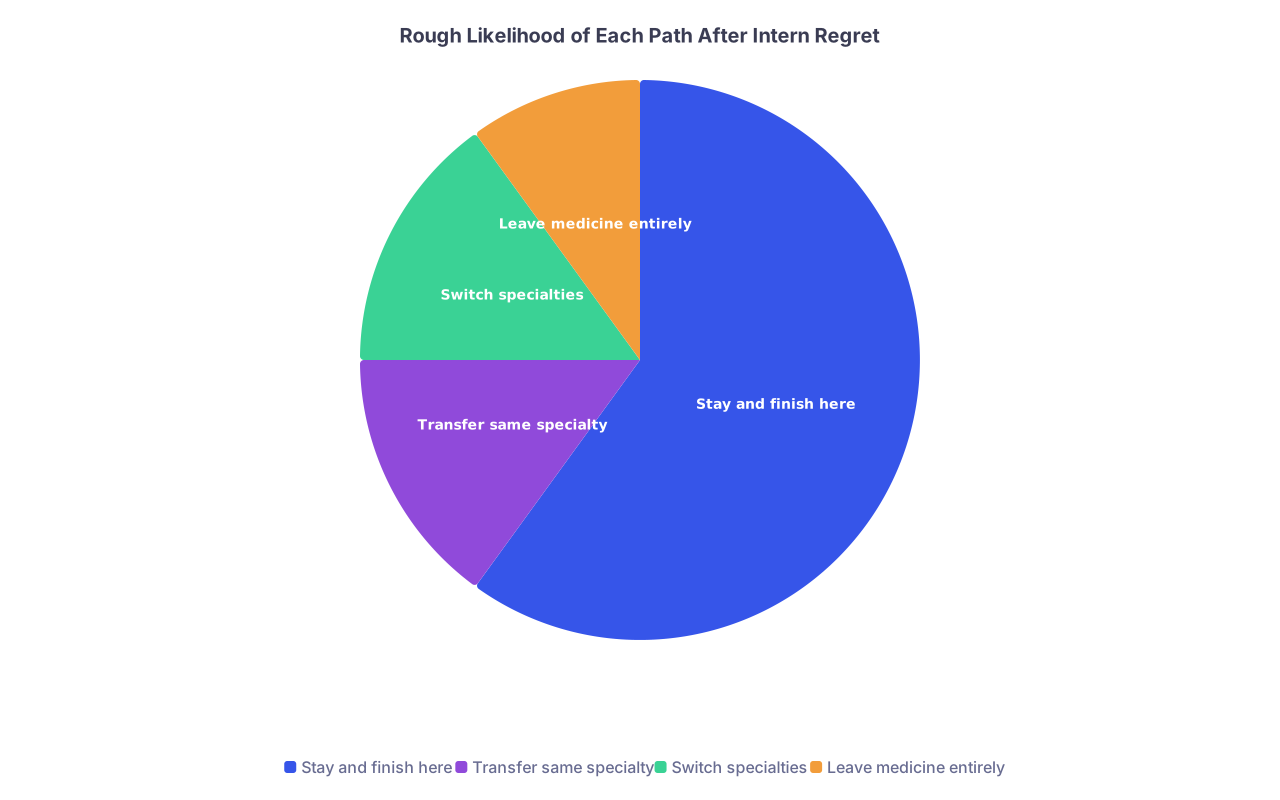
| Category | Value |
|---|---|
| Stay and finish here | 60 |
| Transfer same specialty | 15 |
| Switch specialties | 15 |
| Leave medicine entirely | 10 |
(Anecdotal proportions from programs I’ve seen; may vary by specialty and country.)
C. Option 3: Switch specialties
Sometimes the issue is not this program—it’s this field.
Signs that might be true:
- You’re in surgery and absolutely dread the OR but light up on rounds and in clinic.
- You’re in IM and you hate chronic disease management but you’re obsessed with acute, procedural work.
- You’re in psych and miss working with your hands or doing anything with objective data.
Switching specialties is a big move, but it happens every year.
Rough process:
- Spend a few months paying attention to what you actually enjoy. Which moments, even tiny ones, feel interesting?
- Talk to attendings or residents in the field you’re drawn to. Ask about switching from your current specialty. Most have seen it.
- Get realistic about competitiveness. Switching from a rough community IM program into derm is not a plan; switching into EM, FM, psych, anesthesia, PM&R from IM or surgery is far more plausible.
- Plan out logistics with someone who knows the match and funding rules (GME office, specialty PD). There are limits to how many years of GME Medicare will fund, depending on country.
D. Option 4: Leave clinical medicine (or medicine altogether)
I’m not going to guilt-trip you here.
Some people do discover during residency that practicing medicine is not how they want to spend the next 30 years. If that’s you, pretending otherwise just delays the pain.
But don’t make that call impulsively.
Before you leave:
- Talk to at least 2–3 physicians who left clinical work for industry, consulting, public health, informatics, etc. Ask what they wish they’d known.
- Give yourself a clear timeline: “I’ll reassess at the end of PGY-1 with my therapist, mentor, and a concrete alternative in mind.”
- Run the numbers: loans, income needs, visa status if applicable.
No, you haven’t “wasted everything” if you pivot. You’ve gained a brutal but very real education about yourself.

Step 6: Protect Your Future Self (Evaluations, Reputation, and Relationships)
While you’re in regret mode, it’s easy to start mentally checking out and letting your performance slide. That feels good for about a week and then starts to cost you.
Future fellowship directors, employers, or programs will mostly see:
- Your evaluations
- Your letters
- Your board scores
- Your PD’s opinion of you
So, bare minimum:
- Show up on time. Always. Chronic lateness is a scar that follows you.
- Don’t be a jerk to nurses, consultants, or staff, even if you’re dying inside. Word travels fast.
- Complete your notes and basic tasks reasonably reliably. You don’t have to be a star, but don’t be a liability.
Interns sometimes think, “If I hate it, why try?” Because you might want out. And to get out, you need people willing to vouch for you.
Build 2–3 professional relationships with people who can honestly say:
- “They were going through a tough time, but they were reliable, cared about patients, and grew over the year.”
That’s gold if you try to transfer, switch, or even just apply for a job that isn’t in love with your program’s reputation.
What This Season Is (And Is Not)
This season is:
- A pressure cooker that magnifies everything—your doubts, your values, your limits.
- A brutal stress test for both you and the program you matched into.
- A time when decisions feel final even when they aren’t.
This season is not:
- Proof you’re weak, broken, or unfit.
- The sum total of what medicine will feel like forever.
- Irreversible.
For now, your job isn’t to solve your entire career. It’s to:
- Get yourself out of acute crisis.
- Collect real data on yourself and your environment.
- Make one short-term plan for the next 3–6 months.
- Quietly explore one or two longer-term paths without detonating your current position.
With those steps in place, you’re not trapped. You’re just in a really hard chapter.
You’ll still have to face fellowship decisions, job choices, and what kind of physician—or ex-physician—you want to be. But that’s later.
For now, survive this part intelligently. Then we can talk about how to build something better on the other side.
FAQ
1. How long should I “give it” before deciding my program is truly a bad fit?
Usually 3–6 months of honest effort, with some stabilization of your mental health, is a fair trial. If you’re still dreading every single day, seeing no improvement, and your support network (including a therapist or trusted mentor) agrees things are not shifting—then it’s time to actively explore transfer, specialty change, or larger exits. But if things are slowly improving, even a little, that’s a sign you might want to reassess at the end of intern year instead.
2. Will talking about my struggles with my PD hurt me?
Depends entirely on the PD. Some are genuinely supportive; some weaponize vulnerability. Start with safer people—senior residents, chiefs, a non-evaluating faculty mentor, GME office. Once you have a sense of your PD’s reputation and you know more clearly what you want (support within the program vs help leaving), you can decide how direct to be. Don’t lead with “I hate this place.” Lead with specific concerns and specific asks.
3. If I stay in a program I dislike, am I doomed to be a burned-out attending?
Not automatically. I’ve seen residents suffer through mediocre or even bad programs and then absolutely thrive once they had more control: choosing a sane job, moving closer to family, building a real life outside work. Your residency is part of your story, but it’s not the ending. If you learn from this—about your limits, your non-negotiables, your warning signs—you can use it to design a far better attending life. And that next phase? That’s where the real reconstruction happens.


