

Last fall, a second-year resident called me from a hospital stairwell at 11:30 p.m. She’d just finished a 14‑hour shift. Her father was upstairs on a different floor, newly diagnosed with metastatic cancer. She was debating whether to sneak up to see him or go home and sleep three hours before her next shift. She was crying, exhausted, and mostly furious that she even had to choose.
If you’re reading this, you might be in the same kind of mess. Sick parent. Partner just out of surgery. Sibling in psych crisis. And you’re still expected to preround on 15 patients, answer pages, present on time, smile in conference. Here’s how to handle this without burning yourself to the ground.
First: Get Honest About What You’re Actually Carrying
Burnout when caring for a sick family member in residency isn’t just “I’m tired.” It’s a pile‑on of different loads:
- Emotional load: grief, fear, anticipatory loss, guilt when you’re at work, guilt when you’re not.
- Cognitive load: tracking meds, appointments, labs, insurance nonsense—on top of your actual patients.
- Time load: calls with specialists, family group texts, driving home, being at the bedside.
- Identity load: you’re both “the doctor in the family” and “the child/partner/sibling,” and both roles demand things you can’t fully give.
You’re not failing because you can’t “handle it all.” You’re in an impossible configuration. So the question becomes: how do you reconfigure it so you can survive?
Step 1: Decide How Involved You Can Realistically Be
You cannot be the full‑time resident and the full‑time caregiver and the full‑time medical decision‑maker. When people try, they break.
You need a working boundary: “This is what I can do consistently for my family right now, and this is what I cannot.”
Think concretely, not in vague intentions.
| Role Piece | Reasonable for Many Residents | Often Unsustainable Alone |
|---|---|---|
| Join key family meetings | Yes, if planned ahead | No, if every meeting |
| Be primary medical interpreter | Sometimes | Not for all decisions |
| Daily hands-on caregiving | Light help | Full ADL support |
| Handling all logistics | Rarely | Usually impossible |
Ask yourself three questions and answer them brutally honestly:
- How many hours per week can I give outside residency without losing basic functioning (sleep, food, hygiene)?
- In what ways am I uniquely helpful (e.g., translating medical jargon, emotional support, occasional presence)?
- What parts of caregiving could someone else do just as well or better, if I stopped trying to control everything?
Then pick your non‑negotiables. For example:
- “I will be present (in person or by phone) for all major family meetings about prognosis and big decisions.”
- “I will call my mom every evening for 10 minutes, even if I’m post‑call and half-asleep.”
- “I cannot do daily driving to appointments, but I can handle sorting the medication list once a week by phone/Zoom.”
Once you set this, everything else is optional, not automatic. That mental shift alone saves a lot of burnout.
Step 2: Tell Your Program Early—And Tell Them Clearly
Residents hide family illness because they’re afraid of looking weak or less committed. Then a crisis hits, and suddenly they’re missing shifts, crying in the workroom, making mistakes. That’s what programs care about: chaos.
If you want flexibility, you buy it with transparency and planning. That means:
Tell your program director (PD) or associate PD early. Not when hospice is being called. As soon as it’s clear the illness is serious or prolonged.
Use clear, non-dramatic language. For example:
- “My father has been diagnosed with advanced heart failure and will likely need multiple hospitalizations over the next few months.”
- “My partner is starting chemo next month and will need help after infusions, especially the first cycle.”
Bring options, not just problems. This makes you look responsible, not unstable. Propose concrete possibilities:
- Swapping an ICU block to later in the year when family support improves.
- Temporarily decreasing to 80–90% schedule if your program allows it.
- Cluster your vacation and elective time around a surgery or treatment period.
Here’s a rough script you can adapt:
“I want to let you know something personal that will likely intersect with my schedule this year. My [relation] has [diagnosis]. I’m still fully committed to my training, and I’m functioning fine at work right now. But I anticipate there will be periods (for example, around [surgery/chemo/hospice]) where I’ll need more flexibility.
I’ve thought about some options that might make this easier on the team—like [option A, option B]. I’m not asking for a solution today, but I want you to be aware early so we can plan instead of scramble.”
You don’t need to overshare feelings. Stick to impact and logistics. Programs respond better to “This is what’s coming, and this is my plan” than to collapsing at 2 a.m. during cross-cover.
Step 3: Build a Realistic Support Team (That Isn’t Just You)
Many residents are “the responsible one” in the family. The one everyone calls. The unofficial care coordinator. That role will destroy you if you don’t deliberately distribute it.
You need three circles of support:
1. Family & Friends for Caregiving Tasks
Map out what your family actually needs: transportation, meals, overnight stays, appointment companions, child care, insurance calls, house stuff.
Then assign. Not “Does anyone want to help?” but, “Can you cover X on these specific days?”
Tools that help:
- Shared Google sheet or calendar with appointments, who’s going, what’s needed.
- Group text strictly for logistics; separate thread for emotional dumping.
- Apps like Lotsa Helping Hands or CaringBridge to coordinate meals/visits.
Your job is not to physically do everything. Your job is partly to design a system where everything gets done.
2. Medical Team & Non-Doctor Advocates
Decide how much you want to act as “the doctor in the family.” And set boundaries.
What works well:
- Being present for big decision meetings (by phone/Zoom if needed), to ask questions and help translate afterward.
- Helping create a concise one‑page medical summary for other relatives to carry.
- Clarifying goals of care once as a family and reinforcing them, rather than re‑arguing at every twist.
What does not work:
- You micromanaging every medication change.
- You calling consults, arguing orders, or acting like an attending on your relative’s case. You’re not. You’re the family.
If there’s a level‑headed non‑doctor family member, empower them as the primary logistics person. They can:
- Take notes at visits.
- Track insurance issues.
- Communicate with relatives so you don’t become the information switchboard.
You’re the “special consultant,” not the frontline provider.
3. Your Own People at Work
Identify 2–3 colleagues you trust enough to know the basics:
- “My brother is in the ICU at this hospital.”
- “My spouse will be going through chemotherapy for the next 4–6 months.”
- “My mom’s in hospice and it’s probably weeks.”
Then be explicit: “If I’m off my game or need to step out to take a call, can you help cover for 20 minutes?” Most residents remember being in something similar and will show up, but they need to know the stakes.
Step 4: Make Hard, Repeating Choices About Presence
This is the part that tears people apart: Do I go see them or sleep? Do I stay with them overnight or finish my notes? Do I take the call or let it go to voicemail?
You won’t like these tradeoffs. But you can at least systematize them.
Create rules for yourself so you’re not making the decision from scratch at 1 a.m. when you’re wrecked. For example:
Sleep vs visit rule:
“If I’ve had less than 4 hours of sleep in the last 24 hours, I go home and sleep, even if it means not visiting that night—unless the prognosis is ‘hours to days.’”Work vs call rule:
“If the call is from the primary caregiver or the hospital and I’m not actively in a room with a patient, I step out and take it. If it’s from anyone else, it goes to voicemail and I return it during my next break.”Overnight rule:
“I do not do overnight bedside stays before or between call shifts. Ever. If it’s truly needed, we request a sitter, another family member, or short-term hired help.”
These rules protect you from guilt-driven self-destruction. You’re not choosing between “being a good child” and “being selfish.” You’re choosing between short-term presence and long-term ability to function.
Step 5: Protect Your Minimum Viable Health (MVH)
You are not going for “balanced” right now. You’re going for “just enough to not crumble.”
Your MVH is the absolute minimum you need in three areas:
Sleep:
- Non-negotiable floor: 5 hours in 24 hours on bad days; 7–8 on off days whenever humanly possible.
- If you’re doing <4 hours for more than 3 days in a row due to family + work, something has to give—call in backup, talk to chief, adjust.
Food & Hydration:
- Keep emergency rations in your bag/locker: protein bars, nuts, shelf-stable stuff.
- One real meal per day where you sit down for at least 10–15 minutes. I don’t care if it’s cafeteria food. Your brain needs actual calories.
Emotional Release Valve:
- One outlet where you do not have to be the strong one: therapist, friend outside medicine, clergy, even a support group for caregivers.
- If you can’t schedule weekly therapy, try biweekly virtual. Tell them up front: “I’m a resident with limited time; I need focused, pragmatic support.”
If you feel emotionally numb, crying randomly at work, snapping at nurses, or fantasizing about car accidents as “a break,” that’s your sign you’re below MVH. Not weak. Just depleted.
Step 6: Use Institutional Resources Without Shame
Most hospitals have stuff you’re not using because you’re too busy trying to be tough.
Look for:
- GME wellness or resident support services: free or low-cost counseling, sometimes urgent slots for crises.
- Employee assistance programs (EAP): often include short‑term therapy (4–8 sessions), legal help (for wills, POAs), and financial counsel.
- Social work: can help your family with equipment, home care, hospice, transportation, insurance fights.
- Chaplaincy/spiritual care: not just for religious people. They’re trained in serious illness and grief. They can support both your family member and you.
(Related: In a Malignant Program and Burning Out: Practical Options and Exit Plans)
If your family member is at your hospital, clarify roles with the team:
“I’m a resident here, but I’m family in this situation. Please treat me like family, not staff. I want to be involved in meetings but I do not want to alter clinical decisions outside the usual process.”
If emotions run high and you’re not functioning at work, it is sometimes safer to take formal leave than to try to white‑knuckle through.
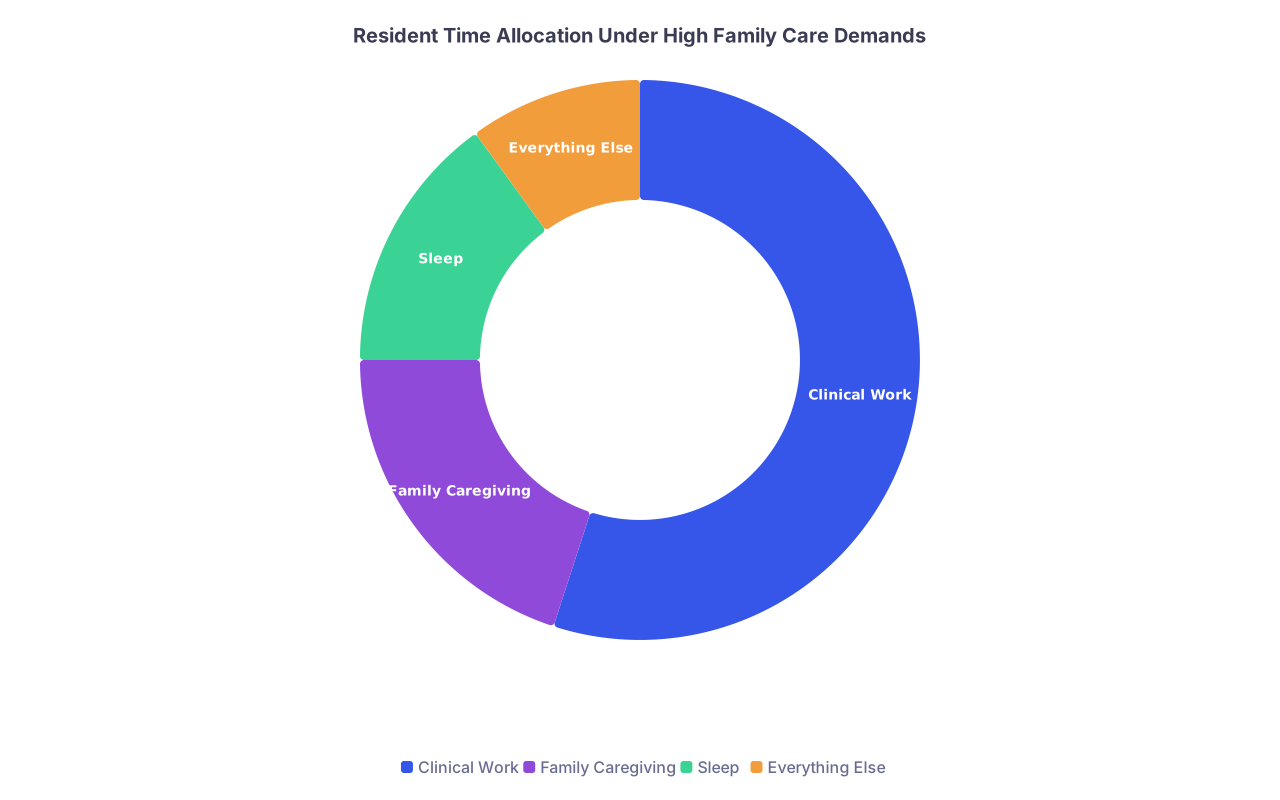
| Category | Value |
|---|---|
| Clinical Work | 55 |
| Family Caregiving | 20 |
| Sleep | 15 |
| Everything Else | 10 |
If your real numbers look worse than that (for example, sleep is down to 5–10%), you’re on borrowed time.
Step 7: If You Need Leave, Here’s How to Approach It
Residents often wait until they’re completely done to ask for leave. By then, it’s usually more disruptive and complicated.
You consider leave if:
- Your family member is in the actively dying phase, and you’d regret not being there.
- You cannot do basic resident tasks safely.
- Your program leadership is already concerned about your performance purely due to the stress you’re under.
Steps:
Review your contract and board requirements. Find out:
- How many weeks per year you must complete.
- What counts as FMLA, personal leave, bereavement.
- Whether added time will extend your residency completion date.
Talk to your PD with a clear ask. For example:
- “I’d like to take 2 weeks of personal/bereavement leave when my dad transitions to hospice.”
- “I need 4 weeks of FMLA to stabilize care for my partner after major surgery.”
Ask about options to minimize damage to training:
- Adding time at the end of the year.
- Using elective time plus leave to create a block.
- Switching to research/non‑clinical time temporarily if available.
Let me be blunt: finishing residency 4–8 weeks later is not the tragedy your burned‑out brain might tell you it is. Missing the last month of your parent’s life and then trying to live with that—usually much worse.
Step 8: Managing Guilt—Because It Will Be Loud
You will feel guilty when you leave the hospital to go see your family.
You will feel guilty when you leave your family to go back to the hospital.
You will feel guilty when you sleep instead of visiting.
You will feel guilty when you stay and show up tired.
The goal is not to eliminate guilt. The goal is to not let guilt be the boss.
A few truths I’ve seen play out:
- Most families do not want you to destroy your career to be there 24/7. They usually want meaningful, honest presence when you are there.
- Being constantly exhausted doesn’t make you a more loving child or partner. It just makes you less present and more irritable.
- You will never look back and say, “I wish I had charted more during that month.” You might say, “I’m glad I was there for that one conversation” or “I’m glad I stayed steady enough to not screw up on someone else’s kid.”
When guilt hits, ask one short question:
“Given my limits and reality, is this the kindest choice I can make for both them and me today?”
Not perfect. Not ideal. Just kind.
Step 9: Planning for the Worst While You’re Still Functional
If your family member has a life‑limiting illness, you need to think ahead before things fall apart.
Use one calm week to:
- Clarify code status and goals of care with them and their primary team. Get it in writing.
- Make sure someone has power of attorney and knows their wishes.
- Ask: “If things get bad quickly, who should call me, and what do you want me to do about work?”
Also decide what will trigger you to step back from work temporarily, so you’re not deciding in shock.
Things like:
- “If they’re admitted to the ICU and the team thinks it’s days to weeks, I take leave.”
- “If hospice is called, I cluster all my available days off around that period.”
Prepare an email template now for your chief/PD that you can send quickly when the situation hits. Fill in basic dates later.
Step 10: After Death or Major Transition—Don’t Bounce Back Too Fast
Residents do this move a lot: funeral on Saturday, back on wards Monday. They think it proves strength. It just buries grief.
If your family member dies or has a major decline:
- Use bereavement leave if you have it. If your institution offers 3 days, take all 3. If you need more, ask.
- Do not volunteer to “make it up” immediately with extra calls or shifts. Let the system absorb it.
- Warn your seniors/attending when you’re back: “My [relation] died last week. I’m okay to work, but I might be a little more emotional than usual.” That heads off misinterpretation of tears or quietness as laziness or attitude.
Grief shows up in weird ways: trouble concentrating, numbness, irritability, or feeling like everything is pointless. If that persists for more than a couple of weeks and is impairing your work or safety, get actual help. Therapy, meds if needed, time off if it’s bad.
You’re not just “tired.” You’ve taken a direct hit.

Quick Scenario Walkthroughs
Let me run through a few real‑world type scenarios and what I’d tell you to do.
Scenario A: Parent Diagnosed with New Cancer During Your ICU Month
Week 1: They’re diagnosed. You’re already drowning in work.
What to do this week:
- Email PD: brief heads‑up, not an emergency, just awareness.
- Identify one sibling/relative to be primary logistic person.
- Commit to 1–2 short phone calls with your parent per week and 1 in‑person visit on your golden weekend.
Do not:
- Try to attend every oncology visit while on ICU.
- Offer to “take over everything” for your family.
Plan:
- Ask to put an elective or lighter rotation in 1–2 months when chemo starts or major surgery is planned.
- Schedule yourself off or light that first treatment week if possible.
Scenario B: Partner Needs Major Surgery and 6 Weeks Recovery
You actually can plan this one.
What to do:
- As soon as surgery is scheduled, meet with PD/chief.
- Request: string together vacation + elective + maybe 1–2 weeks leave to be present immediately post‑op.
- Arrange coverage for overnights at home if you’re post‑call or on nights (friend, parent, hired help if feasible).
Your job:
- Be fully present those first 1–2 weeks.
- Then transition to “supportive but not primary” so you can return to functioning at work.
Scenario C: Terminally Ill Parent Enters Hospice While You’re on Wards
This is where people crack.
Here’s the play:
- Ask for 3–7 days off clustered around the expected last days or right after death, depending on what you and your family prefer.
- Hand off complex patients conscientiously. Accept that you’re not indispensable.
- While you’re with your parent, be with them. Put your phone down, finish notes before you go if you can, or explicitly tell your team when you’ll be offline.
If your program refuses any flexibility at all around an actively dying immediate family member, that’s a data point about the culture. You may still push through now, but you should remember this when you rank fellowships or jobs.
FAQs
1. Should I transfer care of my family member to a different hospital so I’m not “too close” as a resident?
Usually no, unless:
- You cannot emotionally function seeing them regularly at your workplace, or
- Boundaries between you and the treating team are already a mess.
Pros of same hospital: easier visits, easier attendance at meetings, your knowledge of the system helps.
Cons: emotional triggers everywhere, risk of you overstepping.
If they stay at your hospital, be crystal clear with the team about wanting to function as family, not as a shadow attending.
2. What if my co-residents start resenting me for schedule changes or time off?
Some will. People under pressure get selfish. Your job isn’t to make everyone happy; it’s to be fair and honest. Communicate early, offer to swap in ways that don’t wreck your own health later, and stay reliable when you are there. The residents who matter will understand. The others would have found a different reason to resent you anyway.
3. How do I know if I’ve crossed from “stressed” into real burnout or depression?
Red flags:
- You dread every shift and feel detached from patients and colleagues.
- You start making uncharacteristic errors or can’t concentrate on basic tasks.
- You’re thinking, “If I got into a minor car accident and had to be out for a while, that might actually be nice.”
- You’re drinking or using substances more than usual to numb out. Any two or more of these, persisting for weeks, means it’s time to talk to someone professional and consider concrete changes (therapy, meds, leave, schedule adjustment). Pushing harder will not fix it.
Key points to walk away with:
- You cannot be full‑time caregiver and full‑time resident without consequences—decide deliberately what you can do and let the rest go.
- Tell your program early, propose specific solutions, and protect your minimum sleep, food, and emotional support like a clinical priority.
- When the crisis peaks—hospice, surgery, death—seriously consider short, focused time away from work; a delayed graduation is survivable, lifelong regret and severe burnout are not.


