
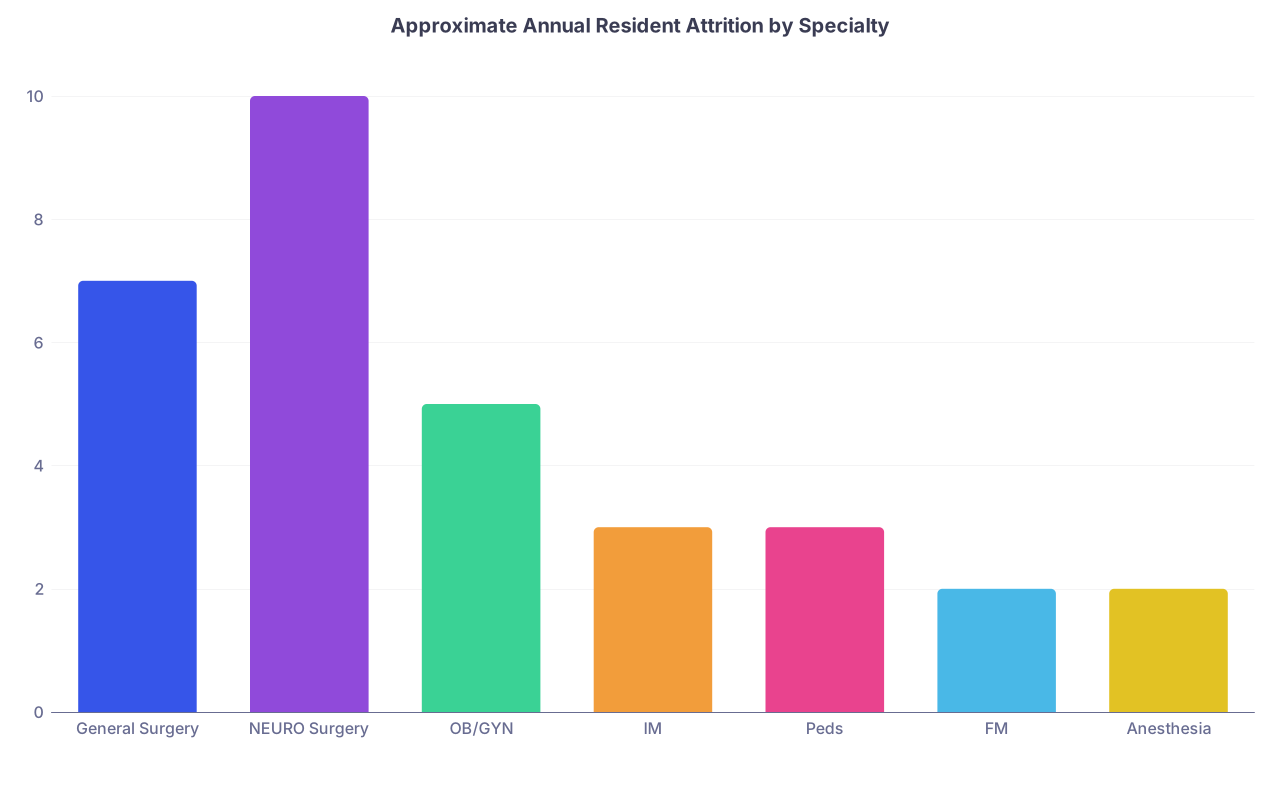
| Category | Value |
|---|---|
| General Surgery | 7 |
| NEURO Surgery | 10 |
| OB/GYN | 5 |
| IM | 3 |
| Peds | 3 |
| FM | 2 |
| Anesthesia | 2 |
The data are blunt: a handful of specialties absorb most of the pain from resident attrition, and they are the same places where duty hours are stretched to the limit and work-life balance is more marketing slogan than reality.
If you strip away the anecdotes and look strictly at numbers from ACGME, ABMS boards, and multi-year cohort studies, a clear pattern emerges. Some specialties hemorrhage trainees at 2–4 times the rate of others. And resident work hours are not the only variable, but they are consistently in the top three predictors of who stays and who walks away.
Let us walk through the data, specialty by specialty, and then tie it back to duty hours, call structure, and culture.
The Baseline: What “Attrition” Actually Looks Like in Residency Data
First, definitions. Otherwise, the numbers get slippery.
Attrition in residency is usually counted as:
- Residents who do not complete the program they started in that same specialty (dropout, dismissal, transfer out to another specialty, or complete exit from training).
- Time frame: most studies track cohorts from PGY‑1 to completion of training or board eligibility.
Large-scale analyses consistently show:
- Overall U.S. GME attrition rates roughly 3–4% across all specialties, but this is heavily skewed by a few high-loss fields.
- Most residents who attrit do so in PGY‑1 and PGY‑2. Once you hit senior resident status, your probability of leaving drops sharply.
Now, the uneven distribution is the real story. Some specialties run attrition near 1–2%. Others sustain 6–10% or higher in certain cohorts.
| Specialty Group | Typical Attrition Range |
|---|---|
| General Surgery | 5–8% |
| Neurosurgery | 8–15% |
| OB/GYN | 4–6% |
| Internal Medicine | 2–4% |
| Pediatrics | 2–4% |
| Family Medicine | 1–3% |
| Anesthesiology | 1–3% |
These ranges come from converging evidence: ACGME data summaries, ABMS board cohort follow-ups, and multiple retrospective program-level studies. The exact percentages wiggle a bit year-to-year, but the ranking does not. The same specialties keep showing up on the high-loss side.
Specialties With the Highest Attrition: The Usual Suspects
1. Neurosurgery: The Outlier
Neurosurgery is the statistical outlier. Every time.
Published estimates:
- Cumulative resident attrition often in the 10–20% range, depending on the era and cohort.
- Some program-level series report close to 1 in 5 residents failing to complete neurosurgical training at their initial program.
Duty hours profile:
- Nominal ACGME cap: 80 hours/week averaged over 4 weeks.
- Real lived experience from survey data: many neurosurgery residents report weeks above 80, especially on busy services or during certain rotations.
- Call: usually in-house, high-acuity, frequent overnight cases, true 24-hour responsibility for life-or-death neurology and trauma.
Mechanisms that link this to attrition:
- Very long training road: 7 years standard, sometimes extended with research.
- High physical and cognitive load on call: intracranial emergencies at 2 a.m., long spine cases running into the night.
- Limited early autonomy and constant high-stakes oversight, which amplifies stress.
Residents do not just leave because it is hard. They leave when the expected personal and professional payoff stops justifying the sustained duty-hour grind. I have seen PGY‑2s in neurosurgery who were simply sleepwalking through the week, looking at seven more years and saying, “I cannot keep this pace and have any life.” And the data show many of them do not.
2. General Surgery: Consistently High Churn
General surgery is the classic attrition-heavy field, with numbers that are reliably unpleasant:
- Longitudinal studies show attrition rates around 5–8% across the 5-year training period.
- Some earlier cohorts, before the 80-hour rule tightened, ran higher than 10%.
Duty hours profile:
- Historically among the worst: 80-hour caps frequently “flexed,” home-call turning into de facto in-house work, post-call days that are post-call in name only.
- More recent data show modest improvements, but PGY‑1 and PGY‑2 years in many programs still hover around the practical upper limit of the duty-hour rules.
Risk patterns inside general surgery:
- Residents who leave often do it by PGY‑2.
- A significant fraction transfer into “lifestyle-improved” but still procedural fields: radiology, anesthesiology, PM&R, or sometimes internal medicine subspecialties.
The causality matrix here is not subtle. Multiple papers list:
- Long work hours and call burden.
- Perceived malignant culture or poor support.
- Mismatch between expectations (operative time, mentorship) and reality.
As core reasons for leaving. Duty hours themselves are not the sole cause, but they create the environment in which burnout, poor teaching, and lack of support hit harder.
Moderate-High Attrition: OB/GYN and A Few Surgical Subspecialties
OB/GYN: High Workload, High Acuity, Heavy Call
OB/GYN is usually in the 4–6% attrition band.
Work structure:
- 4-year training, but call intensity per year is substantial.
- Labor and delivery: 24-hour in-house calls, frequent true emergencies, constant pages.
- Gyn surgery: heavy OR schedules, long days, complex oncologic cases at some sites.
Resident surveys show:
- High rates of duty-hour “violation creep” during busy obstetric blocks (e.g., you leave late every other shift, your 80-hour “average” is a math exercise rather than a felt reality).
- One of the highest reported rates of burnout symptoms among residents, correlating with both hours and emotional intensity (maternal/neonatal loss, complex family dynamics).
Attrition in OB/GYN is a classic multifactor problem:
- High hours and unpredictable nights.
- Emotional toll of bad outcomes.
- Gendered dynamics: many programs have majority female residents, and there is robust evidence that lack of accommodation for pregnancy, childcare, and lactation can push some residents out earlier than they otherwise would have left.
Duty hours are the skeleton; institutional support (or lack of it) decides whether the system breaks.
Other Surgical Subspecialties
Orthopedic surgery, otolaryngology, and some of the more niche surgical fields show intermediate attrition:
- Ortho: often quoted in the 3–6% range.
- Otolaryngology: somewhat lower, but still above medicine and pediatrics in most series.
The pattern holds:
- Procedural specialty.
- High call burden early.
- Long OR days.
- Strong connection between resident satisfaction and whether the “80-hour” limit is honored in spirit or just on paper.
Lower Attrition Specialties: Medicine, Pediatrics, Family Medicine, Anesthesiology
Here is where a lot of myths fall apart. These specialties work hard. Many residents in internal medicine or pediatrics will tell you their weeks feel like 70–80 hours during ICU or wards blocks. But the data show lower overall attrition.
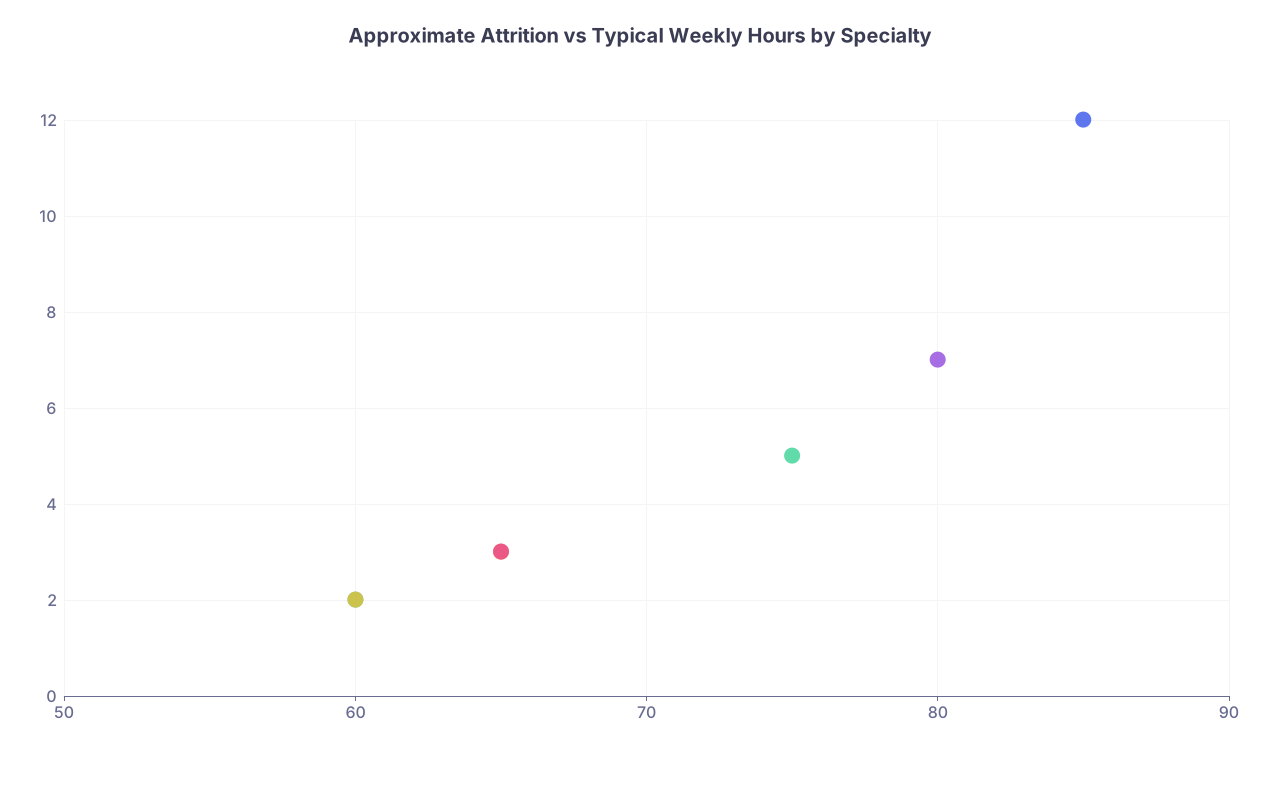
| Category | Value |
|---|---|
| Neurosurgery | 85,12 |
| Gen Surg | 80,7 |
| OB/GYN | 75,5 |
| IM | 65,3 |
| Peds | 65,3 |
| FM | 60,2 |
| Anesthesia | 60,2 |
(Each point: [typical peak duty hours, % attrition upper bound])
Internal Medicine and Pediatrics
Typical attrition:
- Internal medicine: 2–4%.
- Pediatrics: 2–4%.
Why lower?
- Rotational structure: Even in demanding programs, there are lighter ambulatory or elective blocks that function as pressure-release valves. That matters.
- Call model: Night float systems absorb some of the most brutal 24-hour grinds. Not perfect, but less punishing than q3–4 in-house call.
- More predictable path: 3 years, then fellowship or attending status. Residents can endure heavy ward months because the end is near and clearly defined.
Duty hours are still high in ICU and wards. But there is more variability, and more programs actually hit the 70-ish average rather than creeping toward 90.
Family Medicine
Family medicine is consistently at the low end:
- Often 1–3% attrition in aggregate reports.
Duty hours:
- Less inpatient volume.
- More clinic-heavy structure.
- Fewer ICU-level night calls.
The typical family medicine resident still works long hours compared to the average professional job—but compared with neurosurgery or general surgery, the difference is not subtle. The data show that truly extreme hours and constant high-acuity calls push attrition much more than “just busy” days.
Anesthesiology
Anesthesiology has quietly become the landing zone for many surgical refugees, and its attrition numbers suggest why:
- Often reported in the 1–3% range.
Duty hours pattern:
- Early starts, yes.
- Many cases, yes.
- But call is more structured, and many departments aggressively protect post-call days and actual 80-hour compliance. In part because anesthesiology has strong culture around fatigue and patient safety.
The environment is still demanding, but the balance of hours, control, and compensation prospects appears to keep most trainees in the pipeline.
Duty Hours vs Attrition: Correlation, Not Cartoon Causality
If you plot rough specialty-level attrition against rough duty-hour intensity, you see:
- Clear trend: specialties with frequent weeks at or above 80 hours and long in-house calls sit higher on the attrition scale.
- But there are outliers—fields with harsh work that retain people well, and “lighter” fields that still see some losses.
The honest read: duty hours are a primary amplifier of other risk factors:
- Culture and support: A malignant program with 65-hour weeks may generate more attrition than a supportive program holding residents at 78 hours with good backup and teaching.
- Fit vs expectation: Residents who entered for lifestyle reasons but landed in a high-call environment are more likely to bail early. Misalignment between pre-residency expectations and the real duty-hour grind is a strong predictor of exit.
- Life events: Family obligations, financial strain, health issues. Long hours make all of those harder to navigate.
Where duty hours become decisive is when they eliminate any buffer. If you are consistently at 85–90 hours, even small problems—poor mentorship, one toxic attending, a single bad outcome—carry excess weight. You have no time or energy to compensate.
How Program Structure and Scheduling Shape Attrition Risk
Resident duty hours are not just a global number. Structure matters. The data—and frankly, lived experience—show several design features that modulate attrition:
1. Call Model
- Q3–4 in-house 24-hour call is strongly associated with higher fatigue, more errors, and worse resident satisfaction.
- Night float systems, while imperfect, flatten the extremes. Many medicine/peds programs use this and have lower attrition.
- Home call that functions as disguised in-house call (you are paged non-stop, need to come in repeatedly) is a known problem in some surgical fields and certain subspecialties.
2. Rotation Variability
Programs with real “ebb and flow” in schedule:
- Heavy ICU or call months counterbalanced by lighter electives or research rotations.
- Clear rules that prevent stringing multiple high-intensity months back to back if avoidable.
These programs tend to show better retention. Residents can endure a brutal MICU month when they know clinic or elective follows.
Contrast that with repeated trauma, ICU, and call-heavy services stacked. That pattern shows up in exit interviews.
3. Duty Hour Enforcement and Culture
Every resident can tell the difference between:
- A program where 80 hours is a real ceiling, attendings will scrub you out of a case to go home post-call, and documentation is honest.
- A program where everyone “fixes” their hours in the logging system, residents get told “do not log that post-call,” and the 80-hour rule is treated as a PR hurdle.
The second category correlates strongly with higher attrition, regardless of specialty. It is not just the absolute hours; it is the sense that the system is willing to sacrifice you.
Who Leaves and Who Stays: Individual-Level Predictors
Studies that drill down to the individual resident level show some repeating patterns.
Residents more likely to attrit:
- Often in the earliest postgraduate years (PGY‑1/2).
- Report higher duty hours and poorer schedule control.
- Report fewer mentors and lower perceived institutional support.
- Frequently cite “unmanageable work hours” and “poor work-life balance” alongside “culture” when explaining their decision.
Residents who stay despite heavy duty hours:
- Often entered with realistic expectations about the specialty’s lifestyle.
- Have strong support systems (inside and outside the hospital).
- Perceive clear training value in their workload: they believe the suffering is building their competence in a tangible way.
- Can see an endpoint that justifies the cost—competitive fellowship, career autonomy, compensation.
In other words, long duty hours are survivable when they are structured, finite, and meaningful. They become attrition fuel when they feel endless, chaotic, and pointless.
Practical Implications for Trainees Choosing a Specialty
If you are pre-residency or early PGY‑1 and trying to decide how much weight to put on duty hours and attrition data, here is the no-spin summary.
- If you choose neurosurgery, general surgery, or OB/GYN, you are walking into fields with systematically higher attrition and more extreme work hours. You should not pretend otherwise.
- Within those fields, program culture, call model, and schedule design make a massive difference. An 80-hour neurosurgery program that actually honors time off and supports residents is less dangerous (attrition-wise) than a 70-hour program that gaslights you.
- Medicine, pediatrics, family medicine, and anesthesiology keep more residents through to graduation, partly because their work hours are moderate-to-high, not maximal, and their schedules include some real recovery time.
Look for concrete signals:
- How do upper-level residents describe their average week, not just their “worst” week?
- Do residents openly report duty-hour violations in front of leadership, or do they drop their eyes when asked?
- Is there visible variability in rotation intensity, or does every month look punishing?
These are leading indicators of whether you will end up in the attrition statistics.
Where Programs Fail – And What Actually Moves the Numbers
Programs that want to reduce attrition often start with wellness lectures and resilience workshops. The data show those are marginal at best.
The levers that actually shift attrition in high-risk specialties are structural:
- Rebalancing call schedules and protecting genuine post-call days.
- Adding night float systems or cross-coverage to avoid chronic single-resident overload.
- Enforcing honest duty-hour logging and adjusting staffing when patterns show chronic overages.
- Creating real mentorship pipelines so struggling residents are identified early and supported, not isolated.
I have watched surgical programs cut their attrition rate in half over a few years by doing exactly this: fewer consecutive brutal calls, more transparency about hours, and meaningful responsiveness when residents raised concerns. The culture changed when the schedule changed, not the other way around.
Key Takeaways
- Attrition is highest in neurosurgery, general surgery, and OB/GYN, and those same specialties sit at the top of the duty-hour intensity spectrum with frequent 80+ hour weeks and heavy in-house call.
- Duty hours drive attrition mainly by amplifying other risk factors—poor culture, weak mentorship, misaligned expectations—while programs that enforce realistic schedules and provide rotation variability consistently retain more residents, even in demanding fields.


