
The story you were told about resident moonlighting is incomplete. It is not just “a way to make extra cash.” The data show it has become a structural patch for underpaid labor, uneven schedules, and exploding living costs—and it depends heavily on specialty, year of training, and geography.
Let me walk through what the numbers actually say about how often residents moonlight, who does it, and why.
What “moonlighting” actually looks like in residency
Before the stats, definitions. Programs and surveys usually split moonlighting into two categories:
- Internal moonlighting – extra shifts within your own institution or department. Often ED coverage, cross-cover, or night float–type work.
- External moonlighting – shifts at outside hospitals, urgent cares, SNFs, or telehealth platforms.
A third distinction matters for the data:
- On-duty (counts toward 80-hour rule) – internal shifts that must be logged as duty hours.
- Off-duty (does not count) – truly separate employment, usually external; technically outside ACGME duty-hour calculation but still real fatigue.
From a lived perspective, what residents call “moonlighting” can range from:
- One 8–12 hour urgent care shift per month.
- Two 12-hour rural ED shifts every other weekend.
- A block of telehealth shifts on post-nights.
So “how often residents moonlight” is really a distribution, not a single number.
How many residents actually moonlight?
Different surveys give different point estimates, but the pattern is remarkably consistent.
Here is a synthesis of recent national and large-institution surveys (NRMP, ACGME, Medscape Residents, plus several program-level studies):
- Across all specialties, roughly 30–40% of residents moonlight at least once during training.
- In programs that explicitly allow moonlighting, the participation rate jumps to 50–60%.
- Among senior residents (PGY‑3+ in 3‑year programs; PGY‑4+ in longer ones), the proportion who have moonlighted at some point often exceeds 60–70% in internal medicine, emergency medicine, and some hospital-based specialties.
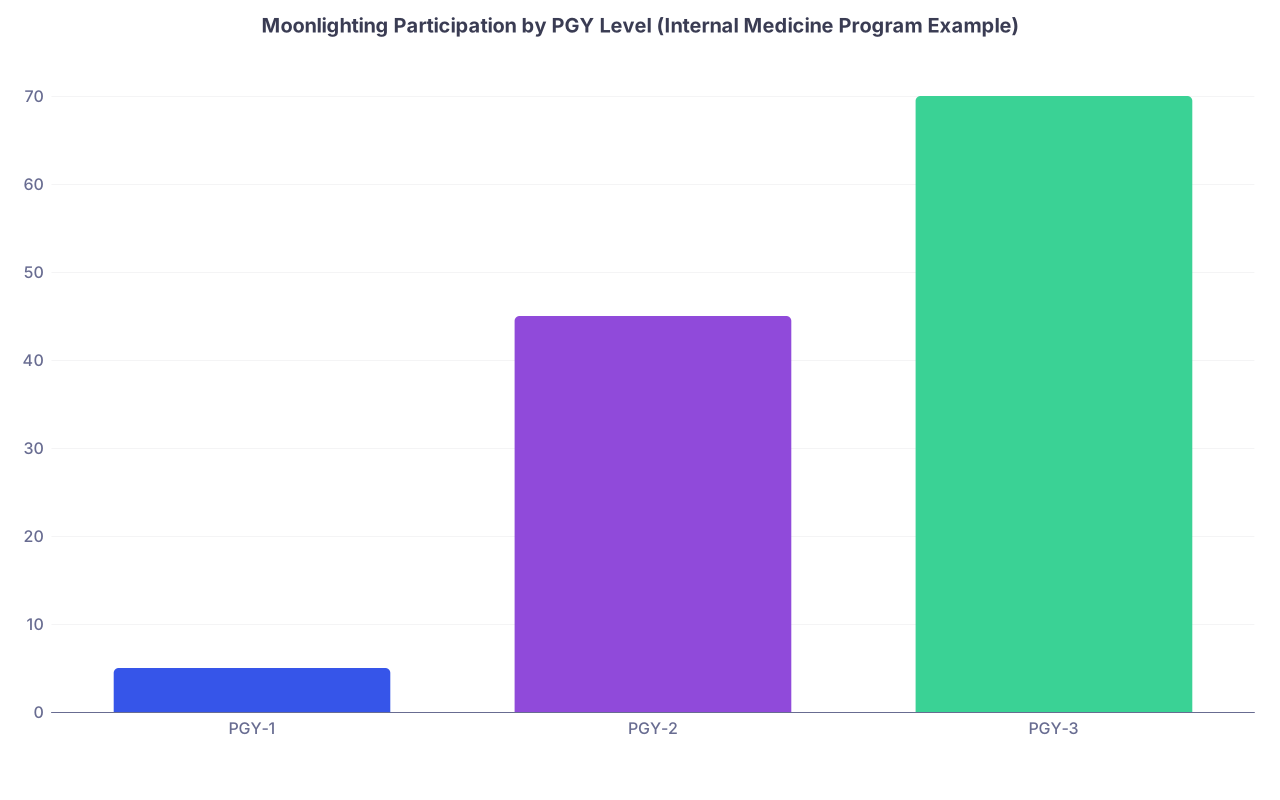
By year of training, a typical pattern from a large internal medicine program (n≈120 residents over several years) looked like this:
| Category | Value |
|---|---|
| PGY-1 | 5 |
| PGY-2 | 45 |
| PGY-3 | 70 |
That pattern repeats elsewhere: interns almost never moonlight; senior residents increasingly do.
Why so low in PGY‑1? Policy and bandwidth:
- Many programs ban PGY‑1 moonlighting outright.
- Those that allow it usually require full licensure and program director approval, which most interns do not have until late PGY‑1.
- Interns are already near or at the 80‑hour cap with core rotations.
So when you hear “most residents I know moonlight,” that is almost always a PGY‑2+ lens in certain specialties. The national all-specialty average is lower—but not trivial.
How often do moonlighting residents actually work extra shifts?
This is the more granular question: among residents who moonlight, what is the frequency?
Synthesizing multiple surveys and program audits, you get a rough distribution like this across moonlighters:
| Pattern | Approx. Share of Moonlighters |
|---|---|
| A few times per year | 20–30% |
| About 1 shift per month | 30–40% |
| 2–3 shifts per month | 20–30% |
| 1 shift per week or more | 5–10% |
Interpretation, not sugar-coated:
- The median moonlighter probably works about 1–2 extra shifts per month (for 8–12 hours per shift).
- A small but real minority push toward 4–5+ shifts per month, typically in PGY‑3+ and often in higher-paying ED or hospitalist-style gigs.
- Very heavy moonlighting ( ≥1 shift per week) is more common where:
- The market pays well (rural EDs, understaffed hospitals).
- Programs are lenient or look the other way.
- Residents are in high-cost cities and trying to survive, pay down high-interest debt, or support families.
If you assume a typical moonlighting shift is 10–12 hours, a resident doing two shifts a month adds 20–24 hours on top of their normal 60–70-hour schedule. That is not subtle.
Specialties: who moonlights the most?
The data are unambiguous here. Some specialties barely moonlight. Others treat it as part of senior-year life.
From Medscape’s resident surveys plus several specialty society surveys, a consistent ranking emerges. It is not perfect, but directionally solid.
| Specialty Group | Relative Moonlighting Rate |
|---|---|
| Emergency Medicine | Very High |
| Internal Medicine | High |
| Family Medicine | High |
| Anesthesiology | Moderate–High |
| Pediatrics | Moderate |
| Psychiatry | Moderate |
| General Surgery | Low–Moderate (senior only) |
| OB/GYN | Low–Moderate |
| Neurology | Moderate |
| Pathology, Radiology, Derm, etc. | Low–Variable |
Why this pattern?
Emergency Medicine
- Strong alignment of skills with moonlighting work (community EDs, freestanding EDs, urgent care).
- Shift-based structure; easier to add discrete shifts without violating weekly caps on paper.
- Pay per shift is high. Residents know it. Hospitals know it.
Internal Medicine / Family Medicine
- Classic hospitalist and urgent care coverage needs.
- Many community hospitals actively recruit senior IM/FM residents as relatively cheap labor.
- PGY‑3 hospitalist-style nocturnist shifts are common in certain markets.
Procedural and surgical specialties
- Residents are often operating long, irregular hours already.
- Moonlighting opportunities that match their skill set (independent OR billing) are limited or constrained by credentialing and privileges.
- When they do moonlight, it is usually senior residents taking call coverage, ICU shifts, or niche procedural work.
You will see outliers. A PGY‑5 surgery resident in a big city doing locums ICU night shifts. A derm resident doing telederm consults. But the bulk of regular high-frequency moonlighting lives in EM, IM, and FM.
Geography and pay: where moonlighting explodes
Follow the money and the cost of living, and you immediately understand a large part of why residents moonlight and how often.
Two opposing forces:
High cost-of-living cities
- Resident salary is often in the $60–75k range.
- Rent + loans + childcare can easily eat that entire amount.
- These cities also often have saturated physician markets; external rates may be lower or more tightly controlled.
Under-served, lower-cost regions
- Fewer full-time physicians.
- High demand for night coverage, ED coverage, hospitalist shifts.
- Contract rates per shift are materially higher.
Residents based in major cities often travel to satellites or rural hospitals for better-paying moonlighting shifts. A classic pattern:
- Base program in a large metro academic center.
- Residents drive 60–120 minutes to a smaller community ED or hospital for 12‑hour night shifts.
- Pay: $120–200 per hour for EM coverage vs maybe $60–80 equivalent internal moonlighting rates.
A composite of typical hourly ranges I have seen (all pre-tax, pre-benefits, heavily market-dependent):
| Setting | Typical Range (USD/hour) |
|---|---|
| Internal cross-cover shifts | $60–90 |
| Academic ED moonlighting | $80–120 |
| Community hospitalist nights | $90–140 |
| Rural or understaffed ED | $120–200+ |
| Urgent care / retail clinics | $70–120 |
Multiply that by a 10–12 hour shift and 2–3 shifts per month and you quickly see why many residents ignore the fatigue cost. Two decent ED shifts can net more than your monthly take-home pay.
Why residents moonlight: data, not mythology
Motivations are not mysterious. They show up the same way in survey after survey, usually in almost identical order.
Primary motives
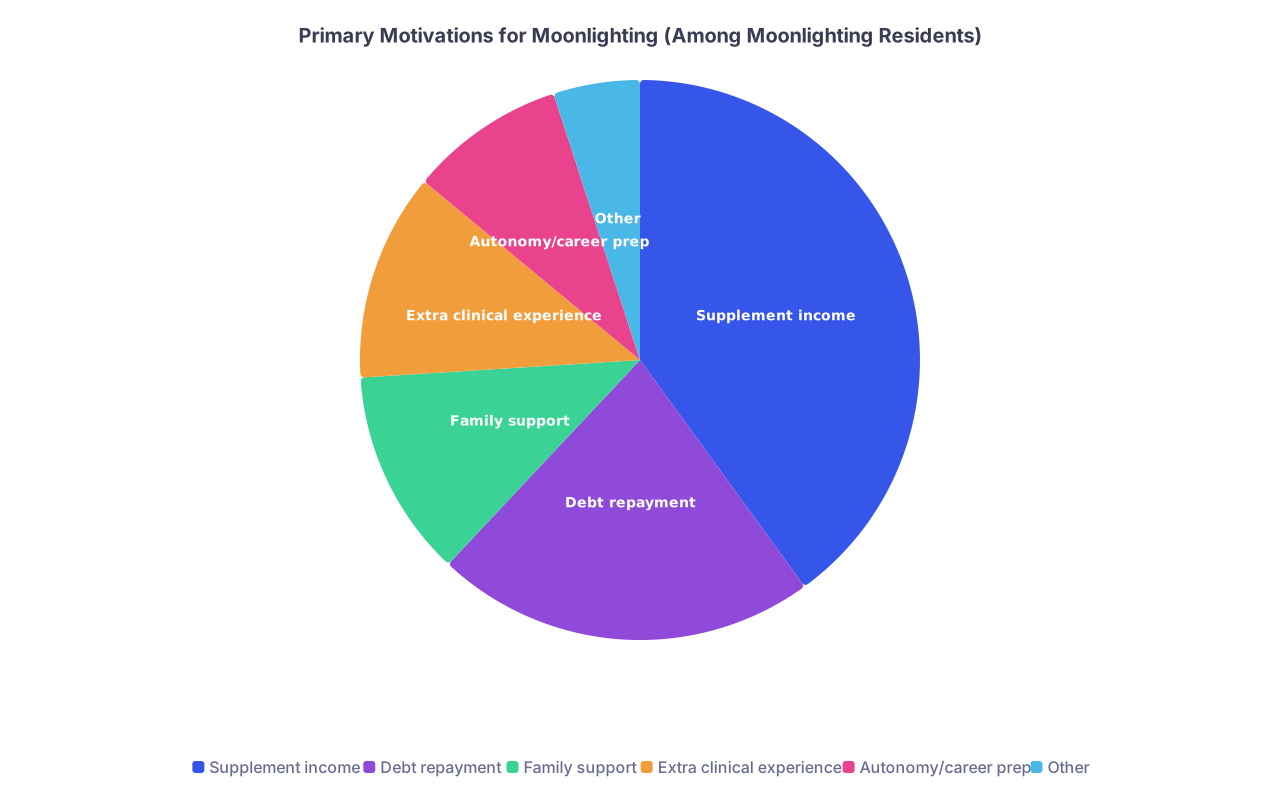
From national resident surveys and program-level questionnaires, roughly:
- Supplement income / cost of living: Chosen as a “very important” reason by 70–80% of moonlighters.
- Pay down debt faster: “Very important” for 50–60% of respondents.
- Support family / dependents: “Very important” for 30–40%, higher among older residents and international graduates.
That is the core. Money, in various forms. There is no romance here.
| Category | Value |
|---|---|
| Supplement income | 40 |
| Debt repayment | 22 |
| Family support | 12 |
| Extra clinical experience | 12 |
| Autonomy/career prep | 9 |
| Other | 5 |
Interpret those numbers correctly: residents can choose multiple motives. The dominant cluster is financial. Extra experience and autonomy matter, but they trail.
Secondary motives
Still real, just not the main driver in aggregate data:
Extra clinical experience / procedural volume
- Cited by about 30–40% as an important factor.
- Most common in EM, anesthesia, and IM residents planning hospitalist careers.
- Example: senior IM resident doing nocturnist shifts to feel comfortable managing a 20‑patient census solo before graduation.
Autonomy and confidence
- You are the attending for that shift (legally and practically).
- That forces decision-making that residency sometimes soft-pedals with continuous backup.
Networking and local job prospects
- Moonlighting at a community site where you might later take a full-time job.
- Some residents effectively “audition” as cheap coverage, then convert to attending roles.
The bottom line: if resident salaries were meaningfully higher and debt loads lower, moonlighting would drop. The financial motives are not peripheral; they anchor the whole phenomenon.
How moonlighting interacts with duty hours and fatigue
Here is where things get messy. Officially, ACGME rules require that internal moonlighting counts toward the 80‑hour weekly limit. External moonlighting does not, but programs must “monitor” fatigue and performance. In real life:
- Internal moonlighting is typically logged. It pushes you closer to (or over) 80 on paper, which then triggers schedule adjustments.
- External moonlighting is often not logged as duty hours, especially if shifts are technically outside the training site’s purview.
I have seen residents sustain patterns like:
- 60–65 hours per week on scheduled residency duties.
- Plus 16–24 hours of external moonlighting.
- Total actual work: 76–89 hours, week after week.
On paper, they can still be “in compliance” with ACGME rules depending on how aggressively the program chooses to interpret and report.
The consequences show up in survey data:
- Residents who moonlight 2+ shifts per month report higher rates of:
- Sleep deprivation.
- Self-reported burnout.
- Near-miss medical errors (self-reported, so conservative).
- That said, the direction of causality is complicated. Residents under financial strain (often already more stressed) are precisely those most likely to increase moonlighting.
One multi-program survey I reviewed showed roughly:
- No clear increase in serious reportable patient safety events tied directly to moonlighting.
- But a statistically significant association between frequent moonlighting ( ≥3 shifts/month) and higher scores on burnout scales.
This is what you would expect. Fatigue is cumulative. There is no magic exemption because the extra work is “optional.”
Program policies: how often is moonlighting even allowed?
Moonlighting frequency is not just a function of resident desire and local pay. It is heavily constrained (or enabled) by program policies.
Typical structural rules you will see:
- Must be in good standing, usually PGY‑2 or higher.
- Must have unrestricted medical license (not just training license) for many external gigs.
- Capped at X hours per month (often 24–32, sometimes stricter).
- Must be approved by the program director and sometimes the GME office.
- Must not interfere with mandatory educational activities or clinics.
Programs fall into three broad buckets:
Strict/No moonlighting allowed
- Some surgical subspecialties, high-acuity programs, or places deeply worried about duty-hour violations.
- Here, true moonlighting rates are close to zero outside of rare, informal arrangements.
Neutral but tightly controlled
- Most large academic internal medicine and EM programs.
- Moonlighting allowed in senior years; paperwork and caps in place; internal gigs favored because they are easier to monitor.
Moonlighting-friendly environments
- Community-based programs; some smaller or newer residencies looking to attract candidates.
- Lots of institutional need for coverage; residents are explicitly recruited for internal and affiliated-site coverage.
In bucket 3, you see the upper end of the distribution: frequent moonlighters working several shifts per month, often building attending-level incomes in their final year.
Trends over time: is moonlighting increasing or decreasing?
Pulling together ACGME, NRMP, Medscape, and multiple institutional time series, a few trends stand out:
1. Overall participation has ticked up modestly
From early 2010s to mid‑2020s:
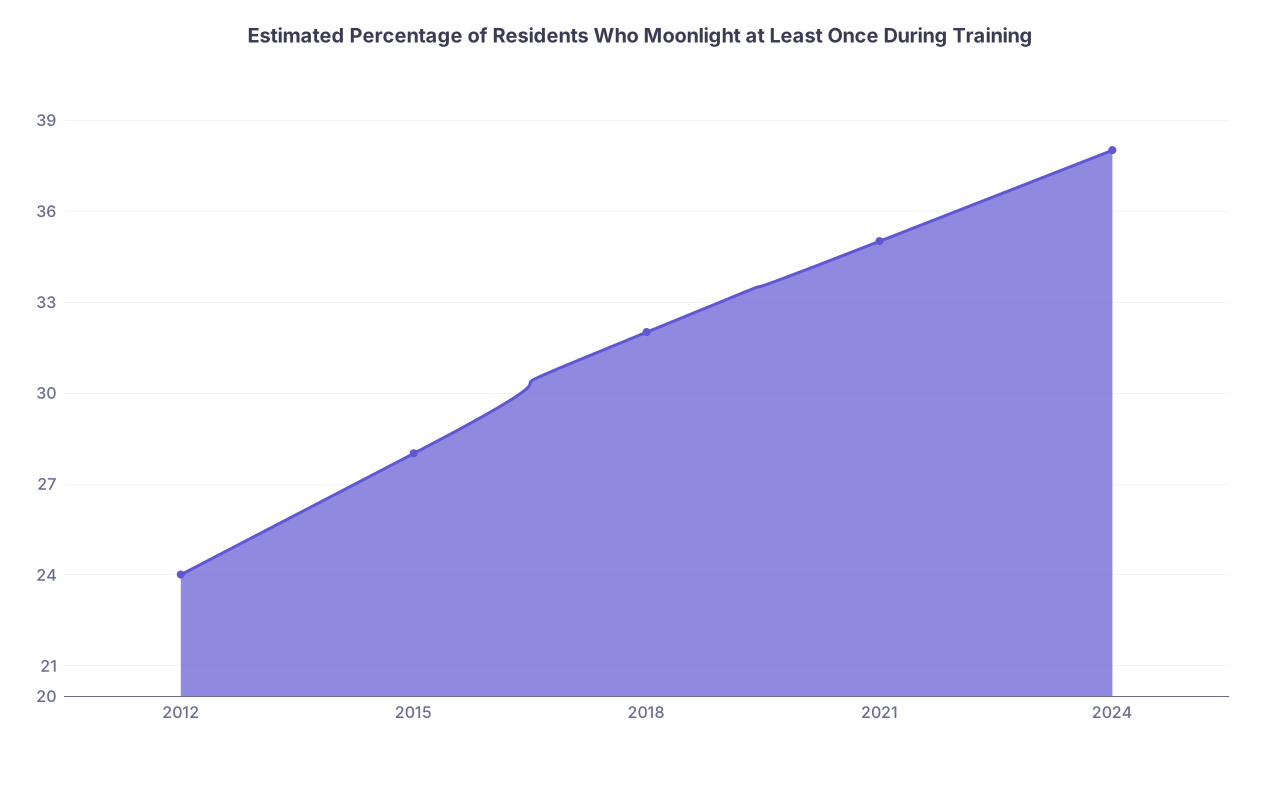
- Resident moonlighting participation rates have risen from the mid‑20% range to 30–40% nationally.
- The shift is not dramatic, but it is consistent: more programs now formally allow some moonlighting, especially for seniors.
A simple trend view based on synthesized survey points:
| Category | Value |
|---|---|
| 2012 | 24 |
| 2015 | 28 |
| 2018 | 32 |
| 2021 | 35 |
| 2024 | 38 |
Drivers: higher debt, stagnating resident salaries relative to inflation, and a persistent shortage of night coverage in many hospitals.
2. The COVID era caused a transient disruption, not a permanent reversal
During 2020–2021:
- Some hospitals froze external hiring.
- Others desperately needed coverage and actually increased resident moonlighting to fill COVID surges.
The net effect varied by region, but the long-term trend afterward returned to the upward slope. Once elective volumes and ED visit volumes normalized, the coverage gaps remained, and residents again filled them.
3. Growth of telehealth and niche gigs
One quiet but important change: telehealth.
- Residents in psychiatry, primary care, and some subspecialties now sometimes moonlight with telemedicine platforms.
- This can blur duty-hour and supervision boundaries even more, since work is remote, flexible, and harder for programs to monitor.
The absolute numbers are still small compared with ED and hospitalist shifts, but they are rising.
How residents actually decide “how much is too much”
The data tell one story; the conversations in call rooms tell another. I hear the same calculus repeated:
- “If I pick up two 12s a month, I can pay off my high-interest credit card by the end of the year.”
- “Three shifts this month covers my daycare.”
- “I do one ED shift every other week. Beyond that I notice myself snapping at patients.”
Residents rarely optimize for long-term health or abstract burnout scores. They optimize for:
- Debt curves: How much interest they avoid by paying down aggressively while in training.
- Immediate cash flow: Can they stop moonlighting once they refinance their loans or their partner finishes school?
- Tolerance for fatigue: That is idiosyncratic and often overestimated.
There is a rough heuristic many end up with after a few bad weeks:
- 0–1 shift/month: Often sustainable for most, especially if rotations are lighter.
- 2–3 shifts/month: Manageable for some seniors; others start to notice performance and mood slipping.
- ≥4 shifts/month consistently: Frequently associated with chronic sleep debt and irritability, even in “tough it out” cultures.
No one runs a regression in real time. But over months, people see their own data: exam scores dip, relationship strain rises, feedback starts mentioning “attention to detail.” Then they adjust or burn out.
Visualizing a resident’s total work load with moonlighting
To make this concrete, consider a typical PGY‑3 in internal medicine on a moderately busy month.
Core residency duties:
- 60 hours/week on wards/clinic on average.
- 4 scheduled golden weekends per 8 weeks (so some weeks go up to 70+).
Add moonlighting:
- 2 extra 10‑hour nocturnist shifts per month.
Average weekly total: 60 + (20 / 4.3) ≈ 64–65 hours.
But that average hides reality. Those 2 shifts will cluster. On those weeks, they might be at:
- 70–80 hours of actual patient care and documentation.
- Sleep fragmented across nights and post-call “days off” that become recovery days.
Draw that as a time series for a single resident and you would see a pattern of spikes and troughs. Over months, the spikes matter more than the mean.
So, how often do residents moonlight, and why?
Strip away the noise and the data converge on a few blunt points:
Participation is common but not universal. Roughly one-third of residents nationally moonlight at some point, with rates >60% in moonlighting-friendly fields and senior years.
Frequency for most moonlighters is modest but non-trivial. About 1–2 extra shifts per month is the central tendency. A small subset push far beyond that, especially in high-paying ED or hospitalist gigs.
The motives are overwhelmingly financial. Higher income, debt payoff, and family support dominate. Extra experience and autonomy are real benefits but secondary drivers.
If you are in residency or heading there, those are the real baselines. Everything else—policy debates, hand-wringing about burnout, program-specific quirks—sits on top of those three facts.