
The first 90 days of intern year will either save you or break you.
If you stumble blindly through them, you’ll spend the rest of the year playing catch-up, exhausted, and irritated. If you treat Months 1–3 like a training camp for your brain, body, and workflow, the rest of residency gets a lot more manageable.
Here’s the timeline: what to build, when to tighten it up, and what to fiercely protect.
Big Picture: The First 3 Months, Broken Down
At this stage, do not think “How do I survive?”
Think: “What habits do I want on autopilot by October?”
You’re building:
- A repeatable pre-rounding and rounding system
- A task and sign-out system that actually works at 2 a.m.
- Sleep and shift routines that survive nights and golden weekends
- Communication habits with nurses, seniors, and consultants
- A deliberate plan for learning while drowning
We’ll go month by month, then zoom into key weekly and daily milestones.
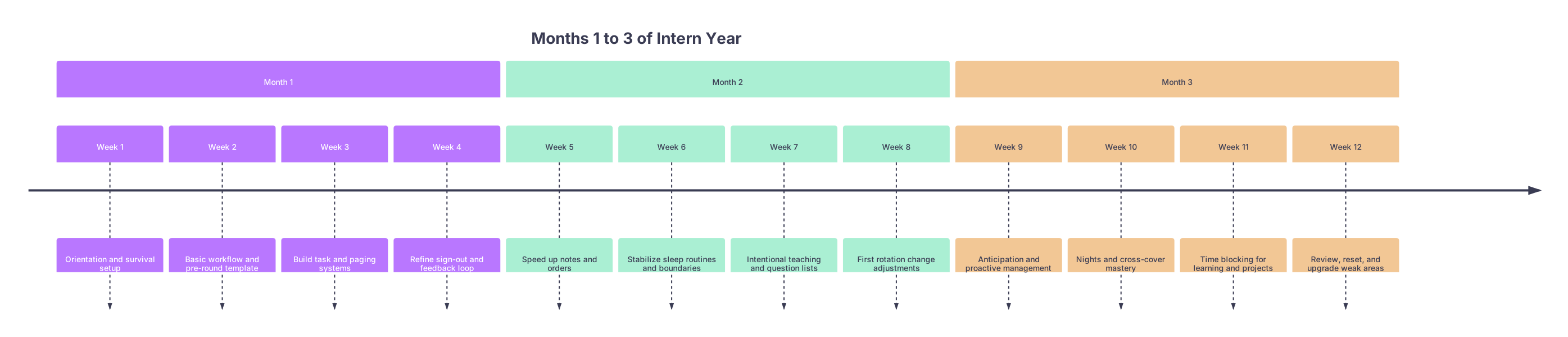
| Period | Event |
|---|---|
| Month 1 - Week 1 | Orientation and survival setup |
| Month 1 - Week 2 | Basic workflow and pre-round template |
| Month 1 - Week 3 | Build task and paging systems |
| Month 1 - Week 4 | Refine sign-out and feedback loop |
| Month 2 - Week 5 | Speed up notes and orders |
| Month 2 - Week 6 | Stabilize sleep routines and boundaries |
| Month 2 - Week 7 | Intentional teaching and question lists |
| Month 2 - Week 8 | First rotation change adjustments |
| Month 3 - Week 9 | Anticipation and proactive management |
| Month 3 - Week 10 | Nights and cross-cover mastery |
| Month 3 - Week 11 | Time blocking for learning and projects |
| Month 3 - Week 12 | Review, reset, and upgrade weak areas |
Month 1: Survival With Structure
Week 1: Orientation and Baseline Habits
At this point you should not be optimizing. You’re just trying to not drown. Your only job: set basic scaffolding.
By the end of Week 1 you should:
Lock in a capture system for tasks One place where everything goes. Paper list, folded index card in your coat, or a notes app you actually use fast. I don’t care which. Just one.
Your task capture should include:
- Patient initials/bed
- Task
- Time-sensitive? (Y/N)
- “Done” checkbox
Choose your pre-rounding template You’ll change it later, but pick a starting point:
- Vitals trends (last 24 hrs)
- I/Os
- Labs/imaging
- Overnight events
- Active problems w/ plan bullets
Make a standard format, handwritten or printed, and use it for every patient. Consistency beats beauty.
Start a sleep anchor Even on weird shifts, protect:
- A baseline wake-up time on most day rotations (e.g., 4:45–5:15 a.m.)
- A wind-down ritual that takes 10–20 minutes: shower, no screens, dark room, maybe white noise
You won’t sleep enough. But you can at least sleep predictably.
Decide your “no” boundaries Interns who say yes to everything in Month 1 burn out by Month 4. Set:
- 1–2 non-negotiable personal habits (e.g., 10-minute walk after work, quick call/text with partner, simple meal instead of vending machine garbage)
- A rough rule for staying late: “I stay to stabilize my patients and finish notes, but I don’t open ‘just in case’ work after sign-out.”
Week 2: Pre-rounding and Rounding Rhythm
At this point you should have stopped constantly getting lost. Now the habit is: a predictable morning run.
Morning flow you should aim for:
T-90 minutes before rounds
- Log in, print/refresh patient list
- Check overnight vitals, events, new consult notes
- Jot down 1–2 questions per complex patient for your senior
On the floor
- See the sickest or most unstable patients first
- Use the same 2–3 questions on every bedside encounter:
- “How did you sleep?”
- “Any pain, trouble breathing, nausea, or new symptoms?”
- “What’s your biggest concern today?”
30 minutes before rounds
- Finalize your “headline” for each patient:
- “Stable, weaning O2.”
- “New fever overnight, workup started.”
- “Ready for discharge once home meds sorted.”
- Finalize your “headline” for each patient:
Your intern superpower this week isn’t fancy medicine. It’s having a clear 10–15 second snapshot ready for every patient.
Week 3: Paging, Tasks, and Not Forgetting Things
By now the pages start to pile up. The interns who crumble are the ones who try to hold everything in their head. Don’t do that.
At this point you should have:
A page-handling script When the nurse calls:
- Ask for: patient name/room, issue, vitals, and what they’re worried about.
- Repeat back a plan: “I’ll come see them in 10 minutes” or “I’ll put in the order now and then come reassess.”
A structure for triaging tasks Split your task list into:
- STAT (bleeding, chest pain, new confusion, hypotension, sats dropping)
- Urgent (severe pain, borderline vitals, new fever)
- Routine (discharge med rec, non-urgent med refills, stable constipation)
A “Do not miss” checklist before leaving Run this every day before you sign out:
- All critical labs followed up?
- All results that change management addressed?
- Discharge orders complete for tomorrow?
- High-risk patients updated with families (or at least discussed with the team)?
Write that checklist on a sticky note stuck to your workstation. Look at it before you log off. Every single day.
Week 4: Sign-out and Feedback Habits
Week 4 is about closing loops. Clinical and personal.
Your sign-out by the end of Month 1 should:
List active issues and what you actually want done:
- Bad: “AKI”
- Better: “AKI from sepsis, improving. If MAP <65 despite fluids, call senior; if UOP <0.3 mL/kg/hr x 4 hrs, recheck labs and page team.”
Highlight “if-then” scenarios for cross-cover:
- “If fever >38.3 again, please get blood cultures x2 and lactate, and start cefepime per protocol.”
Flag new admissions or evolving situations explicitly.
On the personal side:
- Ask your senior for 2–3 specific pieces of feedback:
- “One thing I should stop doing.”
- “One thing I should keep doing.”
- “One habit you wish you had built as an intern that I can start now.”
Write their answers down. Actually act on them.

Month 2: From Surviving to Efficient
By Month 2, you should not still be flailing over basic notes and orders. Now the focus shifts to speed + reliability without being sloppy.
Weeks 5–6: Sharpening Workflow and Protecting Sleep
At this point you should:
Standardize your notes Create 1–2 go-to templates per service:
- Medicine admit note
- Daily progress note
- Surgical post-op note
And then:
- Use the same order of problems every day.
- Lead with the active issues, not the stable chronic stuff.
- Keep one-liners actually one line. “65M with COPD and new hypoxic respiratory failure due to pneumonia.”
Time-box your notes Interns waste hours nitpicking charting. General target:
- Simple progress note: 7–10 minutes
- Complex ICU note: 15–20 minutes If you’re taking 30+ minutes on every note, you’re rewriting the chart. Stop.
Harden your sleep boundary Month 1 you just tried not to fall over. Month 2 you protect actual recovery:
- Pick a latest screen-off time on days you’re on call the next day.
- Use quick sleep aids that aren’t alcohol: eye mask, white noise, melatonin (if you use it), cool room.
- After a brutal call: shower, small snack, no scrolling in bed. You’re not “catching up,” you’re delaying sleep.
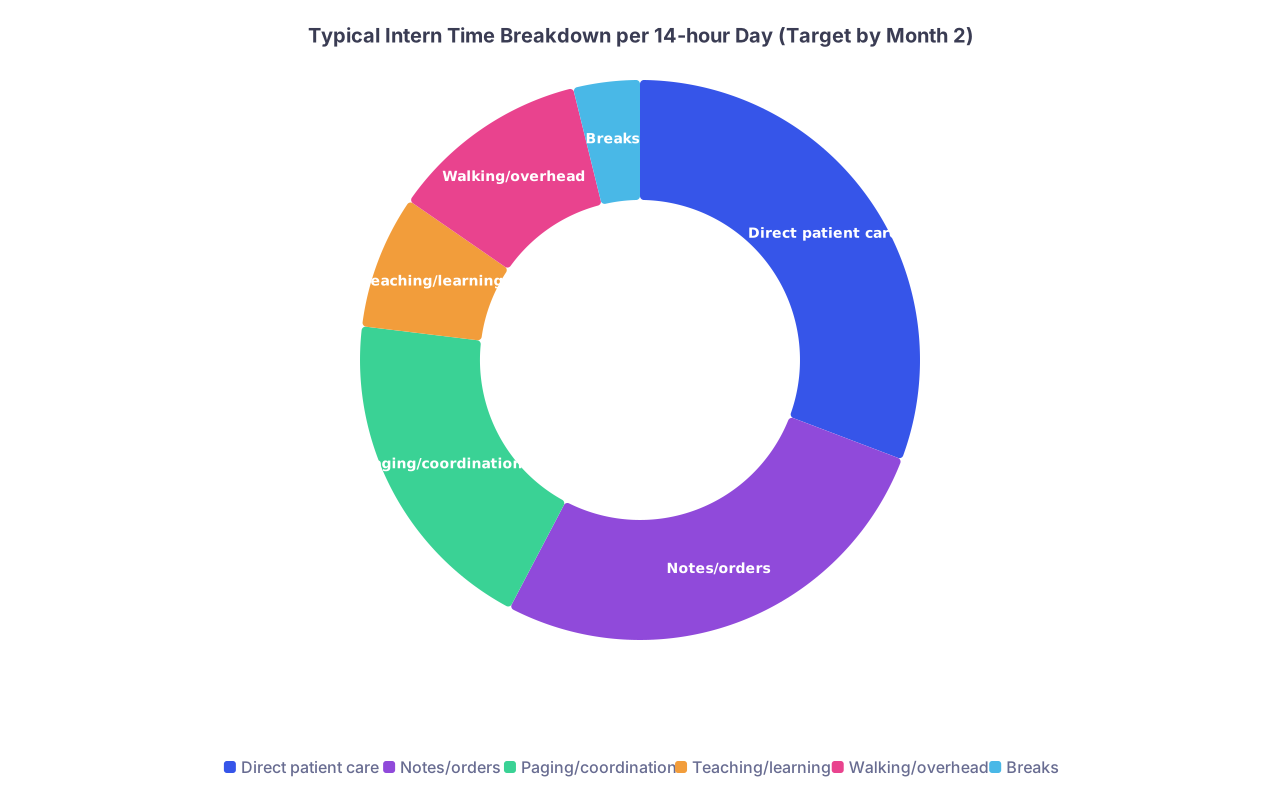
| Category | Value |
|---|---|
| Direct patient care | 240 |
| Notes/orders | 210 |
| Paging/coordination | 150 |
| Teaching/learning | 60 |
| Walking/overhead | 90 |
| Breaks | 30 |
(Minutes per day; the point is not perfection, it’s awareness.)
Week 7: Intentional Learning Amid Chaos
Here’s the trap: “I’ll study when things calm down.” They don’t. You need micro-learning habits.
By this week you should:
Carry a running “question list” Use a tiny notebook or app:
- “Why did we pick ceftriaxone over zosyn?”
- “When do we actually stop VTE prophylaxis pre-op?”
- “Best regimen for alcohol withdrawal in liver disease?”
Then:
- Pick 2–3 questions per day.
- Look them up at lunch or right after sign-out, not “someday.”
Attach learning to patients If you admitted a DKA patient:
- Read 5–10 minutes on anion gap closure targets and insulin transition.
- Write 3 bullets in your notebook. Done.
You’re not doing board prep. You’re building pattern recognition and practical scripts.
Week 8: First Rotation Switch and Identity Check
Your first change in service hits here or soon. It will feel like intern year restarted.
At this point you should:
Spend Day 1 of new rotation doing reconnaissance:
- Who are the key nurses and how do they like to communicate?
- How does this attending run rounds? (Walk with them, table rounds, bedside?)
- What time do discharges need to be done for beds to move?
Adjust, but do not abandon, your core habits:
- Same task system
- Same sign-out structure
- Same “question list”
Remember: new service, same intern. Your habits travel with you.
Month 3: From Reactive to Proactive
By Month 3, you’re dangerous in a good way. You’ve seen enough fire to predict smoke. Now it’s about anticipation, nights, and sustainable growth.
Weeks 9–10: Anticipation and Nights
Nights either forge you or flatten you. Your Month 1–2 systems are about to be tested.
Before your first nights block, you should:
Plan a night-shift sleep pattern:
- Night 1: short nap in the afternoon (60–90 minutes), then push through.
- On nights: sleep as soon as you get home, don’t “just check email.”
- Flip-back strategy: slowly push wake time later or earlier depending on post-nights schedule.
Create a cross-cover cheat sheet:
- Common “pager specials” and your first steps:
- “Pt with sats 88% on 2L” → check vitals, O2 source, examine, consider CXR, ABG/VBG, call senior if unstable.
- “Pt with chest pain” → vitals, brief H&P, EKG, troponin, aspirin if not contraindicated, senior looped early.
- “Agitated, pulling lines” → rule out hypoxia, hypoglycemia, pain, urinary retention, alcohol/benzo withdrawal, low sodium.
- Common “pager specials” and your first steps:
During Nights Weeks (9–10):
Start anticipatory orders:
- PRNs for pain, nausea, insomnia
- Bowel regimens on all constipating meds
- Overnight BMPs only when they’ll change management
Use a strict “one list, one brain” approach for cross-cover:
- Your overnight list should flag:
- DNR/DNI, fresh post-ops, new admits, “watch closely” patients
- Reassess the sickest yourself early in the night.
- Your overnight list should flag:
Week 11: Time Blocking for Learning and Projects
By this point you’re no longer completely in shock. This is the danger zone where you either start coasting or you deliberately grow.
At this point you should:
Choose one small academic or QI thing to attach yourself to:
- Simple case report
- Helping with a QI project on the unit
- Starting a list of “interesting cases” you might present
Block two 20–30 minute learning windows per week:
- Example:
- Tuesday 7:30–8:00 p.m. – reading on a patient problem you saw that day
- Saturday morning – quick board-style questions
- Example:
Protect these like a clinic appointment. People who say “I’ll read when I can” read never.
Week 12: Review, Reset, and Upgrade
End of Month 3 is your first major checkpoint.
At this point you should sit down on a post-call day or golden weekend and actually audit yourself.
Ask:
- Where am I still slow?
- Notes? Pre-rounding? Orders? Calling consults?
- Where am I forgetting things?
- Follow-up labs? Discharge planning? Family updates?
- What’s draining me most?
- Night-to-day transitions? Conflict with staff? Emotional weight of cases?
Then adjust:
- If notes are slow → tighten templates, ask a PGY-2 to walk you through their structure.
- If discharges are chaotic → start discharge planning on Day 1 of admission in your notes.
- If you’re constantly exhausted → fix the basics: caffeine timing, screens before bed, stop agreeing to every extra social thing on your supposed “off” day.
You should also:
- Ask 2–3 seniors/attendings:
“You’ve seen me for 2–4 weeks now. What’s one habit you think I should double down on, and one habit I should drop?”
Write that down. Act on it over the next month.
| Timepoint | Core Habits You Should Have Locked In |
|---|---|
| End of Month 1 | Single task system, basic pre-round template, sign-out basics |
| End of Month 2 | Faster notes, stable sleep routine, daily micro-learning |
| End of Month 3 | Anticipatory management, nights workflow, review/reset routine |
Daily Non-Negotiables: What You Protect Every Single Day
Regardless of the month, by the end of the first 90 days these should be your daily anchors:
Morning check-in with yourself
“What absolutely has to get done today to keep patients safe and my life intact?”Real food at least once
Not crackers and Diet Coke. A cafeteria meal, pre-packed leftovers, or something you don’t inhale in 2 minutes while standing.Move your body 5–10 minutes
Stairs instead of elevator for a few floors, walk outside after sign-out, stretching while you wait for labs to load. Not for fitness glory. For sanity.One micro-learning action
One question answered, one short article skimmed, one guideline bookmarked.Hard stop check before leaving
“Any critical labs pending? Any sick patients not rechecked? Any family that needed an update?”
Then leave. Really leave.
What To Ruthlessly Avoid in Months 1–3
Let me be blunt about a few bad habits you should kill early:
Being a martyr
Staying hours late every day to “help” the team when it’s not needed. You teach people your time is disposable.Pretending you understand
Nodding when you’re confused about a plan or order. The habit you want is: “I’m not clear on that—can you walk me through the reasoning?”Toxic debriefing
Living in group chats or resident lounges where the only topics are how awful everything is. Venting is normal. Living in complaint mode is corrosive.All-or-nothing health goals
“I’ll go to the gym 5 days a week” on a q4 call month. No, you won’t. Try “I’ll move my body twice this week for 15 minutes.” Scale to reality.
FAQ (Exactly 3 Questions)
1. What if my program is disorganized and my seniors are not helpful?
Then your habits matter even more. Build your own structure: your own task list, your own sign-out template, your own pre-round routine. Find one or two approachable upper-levels on other teams or older residents from your med school and ask, “Can I see how you structure your notes and your day?” You don’t need perfect leadership to have a solid personal system.
2. How much should I be studying for boards in the first 3 months?
In Months 1–3, I’d focus on embedded learning, not board blocks. Answer 1–3 clinical questions a day based on your patients. Maybe 10–15 board-style questions once or twice a week if you have capacity. You’re building patterns and habits; the dedicated board grind comes later, once you’re not reinventing your daily workflow.
3. I feel constantly behind compared to my co-interns. Is that normal?
Yes—and honestly, half of them are faking how put-together they look. Some people adapt faster to the chaos, but by the 6–9 month mark, the ones who built solid systems and asked for feedback consistently usually surpass the “naturally good” ones. Measure yourself against last month’s you, not the loudest or most confident intern.
Remember:
Get the basics on autopilot early. Protect your sleep and your brain like they’re consults. And every few weeks, step back, audit your habits, and upgrade one weak spot at a time.