
The biggest mistake new interns make is assuming clinical skills will “come back” automatically on July 1. They will not. Not under cross-coverage pressure at 2 a.m. with five admits waiting.
You build that muscle back. Systematically. And Match Day is exactly when you should start.
Let me break this down into a concrete, specialty-specific clinical skills refresher plan starting the day you open that envelope.
Step 1: Reboot Your Mindset on Match Day Itself
Match Day is loud, emotional, chaotic. But sometime in the 24–48 hours after you see your program, you need a quiet 30–45 minute block to flip from “applicant” to “pre-intern.”
Do three things right then.
1.1 Define your target: what kind of intern your program expects
Programs are not subtle about this. They tell you in pre-interview dinners and on websites. The “good intern” in a high-powered academic IM program is different from the “good intern” in a community EM program.
Sit down and write, explicitly, for your matched specialty:
- The 3–5 core roles of a day-one intern in that field
- The 5–10 concrete clinical tasks you will be expected to handle with minimal hand-holding
Example:
Matched into Internal Medicine at a big academic center?
Your core roles on July 1:
- Pre-round and know your patients cold
- Write accurate, concise daily notes
- Call basic orders safely (IV fluids, common meds, prn orders)
- Present on rounds clearly
- Call consults that do not waste the consultant’s time
Concrete tasks:
- Admit a straightforward CHF or COPD exacerbation
- Manage insulin orders for a stable diabetic
- Write sign-out that another intern can actually use
- Recognize and escalate early sepsis or GI bleed
- Reconcile meds correctly on admission and discharge
If you cannot list similar tasks for your specialty, you are already behind. Fix that first.
1.2 Take a brutally honest skills inventory
This is not “How good was I as an MS3?” This is “Right now, with shelf exams behind me and interview season brain rot, what can I still do confidently?”
Make three columns on paper or in a simple note:
- “Comfortable”: can do with only quick reference
- “Rusty”: did before, but would need step-by-step reminder
- “Weak/never”: avoided, forgot, or never really understood
Run through:
- Core clinical reasoning (workup of CP, SOB, AMS, fever, abdominal pain, etc.)
- Procedures (depending on specialty): IVs, ABGs, LPs, paracentesis, pelvic exams, slit lamp use, suturing, basic splinting
- Documentation: H&P, daily progress note, simple discharge summary, OR note, brief op note, ED course note
- Communication: calling consults, giving handoff, updating families, talking to nurses, answering pages
Be honest. No one will see this list except you. But your entire refresher plan will depend on not lying to yourself here.
1.3 Lock in your “why” before the grind
Intern year will be the most cognitively and emotionally expensive year of your life so far. You are not building this plan to look good on July 1 orientation. You are doing it because:
- It prevents harm. Sloppy medication thinking in June becomes bad orders in July.
- It buys you respect. Nurses and seniors very quickly separate the interns who prepared from the ones who coasted.
- It gives you bandwidth later. You do not want to be learning how to write a basic note in August when you should be focusing on nuanced management.
Write one line at the top of your plan: “I am doing this so that ________.”
Corny, yes. But it works when you are tired in late May.
Step 2: Backward-Design Your Timeline From July 1
You have a finite runway between Match Day and the start of orientation. It is not uniform—some of you have away rotations, some have “scheduled nothing,” some are juggling family or Step 3.
You do not need a 12-week boot camp. You need a tight, high-yield, realistic plan.
2.1 Rough blocks: what your pre-residency calendar should look like
Most U.S. grads have around 10–14 weeks between Match Day and July 1, fragmented by:
- Remaining rotations (sub-I, electives, required blocks)
- Travel, moving, graduation events
- Actual rest (which you do need, by the way)
I like to break it into three phases:
Phase 1 – Decompression + Light Calibration (Match Day → 2 weeks later)
- 80–90% life / 10–20% clinical
- Goal: orient yourself, pick resources, light re-immersion
Phase 2 – Structured Skills Rebuild (Mid-Spring → mid-June)
- 40–60% life / 40–60% clinical
- Goal: rebuild core reasoning and documentation, practice communication
Phase 3 – Pre-Intern Simulation (Last 2–3 weeks before start)
- 50% life logistics / 50% “intern-mode practice”
- Goal: rehearse the actual work you will do on Day 1
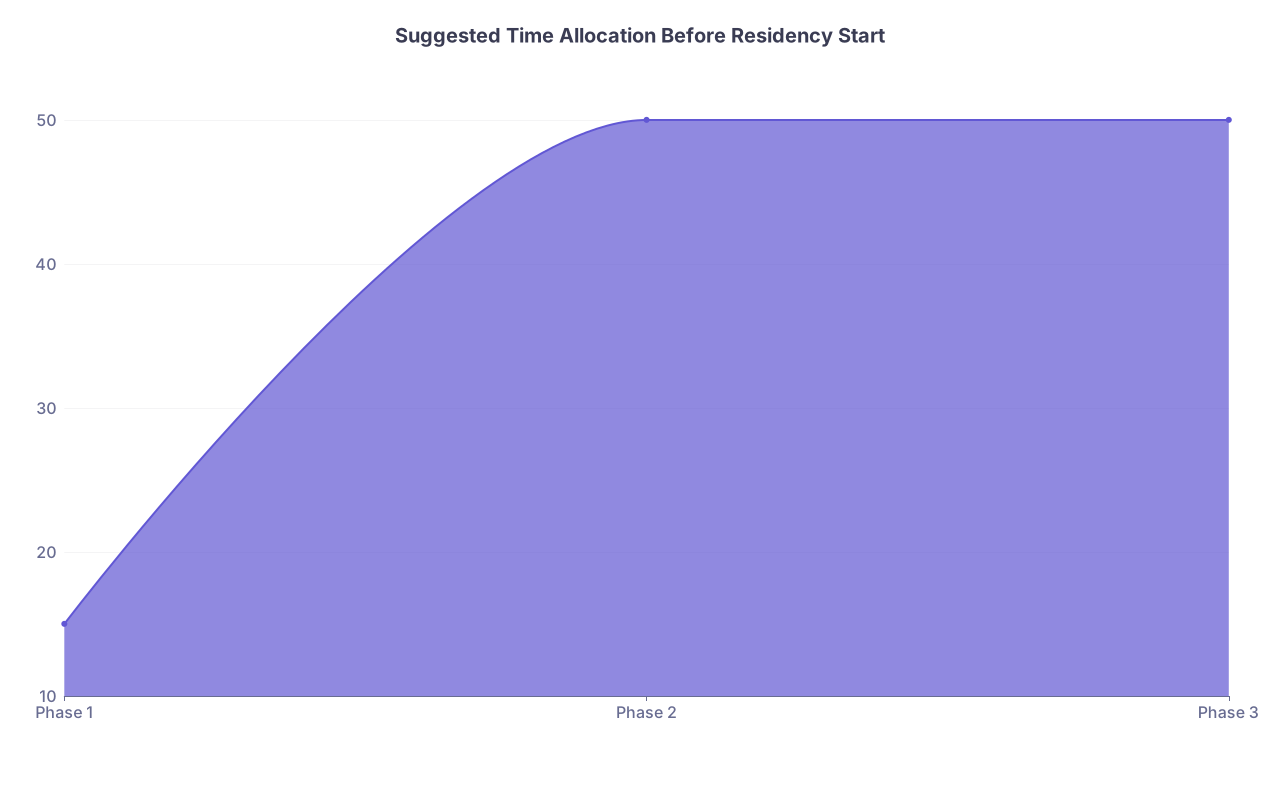
| Category | Value |
|---|---|
| Phase 1 | 15 |
| Phase 2 | 50 |
| Phase 3 | 50 |
That “light” Phase 1 is not laziness. It protects you from burning out before you even show up.
2.2 Map your reality against the ideal
Open your actual calendar (Google, Outlook, whatever) and drop in:
- Fixed academic requirements (rotations, exams)
- Travel/moving dates
- Non-negotiable family events
Then carve out:
- 3–4 hours/week in Phase 1
- 6–10 hours/week in Phase 2
- 6–8 hours/week in Phase 3
If you cannot find that time, your plan needs to be more ruthless, not more “motivated.”
Step 3: Choose Ruthlessly Focused Resources
You do not need to drown in textbooks. You are refreshing, not discovering penicillin.
Here is the basic menu by specialty. You will not use all of it; you will pick 1–2 anchors and a couple of supplements.
| Specialty | Primary Clinical Text | Case/Reasoning Resource | Skills/Procedures |
|---|---|---|---|
| Internal Medicine | Step-Up to Medicine or MKSAP for Students | NEJM Clinical Problem Solving, CPX cases | Hospitalist Handbook (PDF) |
| Surgery | Surgical Recall or Mont Reid | Case Files Surgery | Lippincott Illustrated Procedures, YouTube OR basics |
| Pediatrics | BRS Pediatrics or Nelson Essentials | Case Files Pediatrics | Peds dosage apps, vaccine schedules |
| Emergency Medicine | EM Basic / EM:RAP CorePendium | Anki-based chief complaint cards | Procedure videos (EMCrit, CoreEM) |
| OB/GYN | Beckmann OB/GYN | Case Files OB/GYN | ACOG practice bulletins (selected) |
You do not need the fanciest or latest edition. You need something you will actually open three times a week.
Step 4: Build the Actual Weekly Clinical Skills Plan
Now the part everyone asks for: what do you actually do each week?
I will outline a general structure, then show you how to adapt it for, say, Internal Medicine vs Surgery.
4.1 The four pillars your plan must address
Every specialty’s refresher plan must hit:
- Clinical reasoning
- Documentation
- Communication
- Practical skills / workflow
If your plan is all “reading UpToDate,” you are missing three of the four.
4.2 Base schedule template (Phase 2 weeks)
Think in sessions, not “study time.” Each session has a goal and a deliverable.
A typical week (6–8 hours total):
- Session 1 (1.5–2 hours): Reasoning + cases
- Session 2 (1–1.5 hours): Documentation practice
- Session 3 (1.5–2 hours): Communication + cognitive drills
- Session 4 (1–2 hours): Skills/workflow + specialty-specific tasks
Let me be concrete.
Session 1: Clinical reasoning
Pick 2–3 chief complaints that dominate your specialty.
Internal Medicine example week:
- Week on “shortness of breath, chest pain, fever”
- Read a concise chapter / section on each (Step-Up, MKSAP, CorePendium, etc.)
- Do 5–10 case-based questions (Case Files, UWorld-style, or institutional cases if you have access)
- After each case, write a 3–5 sentence assessment and plan as if you are staffing to your senior
You are not studying for an exam. You are training the habit: “Given this presentation, my brain quickly generates 3–5 reasonable differentials, a workup, and a basic management plan.”
Surgery example:
- Week on “post-op fever, abdominal pain, trauma”
- Review: differential and “red flags” for each
- Work through trauma/ACLS algorithms
- Sketch out your go-to initial orders for common post-op issues
OB/GYN example:
- Week on “vaginal bleeding, abdominal pain in pregnancy, no prenatal care”
- Review algorithms for ectopic pregnancy, early pregnancy bleeding, preeclampsia screens
- Do a few structured cases, then verbalize how you would present to your attending
Session 2: Documentation practice
Everyone thinks they write decent notes. Then July 2 hits and they spend 40 minutes on one H&P.
Once a week, sit down and:
- Take a sample case (from Case Files, old OSCE scripts, or a de-identified real case you remember)
- Write:
- A full H&P OR
- A daily progress note OR
- A discharge summary (for IM/FM/Med-Peds) OR
- A brief op note / post-op check note (for Surgery) OR
- An ED course summary and MDM (for EM)
Then:
- Time yourself. It should not take 45 minutes. Aim for:
- 20–25 minutes for a full H&P
- 10–15 minutes for a daily note
- 15–20 minutes for a discharge summary
- Re-read it as if you are the receiving intern at sign-out. Can you understand the hospital course and plan?
If you have a friend in the same specialty, swap one note per week and critique each other ruthlessly.
Session 3: Communication and cognitive drills
This is where most interns fall flat. They know the medicine but cannot summarize it fast and clean.
Once a week:
- Practice 2–3 “consult calls” out loud. Example for IM:
- “Call Neurology for new focal deficit”
- “Call GI for possible upper GI bleed”
- “Call Cards for NSTEMI”
Use a simple structure (ID, reason, pertinent history, exam, key labs/imaging, what you are asking for).
- Do 2–3 sign-out summaries for imaginary patients:
- “56-year-old with CHF exacerbation, stable on 2L O2, what you need to watch tonight is…”
- If you are going into EM, practice 30–60 second presentations:
- CC, one-line summary, focused HPI, key exam, what you think it is, and what you are doing
Yes, literally out loud. No, thinking it in your head is not the same.

Session 4: Skills and workflow
This is the catch-all for “stuff interns are expected to just know.”
Rotating topics by week:
- How to write admission orders and initial plans
- How to structure daily rounding sheets / to-do lists
- How to approach cross-cover pages systematically
- Specialty-specific skills:
- EM: laceration repair steps, procedural sedation basics, common splints
- Surgery: post-op orders, tube/line management, drains, wound care basics
- OB: labor progress note, NST interpretation basics, triage of pregnant patient
- Pediatrics: weight-based dosing, fluid calculations, vaccine catch-up schedules
Use institutional guidelines if your residency has shared them; otherwise pick a reputable source (UpToDate, EMCrit, national society protocols).
Step 5: Make It Specialty-Specific (Two Worked Examples)
Let me walk you through two concrete specialty plans so you can see how to adapt.
5.1 Internal Medicine-bound student: 8-week structured plan
Assumptions: Matched to categorical IM, moderate schedule, ~6–8 hours/week available.
Weeks 1–2 (light, still decompressing)
Focus: Restart the engine
- 1 session/week: Read through short, high-yield chapters on:
- Approach to chest pain, dyspnea, fever, abdominal pain
- 1 short documentation session/week:
- Write 1 H&P and 1 progress note from cases
Weeks 3–6 (core rebuild)
Each week pick 3 themes. Example week:
- Week A: Cardiovascular (CHF, ACS, Afib)
- Week B: Pulmonary (COPD, pneumonia, PE)
- Week C: Renal/electrolytes (AKI, hyper/hyponatremia, hyperkalemia)
- Week D: Endocrine/infectious mix (DKA, thyroid storm, sepsis)
Weekly structure:
- Reasoning session:
- Read concise material on your 3 themes
- Do 10–15 mixed questions and write APs for 3–4 of them
- Documentation:
- 1 full H&P for an admission-level case
- 1 discharge summary for a simple, resolved admission
- Communication:
- Practice 2 consult calls (Cardiology, Nephrology, etc.)
- Practice 2 cross-cover pages (“patient with low BP,” “patient with chest pain overnight”)
- Skills/workflow:
- Build a template for:
- Admission orders for CHF exacerbation
- Insulin orders for NPO vs eating patient
- Review your hospital’s or generic sepsis and anticoagulation guidelines
- Build a template for:
Weeks 7–8 (pre-intern simulation)
Shift toward realism:
- One “mock call night” each weekend:
- Take a list of 6–8 imaginary patients with active problems
- Write one-line summaries, problem lists, and anticipated issues
- Run through a dozen possible pages and how you would respond (SBP 80, K 6.2, patient falls, etc.)
- Do 2–3 full “admissions” from scratch:
- Read a case, write an H&P, craft admission orders, and a handoff
- If you can, shadow a night float or on-call resident for a few hours just to refresh the rhythm (many programs allow matched MS4s to do this informally)
By the end of this, your brain has already run through the tasks you will do in July. That is the point.
5.2 General Surgery-bound student: 6–8 week targeted plan
Assumptions: Matched to General Surgery, still on some electives, less time but more procedure focus.
Weeks 1–2: Fundamentals and language
- Read through key chapters in Surgical Recall or your program’s recommended pocket manual:
- Pre-op assessment
- Post-op fever, oliguria, hypotension
- Common abdominal emergencies: appendicitis, cholecystitis, SBO
- Once a week:
- Practice writing a brief op note and a post-op check note from a case
- Watch:
- 3–4 high-quality videos on sterile technique, basic knot tying, and suture types
Weeks 3–5: Post-op management and emergencies
Each week pick:
- 1–2 common operations (lap chole, hernia, colectomy, etc.)
- 2–3 complications to focus on (bleeding, infection, anastomotic leak, ileus)
Weekly pattern:
- Reasoning:
- For each operation, map: indications, key steps in plain language, normal post-op course, expected pain, expected labs
- For each complication, list “red flags” that separate “watch and wait” from “call attending now”
- Documentation:
- 1 op note and 1 post-op progress note per week
- Communication:
- Practice calling your chief/attending for:
- Post-op tachycardia and hypotension
- Decreased urine output in a fresh post-op
- Increasing abdominal pain and tachycardia on POD3
- Practice calling your chief/attending for:
- Skills/workflow:
- Memorize and rehearse how to write post-op orders for your chosen operations
- Review drain types, Foley management, DVT prophylaxis basics
Weeks 6–7: ED consults and night float
- Build scripts for common consults:
- “Abdominal pain, concern for appendicitis”
- “SBO on CT”
- “Penetrating trauma”
- Do 1–2 “round simulation” sessions weekly:
- Take 5 imaginary post-op patients and quickly write bullet problem lists and plans
- Revisit wound care, dressing changes, and basic ostomy care via videos or manuals
Again, the goal is not to become a chief resident. It is to avoid being the intern who does not know basic post-op milestones.
Step 6: Layer in OSCE-Style and Physical Exam Refreshers
Physical exam skills atrophy fast when you have been on virtual rotations and interview trails. You will not fix that entirely in March–June, but you can get out of the basement.
6.1 Pick 4–5 exam routines to keep sharp
You will use these constantly:
- Cardiovascular exam with JVP estimation
- Pulmonary exam (including distinguishing wheeze vs crackles vs rhonchi)
- Abdominal exam (peritonitis signs, organomegaly basics)
- Neuro screening exam (CN, motor, sensory, cerebellar, gait)
- For OB: fundal height, Leopold maneuvers, pelvic exam basics
- For EM/surgery: trauma primary and secondary survey
Once a week, do:
- 20–30 minute focused physical exam practice on a willing friend/partner or a pillow + imagination if needed
- Narrate your findings out loud as if presenting on rounds
6.2 Quick OSCE drills
Once every 1–2 weeks, pick a full OSCE-style case:
- Set a timer for 15 minutes
- Take a prompt (“45-year-old with chest pain,” “70-year-old with confusion”)
- Spend 10 minutes doing “history” out loud and 5 minutes describing the focused exam you would perform
- Then write a SOAP note in 15–20 minutes
If your school still has access to OSCE checklists, use them. Otherwise, build your own simple checklists for the big complaints.
Step 7: Integrate Technology and Real-World Tools
You live on your phone. Use it intelligently.
7.1 Build your core app stack now, not on call
At minimum:
- Drug reference (Micromedex, Lexicomp, or Epocrates)
- Medical calculator (MDCalc)
- Your specialty “handbook” app or PDF (e.g., Stanford Hospitalist Handbook, EMRA Basics, local hospital handbook if provided)
- For pediatrics: weight-based dosing app you trust
- For OB: gestational age calculator, due date wheel app
Once a week, during your skills session:
- Pick 2 serious scenarios (DKA, PE, acetaminophen overdose, hypertensive emergency, etc.)
- Use your apps to walk through dosing and management, as you would in real life
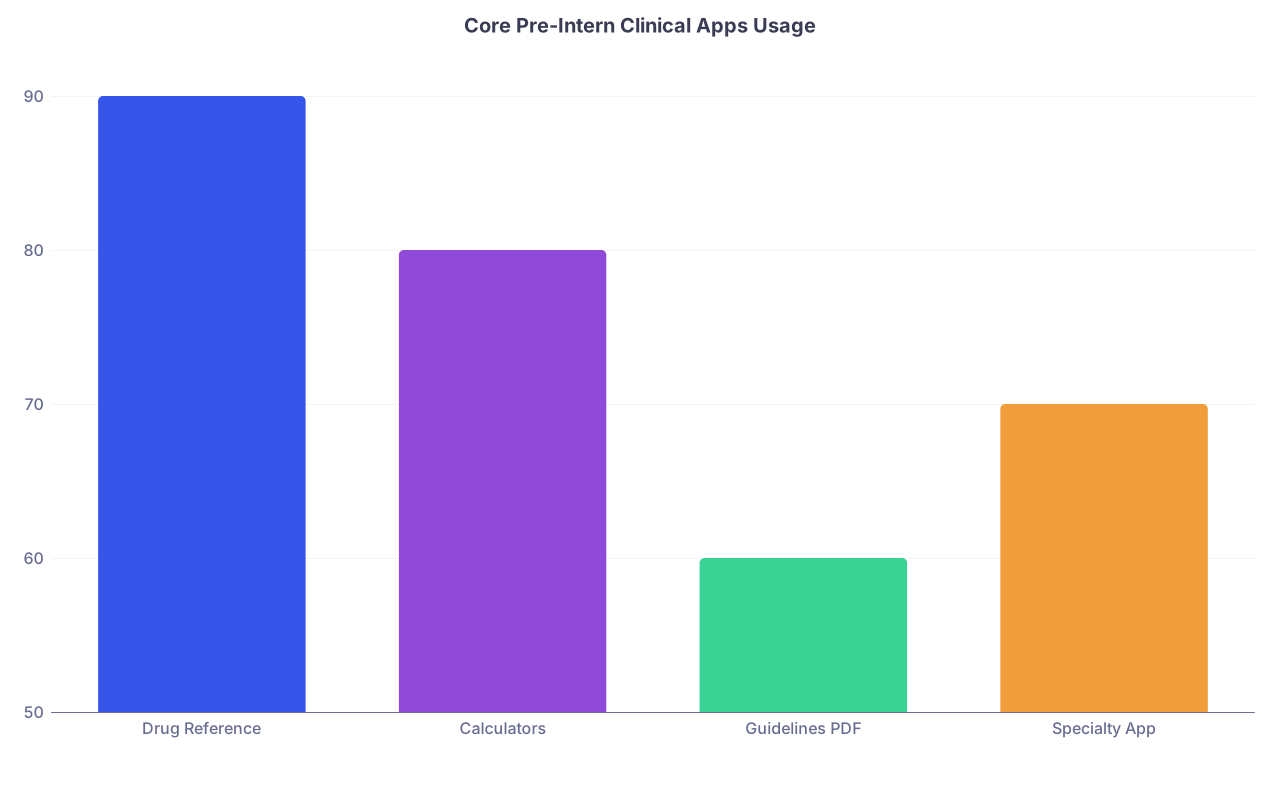
| Category | Value |
|---|---|
| Drug Reference | 90 |
| Calculators | 80 |
| Guidelines PDF | 60 |
| Specialty App | 70 |
Those percentages are how often I actually saw competent interns using them—not how often they downloaded them.
7.2 Templates and checklists
You will save enormous cognitive load if you pre-build:
- Admission H&P templates (with specialty tweaks)
- Discharge summary structure
- Consult call script (literally a one-page script is fine)
- Night cross-cover checklist: what you ask for when paged about low BP, low urine output, chest pain, agitation, etc.
Store these in:
- A notes app folder labeled “Intern Start”
- A small pocket notebook if you are analog-inclined

Step 8: Use Your Remaining Rotations Strategically
If you still have rotations after Match Day, stop coasting. You can relax on the grade obsession, yes. But this is free, supervised practice for July.
8.1 Tell your residents your goal
On Day 1 of your remaining rotations, say something like:
“I just matched into X at Y. My main goal this month is to get ready for intern year—especially with [documentation/consults/procedures]. I would really appreciate feedback on that.”
Good seniors will light up when they hear this. Bad seniors will shrug; ignore them and keep working your plan.
8.2 Convert every patient into intern-level reps
For each new patient you see:
- Do the full H&P but write the note as you would as an intern
- Propose an assessment and plan that includes:
- Admission vs discharge
- Level of care (floor vs stepdown vs ICU if relevant)
- Initial orders: fluids, meds, monitoring
- Call or present as if you are the intern, not the student begging for permission
You are training the role, not padding an evaluation form.

| Step | Description |
|---|---|
| Step 1 | See patient |
| Step 2 | Gather history exam |
| Step 3 | Draft intern-level note |
| Step 4 | Form assessment plan |
| Step 5 | Present to resident |
| Step 6 | Get feedback |
Step 9: Build in Feedback and Reality Checks
You are a terrible judge of your own readiness in a vacuum. You need external input.
9.1 Ask for targeted, not generic feedback
Do not say, “How am I doing?” Ask:
- “If I were your intern in July, what would worry you about how I currently present/write notes/call consults?”
- “What is one thing I should fix before residency?”
And then, crucially, write that down and incorporate it into your plan.
9.2 Short self-assessments every 2–3 weeks
Every couple of weeks, revisit your original three-column skills inventory and re-rate yourself.
You want to see items move from “Weak” → “Rusty” → “Comfortable.” If entire categories are not shifting, your plan is too theoretical.
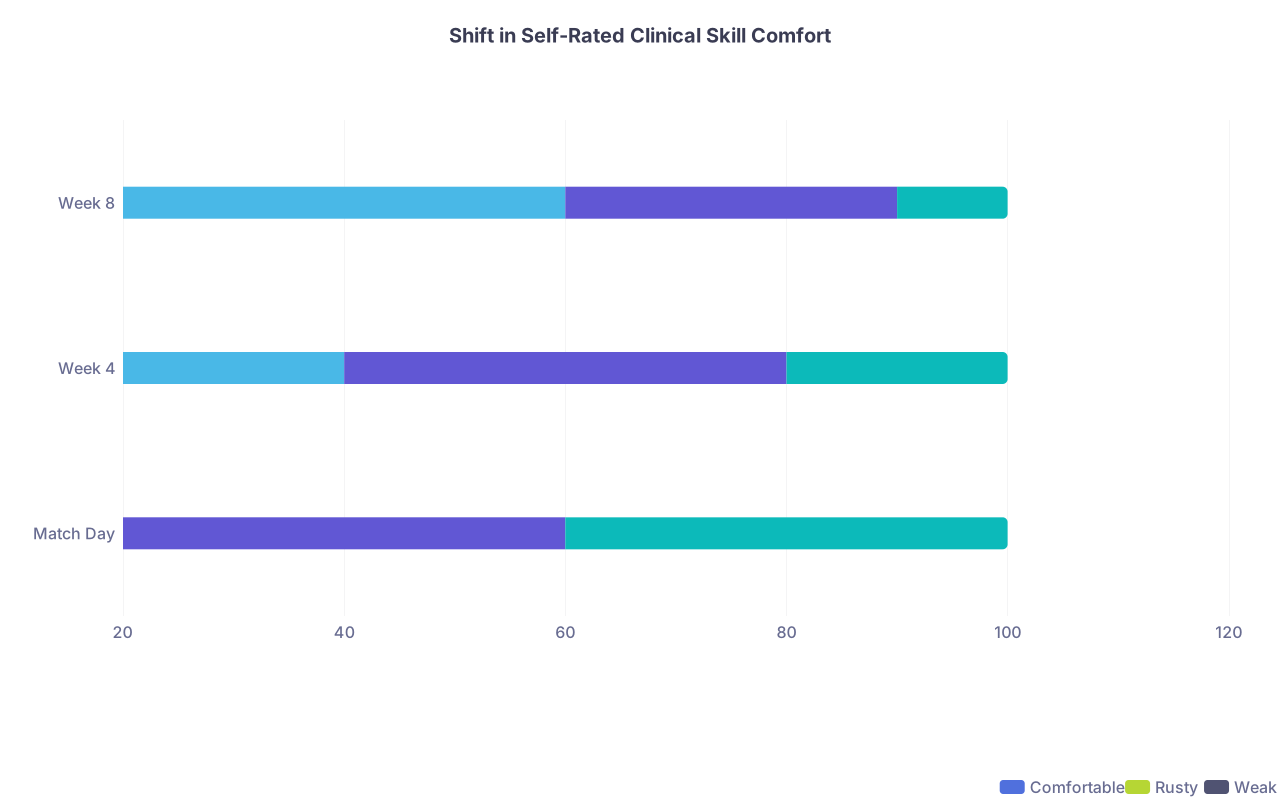
| Category | Comfortable | Rusty | Weak |
|---|---|---|---|
| Match Day | 20 | 40 | 40 |
| Week 4 | 40 | 40 | 20 |
| Week 8 | 60 | 30 | 10 |
You will never be at 100% “comfortable.” That is fine. You just cannot show up with half your core jobs in the “weak” column.
Step 10: Protect Your Energy So the Plan Survives
One last hard truth: the most beautifully designed refresher plan is worthless if you are too fried to execute it.
You do not need martyrdom. You need consistency.
A few rules I have seen actually work:
- Cap any single “study” session at 2 hours. Past that, quality falls off a cliff.
- Always know, at the start of the week, which 3–4 sessions you are doing and on which days. Vague intentions die fast.
- Build in 1–2 completely non-clinical days each week where you are forbidden from touching a textbook or question bank. Your brain needs to defrag.
And accept this: some weeks (moving, graduation travel) will be a wash. That is fine if the other weeks are solid.

The Three Things That Actually Matter
Strip away all the detail and this is what counts:
- You start on Match Day by being brutally honest about your current skills and your incoming role. Not how smart you felt on your best rotation. How sharp you are right now.
- You run a simple, structured weekly plan that hits clinical reasoning, documentation, communication, and workflow using 6–8 focused hours. Not mindless reading, not 2000 flashcards. Actual intern tasks.
- You build feedback loops and protect your energy so the plan survives real life. Ask seniors for targeted critiques, adapt, and refuse to burn yourself out before July.
If you do that, you will not be perfect on Day 1. But you will be safe, teachable, and noticeably more prepared than most of your co-interns. And that is exactly where you want to be.