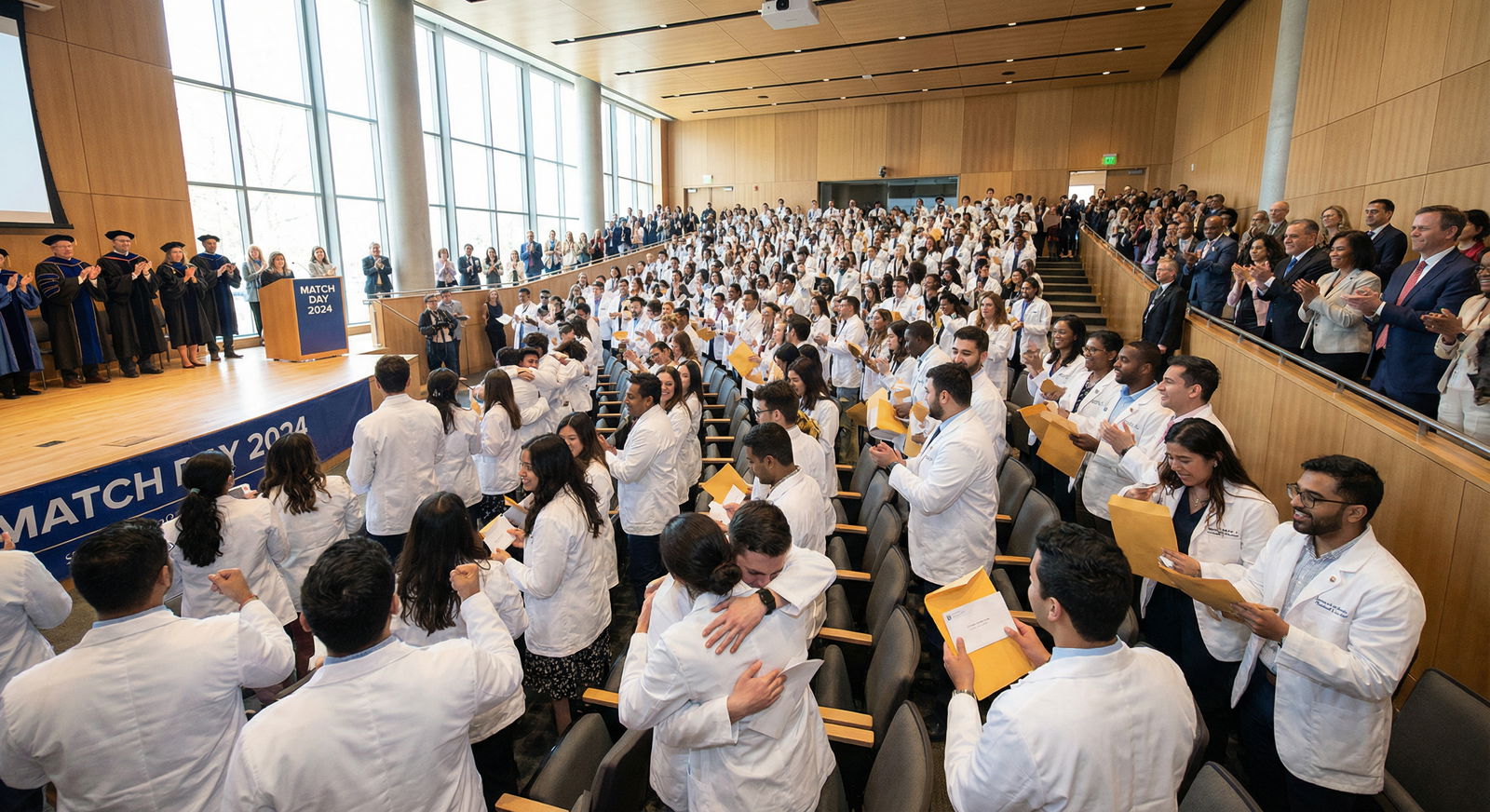
The worst thing you can do on Match Day is pretend it was “just another Friday.”
Your brain will try to do that. Numb it out. Scroll it away. Or go straight from champagne to panic about orientation, housing, visas, SOAP, or fellowship. That is how people end up three years later saying, “Honestly, I barely remember Match Day. It was a blur.”
That is a missed opportunity.
Match Day is a psychological pivot point. Whether you matched your dream program, your safety list, or you are emerging from SOAP completely exhausted, this day is fertile ground for reflection and re-calibration. The right kind of debrief converts chaos into a coherent story. That story, in turn, shapes how you enter residency.
So let me be specific: you need a designed personal Match Day debrief. Not vague “I’ll journal if I have time.” A short, structured framework with targeted prompts you use in the 72 hours around Match.
I will walk you through exactly how to set that up.
1. Why a Match Day Debrief Actually Matters
Before I hand you prompts, you need to understand why this is worth your limited energy. Otherwise, the notebook loses to Instagram every time.
Three things are happening to your brain on Match Day
Emotional overload
You are juggling anticipatory anxiety, relief, joy, disappointment, survivor’s guilt, comparison with classmates, and “what now?” logistics. That cocktail tends to flatten into a vague memory unless you capture it.Identity shift
You stop being “just” a med student and become “a categorical IM resident at X,” or “a prelim surgery going into anesthesia,” or “someone re-strategizing after not matching.” Your professional identity is turning a corner. Identity shifts benefit from explicit processing, not just time.Cognitive distortion risk
I have seen too many trainees rewrite the story of their Match based on one emotion:- “I matched my #5 → I am mediocre.”
- “I matched my #1 → I’ll be fine no matter what I do.” Both are lazy interpretations. A good debrief forces nuance and protects you from those simplistic, damaging narratives.
What a structured debrief gives you
Done well, your Match Day journaling does four critical things:
- Captures the raw experience before it gets sanitized
- Translates that raw emotion into a coherent narrative (“this is what happened and what it means for me”)
- Extracts actual lessons from the application season (what worked, what didn’t, what you want to change next time—for fellowship or future moves)
- Sets a concrete, values-aligned starting stance for residency
It is not therapy. It is not an Instagram caption. It is a private, honest record plus a planning tool.
2. The Basic Structure: 3 Windows, 3 Lenses
If you try to do a massive, perfect deep-dive on Match Night, you will fail. You will be drained, distracted, and interrupted by people texting you “OMG CONGRATS!!!” every 12 seconds.
So split your debrief into three smaller sessions with different purposes.
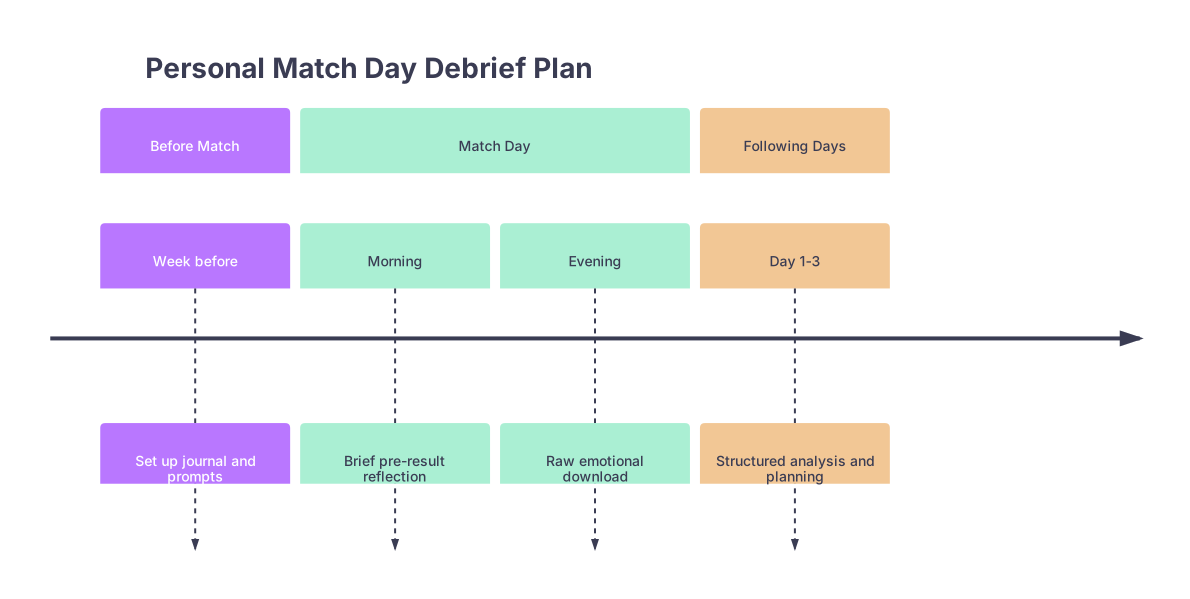
| Period | Event |
|---|---|
| Before Match - Week before | Set up journal and prompts |
| Match Day - Morning | Brief pre-result reflection |
| Match Day - Evening | Raw emotional download |
| Following Days - Day 1-3 | Structured analysis and planning |
Think of it like this:
Pre-Match (24–48 hours before email / envelope)
Lens: Anchor your values and expectations before the result distorts them.Match Day / Match Night
Lens: Capture the emotional weather and concrete facts of what actually happened.Post-Match (Day 1–3 after)
Lens: Meaning-making and forward planning.
You do not need hours. You need 15–30 minutes in each window, with sharp prompts.
I will break down targeted journaling prompts for each phase, then show you how to adapt for three different outcome scenarios:
- Matched close to top choice
- Matched, but not how you hoped
- Went through SOAP / unmatched / complicated outcome
3. Pre-Match: Anchoring Before the Storm
Pre-Match journaling is underrated. Everyone is busy doom-scrolling NRMP statistics, fantasizing about cities, or mentally rearranging their rank list even though it is locked.
This is exactly when you should ground yourself.
Aim: 15–20 minutes, sometime in the 24–48 hours before Match. No results yet. Just you and your actual priorities.
Core Pre-Match Prompts
Use these as direct questions in your notebook. Write in full sentences; short, honest paragraphs are enough.
“What do I actually care about more than prestige?”
Force yourself to list at least three concrete things. For example:- Being near a partner or support system
- Being at a program that treats residents decently (not just “big name”)
- Having strong mentorship for a specific fellowship
- Reasonable call schedule in PGY-1 to not burn out immediately
“If I had to explain my rank list logic to a skeptical attending, what would I say?”
Write your reasoning in plain language. No fluff, no “vibes only.”
Example: “I ranked Program A #1 because I want academic cardiology, and they send 3–4 people to cards fellowship every year, plus I felt like I could actually see myself on their wards without getting crushed.”“What am I afraid the Match result will say about me as a person?”
This one stings. That is the point. Typical answers I have seen:- “If I do not match my top 3, it means I am not as smart as my classmates.”
- “If I only match community, it means I failed academically.”
- “If I do not match at all, it means I am fundamentally not cut out for medicine.”
Write it exactly as your brain says it. Then write: “Is that actually true? What evidence do I have for and against this?” Push for at least 2–3 genuine counterexamples.
“What do I want to remember about myself before I see the result?”
This is identity armor. For instance:- “I have taken care of patients well. Multiple preceptors commented on my bedside manner.”
- “I improved my Step 2 by 20 points with disciplined work.”
- “I adapted through COVID rotations and still showed up.”
“What outcome could I consider ‘good enough’ even if it is not perfect?”
This is a guard against all-or-nothing thinking. Maybe it is: “Any categorical IM spot in my top 7.” Or “Any program in the Northeast with a strong OB volume.” Spell it out now.
You now have a baseline. You can later compare what you said mattered to you versus how you react to the result. That discrepancy alone teaches you a lot about yourself.
4. Match Day / Match Night: Capturing the Raw Data
By the time you see your email or open the envelope, your nervous system is lit up. Adrenaline, heart rate, maybe tears. This is not the time for sophisticated analysis.
Match Day journaling should be very simple: freeze-frame what happened and how it felt.
Aim: 10–20 minutes, sometime in the evening when the dust has settled slightly. You can be in your apartment, hotel, or your car after the ceremony. Just somewhere not on display.
Match Day Debrief: The Non-Negotiable Prompts
Even if you write nothing else, answer these:
“Where did I match? What is the actual fact pattern?”
Write the basics clearly:- Specialty
- Program name
- City / state
- Preliminary vs categorical
- If SOAP: what offer you accepted
It sounds obvious, but years later people genuinely misremember details. Write them cleanly once.
“What was my first physical reaction when I read the result?”
Not your polished version. Your literal body response:- Hands shaking
- Stomach drop
- Chest warm and light
- Nausea
- Numbness
This anchors you in the actual experience.
“What three emotions am I feeling most strongly right now?”
Force yourself to name them with some nuance:- Relief
- Sadness
- Jealousy
- Gratitude
- Anger
- Confusion
- Numbness
Then for each: “Where do I feel this in my body? What is it trying to tell me?”
“Who reached out to me today, and what did they say that stuck?”
Examples:- “My M3 mentor texted: ‘You will thrive there. They are lucky to get you.’”
- “A classmate casually said, ‘Oh, I thought you’d match somewhere bigger,’ which stung more than I expected.”
Capture the micro-interactions that shaped your day.
“If I had to write a one-sentence headline for my Match result right now, what would it be?”
Let yourself be honest, even if it sounds childish.- “Matched my dream program—still in shock.”
- “Matched, but not where I wanted, and I feel small.”
- “Survived SOAP, exhausted and grateful but scared.”
You can also add a free-write: 5–10 minutes of writing without editing. Start with: “Right now, in this moment, Match Day feels like…” and do not stop writing until the timer ends.
5. Post-Match (Day 1–3): Meaning, Integration, and Planning
This is the real work. Your nervous system is still humming, but the acute chaos has eased. You have answered the “Where am I going?” question. Now you need to answer: “What does this mean for me and what do I do next?”
Aim: 30–45 minutes, broken into two or three shorter chunks if needed.
I will give you a core framework and then specific modifications for different match scenarios.
Core Reflection Pillars
Think of your post-Match debrief in three pillars:
- Story – How you are narrating what happened
- Lessons – What you are extracting from the application season
- Starting stance – How you want to enter residency psychologically and practically
Let’s go through them with prompts.
Pillar 1: The Story You Are Telling
“If I had to explain my Match result to a trusted M4 from another school, what would I say?”
Write it like you are DM-ing someone you trust but want to be honest with. Not trying to impress. Not self-flagellating.“Compare my Pre-Match values/priorities with where I actually matched. Where is there alignment? Where is there tension?”
Go back to your Pre-Match list. Ask:- Which values did this result actually support?
- Which values feel compromised?
Concrete example: - You wrote: “Being near my partner is top 2 priority.”
- You matched across the country at a big-name program you ranked high.
Time to admit: prestige beat proximity on your actual rank list. That is not bad. It just needs to be conscious.
“What parts of my internal narrative feel exaggerated or unfair when I read them back?”
If your first Match Day headline was “I am a failure,” sit with that. Ask:- Is that language proportionate to the situation?
- Would I use that language about a friend in the same position?
This is where you start revising from a reflex reaction to a more accurate story.
Pillar 2: Lessons from the Application Season
Here is where you stop obsessing about what could not be changed and dig up what you can carry forward—to residency, fellowship, or any competitive process.
Split this section into three narrower questions:
“What clearly went well in my application process?”
Force yourself to list at least 5 items. They can be:- Strong letters from specific attendings
- Strategic specialty choice
- Early application submission
- Interview performance improving over time
- Realistic rank strategy
Be specific: “I consistently got positive feedback on my explanation of my research project” is better than “interviews went ok.”
“Where did I get lucky?”
This sounds odd, but it keeps you honest and humble.- Did a mentor introduce you to a PD?
- Did an away rotation slot open at the last minute?
- Did a program overlook a weak Step score because of a connection?
Recognizing luck does not diminish your work; it clarifies how unpredictable the process is.
“What would I realistically do differently if I had to apply again for fellowship or another Match?”
No fantasy. You cannot change your entire CV retroactively, but you can identify process changes:- Start personal statement drafts two months earlier
- Do one targeted away rotation differently
- Apply more broadly in a certain geographic area
- Be more selective with interviews to prevent burnout
This is not self-blame. It is a future-optimization exercise.
Pillar 3: Your Starting Stance for Residency
Now you pivot from post-mortem to intention-setting.
Think of this as your “Residency Mission Brief” derived from Match.
“What do I want to protect about myself during residency that got me through the Match?”
For example:- Your capacity to ask for help early
- Your ability to connect with patients, not just “be efficient”
- Your outside-of-medicine identity (music, running, family)
Name 3 items. Next to each, write one specific thing you can do in PGY-1 to protect it.
“What skills that helped me in the application cycle will help me in residency?”
Examples:- Systematic studying → helpful for boards and in-service exams
- Email professionalism → helpful for dealing with admin and program leadership
- Networking and cold emailing → helpful for finding research mentors
The point is to recognize you are not “starting from zero.”
“What do I already know about my matched program that I can use to my advantage?”
Be brutally practical:- Known strengths (e.g., strong ICU training, great fellowship placement)
- Known weaknesses (e.g., heavy call, weaker ambulatory experience)
- Culture signals from interview day (supportive PD, resident camaraderie, red flags)
Turn those into “I will” statements:
- “I will actively seek clinic mentorship outside my home program if ambulatory exposure is thin.”
- “I will prioritize joining the resident wellness or scheduling committee to have some control over workload.”
6. Tailoring Prompts to Your Match Scenario
Not all Match experiences are created equal. A “matched my #1 at home” requires different processing than “SOAPed at 3 a.m. into a location I have never visited.”
Let me walk you through modified prompts for three common experiences.
A. If You Matched Near the Top of Your List
People in this group often skip reflection because everything is “good.” That is a mistake. When things go your way, it is very easy to over-credit your strategy and under-recognize luck and structural privilege.
Add these prompts:
“Where am I tempted to assume this outcome proves I am ‘better’ than others?”
Then ask: “If I say that out loud, do I actually believe it, or is that ego?”
Grounding exercise. Keeps you from developing a hidden superiority complex that will bleed into how you treat co-residents and patients.“Which parts of my application success were about timing, connections, or context rather than pure merit?”
Write them plainly.- Alumni from your school in leadership at that program
- Strong home institution reputation
- Specialty shortages that cycle
“What responsibilities come with this opportunity?”
Not in the cheesy sense. Concrete behaviors:- Mentoring M3s/M4s from less prestigious schools who rotate with you
- Being honest about the role of luck when advising juniors, not selling them the myth of pure meritocracy
- Calling out toxicity in high-prestige environments where people feel “grateful just to be there”
B. If You Matched, But It Was Far From Your Top Choices
This is where the bitterness risk sits. If you do not process this well, the resentment follows you into PGY-1, colors how you see your program, and can poison your experience.
Here are targeted prompts:
“What exactly did I lose by not matching my higher-ranked programs?”
Separate out:- Tangible losses: location, specific fellowship pipeline, call schedule, partner proximity
- Imagined/ego losses: brand name, perceived status, social media brag factor
Both are real feelings, but they are not equal. Name them explicitly.
“What might be unexpectedly better about the program I did match?”
Force yourself to identify at least 3 potential upsides, even if they are not glamorous:- Smaller program → more autonomy
- Lower cost-of-living city → less financial pressure
- Stronger sense of community
This is not toxic positivity. It is recalibration.
“If I treat this program as a launchpad instead of a consolation prize, what could success look like?”
Describe concrete markers:- Matching into your desired fellowship from there
- Becoming a chief resident
- Building a niche project (QI, global health, medical education)
“What boundaries do I need to set with myself to avoid constant comparison?”
Write explicit rules:- “I will mute certain social accounts for the first three months.”
- “I will not stalk the websites of programs that rejected me; that chapter is closed.”
C. If You Went Through SOAP or Did Not Initially Match
This group often gets flooded with shame and secrecy. People go quiet. They do not post. They disappear for a while. Which is understandable but dangerous if it becomes isolation.
You need a much more trauma-informed, self-compassionate debrief.
First: if you are actively in crisis, talk to a real human—mentor, counselor, peer support—not just a notebook. Journaling supports, but does not replace, actual help.
Once the dust of SOAP settles a little, here are the prompts that matter:
“What story is my shame trying to tell me right now?”
Let it speak, unfiltered:- “I blew my Step score and this is proof I am not cut out for this.”
- “Everyone else figured it out, I am the outlier screw-up.”
Then respond on paper as if you were writing to a junior student you cared about. Not with empty affirmations, but with the context and nuance you would give them.
“What parts of this outcome were actually outside my control?”
List them:- NRMP algorithm dynamics
- Specialty competitiveness spikes this year
- Application volume inflation
- Program-specific filters you could not see
It is not an excuse list. It is an antidote to total self-blame.
“What did I do right in the middle of SOAP stress or not matching?”
For example:- Reached out to advisors despite feeling ashamed
- Showed up to interviews even while devastated
- Treated staff and coordinators respectfully under pressure
These matter. A lot.
“Given where I am now, what are the viable paths forward, and what information do I need for each?”
Draw three columns:- Path (e.g., take a research year and reapply, accept a prelim spot and re-strategize, pursue another specialty, step away)
- Pros / cons
- Immediate next 3 actions for each (who to email, what to ask, what to research)
“How do I want to talk about this chapter five years from now?”
Imagine you are a fellow or attending describing your journey to a student. What do you want to be able to say about how you responded, not just what happened?
7. Making the Debrief Practical: Logistics and Tools
Let’s pull this out of abstract land. You are busy, tired, and probably moving soon. Here is how to make this actually happen.
Decide the medium
Paper vs digital is not a philosophical question. It is a practicality question.
| Medium | Pros | Cons |
|---|---|---|
| Paper notebook | Private, tactile, no notifications | Harder to search later, easy to misplace |
| Encrypted notes app | Searchable, always with you | Potential distraction from other apps |
| Voice memo + later transcription | Captures raw emotion, fast | Harder to review systematically |
Pick one. Do not overthink it.
Schedule it like an actual task
If you leave this to “when I have time,” you will not do it. Plug it into your calendar:
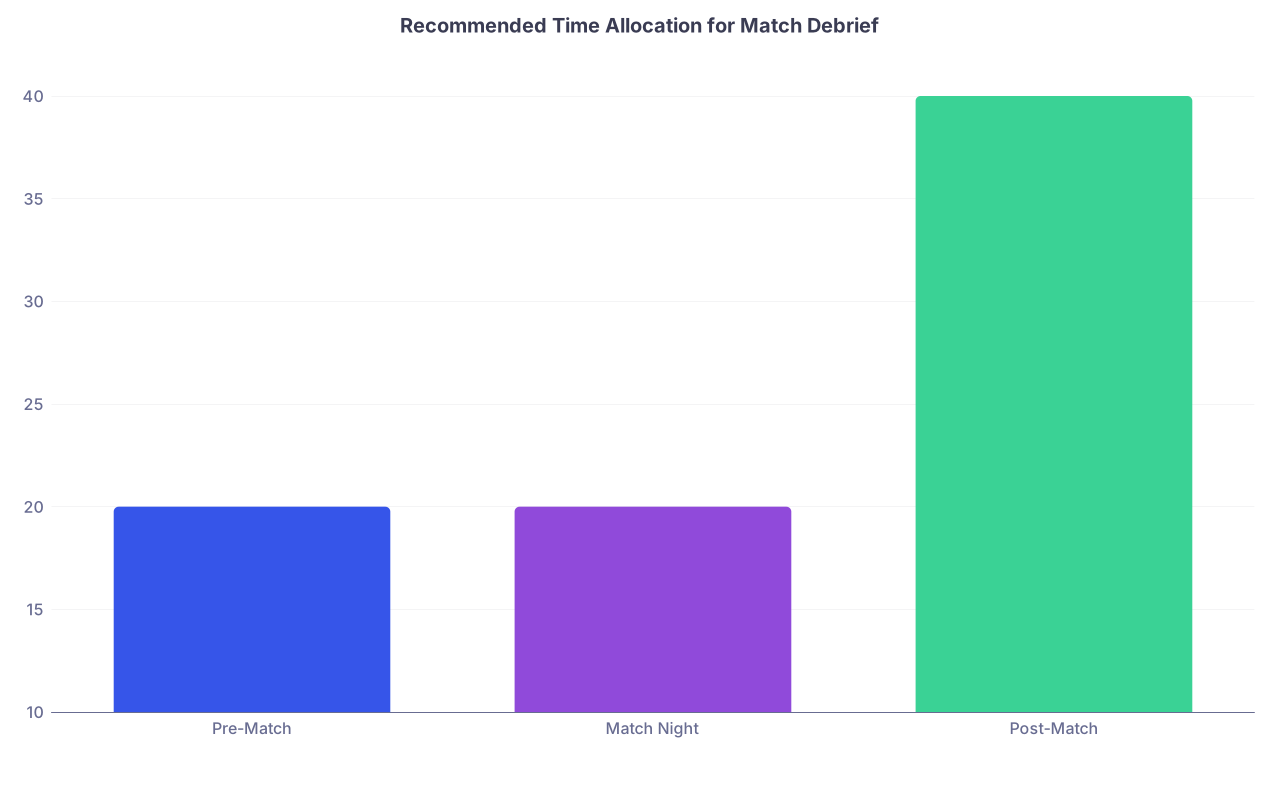
| Category | Value |
|---|---|
| Pre-Match | 20 |
| Match Night | 20 |
| Post-Match | 40 |
That is 80 minutes total across several days. You will lose more time than that to scrolling Match Day posts.
Use prompts as checkboxes
On a single sheet (or notes app), list:
- Pre-Match: Prompts 1–5
- Match Night: Non-negotiable prompts 1–5
- Post-Match: Story, Lessons, Starting Stance prompts
Then literally check them off. You are a trainee—you understand checklists.
8. Extending the Debrief Beyond You: For Mentors and Program Leadership
If you are a chief, advisor, or faculty member reading this, you can formalize this process for your students or interns.
Here is a simple model I have seen work in real programs:
Send out a guided reflection packet one week before Match with 5–7 prompts (a trimmed version of the Pre-Match + Post-Match prompts). Make it clear this is private; you are not collecting it.
Offer small-group debrief sessions a week after Match, optional, with ground rules:
- Camera-on or in-person
- No comparison of program “rank”
- Focus on process and feelings, not just logistics
Normalize non-linear paths
Have one or two residents who SOAPed or re-applied share their stories explicitly. It dismantles the silent stigma and gives unmatched students a concrete template of “life continues.”Integrate into intern orientation
Ask incoming residents to bring one insight from their Match debrief that they want to protect in residency. Use that in their early meetings with advisors.
You cannot control who matches where. You can dramatically influence how your trainees metabolize it.
9. A Quick Word on Sharing (or Not Sharing) Your Debrief
Not every reflection belongs on social media. In fact, most of it should not.
My recommendation:
- Keep the rawest Match Night entry private. That is for future you.
- Consider sharing selected insights with:
- A close friend or partner
- A trusted mentor or advisor
- A therapist or counselor
If you plan to post on Instagram, X, or LinkedIn, ask yourself: “Am I posting for connection, or for performance?” If it is mostly performance, rethink it.
10. Putting It All Together
Let me strip this down to the essentials, so you can actually do it.
Design the structure now.
Three sessions: brief Pre-Match grounding, Match Night capture, Post-Match integration. Total time under 90 minutes across several days.Use sharp, uncomfortable prompts.
If your journaling never makes you squirm a bit, you are staying at the surface. The prompts around shame, ego, loss, and values matter more than generic “how do I feel?”Translate reflection into a starting stance.
End your debrief with concrete “I will” statements about how you want to show up in residency and what you want to protect about yourself.
You cannot control the NRMP algorithm. You can control the story you build around what it did with your data. A deliberate Match Day debrief is how you take that control back.