It’s 3:17 a.m. You’re post-call, lying in bed, staring at the ceiling replaying the same 45 seconds over and over.
The nurse paged you about your patient’s blood pressure. You were exhausted, you gave an order, and now you’re terrified you said the wrong thing. You’re thinking about morbid stuff you don’t even want to say out loud. What if something bad happens on rounds? What if my attending reports me? What if this goes on my “record”? What if I’ve already ruined my career and I just don’t know it yet?
This is the mind of basically every decent resident at some point. But nobody admits it at table rounds.
Let me say the scary thing out loud so we can deal with it: you’re afraid that one on‑call mistake is going to brand you as “unsafe,” blacklist you from fellowships, get you fired, maybe even lose your license.
Let’s pull that apart.
The brutal truth: mistakes are baked into residency
Here’s the ugly, honest baseline: if you take 20+ in‑house calls a year, admit sick patients, field a few hundred pages per month, manage cross‑cover for 40 people you barely know… you are going to screw something up.
Not “if.” When.
On every program’s internal mental whiteboard, there’s an unspoken assumption:
- No mistakes at all = you’re not taking enough responsibility or someone’s covering for you
- Frequent, unrecognized, or repeated mistakes = problem
- Occasional, recognized, and learned‑from mistakes = literally the point of training
Where your brain goes is: “I made a mistake → I’m a danger → they’ll fire me → I’ll never match a fellowship → my whole life collapses.”
Where most programs actually are is much more boring:
“Did they recognize it? Did they own it? Did they learn from it? Are patients safe now?”
That difference is everything.
What actually happens when you screw up on call
Let’s walk through what “one mistake” usually looks like from the program side.
Scenario A: The classic call error
You’re cross‑covering. A nurse calls about new chest pain in a patient you’ve never seen. You’re in the middle of an admission, your pager’s exploding, you’re mentally at capacity. You:
- Accept the story a bit too quickly
- Give Tylenol, maybe order a troponin “just in case,” but don’t actually go see them right away
- Turns out later they had evolving ischemia, and the attending is… not thrilled
Your inner monologue: “They’re going to say I ignored chest pain. They’ll think I’m careless. I’ll be written up. This is going to OPPS (some ominous committee).”
Usually, what actually happens:
- Attending asks what you were told, what you were thinking, and what else you were managing at the time
- There’s a teaching moment about “chest pain = go see the patient”
- Maybe there’s a safety event form so it gets logged and tracked
- It might be discussed at M&M (mortality & morbidity conference), either anonymized or semi‑anonymized
Consequence for your “career”? Typically:
- Verbal feedback, maybe intense but finite
- Maybe a short email or documented note like “discussed with resident; resident understands; plan for closer supervision on similar cases for a bit”
- Then… life moves on
Is it fun? Nope. Does it end your career? Not even remotely.
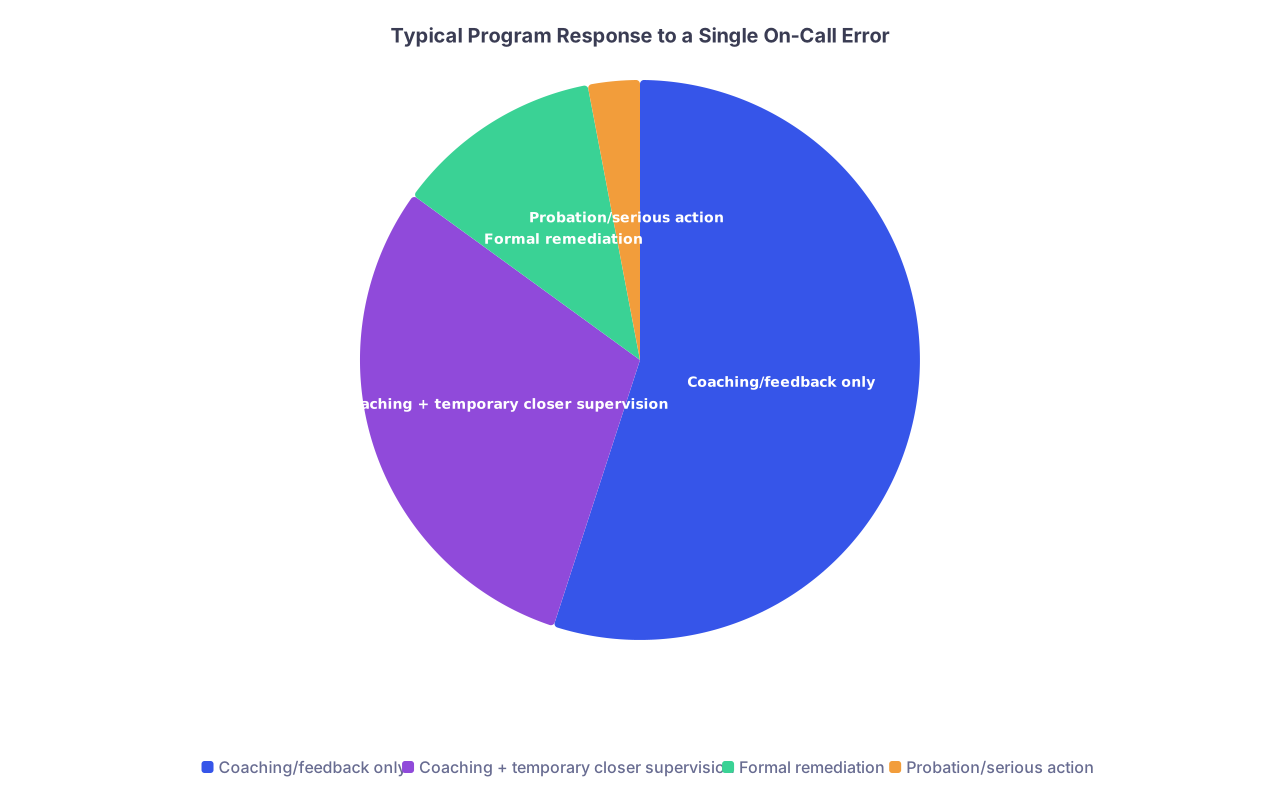
| Category | Value |
|---|---|
| Coaching/feedback only | 55 |
| Coaching + temporary closer supervision | 30 |
| Formal remediation | 12 |
| Probation/serious action | 3 |
Are these exact numbers from some magical national database? No. But they’re directionally right: one isolated call mistake almost never equals “probation and career over.” It equals feedback and heightened awareness.
Scenario B: The near‑miss that scares everyone
Sometimes you get the “that could’ve been really bad” case. Wrong dose, delay in recognizing sepsis, missing a critical lab. The kind of thing that makes the nurse say quietly, “Hey… I think this needs to be reported.”
Programs care a lot more about how you respond than about the fact that the near‑miss happened.
They’re watching for:
- Do you get defensive and blame the nurse/EMR/shift?
- Or do you say, “Yeah, I see how that happened. Next time I should…”
- Do you show up on time the next day clearly rattled but engaged, or do you shut down and withdraw?
Repeated “I don’t think I did anything wrong” in situations where you obviously did? That’s what freaks them out. Not one error. The lack of insight.
What actually does threaten your career vs what doesn’t
Here’s where I’m going to be blunt, because vague reassurance won’t help you sleep.
| Type of Situation | Program Reaction (Typical) |
|---|---|
| Single honestly reported medication error | Coaching, maybe safety report |
| Delay in seeing a sick patient once | Feedback, closer supervision for a bit |
| Pattern of ignoring pages or not seeing sick patients | Formal concern, possibly remediation |
| Lying about what you did/when you did it | Very serious, can be dismissal-level |
| Repeated similar errors after feedback | Documented remediation, probation risk |
Stuff that usually does NOT ruin your career (by itself):
- Misordering a med dose and catching it (or nurse catching it)
- Missing one lab result overnight that the day team then addresses
- Calling a code late because you were unsure, but you called
- Not knowing what to do at 3 a.m. and needing to wake up the senior or attending
Stuff that really can tank you if it becomes a pattern:
- Chronic “I’ll just wing it” without calling for help
- Minimizing or hiding mistakes when asked directly
- Repeating the same type of error after it’s been explicitly addressed
- Getting a reputation among nurses as “won’t come see patients”
And the big one programs lose their minds over: dishonesty. If they think they can’t trust your documentation or your version of events, everything changes.
One clinical mistake? Fixable.
Trust issues? That follows you.
The personal nightmare loop: shame, catastrophizing, and silence
Let’s talk about the psychological part, because that’s honestly what’s wrecking you at 3 a.m. more than the actual event.
Here’s the cycle I see over and over:
You make a mistake → feel deep shame → catastrophize (“I’m dangerous”) → become afraid to tell anyone → you act weird/defensive → team trusts you less → supervision increases → you interpret that as “they think I’m terrible” → anxiety skyrockets → you’re more likely to screw up again.
The fastest way out of that spiral is also the scariest in your head: saying out loud what happened and what you’d change.
Most attendings/residency leadership will think:
“Okay, they’re reflective and appropriately anxious. Good. We can work with this.”
The resident who says, “I don’t see what the big deal is” is the one who quietly ends up on the CCC radar.

| Step | Description |
|---|---|
| Step 1 | On call mistake |
| Step 2 | Get feedback and support |
| Step 3 | Hide it or minimize |
| Step 4 | Learn and adjust |
| Step 5 | Pattern not addressed |
| Step 6 | More mistakes |
| Step 7 | Formal concern |
| Step 8 | Tell someone honestly? |
You worry that admitting the mistake is what will ruin you. In reality, hiding and minimizing is what escalates things.
How programs actually track and remember this stuff
You probably imagine some permanent red stamp next to your name in an ACGME file: “Made dangerous error on 12/4/2024. Do not hire.”
Reality is significantly more… bureaucratic and forgetful.
Most programs have:
- Event reporting systems (safety events, near-misses)
- CCC (Clinical Competency Committee) meetings a few times a year
- Milestones they have to fill out on each resident
One call error generally becomes:
- A brief mention in CCC if at all, usually framed as: “Had an issue with X, we coached them, improving.”
- Maybe a line in your internal file about “needs continued supervision on acute decompensation, but responds well to feedback.”
- Then as time passes and you do OK, that gets overshadowed by everything else.
The people who really get burned at CCC:
- Folks with multiple similar incidents
- Residents the nurses CONSTANTLY complain about
- People who cannot or will not accept feedback
Fellowships and jobs? They don’t see a daily log of your mistakes. They see:
- Program director letter
- Maybe a very general sense of “needed more support early on but improved”
Most PDs are not out here writing: “On February 9, PGY‑1 mismanaged a sepsis case; do not hire.” They’re writing big‑picture patterns.
So: can one on‑call mistake appear in that pattern if it reflects a concern? Sure. Can it, by itself, erase everything else you’ve ever done? No.
What to do the morning after the mistake
You wake up, your stomach drops, the replay starts. Here’s the move that actually helps.
Get the facts before you spiral.
Check the chart. See what happened overnight, what the day team did, what the outcome is. Vague dread is always worse than concrete reality.Talk to someone with authority, not just your co‑intern.
Senior resident, chief, or attending. Short, clear, not dramatic:
“Hey, last night I did X for Y situation. On review, I’m worried I should’ve done Z. Can we talk about how to handle that better next time?”Say the uncomfortable part out loud.
“I’m honestly worried this reflects badly on my judgment and I don’t want to repeat it.”
Most normal humans will lean toward reassurance plus teaching at that point.Document what you learned for yourself.
Not a three‑page essay. Just: “Chest pain overnight in patient with risk factors = always go see, don’t just order labs. Call senior if in doubt.”Do one concrete behavior differently on your next call.
That’s how you prove—to yourself and to them—that this isn’t a pattern.
Programs don’t care that you’re perfect. They care that you show learning and trajectory.
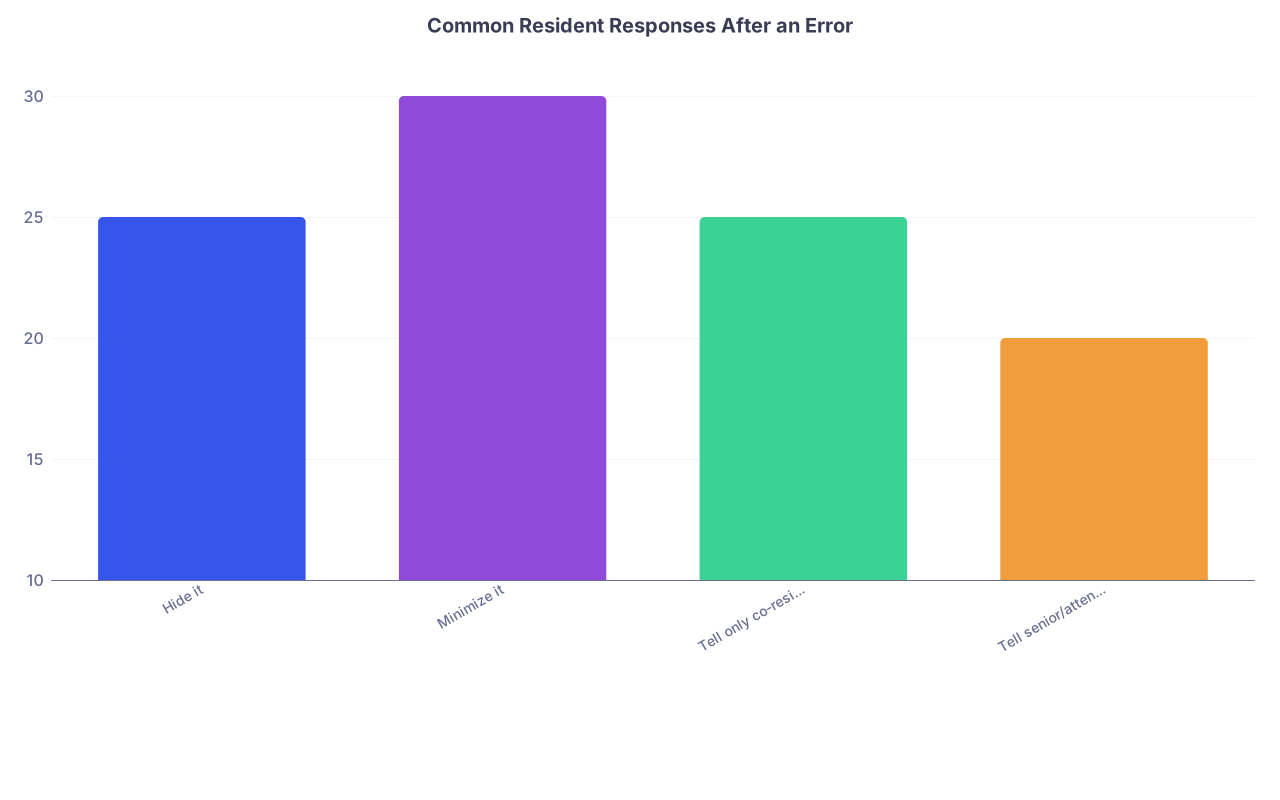
| Category | Value |
|---|---|
| Hide it | 25 |
| Minimize it | 30 |
| Tell only co-resident | 25 |
| Tell senior/attending | 20 |
The “tell senior/attending” group? That’s the group that actually sleeps better six months later. Everyone else just keeps collecting ghosts.
When you should be genuinely worried
I’m not going to sugarcoat everything. There are times when the fear is… not completely irrational.
Red flags that mean you should loop in a chief or PD early, not late:
- You’ve had multiple similar issues (e.g., repeated late recognition of sick patients)
- You’ve been directly told “we’re concerned about your clinical judgment”
- Nursing or ancillary staff have made several formal complaints about the same behavior
- You’ve gotten something in writing that mentions “remediation,” “probation,” or “formal performance plan”
Even then, the path is usually:
- Structured remediation → reassessment → either “good, you improved” or “we need to escalate.”
Not: immediate career death.
If you’re at that stage, hiding doesn’t protect you. Getting proactive—asking plainly, “What exactly do I need to show you over the next X months?”—is your only real play.
How to live with the constant fear that you’re missing something
This is the part nobody prepped you for in med school: the chronic hum of “what if I’ve already screwed up and just don’t know it yet?”
That fear… actually has a purpose. Up to a point.
A little bit of anxiety is what makes you:
- Re‑read that order
- Ask “Is this patient stable enough to stay on the floor?”
- Call your senior for one more set of eyes
Too much anxiety, though, and you freeze. You don’t trust your own assessments, you avoid decisions, you under‑call acuity because you’re afraid of being “dramatic.” Ironically, that can cause the very mistakes you’re terrified of.
What helps that middle ground:
- Have two or three “hard rules” for yourself. Stuff like: “New chest pain? I lay eyes on them.” “Any nurse who says ‘I’m worried’—I go.” This keeps you from overthinking every single page.
- Keep one attending/senior you trust as your internal “voice.” Ask yourself, “What would Dr. X do?” Not what would “the perfect resident” do. What would that specific actual human do.
- Debrief quickly after a rough call. Ten minutes. “What went well / what would I do differently.” Then stop rehashing.
Residency is not the absence of mistakes. It’s building a system where your mistakes are small, caught early, and turned into learning instead of shame and secrecy.

| Stage | Activity | Score |
|---|---|---|
| Immediate | Panic and shame | 4 |
| Next Day | Debrief with senior | 3 |
| Next Day | Learn new rule of thumb | 4 |
| Following Months | Handle similar case better | 5 |
| Following Months | Confidence slowly returns | 3 |
You won’t fully believe this now, but some of the cases you’re most ashamed of end up being the ones that shape you the most as a physician.
FAQs: The terrified resident edition
1. Can one serious on‑call mistake get me fired from residency?
Yes, if it’s coupled with things like dishonesty, obvious recklessness, or a clear pattern of ignoring help. A single honest error, even a bad one, almost always leads to increased supervision and documentation, not immediate dismissal. Programs know residents are learning. They reserve firing for when they truly don’t think someone can be made safe or trustworthy.
2. Will this go in my “permanent record” and ruin fellowship chances?
Most of the time, no. Individual mistakes don’t show up as itemized bullet points in letters. What might show up is a general comment like, “Required additional support early on but responded well to feedback.” Fellowship directors care far more about your current competence and trajectory than about one bad night two years ago.
3. Should I tell my PD about every mistake I make?
No, that’s not realistic, and they’d tune you out. But you should tell a senior or attending about mistakes that: could have harmed a patient, reflect a gap in your judgment, or are starting to repeat. If you’re losing sleep over it and it involves potential harm, it’s probably worth bringing up to someone with authority.
4. What if I don’t fully agree that what I did was wrong?
That’s actually a great opportunity to learn, if you can tolerate the discomfort. Bring it up like this: “Here’s what I did, here’s what I was thinking at the time. I’ve heard some concern that I should’ve done X instead—can we walk through that?” Programs care less about you blindly agreeing and more about you showing you can reason, listen, and update your thinking.
5. Do programs talk about “problem residents” behind closed doors?
Yes. The CCC, chiefs, and PDs absolutely discuss residents who raise safety concerns. But they’re looking at patterns: repeated feedback ignored, multiple complaints, ongoing poor judgment. One on‑call mistake, even if discussed, doesn’t automatically drop you in the “problem” bucket. What you do after the mistake determines whether your name keeps coming up or quietly disappears.
6. What’s one sign I should be more worried than I am?
If nurses, pharmacists, or other staff repeatedly bypass you to go straight to your senior or attending because they don’t trust your decisions, that’s a big warning sign. If that’s happening, you need direct, honest feedback from your leadership. Asking, “Can we talk about how I’m perceived when I’m on call? I want to know if there are concerns I’m not hearing,” is scary—but it’s better than being the last one to know there’s a serious trust gap.
Here’s what you can do today, before your next call:
Pull up your last on‑call shift in your mind and write down one moment you still feel weird about. Just one. Then send a quick message to a senior or attending you trust: “Hey, I’ve been thinking about X from my last call. Could we spend 5–10 minutes talking about how you’d approach that situation?”
You don’t have to fix your whole career tonight. Just show yourself—and them—that you’re the kind of resident who learns. That’s what actually protects you.