
The worst time to learn how to run an ICU night shift is at 02:00 with three pressors beeping and nobody else around.
You need to front‑load the work. Week by week. So when you walk in for night one, your brain is on rails, not improvising.
Below is a four‑week, then week‑by‑week, then day‑before and night‑of plan for what to practice before starting ICU nights as a resident. Assume you have at least 4 weeks’ notice. If you have less, condense but keep the order.
Overview Timeline: Four Weeks Out to Night One
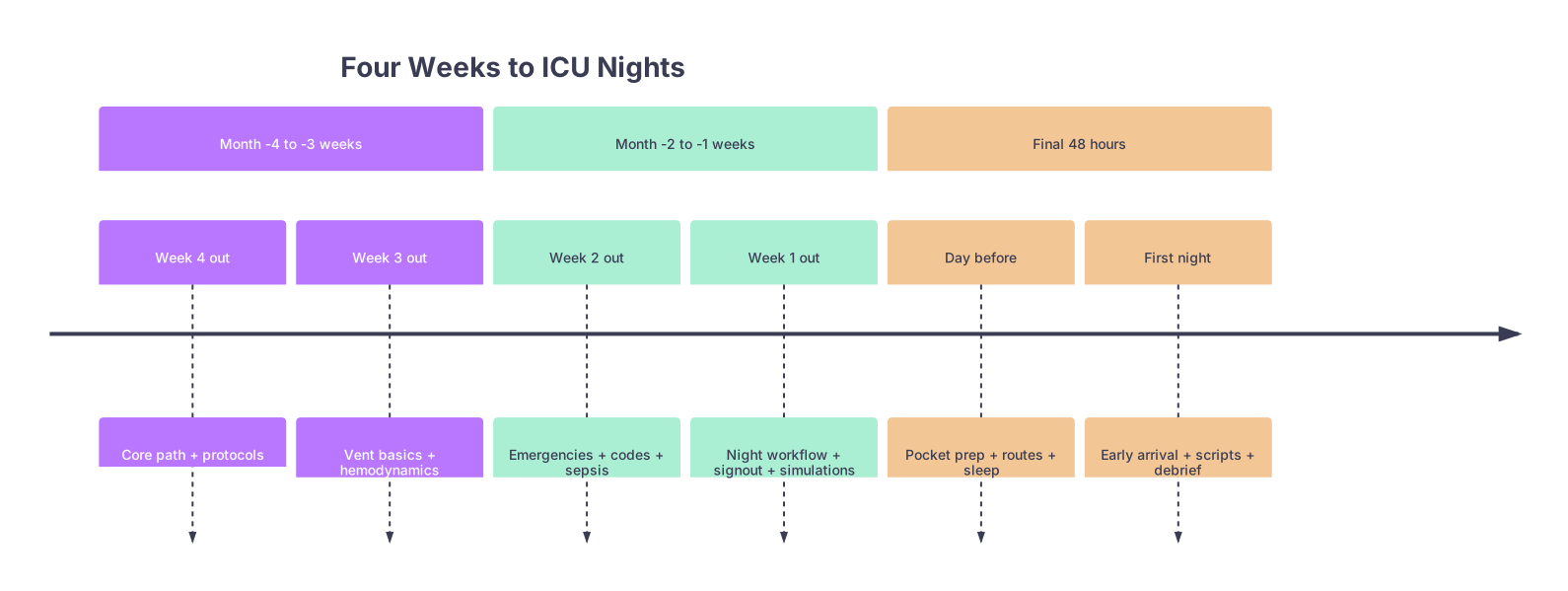
| Period | Event |
|---|---|
| Month -4 to -3 weeks - Week 4 out | Core path + protocols |
| Month -4 to -3 weeks - Week 3 out | Vent basics + hemodynamics |
| Month -2 to -1 weeks - Week 2 out | Emergencies + codes + sepsis |
| Month -2 to -1 weeks - Week 1 out | Night workflow + signout + simulations |
| Final 48 hours - Day before | Pocket prep + routes + sleep |
| Final 48 hours - First night | Early arrival + scripts + debrief |
At each point, you will focus on a narrow set of skills:
- Week 4: Understanding the diseases that actually land people in the ICU
- Week 3: Ventilators and pressors so you are not guessing at the bedside
- Week 2: Crashes, codes, and sepsis bundles on autopilot
- Week 1: Workflow, communication, and “what do I do right now” habits
Then you layer in small daily reps.
Four Weeks Before: Build the Core ICU Brain
At four weeks out, you should stop reading random UpToDate pages and start training like this is a sport. Focus: core pathophysiology + standard ICU protocols.
Week 4: One System Per Day
Aim: 30–40 focused minutes per day. Not endless reading. Targeted practice.
Day 1–2: Respiratory failure
At this point you should:
- Be able to say out loud:
- “Type 1 vs type 2 respiratory failure – definitions and common causes.”
- “When this ABG shows X, I think Y.”
- Practice:
- Pull 5 recent ICU notes with ARDS, COPD exacerbation, or pneumonia.
- For each, write in a notebook (not your EMR):
- Why they are in respiratory failure
- What the current oxygen/vent strategy is
- What you would change tonight if they worsen
Day 3: Shock states
At this point you should:
- Differentiate cardiogenic, distributive, hypovolemic, and obstructive shock without looking anything up.
- Practice:
- Take a blank sheet. Draw four quadrants: “cardiogenic / distributive / hypovolemic / obstructive.”
- Under each:
- 3 common causes
- Expected CVP/ScvO2/BP/HR patterns
- First‑line treatment
- Then close your notes and reproduce from memory.
Day 4: Renal and metabolic disasters
You will be managing:
- Severe hyperkalemia at 03:00
- DKA/HHS
- Acute kidney injury on CRRT
At this point you should:
- Be able to write a full treatment order for hyperkalemia from memory (dose, route, sequence).
- Practice:
- Write your “hyperK order set” on an index card:
- Calcium dose
- Insulin + dextrose
- Beta‑agonist
- Bicarb indications
- When to call nephrology for dialysis
- Do the same for:
- DKA initial orders
- HHS initial orders
- Write your “hyperK order set” on an index card:
Day 5: Neurologic issues in the ICU
You are not a neurologist. But you must not miss:
- Status epilepticus
- Increased intracranial pressure
- Sedation vs true neuro decline
At this point you should:
- Have a 3‑step approach to any altered ICU patient:
- Is this structural? (bleed, stroke)
- Is this metabolic/toxic?
- Is this drugs/sedation/CO2?
Practice:
- Take 3 old charts of “encephalopathy” or “status epilepticus.”
- For each, outline:
- Initial exam
- Initial labs/imaging
- First two medications and doses you would give on nights
Day 6–7: Put it together with protocols
Now you start matching your brain to your unit’s actual rules.
At this point you should:
- Know where the following are stored (physically or electronically) for your ICU:
- Sepsis protocol
- Sedation/analgesia/delirium protocol
- Vent weaning protocol
- Code blue / rapid response algorithm
Practice:
- Spend one hour walking the unit (on your day off).
- Ask a day resident or charge nurse: “Show me where the protocol binder/online folder lives.”
- Bookmark PDF links on your phone.
- End of week 4: do a 15‑minute “teach‑back” to yourself or a co‑resident:
- Explain, out loud, your approach to: ARDS, septic shock, DKA.
This feels overkill now. It will not feel overkill when you get your first crashing septic patient.
Three Weeks Before: Vents and Hemodynamics Every Day
Week 3 is for all the stuff that terrifies day‑shift residents who have never touched a ventilator. You are going to practice it daily, in small chunks.

Week 3: Daily Vent and Pressor Reps
Day 1–2: Vent basics
At this point you should be able to:
- Define: tidal volume, PEEP, FiO2, plateau pressure, driving pressure.
- State:
- ARDS lung‑protective ventilation targets (ml/kg IBW, plateau goal).
- When to escalate PEEP safely.
Practice (15–20 minutes):
- Take 3 ventilator screenshots or printed flowsheets (ask RT or co‑resident for anonymized examples).
- For each:
- Identify mode, tidal volume, PEEP, FiO2, rate.
- Write: “If this patient desats from 94 to 84, my first 3 steps are…”
- Do it without checking a reference, then correct with a guideline.
Day 3: Vent modes and common problems
At this point you should know:
- Difference between:
- Volume control
- Pressure control
- Pressure support
- What “patient fighting the vent” looks like on waveforms and vitals.
Practice:
- Ask RT on your current rotation for 10 minutes:
- “Show me volume vs pressure control on one patient and explain why this mode was chosen.”
- Later that day, in a notebook:
- Write 3 bullet lists:
- High peak pressure – causes and responses
- Desaturation – causes and stepwise interventions
- Auto‑PEEP – recognition and immediate actions
- Write 3 bullet lists:
Day 4–5: Vasopressors and inotropes
You must not guess dosing at 03:00.
At this point you should:
- Know:
- First‑line pressor for septic shock in your ICU
- Typical starting doses and titration ranges for:
- Norepinephrine
- Vasopressin
- Epinephrine
- Dobutamine
- Understand:
- Why pure vasoconstrictor vs inotrope vs mixed agent.
Practice:
- Build a “pressor one‑pager”:
| Drug | Main Effect | Typical Start Dose | Key Concern |
|---|---|---|---|
| Norepinephrine | Vasoconstrictor | 0.02–0.05 mcg/kg/min | Peripheral ischemia |
| Vasopressin | Vasoconstrictor | 0.03 units/min | Ischemia at high dose |
| Epinephrine | Inotrope + pressor | 0.01–0.05 mcg/kg/min | Tachyarrhythmias |
| Dobutamine | Inotrope | 2–5 mcg/kg/min | Hypotension |
- Handwrite this twice from memory.
- Then practice 2–3 scenarios:
- MAP 52 on norepi 0.2 → what do you do next?
- Septic shock, new Afib with RVR on high dose norepi → plan?
Day 6–7: Reading lines and basic hemodynamic interpretation
At this point you should:
- Identify from the monitor:
- A‑line tracing basics (dampened vs normal)
- CVP line appearance
- Know your unit’s:
- “Target MAP”
- When to call attending for adding a second pressor
Practice:
- Sit at a bedside (with permission) for 10 minutes and look at the actual waveforms.
- Ask senior or fellow: “Walk me through what you see and what would make you change management.”
- End of week 3: Do a 10‑minute self‑quiz:
- Draw an arterial line waveform
- Label systolic, diastolic, dicrotic notch
- List 3 causes of damping
Two Weeks Before: Crashes, Codes, and Sepsis on Autopilot
Week 2 is scenario week. You are drilling “if X then Y” patterns so that your hands move before your anxiety does.
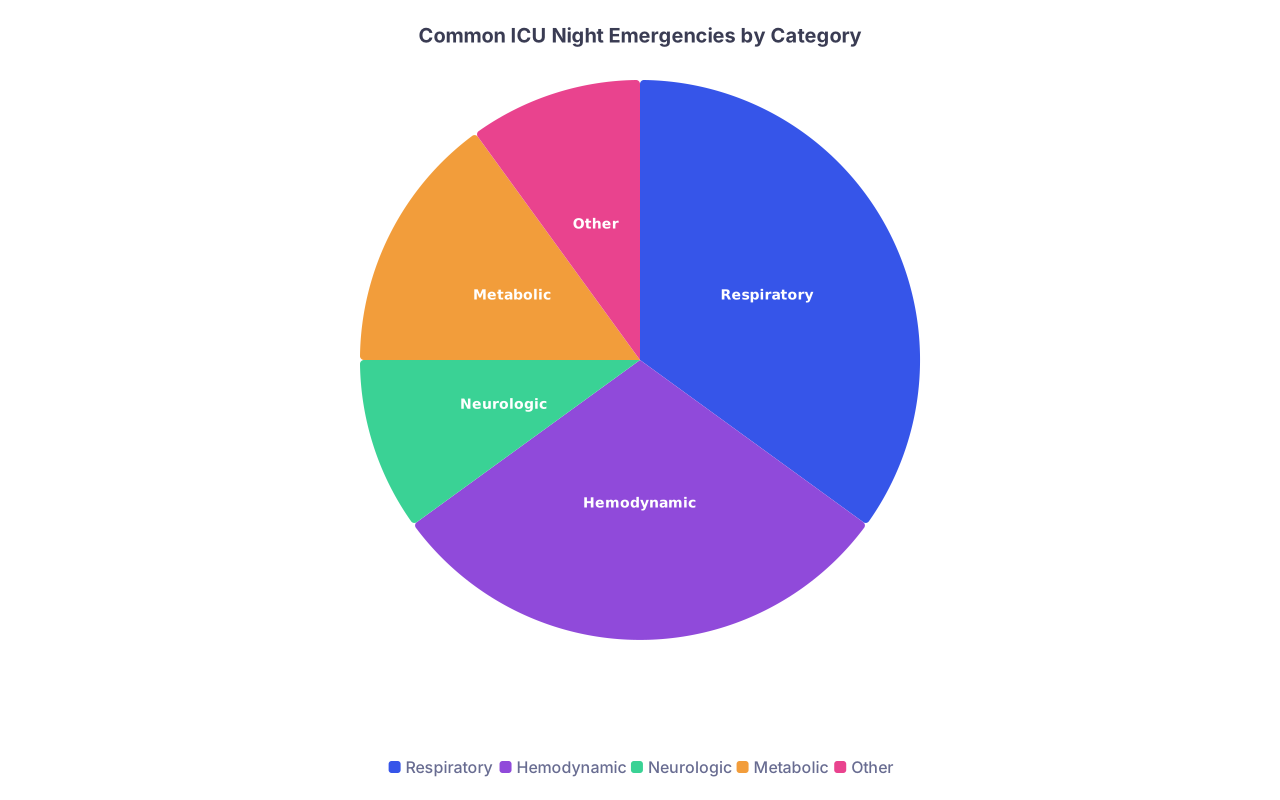
| Category | Value |
|---|---|
| Respiratory | 35 |
| Hemodynamic | 30 |
| Neurologic | 10 |
| Metabolic | 15 |
| Other | 10 |
Week 2: One Emergency Per Day
Day 1: Respiratory crash
At this point you should:
- Have a 60‑second algorithm in your head for “patient decompensating on vent or high‑flow.”
Practice (use a timer):
- Set a 2‑minute timer.
- Out loud, walk through:
- Step 1: Check monitor, SpO2, waveform, alarms
- Step 2: At bedside – look at patient: chest rise, secretions, tube position
- Step 3: Bag‑mask readiness, call RT, increase FiO2, check circuit
- Step 4: Consider pneumothorax, mucus plug, equipment failure
- Repeat 3 times in a row until it is smooth.
Day 2: Hypotension and shock on nights
At this point you should:
- Be able to differentiate:
- Artifact vs real hypotension
- Volume‑responsive vs pressor‑responsive
Practice:
- Take 3 imaginary patients:
- Septic shock on norepi
- GI bleed with dropping Hgb
- RV failure post massive PE
- For each, write:
- “If MAP falls from 70 to 55 at 01:30, my first 5 actions are…”
Day 3: Code blue flow
You cannot be the person quietly backing into the corner at a code. Even as a new resident, you should have roles in your head.
At this point you should:
- Know:
- ACLS rhythms and drugs cold
- Who runs codes in your hospital at night (you? ICU fellow? code team?)
- Practice:
- Watch one ACLS algorithm video at 1.5x speed.
- Then draw out the pulseless arrest algorithm from memory.
- Envision:
- You arrive first to a pulseless ICU patient. What 3 commands do you give the room?
Day 4: Sepsis night management
At this point you should:
- Have the “3‑hour bundle” in your brain:
- Blood cultures, lactate, antibiotics, fluids, pressors.
Practice:
- Open your hospital’s sepsis order set.
- Time yourself: how fast can you find:
- Broad‑spectrum regimen for pneumonia
- Regimen for intra‑abdominal source
- Dosing adjustments for renal injury
- Write your own 3 default regimens (based on local antibiogram, ask ID or senior).
Day 5: Neurologic emergencies
Focus: status epilepticus and sudden neuro decline (pupil changes, unresponsiveness).
At this point you should:
- Have exact doses for:
- Lorazepam
- Levetiracetam (or your unit’s go‑to)
- Know:
- Who you call first: neurology, neurosurgery, CT tech, attending.
Practice:
- Write the full sequence for status epilepticus management, including:
- First benzo dose
- Second line AED
- When to intubate
- When to start continuous infusion
Day 6: Arrhythmias on nights
At this point you should:
- Have a reflex plan for:
- Afib RVR in a hypotensive ICU patient
- VT with pulse vs pulseless VT/VF
- Bradycardia in a patient on beta‑blockers and pressors
Practice:
- Make yourself a tiny rhythm card (fits in a badge holder):
- Afib RVR – metoprolol vs amiodarone vs diltiazem, plus when all are wrong
- VT w/ pulse – amiodarone dose sequence
- Stable vs unstable vs pulseless decisions
Day 7: String three scenarios together
At this point you should:
- Run 3 full mini‑simulations in your head:
- 1 respiratory crash
- 1 septic shock
- 1 code
Practice:
- Ask a co‑resident or partner: “Give me random ICU night emergencies for 10 minutes” and respond out loud. No notes.
One Week Before: Workflow, Communication, and Survival Systems
Week 1 is about how nights actually run. Less pathophysiology. More “what do I literally do between 19:00 and 07:00.”

7–5 Days Before: Learn the Unit’s Night Rhythm
At this point you should know:
- Who is in the hospital at night:
- Fellow? Attending in‑house or home call?
- Anesthesia availability?
- Respiratory therapist coverage?
Practice:
- Spend one pre‑night evening shadowing the outgoing night resident for 2–3 hours.
- Watch: how they receive signout, how they prioritize cross‑cover vs admits.
- Write down:
- When they pre‑chart
- How they round at night (if they do)
- How often they check each patient
Create your “night checklist” (one page, front and back):
- At start of shift:
- Receive signout using a structured template:
- Code status
- Pressors/vents
- Active issues overnight to watch
- Labs pending / imaging pending
- Receive signout using a structured template:
- Mid‑shift:
- Scheduled to‑dos (gas on ECMO, neuro checks, labs)
- Pre‑morning:
- Quick re‑exam of sickest 3–5 patients
- Update notes of overnight events
4–3 Days Before: Notes, Orders, and Scripted Phrases
At this point you should:
- Have 2–3 standard note templates ready:
- Brief overnight event note
- Cross‑cover progress note if something big happens
- Death summary skeleton
Practice:
- In your EMR sandbox or a separate doc, build:
- “ICU overnight event” template with:
- Brief HPI of event
- Focused exam
- Interventions
- Response
- Plan
- “ICU overnight event” template with:
- Practice writing a 3–4 line note for:
- Acute desaturation
- Hypotension requiring pressor start
- New Afib with RVR
Also build standard scripts for talking to:
- Nurses:
- “Here is what I am worried about with this patient tonight, and when I want you to call me…”
- Families (in the middle of the night):
- 2–3 sentences that explain escalation, code status clarifications, and uncertainty without rambling.
2 Days Before: Logistics and Energy Management
This is the part residents ignore and then regret.
At this point you should:
- Have your night kit ready:
- Small notebook and pens
- Badge card cheat sheets (pressors, vent basics, emergency doses)
- Snacks that are not pure sugar
- Blue‑light blocking strategy if you care about sleep hygiene
Practice:
- Do a test run:
- Drive or walk to the hospital at your new start time.
- Figure out: where you will park, where you will stash your bag, where to find coffee at 02:00.
- Set your sleep schedule:
- Two days before: shift bedtime by 1–2 hours later.
- Day before: short afternoon nap, wake by 16:00–17:00.
Final 24 Hours and First Night: Concrete Moves

Day Before Your First ICU Night
At this point you should:
- Stop cramming new information. You need speed, not more facts.
Do this instead:
Morning (if you are awake)
- Review your 2–3 pocket cards:
- Pressors
- Vent basics
- Emergency doses (epi, amio, calcium, insulin, benzos)
- Run one last 5‑minute simulation in your head:
- “It is 02:00. MAP 45. Pressor maxed. What do I do?”
- Review your 2–3 pocket cards:
Afternoon
- Nap 60–90 minutes. Maximum 2 hours.
- Pack your night kit, lay out scrubs, charge devices.
Evening (before going in)
- Quick review:
- Your unit’s phone numbers (RT, anesthesia, lab, blood bank).
- Where to find: code cart, airway cart, emergency meds.
- Quick review:
First Night: Hour‑By‑Hour Focus
18:30–19:00 – Arrive early
At this point you should:
- Be on the unit before the day team is desperate to leave.
Practice:
- Take 5 minutes to:
- Look at the board – which patients are on vents, which on multiple pressors.
- Identify your top 3 “sickest or most unstable” before you even get signout.
19:00–20:00 – Structured signout
Use the template you practiced:
- For each patient, you insist on at least:
- Why they are in ICU
- Code status
- Vent/pressor status
- Tonight’s “if X happens, do Y” instructions from day team
Write down one “watch item” per sick patient:
- “If urine <0.3 ml/kg/hr”
- “If MAP <65 despite norepi 0.3”
20:00–23:00 – Intentional first rounds
At this point you should:
- Lay eyes on every single patient. Briefly but deliberately.
Practice:
- For each intubated or pressor‑dependent patient:
- 30–60 second focused check: vitals, vent settings, lines, tubes, drains, mental status (if sedated, RASS goal).
- Ask the bedside nurse: “What are you most worried about tonight?”
23:00–03:00 – Controlled vigilance
You will be paged. A lot. The goal is not to be calm. The goal is to be organized while not calm.
At this point you should:
- Use your notebook in three columns:
- Column 1: Time + room
- Column 2: Issue
- Column 3: Plan / follow‑up time
Practice the rule:
- Do not leave the bedside of a crashing patient without:
- Clear next steps
- Re‑check time
- Nurse understanding the plan
03:00–05:00 – Second full check on sick patients
At this point you should:
- Re‑examine your top 3–5 highest risk patients:
- Shock
- ARDS on high vent settings
- New postop or post‑procedure
If they are stable, you can actually breathe.
05:00–07:00 – Hand‑off prep
At this point you should:
- Update:
- Significant overnight events in notes or signout tool
- New labs, imaging, code status changes
- Build a brief, precise morning report for the day team:
- “Room 12 – norepi from 0.1 to 0.2, 2L LR given, lactate downtrending from 4.2 to 3.0.”
Then go home. Do not hang around to re‑round unless explicitly asked.
Key Points to Remember
- You do not “wing” ICU nights. You front‑load: week 4 = core path, week 3 = vents and pressors, week 2 = emergencies, week 1 = workflow.
- Practice out loud and on paper: algorithms, doses, and scripts. Under stress, you will default to whatever you rehearsed.
- The first night is not about being a hero. It is about being predictable, organized, and fast to recognize deterioration – everything else comes later.