
It’s 2:37 a.m. You’re half-asleep on call, finally lying down, when your pager explodes:
“RAPID RESPONSE ROOM 412 – RESP DISTRESS”
Your heart rate hits 200 before you even stand up. You fumble for your shoes, grab your stethoscope, realize you forgot your pen, go back, swear at yourself, and by the time you’re speed‑walking to the room you have this awful thought:
“I’m too slow. Everyone else would already be there. I’m going to miss something. I’m going to kill someone because I can’t think fast enough.”
And now, every call shift, that thought is just… there. Waiting.
Let me just say this up front: you’re not the only one terrified of being “too slow” in a crisis. In fact, most of the residents who are actually dangerous are the opposite problem: they’re too fast, in the wrong direction.
You’re scared because you care. That’s a good starting point. Now we just have to turn that into safe, reliable speed.
The uncomfortable truth about “being slow”
Everyone talks like speed is some magical resident DNA: “She’s just so fast,” “He’s a machine on nights.” That’s nonsense.
What feels like “speed” from the outside is usually just:
- Reps (they’ve seen this exact thing 30 times)
- Patterns (their brain has shortcuts now)
- Systems (they don’t reinvent the wheel each crisis)
- Emotional control (they look calm, so they waste less mental energy panicking)
And here’s the part no one says out loud: you will feel slow for a while even when you’re not actually being slow. Because your brain is still building those shortcuts.
The danger is you try to force speed before you’ve built the structure under it. That’s when people:
- Skip vitals
- Don’t lay hands on the patient
- Order random labs “just in case”
- Intubate when BiPAP or just sitting them up would’ve been enough
- Forget to call for help early
That’s not fast. That’s just chaotic.
What “safe speed” actually looks like
Safe speed isn’t about running faster down the hallway or talking at 2x speed. It’s about reducing wasted time and wasted thinking. There’s a difference between:
- Moving quickly
- And deciding quickly
You can move quickly while buying yourself decision time. That’s the goal.
| Style | Looks Like | Risk Level |
|---|---|---|
| Slow | Frozen, disorganized, delayed calls | High |
| Unsafe Fast | Random orders, skipping basics | High |
| Safe Fast | Structured, deliberate, repeatable | Lower |
Safe speed in a crisis usually has the same skeleton:
- Get to the patient quickly.
- Do a structured first look: ABCs, vitals, mental status.
- Say what you see out loud (this actually speeds you up).
- Take one or two stabilizing actions.
- Call for backup if something serious is brewing.
- Then refine, expand, and think deeper.
Notice: no brilliance required. Just boring repetition.
Step 1: Fix the “I’m always behind” hallway panic
Let’s deal with the physical speed first, because that’s the part that feels awful.
You can’t control how long it takes for an elevator to arrive, but you can control the junk that eats up the first 30–60 seconds of every crisis.
Make these non‑negotiable habits:
Your on-call uniform lives in one place. Pen, small notebook, phone, badge, stethoscope, mini light, alcohol pads. Same pocket layout every single shift. You shouldn’t have to think “where’s my pen?”
Your shoes live at the same spot. Near your call room or workstation. Laces loose enough to slip on fast.
Your sign-out is organized the same way every night. So you can glance fast and see: code status, oxygen needs, “watch closely” patients.
Those small frictions add up. Every time I saw a senior who seemed “magically fast,” they weren’t actually sprinting. They just never wasted 45 seconds looking for a pen or trying to remember what floor 5B is on.
You can steal that.
Step 2: Use a crisis script instead of “thinking fast”
When you’re scared of being slow, your brain tries to do too much: diagnose, treat, impress, anticipate questions, remember algorithms… all at once. That’s why you freeze.
You don’t need creative thinking in the first minute of a crisis. You need a script.
Something like this, that you run automatically every time:
Walk in and say, clearly:
“Hi, I’m Dr. ___, the resident. Can I get the latest vitals and the story in one sentence?”While someone talks, you’re already:
- Looking at the patient’s position and color
- Looking at the monitor (HR, BP, RR, SpO2)
- Checking mental status: “How are you feeling? Can you tell me your name?”
Touch the patient. Hands on chest, feel breathing. Hand on radial pulse.
Then:
“Let’s do this step by step — I’m going to check airway, breathing, and circulation.”
It sounds basic. But this stops you from flailing. And paradoxically, structure makes you faster. You’re not deciding what to do from scratch; you’re just running your internal program.
Here’s the harsh part: if you try to “think fast” instead of using a script, you’ll absolutely miss obvious stuff. And then you’ll feel even slower, which feeds the anxiety loop.
Script > panic every time.
Step 3: Pre‑decide your first moves for common emergencies
You know what absolutely murders your speed? Standing in the doorway thinking, “Okay… what do I do now?”
You can erase a huge amount of that by pre‑deciding your first three moves for the common on‑call nightmares.
Not full management. Just the first three things you’ll always do.
Example: “O2 sat 80s, nurse calls you panicked.”
Your pre‑decided first three:
Tell nurse on the phone:
“Put the patient on a non‑rebreather now, sit them upright, and I’m on my way.”When you arrive: ABCs + vitals + mental status, as above.
Then:
- Check the airway and look in the mouth
- Listen to lungs in at least 4 spots
- Check for leg edema / JVD if it fits the story
Only after these three do you let your brain branch into CHF vs COPD vs PE vs pneumonia. The pattern gives you safe momentum.
Do this for:
- Hypotension
- Chest pain
- New confusion / unresponsive
- Seizure
- Fever in a neutropenic or ICU patient
- Post‑op dyspnea
Write them down on a tiny card you keep in your pocket. Yes, like a cheat sheet. The best residents I know quietly carry those.
Over time, your brain internalizes these first moves. That’s when you start to feel “fast” — because you’ve removed the awkward thinking silences.
Step 4: Use checklists, not memory flexing
If your brain is screaming, “You should know this by now,” you’ll resist tools that make you look “junior,” like checklists or apps.
That’s dumb. Airline pilots with 10,000 hours still use checklists. Your ego is absolutely allowed to sit down for this part.
Very practical move: make or steal one-page crisis cards. Laminated if you’re fancy. Things like:
- Acute asthma exacerbation
- Septic shock starter bundle
- DKA initial orders
- Status epilepticus meds and time points
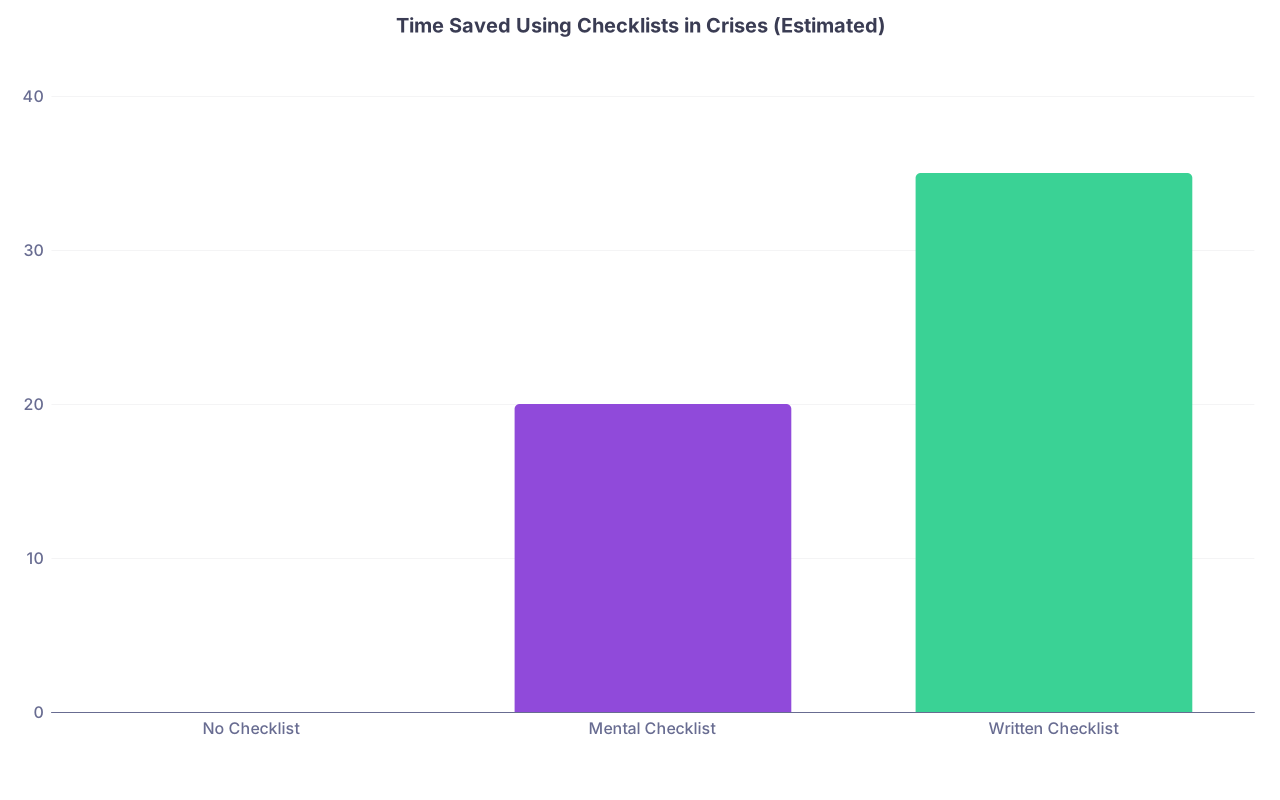
| Category | Value |
|---|---|
| No Checklist | 0 |
| Mental Checklist | 20 |
| Written Checklist | 35 |
Are the exact numbers here scientific? No. But I’ve watched actual humans: when they have a written guide, they:
- Order the right things the first time
- Call the right consult earlier
- Don’t waste time backtracking
You’re not too slow because you need a checklist. You’re slow because you’re trying to brute‑force everything from memory while also fighting your own anxiety.
Drop the performance mindset. Pick up the card.
Step 5: Practice “speed reps” outside of crisis
You cannot become faster only during live emergencies. That’s like trying to learn to suture only on real patients at 3 a.m. It’s possible, but it’s ugly.
You need deliberate reps.
Very tangible ways to do this:
Run 5‑minute simulations with a co-resident or medical student.
“Okay, you’re the nurse. Page me with: ‘BP 70/40, patient altered, on the floor.’ Time me from the page to first order. Then we debrief for 3 minutes.”Use real patient charts.
End of the day, pick a sick patient and ask yourself: “If they crashed right now, what would I do first, second, third?” Say it out loud. You’ll hear your own gaps.Ask your seniors for their first‑five‑minutes.
Not full management. Just: “In the first five minutes of hypotension, what exactly do you do and say?”
If you don’t practice this way, your brain will keep treating every crisis like a brand‑new, one‑time, terrifying event. That’s exhausting and slow.
You’re trying to train your brain to say: “Oh. Another hypotensive. I know the first five steps.”
Step 6: Control the one thing that really slows you: panic physiology
We have to talk about your body.
You can’t “think your way” out of panic in a code situation. Your heart is pounding, your hands are shaking, time feels warped. Of course you feel slow and stupid. Your nervous system is in full alarm mode.
So you need a physical reset you can run in under 10 seconds. Right there in the room. No yoga mat.
Try this:
- Plant your feet flat. Feel them in your shoes.
- Drop your shoulders down once, like an exaggerated sigh.
- Quietly lengthen your exhale for 3–4 breaths. In for 3, out for 5–6.
- While you breathe out, say in your head: “One thing at a time.”
It’s not spiritual. It’s mechanical. Long exhalation kicks your parasympathetic system just enough to get back 10–20% of your frontal lobe function. That’s often the difference between “frozen and useless” and “functional but scared.”
You will still be anxious. Fine. You just need to be anxious and operational.
Step 7: Protect against your worst‑case fear: “I’ll miss something and hurt someone”
Let’s hit the nightmare directly.
Your fear: “Because I’m slow, I’ll make a fatal mistake.”
Reality: Single residents almost never harm patients purely because of slowness in a crisis. The tragedies almost always involve:
- No one calling for help early
- No one reassessing
- Or the team thinking someone was watching when actually no one was
Your best safety net against your nightmare scenario isn’t suddenly becoming a superhero. It’s building boring, non‑heroic habits:
Call early, not late. When in doubt about a crashing patient, page your senior/attending/ICU sooner. You will never be punished long-term for, “I may be over-calling, but I’m worried.” You will be haunted by, “I thought I could handle it alone.”
Say what you don’t know out loud. “I’m not sure why he’s hypotensive yet, but right now we’re supporting his blood pressure, getting labs, flushing the lines, and I’ve called ICU.” That is not incompetence. That is safe.
Document your thought process simply. One or two lines: “Called to bedside for X. Initial vitals Y. ABCs intact. Suspect Z, started A, B, C, and called [senior/ICU].” This both protects you and forces you to check: did I actually do these things?
The residents I worry about? Not the ones who say, “I’m afraid I’m too slow.” The ones who scare me are the ones who never ask for help because they’re so busy proving how “fast” they are.
How to tell if you’re actually improving (and not just constantly anxious)
Your anxiety will not immediately drop when you get faster. Sorry. Your brain will keep telling you you’re slow for a while. So you need external data.
Watch for these:
- Nurses stop pre‑emptively calling your senior when things escalate. They trust you to show up and start something reasonable.
- Your senior doesn’t need to redo your entire first pass. They build on it instead of starting over.
- In debriefs, you hear: “You did the right things; we just needed to add X.”
- You’re getting to the room in under 2–3 minutes consistently.
You can also literally time yourself for a week:
- From pager beep to leaving your chair/bed.
- From entering room to first meaningful order (oxygen, fluids, meds, call a team).
Then, once you’ve fixed the obvious stuff (wandering around looking for gloves, forgetting your badge), pay less attention to seconds and more to structure.
You don’t win on-call by shaving 10 seconds off your hallway walk. You win by shaving 5 minutes of confusion off your brain.

| Step | Description |
|---|---|
| Step 1 | Pager goes off |
| Step 2 | Stand up immediately |
| Step 3 | Grab essentials |
| Step 4 | Walk quickly to room |
| Step 5 | Introduce and request brief story |
| Step 6 | ABCs and vitals |
| Step 7 | Stabilize and call help early |
| Step 8 | Focused exam and initial orders |
| Step 9 | Reassess and document |
| Step 10 | Life threat? |
FAQ: Speed, Safety, and Not Crashing Yourself
1. What if I freeze completely and can’t remember my “script”?
Then your only job is to say this out loud:
“I’m feeling overwhelmed; let’s go back to basics — airway, breathing, circulation.”
This buys you time and signals the team to help you refocus instead of just watching you drown. If you truly blank, ask: “Can someone read me the latest vitals out loud while I examine the patient?” Start moving your hands. Action pulls your brain back online.
2. How do I stop comparing myself to that one resident who’s insanely fast?
Short answer: you can’t fully stop. Your brain loves hierarchy. But you can reframe it. Instead of “I suck compared to her,” ask, “What are her first three moves in a crisis?” Then steal them shamelessly. Also remember: that resident probably feels slow compared to someone else. The comparison ladder never ends. Focus on: Am I better structured and calmer this month than last month?
3. Is it okay to carry printed algorithms or apps into a code? Won’t I look incompetent?
Honestly? The people judging you for using tools are either insecure or out of touch. I’ve watched ICU attendings pull up drug calculators during codes. Use whatever keeps patients safest. The key is: don’t bury your face in the paper/phone for 2 minutes straight. Glance, act, glance again. Short, targeted use. And if anyone comments, you can always say, “I’d rather be accurate than pretend I’ve memorized everything.”
4. What if I call my senior too often and they think I’m weak?
You’re in residency, not an audition for a solo hero movie. Seniors would much rather be mildly annoyed at an extra consult at 1 a.m. than be pulled into a disaster at 3 a.m. that’s been brewing for hours. If you’re worried, frame your calls well:
“Hey, I’m at the bedside of X. ABCs are [status], vitals are [numbers], I’ve done A, B, C. I’m concerned about Y and would appreciate your eyes.”
People don’t hate questions. They hate disorganized questions.
5. How do I deal with the guilt from a case where I really was too slow?
First: you’re not the only variable, even if your guilt story says you are. Second: do a formal debrief with someone you trust — senior, chief, or attending — and demand honesty. What was preventable? What was system failure? Then, turn that into specific changes: new checklist, new first‑three‑moves, new trigger to call help. Your guilt wants you to replay the horror without resolution. Your job is to extract lessons, implement them, and then — and this is hard — let that version of the story sit down.
6. What’s one thing I can do before my next call to be even 10% faster and safer?
Tonight, make a tiny pocket card with your first three moves for: hypotension, hypoxia, chest pain, and altered mental status. Literally: front and back of an index card. Carry it. Look at it once at the start of your shift. That’s it. You’ll be shocked how much calmer you feel just knowing it’s there — and how much less you freeze when your pager explodes at 3 a.m.
Open a blank index card or a notes app right now and write: “First 3 moves for hypotension…” and fill it in. Don’t overthink it. Just start that one card. That’s your first concrete step toward real, safe speed.