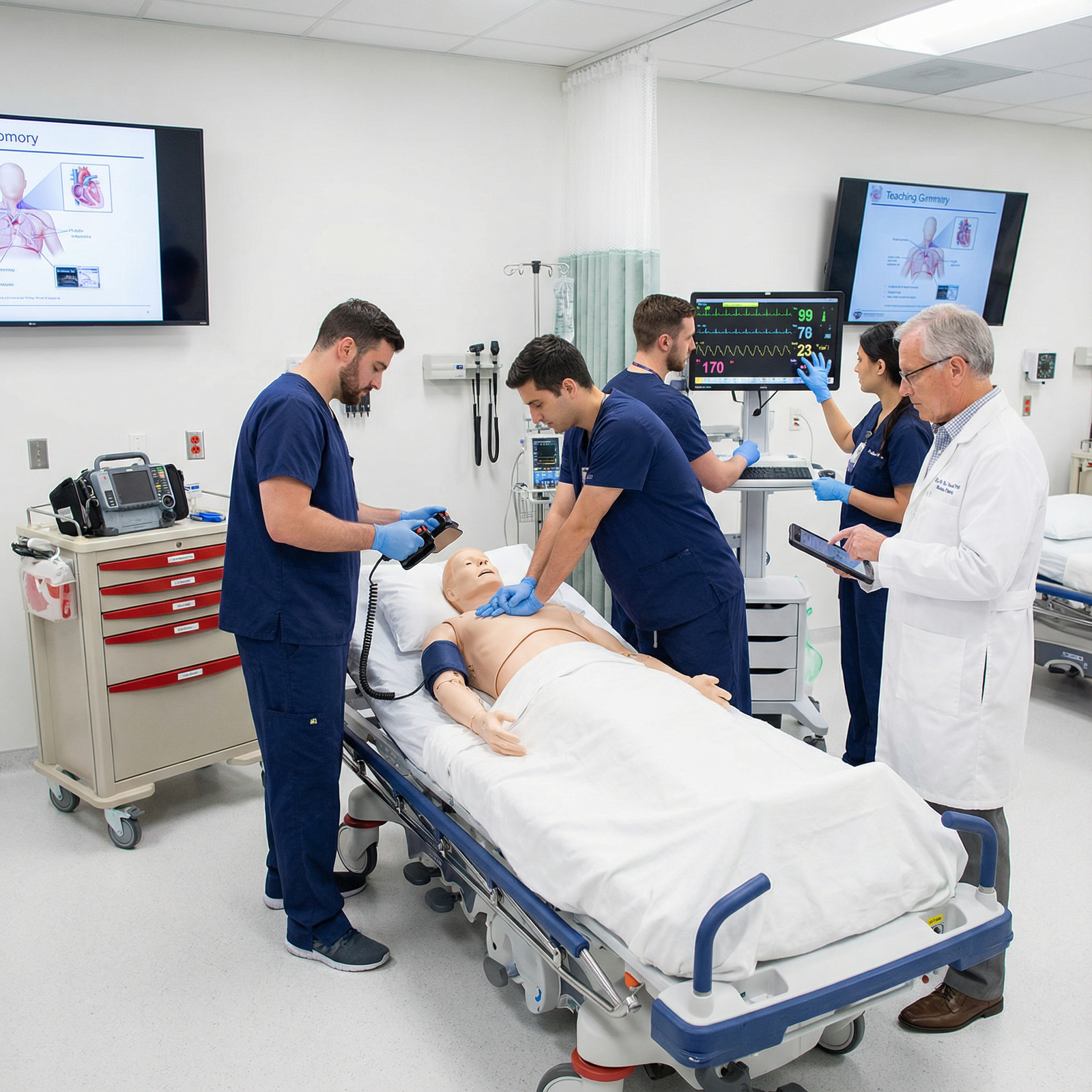
The nightmare isn’t that you don’t know what to do in a code blue.
The nightmare is that you do know—and your brain locks up anyway.
You’re not scared of ACLS algorithms on paper. You’re scared of being the intern standing at the foot of the bed at 3:17 a.m., alarms screaming, chest compressions going, everyone turning to you—and nothing comes out of your mouth.
Let me say this clearly: freezing during your first code blue is not a moral failure, a sign you’re not cut out for medicine, or some permanent label you never shake. It’s a very human response to a situation your nervous system was not built for. And residents cope. All the time.
Let’s walk straight into the worst-case scenario your brain keeps replaying—and then I’ll tell you what actually happens, how people recover, and what you can do now to not fall apart when it’s your turn.
What “Freezing” in a Code Actually Looks Like (And What Really Happens Around You)
Everyone imagines the Hollywood version: you’re the intern, code is called, you rush in, someone tosses you a laryngoscope, nurses stare at you, and you just stand there, useless.
Reality is messier, and honestly, a little more forgiving.
Freezing isn’t always a statue moment. It can look like:
- Staring at the monitor trying to name the rhythm and drawing a blank.
- Forgetting the next ACLS step even though you passed the exam.
- Saying “uh… epinephrine?” when it’s clearly not time yet.
- Not being able to decide whether to shock or not, and hesitating.
- Feeling like your voice is stuck in your throat when asked for an order.
I’ve watched a brand-new intern walk into their first code, grab the chart, flip through it like they were “reviewing,” and literally not process a single word. They were just trying not to pass out.
Here’s the piece your anxiety conveniently leaves out: codes are not solo events. They are teams, and those teams are built with the assumption that the intern might be overwhelmed.
Typical structure looks something like this:
| Role | Usual Responsibility |
|---|---|
| Nurse | CPR quality, meds, defib setup |
| Respiratory | Airway, bagging, vent adjustments |
| Senior resident | Algorithm, orders, leadership |
| Intern | Document, meds, compressions, help |
| Attending | Oversight, big decisions |
You’re almost never the only doctor in the room. In many hospitals, your senior runs the code, not you. If you freeze on your first one, the odds that the whole team pauses and stares until the patient dies? Basically zero. Someone else steps up. Instantly.
I’ve watched ICU nurses calmly say, “We’re in PEA, continue CPR, can we get epi?” before any doctor opens their mouth. They’ve done this 200 times. They’re not waiting for you to be perfect.
So yes, you might freeze. But you will not be alone, and the patient’s outcome does not hinge on your personal performance at 3 a.m. on night one.
The Physiology of Panic: Why Your Brain Goes Blank at the Worst Possible Time
You’re not dumb. You’re not unprepared. Your nervous system is just doing what it does under threat: tunnel vision, shaky hands, blank mind. It’s not a character flaw; it’s biology.
Your brain sees:
- Blaring alarms
- People shouting
- Someone literally dying in front of you
…and it decides: “We are in mortal danger.” Then it does the usual:
- Adrenaline spikes
- Heart races
- Fine motor control tanks
- Prefrontal cortex (thinking brain) partially offline
- Primitive “fight/flight/freeze” kicks in
In your head, “freeze” feels like: “I suddenly became incompetent.”
In reality, it’s: “My threat system temporarily hijacked my access to stored knowledge.”
Why does this matter? Because it means you can train around it. You can’t stop being human, but you can give your body and brain scripts that still run even when your IQ temporarily drops 40 points from stress.
That’s what residents actually do.
How Residents Actually Cope After Their First Code (Including the Disasters)
Here’s the part you never see in official orientations: the debriefs that happen at 4 a.m. in the stairwell or call room.
I’ve seen:
- A PGY-1 walk out of a code, sit on the floor in the stairwell, hands shaking, saying, “I couldn’t remember if we shock PEA. I know we don’t. I just blanked.”
- A senior who forgot to check fingerstick glucose early on and the whole room realized 15 minutes in.
- An intern who was “running” a code but really just repeating whatever the nurse quietly suggested: “We’re in vfib, can we charge to 200?,” then the intern: “Okay, charge to 200.”
What happens to them long-term? They get better. Period.
They cope in a few predictable ways:
Ritualized review after every code
People go back to the call room or workroom and immediately pull up ACLS. Not because they don’t know it, but because once you feel how your brain can glitch, you want to re-wire it. Stuff like:- “Okay, PEA/asystole = no shock. Always meds + CPR. VT/VF = shockable.”
- “Check H’s and T’s earlier next time.”
- “Next time I’ll assign roles out loud.”
Talking to someone who’s seen worse
A lot of residents grab their senior or co-intern afterward and say some version of, “I feel like I totally screwed that up.” And they almost always hear back:- “My first code, I couldn’t even find the backboard.”
- “Dude, I forgot to start compressions for like 30 seconds once because I was staring at the monitor.”
You realize you’re not the only disaster. You’re just early in your disaster-to-competent arc.
Dark humor and normalization
This sounds awful if you’re not in it yet, but there’s a lot of dark humor around codes. Not because people don’t care, but because it’s how you survive seeing death repeatedly. Someone will say, “Well, at least you didn’t shock asystole,” and everyone laughs, and the tension drops.Deliberate practice the next time
The second or third code, people start doing one tiny thing differently:- Saying one sentence clearly: “Okay, I’m running the code; you’re on compressions, you’re on meds.”
- Forcing themselves to step closer to the bed instead of hovering in the doorway.
- Volunteering to push meds or call out times.
None of this looks brave and polished. It looks like a gradual, awkward leveling up. But I’ve watched interns who froze in July run smooth, confident codes by March.
How to Prepare Now So If You Freeze, You Un-Freeze Faster
You can’t fully simulate the emotional hit of your first real code. But you can absolutely stack the deck so that even if you freeze for 10–20 seconds, you come back online faster.
Think of it as building “default scripts” your body can run even while your brain is screaming.
1. Learn the flow, not just the algorithm
Everyone memorizes ACLS as a page of boxes and arrows. That’s fine for the test. During a code, your brain wants a storyline, not a flowchart.
For example:
- Walk in: “Is this a real arrest?” Look for pulse, breathing.
- If pulseless: “Start compressions. Now. Who’s doing them?”
- Look at rhythm: shockable vs non-shockable.
- Shockable: “Shock, then compressions, epi after second rhythm check, consider amio.”
- Non-shockable: “No shock, just compressions + early epi, fix H’s and T’s.”
Literally say it out loud when you’re alone. In the shower, in your car, before bed. It’s not overkill; it’s muscle memory.
2. Pre-plan one sentence you’ll say when you walk in
One of the most paralyzing parts is that sense of social spotlight—everyone waiting for you to say something. So cheat. Decide your line now.
Something like:
- “Hi, I’m the medicine intern. What’s the story so far?”
- “Okay, I’m here. Who’s running the code right now?”
- “Keep compressions going. What rhythm did we start with?”
You don’t have to be the hero who takes charge in the first 3 seconds. You just have to open your mouth.
3. Use a stupidly simple grounding trick
Right before you walk into the room (or as you’re coming down the hall), take one deliberate breath: in for four, hold for four, out for six. Name three things quickly in your head:
- “Gloves on.”
- “Check for compressions.”
- “Look at the monitor.”
It feels trivial. It’s not. It yanks your brain halfway out of panic and back into task mode.
4. Understand your role as an intern is limited—and that’s okay
In most places, early on you’re not:
- Deciding when to terminate efforts
- Making big ethical calls
- Solo-running the entire ACLS algorithm
You’re more likely:
- Documenting times and meds
- Getting labs or equipment
- Calling the attending
- Helping with compressions and meds
Which means if you freeze, the entire show doesn’t grind to a halt. You’re one piece of a much bigger machine.
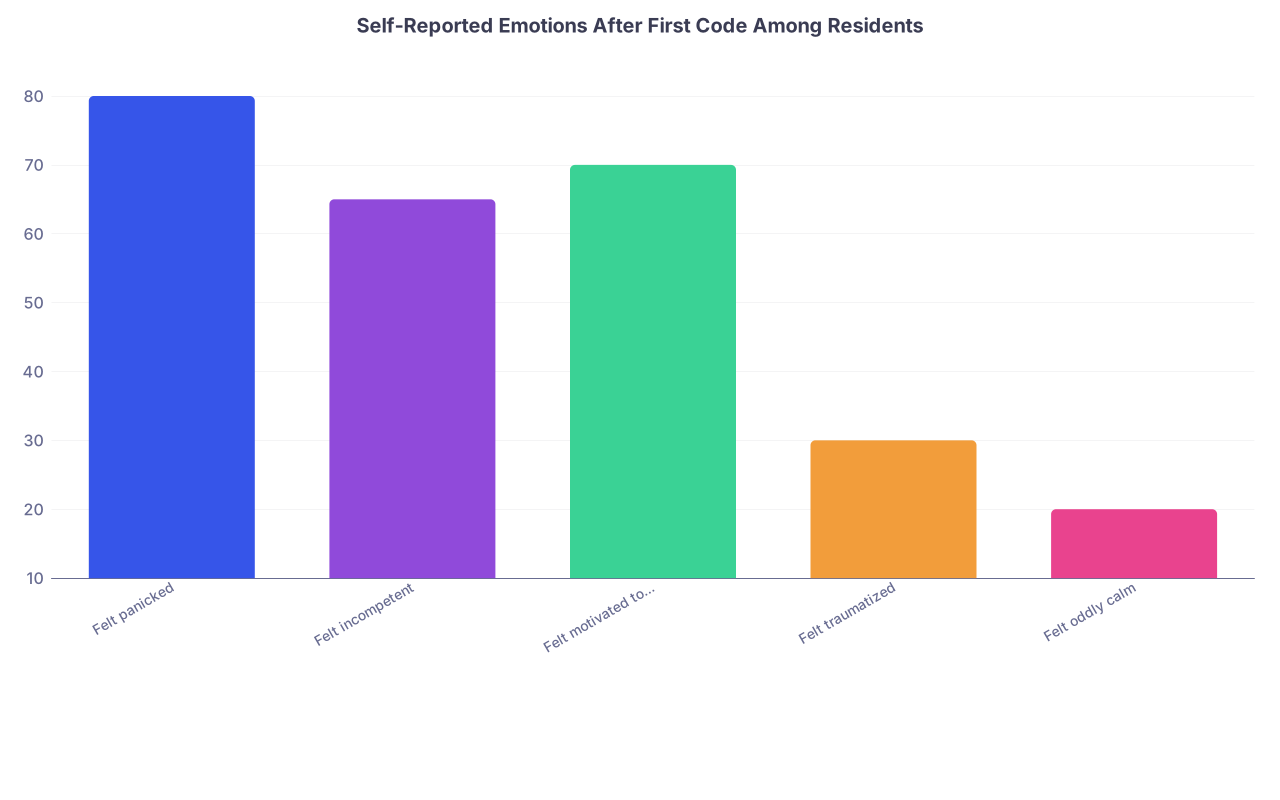
| Category | Value |
|---|---|
| Felt panicked | 80 |
| Felt incompetent | 65 |
| Felt motivated to improve | 70 |
| Felt traumatized | 30 |
| Felt oddly calm | 20 |
The Fear Underneath the Fear: “What If My Freeze Hurts Someone?”
This is the one that really eats at people. Not just, “I’ll look stupid,” but, “Someone will die because I choked.”
Hard truth: people will die in codes no matter how perfect you are. CPR survival is not like TV. Even in the best, fastest, most textbook-perfect codes, a lot of patients don’t make it.
So what’s your responsibility?
Your responsibility is effort and growth, not omnipotence.
You’re responsible for:
- Showing up
- Trying your best with the training you have
- Reflecting honestly afterward
- Learning from mistakes, not denying them
You are not responsible for:
- Rewriting the laws of physiology on a crashing 90-year-old with metastatic cancer
- Being smoother than your seniors on day one
- Erasing all uncertainty and risk from a chaotic medical situation
I’ve seen interns blame themselves because they took “too long” to call a code on a patient who was already circling the drain. Their attendings almost always say the same thing: “We could have been there two minutes earlier, and this outcome would likely be the same.”
This doesn’t mean your actions are meaningless. They matter. But they exist inside a huge web of patient factors, system limitations, and biology. You’re one piece. You’re not the entire story.

What If You Completely Lose It Afterward?
Another fun what-if your brain likes: “What if I hold it together in the room but then totally crumble? Cry. Shake. Can’t go back to work.”
It happens. Not daily, but way more often than anyone admits publicly.
I’ve seen residents:
- Cry in the med room with the door closed for 5 minutes
- Call their partner from the stairwell just to hear a familiar voice
- Ask the senior, “Can I take 10 minutes? I just need to reset,” and go sit in the call room in silence
You’re allowed a reaction. You’re not a robot. Sometimes your internal dam breaks after the code is over, when the adrenaline drops and your brain goes, “What the hell just happened?”
What helps:
- Name it to someone you trust: “That messed me up more than I expected.” It kills the shame faster.
- Give yourself one concrete takeaway: “Next time I’ll speak up earlier about H’s and T’s,” instead of spinning on “I’m terrible.”
- If it’s sticking with you for days—nightmares, intrusive replays, dread before shifts—talk to a counselor or program leadership. Post-code distress is not rare, and you’re not going to be the first resident to ask for help.
The Quiet Truth: You Will Change, and It Won’t Be Overnight
The scariest part of thinking about your first code is believing that how you are now—anxious, inexperienced, overthinking—will be how you are then and forever.
That’s just not how this works.
I’ve watched this arc too many times:
- July: Intern hangs back at doorway, frozen, heart racing, barely speaks.
- November: Same intern steps into the room faster, still shaky but able to say, “Keep compressions going, I’ll grab the chart.”
- March: Same intern calls out, “We’re in PEA. Keep compressions. Can someone get a glucose?” without waiting to be asked.
- End of year: That intern is the one quietly reassuring the next baby intern: “Your first code is awful. You’ll be okay.”
You don’t flip a “competent in codes” switch. You accumulate small, uncomfortable reps, one terrifying situation at a time. You make micro-corrections. You screw up small things and fix them. You slowly start believing that even if your brain freaks out for a moment, you can still help.
And your fear about freezing? It never totally vanishes. But it stops owning you.
FAQ: 5 Things Your Anxious Brain Is Still Asking
1. What if I literally can’t move or speak when I walk into my first code?
Then someone else will. Nurses, your senior, the attending—someone will step into the vacuum. Codes are not waiting for you to be a superhero. If you find yourself frozen, focus on doing one tiny thing: step further into the room, put on gloves, or ask, “What do you need me to do?” That one action usually breaks the freeze.
2. Will people secretly think I’m incompetent if I mess up or hesitate?
People will think you’re an intern. Which is exactly what you are. They fully expect you to be green, scared, and clumsy in your first few codes. If you’re respectful, show effort, and clearly try to learn from mistakes, most staff will give you a lot more grace than you’re giving yourself.
3. How much ACLS do I really need memorized before residency?
Enough to know the basic branches: shockable vs non-shockable rhythms, when to use epi, and that compressions never stop for long. You don’t need to be a walking textbook on day one. You will review ACLS in residency, and you can always keep a pocket card or app. Aim for familiarity, not perfection.
4. What if I’m the only doctor there at first?
That might happen for a few minutes on nights in smaller hospitals. You still don’t have to be fancy. Focus on the basics: start or ensure high-quality CPR, call for help/code team if not already activated, hook up the monitor/defib, and follow the algorithm as best you can. When backup arrives, hand off clearly: “Found patient pulseless, started CPR, now in PEA, gave one epi.”
5. Is it a red flag for me as a future resident that I’m this anxious about codes before I’ve even started?
Honestly? No. If anything, it suggests you care about your patients and you understand the seriousness of what’s coming. The residents who scare me are the ones who swagger in, act like nothing can rattle them, and then crumble the first time real chaos hits. You being worried now means you’ll probably prepare more, reflect more, and grow faster than you think.
Key things to remember:
You might freeze during your first code blue—and that doesn’t make you a bad doctor, just a human one. You will not be alone; real-life codes are team events with built-in redundancy. And the version of you who walks into that first code is not the same version who’ll be running them a year later.