
It’s 8:47 p.m. Everyone else on your team left hours ago. The workroom is dark except for your screen, the hum of the AC, and that stupid blinking cursor in the last progress note you’re still finishing. You swipe your badge to leave and pass by the attending’s office. Lights off. Nobody sees you. Nobody knows you were the last one out. Again.
And on the way home, the spiral starts:
“They must think I’m slow.”
“Everyone else finished at 5:30. What is wrong with me?”
“Are they talking about me? Are they going to mention this on my eval?”
I know this headspace way too well. You’re exhausted, your badge log says you clocked out way after everyone else, and instead of being proud you stuck it out and finished everything, you’re convinced you just outed yourself as The Inefficient Intern.
Let me be blunt: staying late doesn’t automatically mean you’re inefficient. But it also doesn’t automatically mean you’re a quiet hero. The truth is messier—and more fixable—than your anxious brain is making it.
Let’s actually pick this apart.
What Staying Late Usually Actually Means
You’re stuck on the thought: “If I’m always the last one leaving, they must think I suck.”
Here’s what I’ve actually seen it usually mean in residency:

- You care about doing things right, not just fast.
- You’re doing extra “invisible” work nobody else is counting.
- You’re bad at cutting corners (which is good for patients, bad for your psyche).
- You haven’t learned a few key time-protection tricks… yet.
Residency culture is twisted: we tell people “patient safety first,” then silently reward the person who somehow discharges four complex patients by 10 a.m. with flawless notes and no apparent struggle. You’re comparing your messy, behind-the-scenes chaos to other people’s highlight reels.
And there are a few ugly assumptions your brain is quietly making:
“Everyone else is truly done at 5.”
False. A big chunk of them are leaving with unfinished notes, vague plans they’ll “fix later,” or pending tasks they hope night float won’t notice.“My attendings are tracking who leaves when and judging me.”
Usually false. They’re glancing at your notes, your sign-outs, your patient outcomes, and how frazzled you look. Most aren’t pulling up the time clock and plotting a graph.“If I was competent, I’d be leaving when everyone else does.”
Flat-out wrong. I’ve watched some of the safest, most thorough residents consistently be 30–60 minutes behind the “fast” ones.
The real question isn’t “Am I inefficient?” The real question is:
“Is the way I’m working sustainable, safe, and aligned with what actually matters in residency?”
Four Common Reasons You’re Always Last (None of Which Mean You’re Dumb)
Let me walk through the patterns I see over and over. Pick which one sounds like you.
1. The Over-Documenter
You’re writing novels. Every note is a masterpiece. ROS is a page. Assessment and plan is a thesis.
You tell yourself, “I’m just being thorough.” But your notes are taking 2–4x what they need to.
Signs this is you:
- You re-read each note multiple times before signing.
- You’re getting behind on notes by early afternoon.
- You feel actual physical anxiety if you don’t document every little thing perfectly.
Hard truth: No one is giving you an award for that extra paragraph. But you are paying for it with lost sleep and self-esteem.
2. The “I’ll Just Do It Myself” Resident
You could ask the nurse politely to help coordinate something. You could page the case manager. You could ask your co-intern to pick up a task.
But instead, your brain goes, “They’re busy, I don’t want to be annoying,” and you run around doing everything yourself. So you’re:
- Calling transport yourself.
- Tracking down records personally.
- Re-doing tasks someone else already half-did because you don’t fully trust it.
You’re not inefficient. You’re refusing to outsource. That’s different.
3. The Chaos Brain With No Workflow
You’re smart. You know the medicine. But your day looks like this:
- Answer 3 random pages
- Start a note
- Distraction
- Follow a nurse into a room
- Check labs
- Start another note
- Get pulled into a family talk
- Now you have seven half-finished notes and it’s 4:30.
You’re not slow. You’re scattered. No system. I’ve seen brilliant people drown this way.
4. The “Quiet Perfectionist” Who Hides Struggle
You’re behind by noon but too embarrassed to say, “I’m drowning.” So you:
- Nod and say “Yep, I’m good” on afternoon check-in.
- Start pretending everything’s fine while your task list grows.
- Stay two hours late fixing it alone.
Your team can’t help a problem they never see.
What Your Program Actually Cares About (It’s Not Your Exit Time)
Programs don’t sit in a room saying, “Wow, she left at 7:12 p.m. again—let’s tank her eval.”
They care about a few much more concrete things:
| What They Notice Most | What You Obsess Over |
|---|---|
| Patient safety issues | Clock-out time |
| Chronic lateness on pre-rounds | Being the last in the workroom |
| Sloppy/late sign-outs | How long your notes take |
| Teamwork, attitude | Number of unread Epic messages |
| Responsiveness to feedback | Whether the senior “likes” you |
If:
- Your patients are safe
- Your sign-outs are clear
- You’re not consistently making nurses wait hours for orders
- You’re responsive when someone says “try doing X faster”
…then being the last one out does not automatically equal “inefficient” in their eyes.
Here’s what does read as inefficiency to attendings:
- You’re always late on pre-rounds and missing data.
- You chronically don’t know your patients when asked.
- Your discharge summaries are delayed and holding beds.
- Nurses are escalating complaints that you never respond.
If none of that is happening, your inner critic is probably louder than your program.
How to Tell If You Have a Real Problem vs Just Anxiety
You want a litmus test? Try this.
1. Ask Your Senior Directly (Yes, Out Loud)
Something like:
“Hey, I’ve noticed I’m usually the last one leaving. I want to get more efficient and also make sure I’m meeting expectations. Do you see anything specific I’m doing that slows me down, or is it just reps and time?”
If they say:
“Nah, you’re fine, your notes are good and you’re safe. You’ll speed up.”
Believe them. That’s not code for “you’re terrible.”“Yeah, your notes are really long and you redo work a lot. Let’s work on that.”
Great. Now you have something to actually fix, not just vibe-check anxiety.
2. Watch for Patterns in Evaluations
If you were truly inefficient in a problematic way, you’d start seeing phrases like:
- “Needs to work on time management.”
- “Sometimes struggles to complete tasks in shift.”
- “Can benefit from prioritization skills.”
If your evals say things like “thorough,” “hard-working,” “reliable,” and nothing about time management, the story in your head doesn’t match the story on paper.
3. Compare Today You to Month-1 You
You should be faster than you were 3–6 months ago. Not night-and-day, but noticeably.
If you’re still leaving at 9 p.m. for a day that should realistically end by 6, every single day, and it’s been 8 months on the same type of service—that’s worth intervening on. Not because you’re bad. Because you’re suffering.
Concrete Habits That Actually Make You Faster (Without Being Unsafe)
Here’s the stuff I wish someone had sat me down and told me at the beginning.
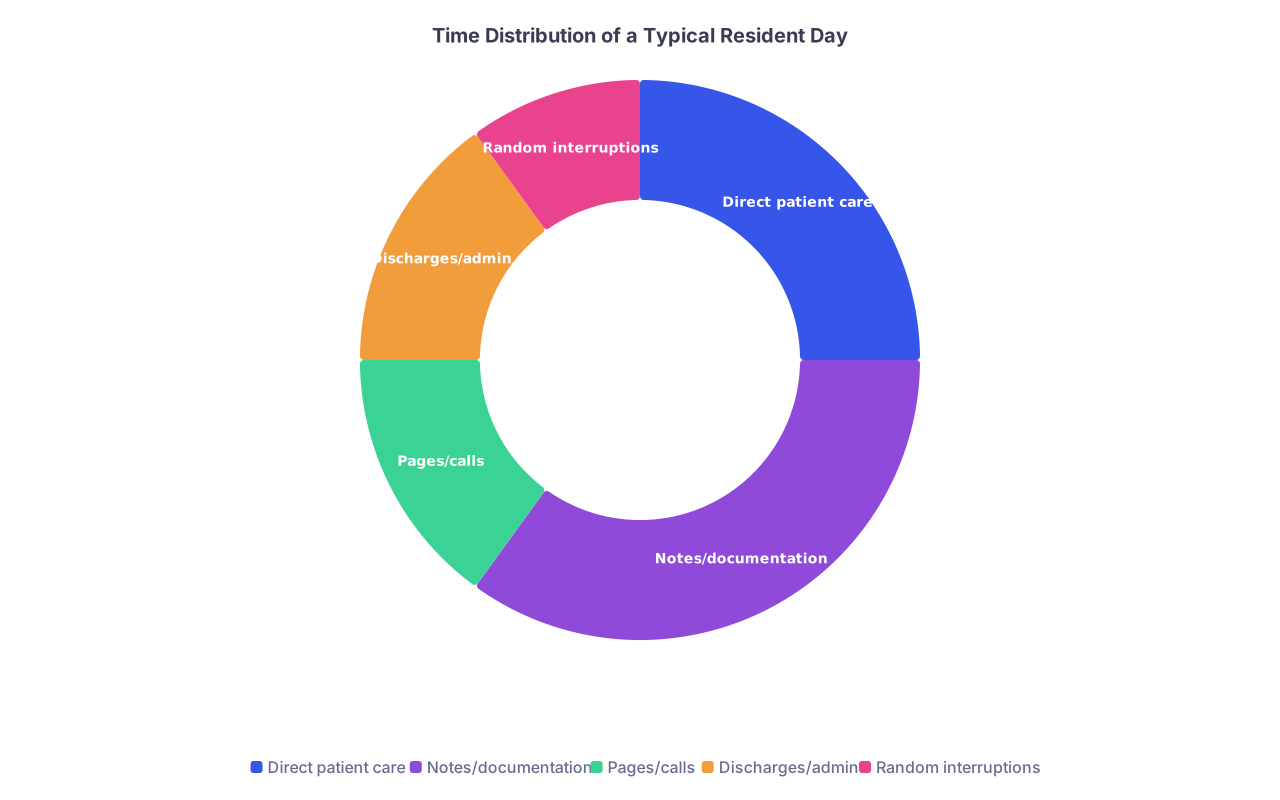
| Category | Value |
|---|---|
| Direct patient care | 25 |
| Notes/documentation | 35 |
| Pages/calls | 15 |
| Discharges/admin | 15 |
| Random interruptions | 10 |
1. Protect Your Note Time Like It’s a Procedure
Midday, not at 6:30 p.m. An actual block.
Example approach:
- Finish rounds.
- Immediately sit down for 60–90 minutes of focused documentation.
- Silence non-urgent distractions (within reason).
- Do notes in this order: sickest/most complex → discharges → everyone else.
You’ll still get interrupted, sure. But if you never protect a chunk of note time, of course they bleed into the evening.
2. Stop Writing Novels
For non-complex stable patients, your note doesn’t need to be a manifesto. Try:
- Tight HPI.
- Focused worked-up assessment.
- Bullet-style plan.
If you’re PGY-1, ask a fast PGY-3, “Can I see one of your notes?” Steal their structure. Shorter doesn’t mean worse; it often means more readable.
3. Batch Your Work Instead of Constant Task Switching
Instead of this ping-pong “notes–labs–pages–notes–rounding–notes” nonsense, cluster.
Basic structure:
- Early: pre-rounds, quick orders, first safety issues.
- Mid: rounds.
- Post-rounds 1–2 hours: notes + discharges.
- Late afternoon: wrap-up tasks, pre-signout, final checks.
You’re always going to get pages and random chaos. But if everything is “urgent,” nothing is. Decide what is actually priority.
4. Use Your Team Like an Actual Team
You’re not noble for drowning alone. You’re just silently miserable.
Say things like:
- “I’m behind on notes—can you help with this discharge med rec?”
- “Can I sign out this one stable patient early so I can finish two urgent notes?”
- “I’ve got three family updates pending—can you take one?”
A decent senior will help redistribute. And if they don’t, that’s on them, not a failing of you asking.
The Ugly Fear: “Are They Secretly Talking About Me?”
You’re imagining:
- The program director staring at your late clock-out times in a spreadsheet.
- Attendings whispering, “Yeah, she’s always here late, not sure she can handle fellowship.”
- Co-residents rolling their eyes: “Of course she’s still here.”
Reality check from what I’ve actually seen:

| Step | Description |
|---|---|
| Step 1 | Stay late again |
| Step 2 | Assume others think I am inefficient |
| Step 3 | Feel guilty and anxious |
| Step 4 | Avoid asking for help |
| Step 5 | Fall further behind |
Most people are so wrapped up in their own chaos they barely clock your exit time. They notice:
- If you’re always offering help when you’re done.
- If your sign-out is solid.
- If you’re kind to nurses.
Do some people judge? Sure. There’s always that one “I was out by 4:30 every day as an intern” hero. Usually they’re conveniently forgetting the patient they half-dispositioned and the notes they finished from their couch.
The people you actually want in your corner care way more that you’re conscientious and improving than that you match their personal speed record.
When Staying Late Is a Real Red Flag (and What To Do)
I’m not going to sugarcoat it: sometimes constant late days mean something needs a real fix.
Take it seriously if:
- You’re 2+ hours after everyone else almost every day.
- You’re emotionally or physically wrecked, crying on the drive home regularly.
- You’re getting actual feedback about time management.
- You feel your patient care might suffer because you’re so fried.
This isn’t a “be tougher” moment. It’s a “get strategic help” moment.
Who to talk to:
- A trusted chief resident: “I’m consistently staying way later than my peers. I’m not sure what I’m doing wrong, but this doesn’t feel sustainable. Can you watch my workflow for a day or two and help me fix it?”
- A senior you respect: ask to shadow how they structure their day.
- Program leadership if it’s truly burning you out: frame it as, “I want to improve my efficiency and protect my wellness; can we problem-solve together?”
I’ve seen residents totally turn this around with:
- Two afternoons of focused coaching.
- Brutal but fair feedback on their notes.
- Permission to actually delegate.
A Quick Reality Check Before You Spiral Again Tonight
Let me say this plainly:
Being the last one to leave does not automatically mean:
- You’re stupid.
- You’re failing.
- You’re not cut out for this.
Often it means:
- You care.
- You’re still building reps.
- No one has ever actually taught you how to protect your time.
You’re not broken. You’re just in that brutal part of training where you’re doing a full-time job and learning the job at the same time, under a stopwatch you half-invented yourself.
You can fix pieces of this. Not overnight, not perfectly, but meaningfully.
FAQ – Exactly What Your Anxious Brain Is Asking
1. If I ask for help with efficiency, will that make me look weak?
No. It makes you look self-aware and coachable. Chiefs and attendings get nervous about residents who don’t see their own patterns, not the ones who say, “I want to improve this specific thing.” Phrase it as growth, not crisis.
2. My co-interns leave on time and seem fine. Am I just not cut out for residency?
Different backgrounds, different rotations, different seniors, different thresholds for cutting corners. You cannot see what they’re sacrificing to leave on time. Some are skipping meals, some are charting from home, some just had a lighter patient load that day. One metric doesn’t define your entire fitness for residency.
3. Are attendings actually looking at clock-out times?
Most aren’t. Some programs monitor duty hours broadly to avoid violations, but I’ve almost never seen someone dragged into a meeting because they left at 7:30 too often. If anything, they get worried you’re overworked, not that you’re lazy.
4. How do I know if my notes are “too long”?
Ask. Literally: “Can you look at this note and tell me what you’d cut?” If it takes attending-level stamina to scroll, it’s probably too long. If you’re writing full H&Ps every day on stable chronic patients, that’s overkill. Try shortening each section by 30% and see if any critical info is actually lost. Spoiler: it won’t be.
5. Is it bad if I sometimes finish notes from home?
It’s not ideal for your sanity, but a lot of people do it sometimes. Occasional “I had a brutal day and I’ll finish one note from my couch” isn’t a crime. If you’re routinely taking hours of work home, though, that’s a sign your workflow needs an overhaul and maybe your service is understaffed.
6. What if my senior really does think I’m inefficient?
Then you ask them for specific examples and solutions. “Can you tell me 1–2 things I can do differently tomorrow to be more efficient?” If they just say, “Be faster,” that’s useless feedback and on them. If they say, “You redo labs five times” or “Your prerounds are unstructured,” that’s gold—you can work with that.
Today, do one concrete thing:
Tomorrow on rounds (or your next shift), pick one person you trust—a senior, chief, or co-resident—and say: “I’ve noticed I’m usually the last to leave. I want to get better. Can you watch how I work for a bit and point out anything I could tighten up?”
Then actually listen. And give yourself permission to believe that being teachable matters more than being magically fast right now.