
On a Tuesday night post-call, a second-year resident stood in the hospital parking lot at 8:15 p.m., staring at two text messages: one from the attending asking for an updated note, and one from their partner that just said, “She’s asking why you missed bedtime again.” That’s the moment it hits a lot of people: the system wasn’t built for you to be both a resident and an involved parent.
You are not going to fix residency culture this year. Your only job is to build a survival system that protects your kids, your partner, and whatever is left of you. That means getting ruthless about what you do, what you don’t do, and what you automate or delegate.
Step One: Build a Realistic Weekly Blueprint (Not a Fantasy Schedule)
You cannot “wing it” as a resident parent. The hospital already owns your time unless you fight back with structure.
You start by building a weekly blueprint, not a perfect hour-by-hour schedule. Something you and your partner (or support system) can actually run.
Core moves for the weekly blueprint
Lock in non-negotiables first.
- Call schedules
- Required didactics
- Commute time (door-to-door, not some fantasy Google Maps number)
- Daycare/school drop-off and pick-up times
Put these in one shared calendar. If you and your partner are on different platforms, fix that. Google Calendar, iCal, whatever. One source of truth.
Assign default roles per day.
Instead of arguing every night about who does what, pre-decide.For each weekday, decide:
- Who’s primary for morning routine and drop-off
- Who’s primary for pick-up and dinner
- Who’s primary for bedtime
On heavy services (ICU, trauma, nights), assume you are not primary for anything at home except maybe a quick check-in or story.
Default childcare backup plan.
Stop pretending emergencies are rare. They’re the rule in residency.Create a backup ladder, written down:
- 1st line: partner / you
- 2nd line: nearby grandparent / sibling / neighbor
- 3rd line: paid sitter / backup daycare / nanny service
Everyone on that list should:
- Know they’re on it
- Know where the spare key is
- Have your kid’s pediatrician and preferred ER written somewhere obvious
Anchor “kid time” blocks.
You’re not going to have long stretches. So use short blocks that you protect aggressively:- 15 minutes in the morning for breakfast or play
- 20–30 minutes after you get home (no phone, no charting)
- One “protected” half-day a week if your schedule allows (often post-call afternoon)
If you don’t mark this on your calendar, it will be eaten by notes, pages, or doom-scrolling.

| Step | Description |
|---|---|
| Step 1 | Get schedule for month |
| Step 2 | Block shifts and call |
| Step 3 | Assign home roles by day |
| Step 4 | Set backup childcare ladder |
| Step 5 | Add protected kid time blocks |
| Step 6 | Share plan with partner |
Step Two: Strip Home Life Down to a System
Most resident-parents don’t fail because of medicine. They fail because home is chaos. You do not need an Instagram home. You need an industrial kitchen and a clean-ish laundry loop.
Food: Go for boring, repeatable, fast
If you’re cooking “from scratch” nightly during residency with kids, you’re either superhuman or lying.
You want a rotation, not creativity.
Decide on a 7–10 meal core rotation, where:
- Prep time is under 20 minutes
- Ingredients overlap heavily
- You can scale up for leftovers
Examples:
- Sheet pan chicken + frozen veggies + potatoes
- Tacos (ground turkey or beans, bagged salad, tortillas)
- Slow cooker chili or curry (dump ingredients before leaving)
- Pre-marinated proteins with microwavable rice and a bagged salad
Then automate:
| Task | Tool / Rule |
|---|---|
| Meal plan | 7 rotating dinners, repeat weekly |
| Grocery ordering | Sunday night standing order |
| Cooking | Batch cook 2 nights, leftovers |
| Backup options | 3 go-to takeout spots |
Use grocery delivery or pickup. Yes, it costs. So does burnout and divorce. You’re buying time with your kid.
Laundry, dishes, and cleaning: industrial mindset
You’re not running a home. You’re running a small operation.
Laundry rule: one load per day or every other day, start-to-finish.
No “laundry day.” You don’t have one.Hack:
- Throw a load in before work (or at night)
- Partner flips to dryer
- Folding is optional. Bins labeled “kid tops,” “kid bottoms,” “scrubs,” “towels” are good enough.
Dishes rule: sink empty at bedtime, no exceptions.
This doesn’t mean you personally. It means someone.If budget allows, dishwasher every single night, even half full. If not, 10-minute nightly sprint. Set a timer. Do it.
Cleaning rule: pay for cleaning if there is any way in hell you can afford it.
Even once a month for bathrooms and floors. Residents will hire a $60/mo subscription but balk at $100–150 for a cleaning service that saves 4–5 hours and one massive argument.
If you can’t afford cleaners:
- Saturday or post-call: 30-min “family clean” with music, everyone has 2–3 tasks
- Don’t deep clean. Just keep surfaces and bathrooms decent and floors safe for a crawling kid.
Step Three: Turn Hospital Tasks into Checklists and Templates
Your brain is not reliable when a toddler kept you up at 2 a.m. and you’re post-call on hour 27. You need systems for the hospital side too.
Charting: faster, not prettier
You want every repetitive thing templated.
Create smart phrases/macros for:
- Common admission H&Ps (e.g., CHF, COPD, pyelo, DKA)
- Standard daily progress note skeleton
- Discharge summary structure
- Patient instructions for your frequent diagnoses
Spend one quiet call shift loading these into your EMR. That time comes back a hundred times.
Then change your workflow:
- Write notes in real time after rounds while details are fresh
- Finish the day with no more than 1–2 notes pending
- Post-call: never leave with >1 note unfinished unless your attending absolutely blocks you
You are not allowed to bring 12 unfinished notes home and then also feel guilty for not playing with your kid.
Paging and communication
Every extra 10 minutes at the hospital is 10 minutes you’re not at home. So you:
- Call consults early in the day, before they’re slammed
- Batch pages when possible
- Use structured communication (like SBAR) so you don’t have to call back to clarify
And you protect hard out-times:
- If sign-out is 6:00 p.m., be wrapping non-urgent stuff at 5:30
- Learn to say: “I’m handing off to night float who can follow up on that lab when it results.” Then actually document it.
Step Four: Redesign Mornings and Evenings Around Kid Needs
Resident life with kids is won or lost in the first and last 90 minutes of the day.
Mornings: avoid the 6 a.m. meltdown
The enemy in the morning is decision-making.
The night before (even when you’re exhausted):
- Lay out your scrubs, badge, socks, shoes, bag
- Lay out kid clothes, diaper bag/backpack, shoes
- Pack lunches or at least group items together in the fridge
Then build a minimal morning routine:
- 5–10 minutes for yourself (shower/coffee/quiet)
- 10–15 minutes fully focused on the kid(s)
- 10 minutes for logistics: final packing, loading car
If you’re leaving before they wake up:
- Leave a short note or video
- Have a morning ritual item: a drawing on the fridge, a packed “from mom/dad” snack in their lunch
Evenings: don’t waste your best 30 minutes
Most residents walk in the door, see their phone explode, and mentally stay at the hospital.
New rule: first 20–30 minutes at home = no phone, no EMR, no “just one quick thing.”
You are with your kid. Full focus. That small block hits way above its weight emotionally.
After that, you can:
- Do a 15–20-minute charting burst if needed
- Switch with your partner: one handles kid bedtime, the other handles kitchen reset
If you’re on nights:
- Do video calls strategically (before bedtime routine starts, not in the middle)
- Keep it short and predictable: “I’ll call at 6:45 p.m. for ten minutes before story time.”
Step Five: Protect Your Partner and Relationship from Collateral Damage
Residents with kids don’t crash because of a single bad shift. They crash because the resentment at home gets too high.
You’re working insane hours. Your partner might be carrying home life plus their own job. Or you might be the single parent, in which case: we’re playing survival mode, not optimization.
The weekly check-in
Have a 20–30 minute standing check-in each week. Sunday evening works for most.
Agenda (keep it simple):
- Review the coming week’s schedule and child logistics
- Each person names 1–2 things that would make next week easier
- Agree on any “protected” time for each adult (gym, therapy, 1 solo outing)
No solving giant relationship issues here. Just operational coordination and small adjustments.
“Invisible work” reality check
If your partner is non-medical, they will never fully get your world. And you won’t automatically see how much mental load they’re carrying at home.
So you ask bluntly:
- “What’s one thing I could take off your plate this week that would actually help?”
And when they tell you, you:
- Write it down
- Put it on the calendar or to-do app
- Follow through
Not 10 things. One or two.
If you’re both in medicine:
- Outsource more aggressively if you can
- Get grandparents/sitters involved more than feels “normal”
- Loosen standards at home further. You don’t need gourmet dinners and folded laundry. You need safety, basic hygiene, and some smiles.
Step Six: Plan Around the Hard Rotations and Call Months
Stop treating every month like it’s the same. It isn’t. ICU, nights, ED — these will wreck you if you don’t plan for them.
Pre-load support for hard months
When you see an ugly block coming (q4 call, ICU, nights), do three things:
Increase childcare support for that month.
- Extra daycare hours
- More sitter coverage on post-call days
- Ask grandparents to visit that month, not some random elective month
Simplify everything at home.
- More frozen meals, fewer fresh perishables
- Cleaner scheduled at the start and end of the month if budget allows
- Social obligations: say no by default
Set expectations early.
Tell your partner something like:
“This month is going to be bad. I’ll be a zombie. My realistic contribution at home will be X, Y, Z. Can we plan around that instead of both getting blindsided?”
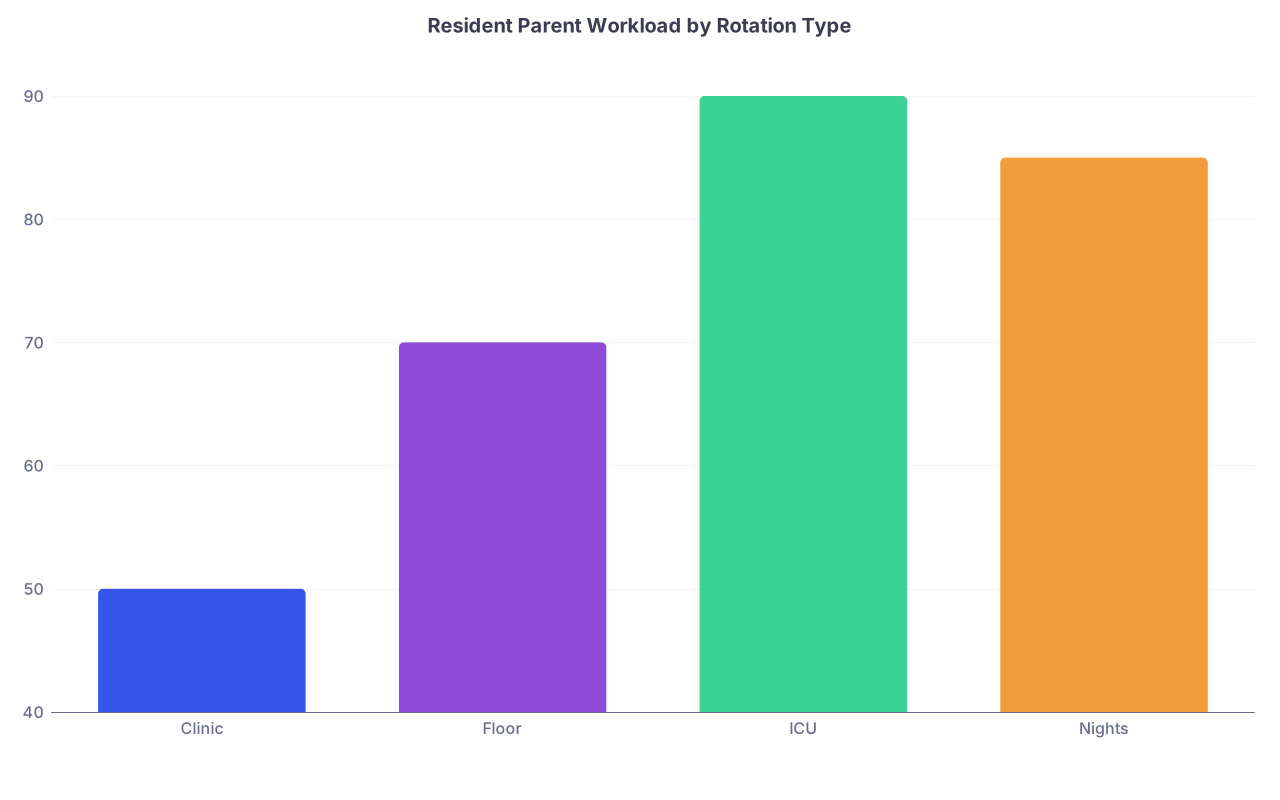
| Category | Value |
|---|---|
| Clinic | 50 |
| Floor | 70 |
| ICU | 90 |
| Nights | 85 |
(The numbers here are just “severity” points out of 100 — the point is you treat “90” months differently from “50” months.)
Step Seven: Manage Your Guilt Like a Clinical Problem
The emotional load might be worse than the physical one. The guilt is constant:
- Missed bedtimes
- School events you skipped
- Partner exhausted while you’re on hour 28
You’re not going to eliminate the guilt entirely. But you can keep it from controlling your behavior.
Reframe what “good parent” means during residency
Right now, “good parent” is not:
- At every event
- Doing every bedtime
- Cooking every meal from scratch
Instead, “good parent during residency” looks like:
- Reliable in your promises (you don’t casually promise things you might miss)
- Present when you are physically there
- Providing safety, love, and basic stability, even if it’s messy
Do a quick check before spiraling:
- Is my child safe?
- Is my child loved?
- Are we moving toward a more sustainable setup, even slowly?
If yes, you’re doing the job under brutal conditions.
Step Eight: Tools and Shortcuts That Actually Help
Quick list of tools that I have seen actually make a difference for resident parents:
- Shared calendar app (Google Calendar with separate colors for each person and “home”)
- Shared task manager (Todoist, Reminders, Notion — whatever both of you will actually open)
- Grocery delivery service (Instacart, Walmart pickup, local) on recurring order
- Pre-set EMR smart phrases customized by you
- Whiteboard by the door with this week’s essentials: who’s on call, who’s on pickup, any big kid events
- Auto-pay for every bill that can possibly be automated
What doesn’t reliably help:
- Overcomplicated chore apps that require constant updating
- Vision boards and “perfect morning routines” that assume 9–5 life
- Trying to keep your pre-kid standard for hobbies, workouts, and social life during your hardest rotations
Brutal truth: this is a season of life where survival is the goal. You’ll add back more “nice-to-haves” later.
FAQs
1. I feel like I’m failing both at home and at the hospital. Is this normal or a sign I should quit?
That feeling is almost universal among resident parents, especially in the first year with a new baby or toddler. It’s not automatically a sign you should quit. It usually means your systems are still built for “solo resident” life, not “resident with a family.” Before you make big career decisions, adjust your structure: more childcare support, stricter boundaries on charting at home, meal and housework systems. If, after 6–12 months of that, you still feel like you’re drowning with no path forward, then a serious conversation with a mentor or program director about schedule adjustments or specialty fit is reasonable.
2. What if my partner resents my hours and says they didn’t sign up to be a single parent?
Resentment is common and valid. You cannot fix this with one long apology and flowers. You fix it with: clear expectations (“this rotation will be brutal until X date”), visible effort to lighten their load in small ways, and actually honoring the time you do have at home. A weekly check-in helps more than big emotional talks that lead nowhere. If it’s really tense, couples counseling during residency is not overkill. It’s preventative maintenance.
3. I’m a single resident parent with no local family. Is this even sustainable?
It’s extremely hard, but I’ve seen people do it with radical simplicity and strong paid support. Key moves: stable full-time childcare plus a backup sitter list, ruthless use of delivery services, minimal social commitments, and speaking with your program early about protected times for pickups when possible. You will need help — from co-residents, friends, and sometimes your program leadership — and you cannot wait until crisis mode to ask.
4. How much screen time is “okay” for my kids if I’m just trying to survive?
Perfect-world parenting guidelines do not match residency reality. Screen time is a tool. If 30–60 minutes of cartoons lets you cook, shower, or sleep after nights, that’s not bad parenting, that’s triage. Aim for some non-screen connection daily (reading, talking, playing), but drop the guilt about using screens as backup. Long-term emotional safety and your survival matter more than hitting an arbitrary number.
5. How do I handle missing major events like birthdays or school performances?
You handle it by planning around the absence, not pretending it won’t happen. If you know you’ll miss a birthday, celebrate on your day off before or after. For school performances, ask someone to record them. Tell your child, in simple terms, that you’re sad to miss it and proud of them anyway. Follow through afterward with focused attention. Your kid will remember that you cared and that you showed up when you could, not that you were magically present at every 2 p.m. Tuesday event.
Bottom line:
You can’t make residency easy, and you can’t make parenting simple. What you can do is: build rigid systems for the repetitive stuff, reserve a few fiercely protected blocks for your kid, and be brutally honest with your partner about what you can and cannot do in a given month. The goal right now is not perfection — it’s a home that’s stable enough and a you that’s intact enough to still be standing when this training phase is finally over.