
The malignant service is not a rite of passage. It’s a system failure. You just happen to be stuck inside it. Your job is to get out intact.
This is not about turning the service into a healthy learning environment. You do not have that power. This is about three things: protecting your time, protecting your task list, and protecting your sanity long enough to finish the rotation without burning your career down in the process.
Let’s walk through what to do if you’re on a malignant service right now and bleeding time, sleep, and dignity.
Step 1: Name What You’re Dealing With
You cannot manage what you’re pretending is “just a tough month.”
Here’s what “malignant” usually looks like on the ground:
- Constant new admissions clustered at unsafe hours, no cap respected.
- Attendings or seniors who humiliate, threaten, or undermine you.
- You’re regularly staying 2–4 hours past “sign-out” because “the work’s not done.”
- Tasks are handed to you by everyone: nurses, consults, attendings, random people in the hallway, with “can you just…” attached.
- You feel unsafe saying, “I don’t have capacity,” because the implied answer is: “Figure it out.”
If three or more of those are hitting you, stop telling yourself it’s just “a hard rotation.” You’re in damage-control mode now.
Your priorities change. On a malignant service, your hierarchy becomes:
- Patient safety
- Your own safety (including psychological and legal)
- Protect your time and task list
- Everything else (education, “being a team player,” impressing people)
You can’t optimize for everything. Pick survival.
Step 2: Build a Ruthless Task Capture System
On a malignant service, your brain will not remember everything. Do not rely on it. You need a system.
Use a single master task list — always
The worst thing you can do is scatter tasks: a few on the EMR, a few on sticky notes, some “in your head.” That’s how labs don’t get checked, consults don’t get called, and you end up chart-reviewed by someone who’s never met you.
Pick one primary capture method:
- Paper task list on your patient list
- A small pocket notebook
- A digital note on your phone if your institution allows and you’re careful about PHI (no identifiers)
Then make this rule: every task gets written down the second it’s requested. Not later. Not “I’ll remember.” Right then, even if you say, “Hang on, let me write that.”
Your list should have:
| Column | Example Entry |
|---|---|
| Patient | 612B - Smith |
| Task | Call nephrology |
| Time Assigned | 09:10 |
| Priority | A / B / C |
| Status | Pending / Done / DC |
The point is not beauty. The point is that when you get interrupted the 15th time in a row, you have an external brain you can look back at.
Use a simple priority code
You’re not running a NASA mission control board. Keep it dumb and fast.
- A = must be done this shift or patient safety issue
- B = should be done this shift, but can be handed off if needed
- C = nice to have / can absolutely be handed off
When someone asks, “Did you do X?” you shouldn’t be scanning your memory. You look down and see the status.
Step 3: Defend Your Time with Scripts, Not Vibes
Malignant services exploit residents who “seem available.” If you answer every page instantly and say yes to every non-urgent ask, you’re signaling infinite bandwidth.
You don’t have that. So you need language. Not attitude — language.
Here are scripts that actually work on the ground.
When a nurse calls with something non-urgent while you’re in the middle of a time-sensitive task
“Got it, thanks for calling. I’m currently handling an urgent issue on another patient. I’ve written this down and will address it as soon as I safely can. If the situation changes or becomes urgent, please page me STAT.”
You’re not saying “no.” You’re time-stamping and prioritizing.
When a consultant or attending throws in a “while you’re at it, can you also…” list that’s clearly beyond safe bandwidth
“Just so I’m clear: for today, between [A, B, and C], what’s your top priority? I don’t want to miss something important trying to do everything at once.”
You’re making them pick. Sometimes they’ll say, “Well if you can’t do all that, I don’t know what to tell you.” Translation: “I’m used to residents absorbing infinite work.” You repeat:
“Understood. I already have [X] A-level tasks for patient safety that I’m committed to. If more are getting added, I need your guidance on what can drop.”
Over time, this forces some people to think before dumping.
When your senior keeps adding work near sign-out
“Right now I’ve got [X, Y, Z] pending, and sign-out is in 20 minutes. Which of these do you want done before I leave, and which can I hand off?”
Say this calmly, every single time. You’re training them that your time has a boundary.
Step 4: Master the “Live” Task Triage
Malignant services feel like standing in a hallway while people throw things at you. Admissions. Pages. Procedures. Family updates. Notes. Orders.
You need a 30-second internal triage process you can run on every new demand:
Is this about airway, breathing, circulation, mental status, or a rapidly changing clinical situation?
- Yes → stops everything. Go.
- No → continue.
Is there legal or irreversible harm if this waits 30–60 minutes?
- STAT antibiotics? Maybe.
- Repeat BMP on a stable creatinine? Probably not.
Can this be done by someone else on the team?
- Day nurse can call transport.
- Unit clerk can hunt down old records.
- Social work can call family for logistics questions.
Does this actually need to be done by you right now, or is it “the resident usually does it”?
- There’s a lot of fake urgency in hospitals.
If it’s not critical and not unique to you, you put it on your list as B or C and keep moving.
Step 5: Use the EMR as Armor, Not Just a Burden
On malignant services, the EMR becomes your protection. If you’re not using timestamps and notes to cover your decision-making, you’re exposed.
Time-stamp your key decisions
Examples:
- “Called cardiology at 15:20, awaiting recommendations.”
- “Discussed with senior at 16:40; plan to monitor vitals closely, no transfer at this time.”
- “Nurse updated at 17:05 regarding plan for Q4h neuro checks.”
You are building a paper trail that shows you were not asleep at the wheel.
If someone later says, “Why didn’t you do X?” and the chart shows you recognized the issue, escalated, and documented — that’s your shield.
Use quick phrases for repetitive work
If your EMR lets you use smartphrases or templates, build 2–3:
- “Interval events” scaffold for your progress notes
- “Cross-cover event” template for night issues
- “Sign-out” template to structure your handoff
These save time when your brain is fried and push you to not forget critical elements.
Step 6: Protect Your Handoff Like It’s Your License
On malignant services, handoff is where balls get dropped. Then they roll downhill. Onto you.
You need a short but brutal rule set for sign-out:
Every A-priority pending task is explicitly said out loud, with what, why, and when.
- “Recheck lactate at 22:00, if rising, call ICU fellow.”
- Not “labs pending.”
Anything that could blow up overnight is named.
- “This patient is on the edge. If they spike a fever again or get hypotensive, low threshold to upgrade level of care.”
If you are the one getting sign-out on a malignant service, you push back gently but firmly on vague stuff:
- “What specifically are you worried about on this guy?”
- “If X happens, what’s the plan and who do I call first?”
You’re not being annoying. You’re trying not to be set up.
Here’s a simple mental checklist when you give or get sign-out:
| Letter | Focus |
|---|---|
| A | Active issues |
| B | Big risks |
| C | Critical tasks |
| D | Deadlines & calls |
If all you hear is “stable, nothing to do,” on a patient with multiple active problems, something’s being left unsaid. Ask.
Step 7: The L-word – Limits
“Set boundaries” is useless advice if you’re a PGY-1 and your senior is malignant. You’re not going to stroll in and say, “These are my boundaries,” and watch everyone respect them.
You set limits more quietly.
Time-based limits
You do not announce, “I’m leaving at 7.” You say, at 5:30 or 6:00:
“I want to make sure I get through what’s realistic before sign-out. Right now on my list I’ve got [X, Y, Z]. Are there any other must-do tasks you want to add? Because after sign-out I’ll need to go, and anything else will need to be handed off.”
You’re notifying, not asking permission. You’re also warning them that piling on at 6:45 means it probably won’t get done.
Scope-based limits
When your attending tries to turn you into the service secretary or social work:
“I can start that, but I won’t be able to complete the whole thing this afternoon and also get through my clinical tasks. Would you rather I prioritize the medical workup/orders or the administrative steps? I can’t fully do both before sign-out.”
You’re forcing prioritization and making tradeoffs explicit.
Step 8: What to Do When You’re Actually Drowning
There’s “busy” and then there’s “unsafe.” On a malignant service, you’ll hit unsafe more than once. The fantasy that “good residents just handle it” is exactly how errors happen.
Use the “escalation with receipts” approach
When you’re underwater:
Tell your senior concretely what’s on your plate, not “I’m drowning.”
- “Right now I have three new admissions to see, two stat CTs to follow up, this hypotensive patient to reassess in 20 minutes, and six other A-level tasks. I cannot safely do all of this alone.”
Ask for specific help.
- “Can you take X?”
- “Can we redistribute the new admits?”
- “Can we delay Y until tomorrow?”
If they blow you off:
- “I’m worried this is unsafe. I want to make sure we’re both aware that if something gets missed, it’s because the workload exceeded what one resident can reasonably handle.”
No drama. Just saying the quiet part out loud.
If it’s really bad and you have a halfway decent chief or program leadership, you loop them in contemporaneously, not weeks later:
“Tonight between 18:00 and 23:00 I had [specific tasks list]. I raised concerns to [senior/attending] about safety but was told to ‘just get it done.’ I want this on your radar because this level of workload feels unsafe.”
Keep it factual. No name-calling, just raw data.
Step 9: Work Smart on Documentation (Without Getting Burned)
You can’t write novel notes on a malignant service and still get out before midnight. But you also cannot chart like a ghost and expect support if there’s a complaint.
So you split the difference.
What must be in your note
For progress notes, keep structure but cut fluff:
- Today’s real problem list (not 15 lines of inactive problems)
- Snapshot of overnight events / any changes
- Your assessment of each major active problem
- Clear plan: what you’re doing, what you’re not doing, and why
You don’t need:
- Paragraphs of review of systems nobody reads
- Copy-pasted radiology reports in full
- Rewriting an entire H&P every day
When time is tight, use your smartphrases/templates plus 1–2 sentences of real thinking. That’s the shield: “Resident knew what they were doing and had a plan.”
Step 10: Mental Triage – Protect Your Head
Malignant services do something sneaky: they convince you that you are the problem. That you’re too slow, too soft, not cut out for this.
No. The service is broken. You’re operating inside a broken machine.
Here’s what to do while you’re in it:
- Pre-decide this: “I am not going to evaluate my worth as a resident based on this month.” This rotation doesn’t get that power.
- Have 1–2 people you can text and say, “Tell me I’m not crazy, this is insane, right?” Get reality checks.
- Protect sleep like a procedure. On your post-call or one lighter day: phone on silent, blackout curtains, eye mask, no guilt. If you’re not sleeping, everything else falls apart.
- Eat something that isn’t vending-machine sugar at least once per shift. Even if it’s just peanut butter on crackers you shoved in your bag.
And be blunt with yourself: if you start having thoughts like “I don’t care if this patient codes” or “I wish I’d get hit by a bus so I didn’t have to go in,” that’s a red flag. That’s not weakness; that’s your brain telling you it’s overloaded.
That’s when you talk to someone outside the malignant service power structure — GME office, trusted attending in another department, therapist if you have one.
Step 11: Think Beyond the Rotation
You’re allowed to learn from this, even if it sucked.
After you’re off service and you’ve slept a couple nights, do a 10–15 minute post-mortem:
- What were my biggest time sinks?
- What scripts or phrases actually helped protect my time?
- Where did I consistently get overloaded?
- Who was actually helpful, and who was toxic?
Capture 3–5 lessons and keep them in your notes app. Next year, when you’re the senior, you’ll have a playbook on how not to run a team.
And if this malignant culture is systemic, not just one rotation, you quietly start planning your exit or your strategy. Fellowship somewhere else. Different hospital. Different program. You do not have to stay stuck forever.
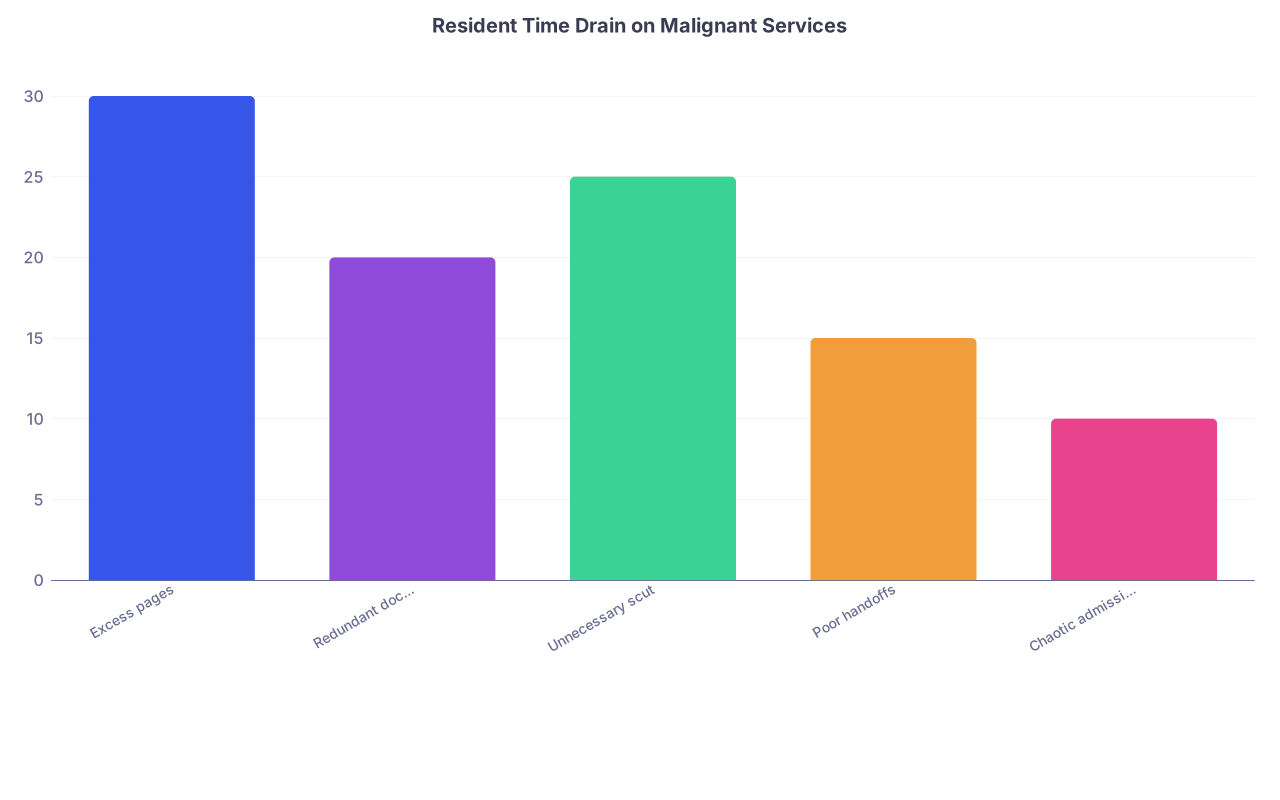
| Category | Value |
|---|---|
| Excess pages | 30 |
| Redundant documentation | 20 |
| Unnecessary scut | 25 |
| Poor handoffs | 15 |
| Chaotic admissions | 10 |

| Step | Description |
|---|---|
| Step 1 | New Task or Page |
| Step 2 | Stop and respond now |
| Step 3 | Mark A priority |
| Step 4 | Mark B priority |
| Step 5 | Delegate or Mark C |
| Step 6 | Life or limb threat |
| Step 7 | Legal or irreversible harm if delayed |
| Step 8 | Must be you |

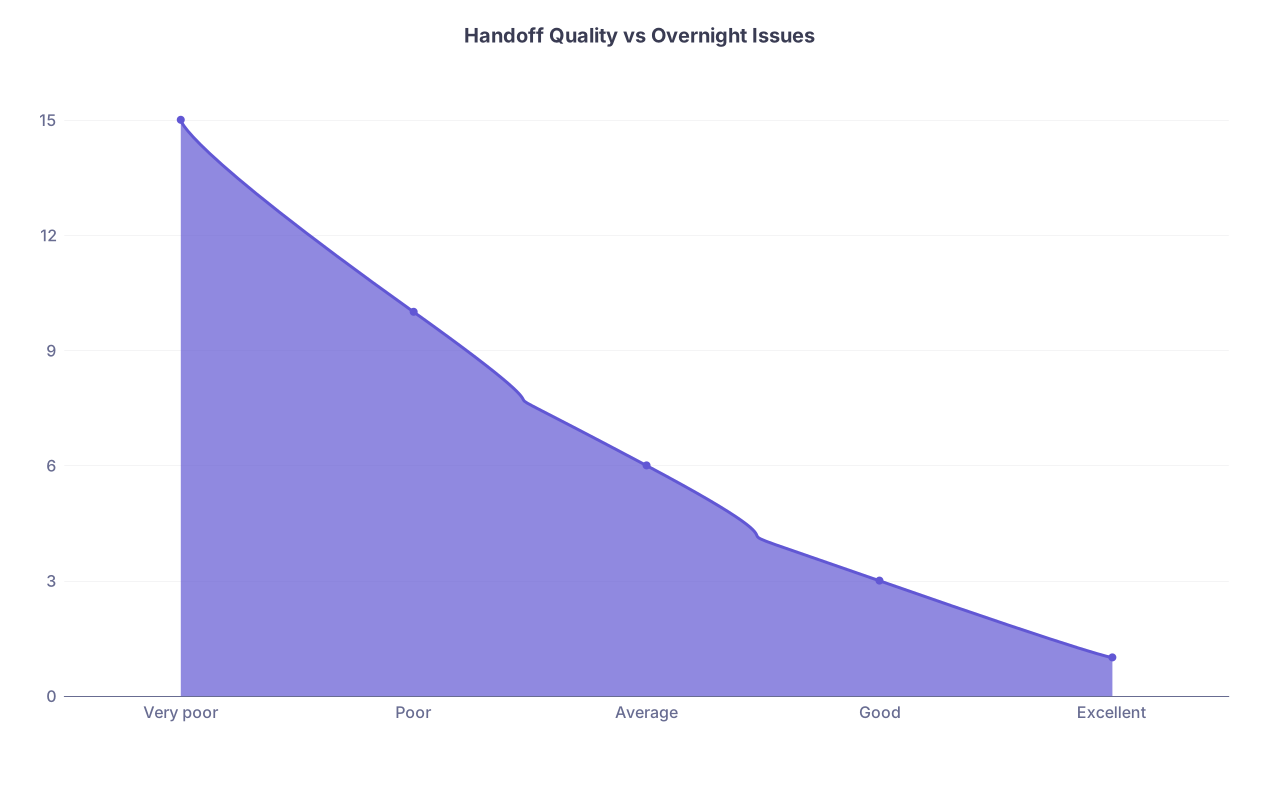
| Category | Value |
|---|---|
| Very poor | 15 |
| Poor | 10 |
| Average | 6 |
| Good | 3 |
| Excellent | 1 |

FAQs
1. How do I know when a malignant service has crossed from “awful” into “I need to report this” territory?
Three things: repeated patient-safety concerns you’ve raised and been ignored on, clear violations of duty hour rules that are chronic (not one bad call night), and any pattern of abuse or retaliation when you advocate for basic safety. When those are present, you document specific incidents (dates, times, cases) and bring them to a chief resident, program director, or GME rep outside that service. Always go in with concrete examples, not “this rotation sucks.”
2. What if pushing back on tasks or time gets me labeled as “lazy” or “not a team player”?
On malignant services, you might get that label no matter what you do. The question is: do you want to be “the hard worker who quietly absorbs unsafe workloads and burns out,” or “the professional who consistently frames work in terms of safety and priorities”? Use language anchored in patient safety and realistic capacity. People may still grumble, but when attendings outside that toxic bubble hear you say, “I want to make sure this is safe and realistic,” they usually respect it.
3. How can I prepare before starting a notorious malignant rotation?
Talk to residents who just finished it. Ask very specific questions: “What were your biggest time sinks? What did you wish you’d done differently in week one? Which attendings/seniors were reasonable, and which were rough?” Build your templates and smartphrases before day 1. Stock your bag with snacks, a reliable notebook/task list system, and pre-written scripts for common scenarios. And set a mental contract with yourself: “This month is about survival and safety, not impressing anyone.”
Key points: On a malignant service, you’re not fixing the system; you’re managing your exposure. Use a single ruthless task list, protect your time with clear scripts, and document your decisions like your license depends on it—because one day, it might.