
The way most residents approach night float is broken. They show up, react to whatever beeps first, drown in cross-cover pages, and stagger out at sunrise wondering what actually happened. That is not survival. That is slow burnout.
You need a system. A blueprint. Something you can run half-asleep at 3:17 AM and still not miss the patient who is actually trying to die.
This is that blueprint.
Step 1: Set up your night before it starts
If you walk onto the floor and start answering pages without a plan, you have already lost.
A. Pre‑shift intel: do not skip this
Show up 15–20 minutes early. Yes, even when you are exhausted. Those minutes pay you back all night.
Get sign‑out with a purpose:
Structure your sign‑out
For each patient, quickly capture:- Diagnosis / why in hospital
- Code status / goals of care
- Overnight “if X then Y” plans
- Active issues that could blow up: GI bleed, DKA, new O2 requirement
- Pending tests that might come back at 2 AM
I keep a two-column sheet: “Likely to page me” vs “Probably quiet.” It is never perfect, but it sharpens your antennae.
Ask the right questions
Not “Anything else?” but:- “Who are the top 3 I should worry about tonight?”
- “Who’s on the fence for ICU?”
- “Who do you not trust their stability?”
- “Any families likely to show up late/angry/confused?”
I have seen nights saved just because someone warned, “Bed 24 looks okay now, but she crashes fast when she goes bad.”
Clarify autonomy and boundaries
Especially early in training:- “What do you want me to wake you up for?”
- “Any hard no’s on procedures / code status discussions / goals conversations?”
- “If a borderline patient worsens (e.g., more O2, softer BP), do you want a call right away or after I have examined and done basic labs?”
You are not being annoying. You are protecting patients and yourself.
B. Build your quick-reference board
Whether you use paper, an app, or a folded census printout, you need a visible brain.
Your board should have, per patient:
- Room/bed
- Name / age
- Brief problem (e.g., “DKA”, “NSTEMI”, “Fever neutropenia”)
- Code status
- One‑liner risk red flag (e.g., “borderline O2”, “MAP 62”, “new GI bleed”)
Highlight:
- DNR/DNI
- Unstable / watch list
- “Do not miss” tasks (repeat labs, imaging follow-up, wound checks, etc.)
Your brain will be mush at 4 AM. This board will not.
Step 2: Triage your entire night—on purpose
You are not there to clear every task instantly. You are there to make sure the most dangerous problems are handled first, efficiently, and safely.
A. Use a hard triage hierarchy for pages
Every page, I mentally drop into one of four buckets:
| Level | Example Issues | Response Target |
|---|---|---|
| 1 - Critical | Chest pain, new O2 drop, hypotension, seizure, stroke symptoms | Go NOW |
| 2 - Urgent | Uncontrolled pain, agitation, fever in neutropenic patient | 5–15 minutes |
| 3 - Routine | Sleep meds, constipation, mild HTN, lab clarification | 30–90 minutes |
| 4 - Clerical | Order sets, non-urgent home med reconciliation | Batch later |
Never treat a Level 3 issue before scanning for Level 1 and 2. That is how you miss the septic grandpa while ordering melatonin for three different people.
B. Run a “priority sweep” after sign‑out
Right after you take over:
Scan vitals and alerts for all your patients:
- New O2 orders
- Soft BPs
- Increasing HR, especially in elderly patients
- Fever spikes in high-risk patients (neutropenic, post-op, etc.)
Physically see your top risk group in the first hour:
- The unstable-but-not-ICU-yet patient
- The new GI bleed
- The fresh post-op with borderline pressures
- Anyone on pressors, BiPAP, or high O2 (depending on your service)
Set thresholds with nursing early
- “Call me if SBP < 90, or MAP < 65, or O2 sat < 92% on >4L, even if sleeping.”
- “If urine drops to almost nothing for 4 hours, page me.”
- “If this delirious guy tries to get out of bed again, call before restraints.”
One clear minute with the nurse at the start will prevent five chaotic pages at 3 AM.
Step 3: Build a repeatable task pipeline
You need an assembly line, not whack‑a‑mole.
A. The 4‑bin system for all your tasks
I run everything through four bins in my notes or task manager:
STAT – Do immediately
- Active chest pain
- New neuro deficit
- Massive bleeding
- Rapid O2 desaturation
You stop everything. You go.
SOON – Address within 15–30 minutes
- Fever in neutropenia
- Escalating pain
- Borderline but not crashing vitals
- Possible new infection in high‑risk patient
LATER – Batch every 60–90 minutes
- Sleep meds
- Bowel regimen
- Mild HTN management
- Non-urgent order clarifications
You group these and handle in one computer burst.
HANDOFF – For the day team
- Stable but unresolved diagnostic questions
- Chronic med adjustments
- Discussions that need families or primary teams
Label every task when it comes in. If you are not labeling, you will end up doing 10 LATER items before a SOON one and eventually hurt someone.
B. Cluster and route by geography
You are not a Roomba. Stop running all over the hospital.
When you have multiple in-person tasks:
- Group by floor and wing
- Do all “see patient” tasks in one loop
- Save purely order-entry work for a separate computer block
Example:
- 2A: check chest pain patient, assess uncontrolled pain, examine new fever
- 2B: re-evaluate soft BP, check confused elderly patient trying to leave
- Then back to the computer to write orders and notes for all six
You will be faster and less exhausted. And you will miss fewer things.
Step 4: Use decision algorithms, not vibes
“Use clinical judgment” is how people justify random guessing at 3:40 AM. You need simple internal protocols.
A. Vital sign change playbook
For common overnight issues, decide your default steps in advance.
Example: Hypotension (non-ICU adult floor)
- Confirm with repeat manual BP and full vitals
- Check:
- Mental status
- Urine output
- Skin: warm vs cold, clammy
- Fluid status (JVP, edema, lungs)
- Order:
- STAT CBC, BMP, lactate, maybe cultures if suspect sepsis
- Bolus (if not fluid overloaded) 250–500 mL and reassess
- Escalate if:
- MAP remains < 65
- New confusion, chest pain, or O2 requirement
- This was a “borderline ICU” during sign‑out
Write your own version for:
- Fever spike
- New or increased O2 requirement
- Chest pain
- New neuro deficit
- Acute agitation/delirium
Have these patterns in your head so you are not inventing from scratch each time.
B. A real “do not wake attending” vs “absolutely wake” line
Stop agonizing on the fence every night. Work this out early with your upper level/attending and make yourself a simple rule set.
Common “always call” triggers:
- Transfer to ICU
- New focal neuro deficit / code stroke
- Concern for STEMI or serious arrhythmia
- Code status discussion in an unstable patient
- Any procedure you are not credentialed/comfortable for
Common “local upper-level only” triggers:
- Borderline but not crashing vitals
- Unclear sepsis versus mild viral issue
- Repeated pages for same problem not improving
Create a short list in your notebook. When in doubt at 3 AM, check the list, not your guilt.
Step 5: Sleep pressure vs patient safety – manage both
The enemy is not just the pager. It is your own deteriorating brain.
A. Protect micro-rest windows aggressively
No, you will not get four uninterrupted hours. Forget that fantasy.
What you can usually find:
- 10–20 minute windows between predictable spikes (e.g., after midnight meds settle, before 4–5 AM labs and vitals)
- Short stretches after you clear a big cluster of pages and pending problems
In those windows:
- Tell the operator/nurse: “I will be in the call room for the next 20 minutes, page for urgent/STAT only.”
- Close your eyes. No phone. No scrolling. Just horizontal, dark room.
You are not lazy. You are preserving your brain so you stop making dumb mistakes at 5 AM.
B. Use caffeine like a medication, not a lifestyle
I have watched residents destroy their circadian rhythm with random coffee hits.
Simple protocol:
- One caffeine dose at the start of shift
- Optional second small dose around midnight–1 AM
- Stop by 2–3 AM so you can sleep post‑shift
- Avoid energy drinks with huge sugar shots; they crash you
If you are slamming coffee at 4:30, you will be staring at the ceiling at 10 AM, then walking in half-dead the next night.
Step 6: Handle common night float disasters systematically
These are the predictable nightmares. Have playbooks ready.
A. “Your patient looks bad” with a vague page
Page: “Patient looks bad, can you come?”
This is the nurse rescuing you from a disaster. Do not blow it.
Your script:
On the phone, ask three questions:
- “What are the vitals right now?”
- “What changed from baseline?”
- “Is there anything in particular worrying you?”
Tell them: “I am coming now. Put the chart at the bedside.”
When you arrive:
- ABCs: Airway, Breathing, Circulation
- Quick neuro: is patient awake, oriented, moving symmetrically
- Look at monitor yourself, not just report
- Review last vitals and trends
Act, then escalate:
- Simple corrective measures (fluids, O2, glucose check, EKG, labs)
- If you feel uneasy after initial stabilization, call someone: upper-level, ICU, attending
The mistake is treating “looks bad” like a nuisance. In my experience, nursing is rarely wrong when they use that phrase.
B. Endless cross-cover for chronic issues
You will get 20 versions of:
- “Patient cannot sleep.”
- “Patient needs something for constipation.”
- “BP is 160 systolic, they never run that high.”
Solve this without letting soft problems drown real ones.
Build default order sets with your day team:
- Standard sleep meds for your service (avoiding deliriogenic drugs in elderly)
- Bowel regimen ladder (senna, then PEG, then PRN suppository)
- BP parameters with clear “call if > X or < Y” rules
On night float, you:
- Use the protocol
- Avoid “new drug for every page” chaos
- Defer chronic BP/diabetes treatment overhauls to the day team unless truly dangerous
Your goal is safe, reasonable, non-creative medicine at 3 AM.
Step 7: Documentation and handoff that do not haunt you
You are tired. You want to go home. This is when sloppiness creates future disasters.
A. Night documentation that is just enough
You do not need a novel. But you do need a clear trail.
For significant events:
- Problem
- Key exam/vitals
- Actions taken
- Response to treatment
- Plan and pending items
For minor issues:
- A short note or order comment is enough (“Paged for insomnia; ordered melatonin 3 mg x 1, will let primary team adjust if persistent.”)
Rule: If the day team or a lawyer would reasonably ask “What were you thinking?”, you document.
B. Structured morning handoff
Do not dump chaos on the day team. They will remember.
Right before sign‑out, create three lists:
Crashes and near-crashes
- “Bed 12 had borderline pressures all night, needed 2L fluids; may need daytime ICU eval.”
- “Bed 7 had TIA-like symptoms at 3 AM; CT negative, still slightly slurred, needs full neuro work-up.”
Unresolved active issues
- New fevers without complete workup
- Abnormal imaging results
- Labs trending the wrong way that need follow-up
Stuff that can burn them later if ignored
- Family that wants goals-of-care meeting
- Repeated agitation or near-falls
- Refusal of critical meds (anticoagulation, antibiotics, etc.)
Make it clear, fast, and honest. You are not confessing; you are handing off a live patient, not a file.
Step 8: Protect your brain and body across a night float block
One bad night you can brute-force. A 2–4 week block will break you if you do not adjust.
A. A realistic night float daily rhythm
Something like:
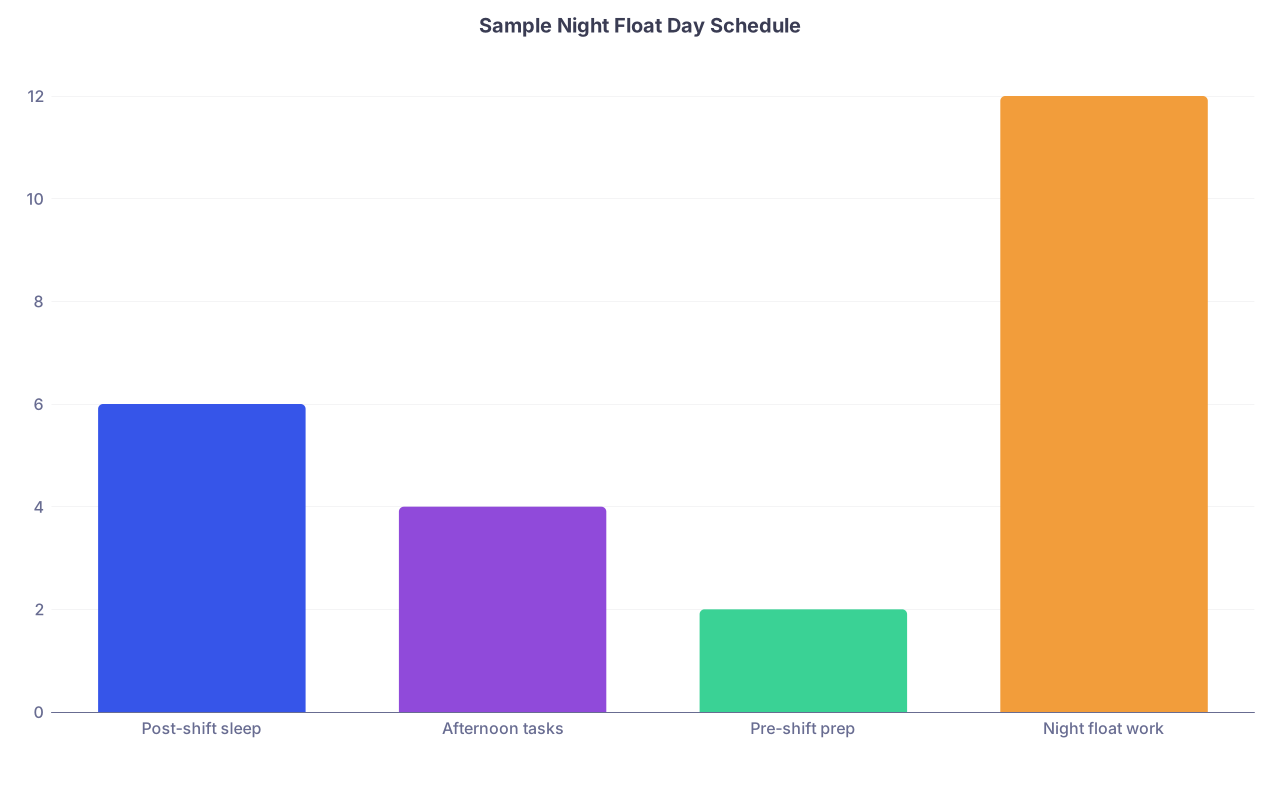
| Category | Value |
|---|---|
| Post-shift sleep | 6 |
| Afternoon tasks | 4 |
| Pre-shift prep | 2 |
| Night float work | 12 |
More specifically:
After shift (post-call):
- Small snack or light meal
- Sleep block of 4–6 hours in a dark, cold room
- Use earplugs, eye mask, white noise if needed
Afternoon:
- One anchor activity (exercise, quick errand, call family)
- Avoid huge social obligations; you are not on vacation, you are on an inverted schedule
Pre-shift (1–2 hours before):
- Light meal with protein
- Brief review of any high-risk patients you know will be on
- Mentally rehearse your protocols: chest pain, hypotension, new confusion
You are not trying to live a normal day life plus nights. That is how people crash their cars driving home.
B. Rules for off-days between floats
On your off day:
- Decide: Are you staying on night schedule or shifting a little earlier?
- Do not swing 8 hours each way. That crushes you.
- Protect one block of uninterrupted 6–8 hours of sleep—whatever clock time it lands on.
This is not the time to be a hero with full daytime social plans. Night float is temporary. Treat it like a controlled, short-term deployment.
Step 9: Build alliances with nurses and staff
You cannot “organize your night” if the people paging you do not trust you.
A. Make the first 2 nights an investment
Early in the block:
- Learn charge nurses’ names
- Tell them: “If you are worried and something feels off, even if vitals look okay, call me.”
- Actually show up when they do. Fast.
When nurses see:
- You respond quickly to concerning changes
- You are not defensive or dismissive
- You close the loop (you tell them what you think and what you did)
…they start triaging pages more thoughtfully. You will get fewer nonsense calls and more accurate alarms.
B. Use scripts that reduce friction
When you disagree or decline a request:
“I see why you are concerned about the BP. Right now it is high but not dangerous, and lowering it too fast tonight could make things worse. Here is what I will order, and if it goes above X, call me back right away.”
“I cannot increase his opioid dose safely tonight without seeing the primary team’s plan, but I can add this non-opioid option and will flag for the day team.”
You are not there to win arguments. You are there to keep everyone reasonably safe until morning.
Step 10: Turn chaos into a repeatable system
Everything above seems like a lot. It is, if you think of it as 50 separate tricks. It is easier if you build one coherent routine.
Here is a simple night float blueprint you can literally tape into your pocket:

| Step | Description |
|---|---|
| Step 1 | Arrive early |
| Step 2 | Get focused sign out |
| Step 3 | Mark high risk patients |
| Step 4 | Priority vitals sweep |
| Step 5 | See top risk patients |
| Step 6 | Start triage buckets |
| Step 7 | Cluster tasks by floor |
| Step 8 | Batch low priority orders |
| Step 9 | Micro rest when safe |
| Step 10 | Document significant events |
| Step 11 | Prepare morning handoff |
You do that loop every night. You adjust details to your hospital and specialty. But the skeleton stays the same.
Three takeaways
- Night float is not brute endurance; it is systems work. If you are reacting instead of triaging, you are losing.
- You need simple, hard rules for triage, escalation, and documentation that your half-asleep brain can follow at 4 AM.
- Protect your micro-rest, your alliances with nurses, and your handoff quality. Those three things determine whether you survive the block or the block eats you.