
It’s late at night. Your email is quiet for once. Second look season is basically over, and you’re staring at your calendar thinking: “I went to the wrong places. I wasted my second looks. I should’ve gone back to Program X, not Program Y. And now my rank list is screwed.”
Your brain is running the full catastrophe:
I picked the wrong programs. I missed my shot. Everyone else was more strategic. I’m going to match somewhere I hate because I didn’t second look the “right” places.
Let’s walk through this like two people in the call room at 2 a.m. Because I’ve seen this exact spiral way too many times.
First: What Second Looks Actually Do (And Don’t Do)
Let me be blunt: second looks are not the magic lever programs use to decide who to rank.
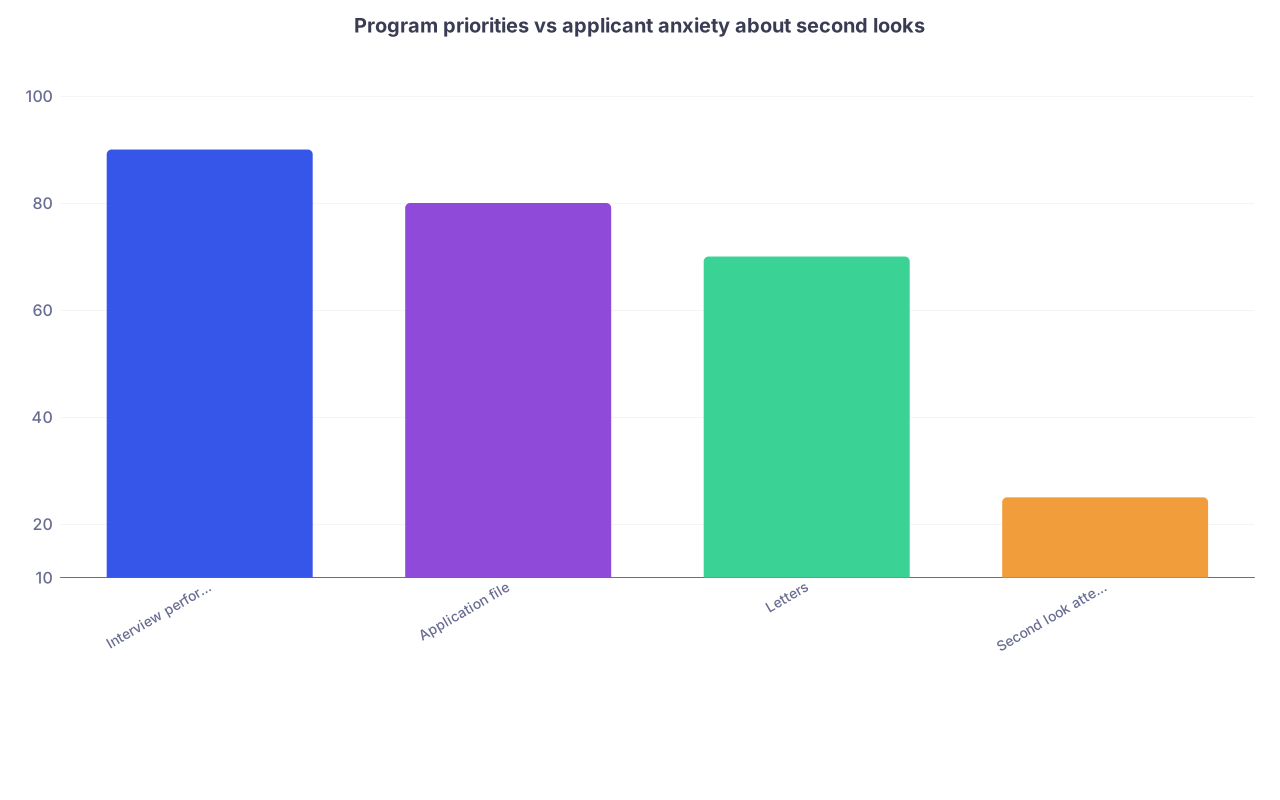
| Category | Value |
|---|---|
| Interview performance | 90 |
| Application file | 80 |
| Letters | 70 |
| Second look attendance | 25 |
Most programs care way more about:
- How you interviewed
- Your letters and application
- Whether you seem like you’ll function on their service without imploding
Second looks are mostly for you. To answer your own questions. To see if the vibe you got on interview day was real or just adrenaline and free pastries.
Do some programs take note of second looks? Sure. But in most places it’s:
- A mild positive: “Oh cool, they came back.”
- Or totally neutral: “We don’t track that.”
I have literally sat in rank meetings where someone asked, “Did this applicant do a second look?” and the coordinator said, “We don’t keep that data,” and the entire room just moved on.
So before you beat yourself up for “choosing wrong,” understand: you’re probably catastrophizing something that’s 80% about your clarity, not their decision.
The Fear: “I Went to the Wrong Second Looks. Did I Just Tank My Match?”
Short answer: no. Longer answer: no, but your brain’s not going to accept that yet, so let’s walk it through.
Scenario 1: You second-looked lower programs, skipped higher ones
You’re thinking: “I visited programs 5, 7, and 9 on my current list, but not 1–4. The top ones will think I don’t care enough. I blew it.”
Reality:
- Plenty of top-ranked applicants never do a second look anywhere.
- Programs know second looks are influenced by:
- Travel cost
- Distance
- Schedule
- Pure exhaustion
- They do not sit there with a spreadsheet: “No second look, drop them 10 spots.”
If they liked you on interview day, you’re in their rank list already. Showing up again is not the difference between Rank #5 and “never heard of them.”
Scenario 2: You hated your second look somewhere you thought you loved
Now you’re thinking: “Great. I loved them on interview day, went back, saw the chaos, and now I’m doubting everything. What if I misjudged every place?”
This actually means your second look did what it was supposed to:
- It gave you more data
- It popped the interview-day honeymoon bubble
- It forced you to see real residents on a regular day
That uncomfortable disillusionment? Annoying. But extremely useful. You didn’t choose wrong. You just learned something honest.
Scenario 3: You didn’t second look your true #1 and now feel like a fraud
This comes up a lot: “Can I really rank a place #1 if I didn’t do a second look? Is that irresponsible?”
Yes, you absolutely can.
You already spent a full day (or more) at that program. Talked to residents. Sat through conferences. Even a “second” look is still a curated snapshot. You’ll never fully know a place until you’re there at 3 a.m. doing admissions.
You’re not irresponsible. You’re just human and tired and ran out of time/energy/money.
What You Can Still Do Now (Even If Second Looks Are Over)
You can’t go back in time and teleport yourself to a different second look. Fine. But you’re not helpless.
1. Do a structured brain dump on each program
Your brain is spinning because everything is swirling together as “vibes.” Split it apart.
Take 30–60 minutes and for each serious program, force yourself to write:
- 3 things that genuinely excite you about the program
- 3 things that genuinely worry you
- 1 concrete moment or quote you remember from interview day or second look

This forces your brain to stop replaying, “I picked all the wrong places,” and instead focus on, “Okay, what do I actually know about each of these?”
2. Use low-stakes follow-up communication
No, I’m not talking about a creepy “I’ll rank you #1” email to every PD.
I mean:
- A short, normal thank-you or clarifying question to the coordinator or a resident you connected with
- Example: “After my interview, I realized I forgot to ask about X. Could you share a bit about how your program approaches Y?”
You are not “too late” to do this unless rank lists are literally locked. Residents expect these questions now. Nobody’s marking you as needy for caring about fit.
3. Talk to actual residents one-on-one
You don’t need another official “visit day” to get a reality check. Ask to hop on a quick call or send a message to a resident at:
- The program you loved on interview day but didn’t second look
- The program you second-looked and now feel weird about
- The “safe” program you’re low-key terrified you might end up at
Keep it simple:
- “What surprised you most when you started?”
- “If you had to rank again, would you still put this program first?”
- “What’s something that looks great on paper here but is rough in real life?”
You’ll get more truth from one unscripted resident conversation than an entire glossy second-look day.
Biggest Myth: “Second Look = Signal of Interest = Better Rank Position”
Let’s be clear on this part, because I know this is what’s lurking underneath everything:
You’re worried other applicants second-looked smartly and now look more “interested” than you, and programs will rank them higher.
Here’s the problem with that theory: programs are terrified of reading into “signals” that don’t really mean anything.
Why?
Because they’ve been burned. The “super enthusiastic” second-look person says, “You’re my top choice,” then ranks them #5. Or doesn’t match there at all.

| Step | Description |
|---|---|
| Step 1 | Applicant does second look |
| Step 2 | Minor positive signal |
| Step 3 | Neutral signal |
| Step 4 | Still rank by overall file |
| Step 5 | Program reaction |
So most sane programs use this logic:
- Second look = maybe a mild positive
- No second look = not a negative
- Rank list = mostly based on interview + whole application
They are not doing, “Second looked us? Auto top 10. Didn’t? Drop.”
You feel like second looks are this huge Signal of Serious Interest™. They don’t.
The Real Purpose: Second Looks Are For Your Anxiety, Not Their Algorithm
This might sting a bit, but it’s true: second looks are mostly a psychological crutch.
Not because they’re useless, but because they:
- Make you feel like you did “everything you could”
- Give you the illusion of control in a process where you have almost none
- Let you temporarily quiet the voice saying, “What if you’re missing something huge?”
So now you’re sitting here, post second-look season, feeling like you used that crutch on the wrong leg.
The fix isn’t to chase more second looks or to obsess over the ones you picked. The fix is to admit:
- No combination of second looks gives certainty
- You will still have doubt no matter what
- The rank list is a bet, not a solved equation
And your job right now is not to eliminate uncertainty. It’s to make a defensible, honest bet on where you’ll most likely be okay living and working.
How To Rank When You’re Second-Look-Regret Spiraling
Forget where you did or didn’t do second looks for a second. Build your list like this instead.
Step 1: Decide your non-negotiables
I’m talking about actual non-negotiables, not the 15 things you’d like in a perfect world.
Stuff like:
- “I need to be within X hours of my partner/kids”
- “I cannot function doing q2 home call for 3 years”
- “I need some chance at fellowship in X, not zero”
| Type | Example |
|---|---|
| Real | Must be within 3 hours of sick parent |
| Real | Cannot afford big coastal city cost of living |
| Fake (usually) | Every resident must be exactly like me |
| Fake (usually) | Brand name or nothing |
| Real | Need strong childcare support locally |
Second looks don’t change these. They just color around the edges.
Step 2: Group programs into tiers based on fit, not prestige
Rough buckets:
- “I’d be honestly happy here”
- “I could tolerate this but would need to grow into it”
- “This feels wrong, but I’m scared to drop it lower”
Inside each bucket, rank based on your gut. Yes, the same gut that’s screaming at you. Underneath the noise, you still know which programs felt more like you.
Step 3: Use your second looks as tiebreakers, not the main story
This is the key shift.
Second looks should answer questions like:
- “Between these two I already liked, which felt more real?”
- “Is this place as malignant as the rumors suggest?”
- “Do I see myself walking these halls at 5 a.m. half-awake?”
They should not answer:
- “Which program deserves to exist on my list?”
- “Which one will love me more?”
- “Which one guarantees career safety forever?”
If you’re using second looks as the foundation of your ranking instead of just one datapoint, yeah, everything’s going to feel like it’s collapsing right now.
A Quick Reality Reset: Most Residents Didn’t Second Look Perfectly Either
You’re imagining everyone else in your class did this flawlessly.
They didn’t.
I have talked to:
- People who matched at their #1 without a second look anywhere
- People who hated their second look at their eventual program and still ranked it #1 and ended up loving it
- People who did 4 second looks, matched a place they never revisited, and are fine
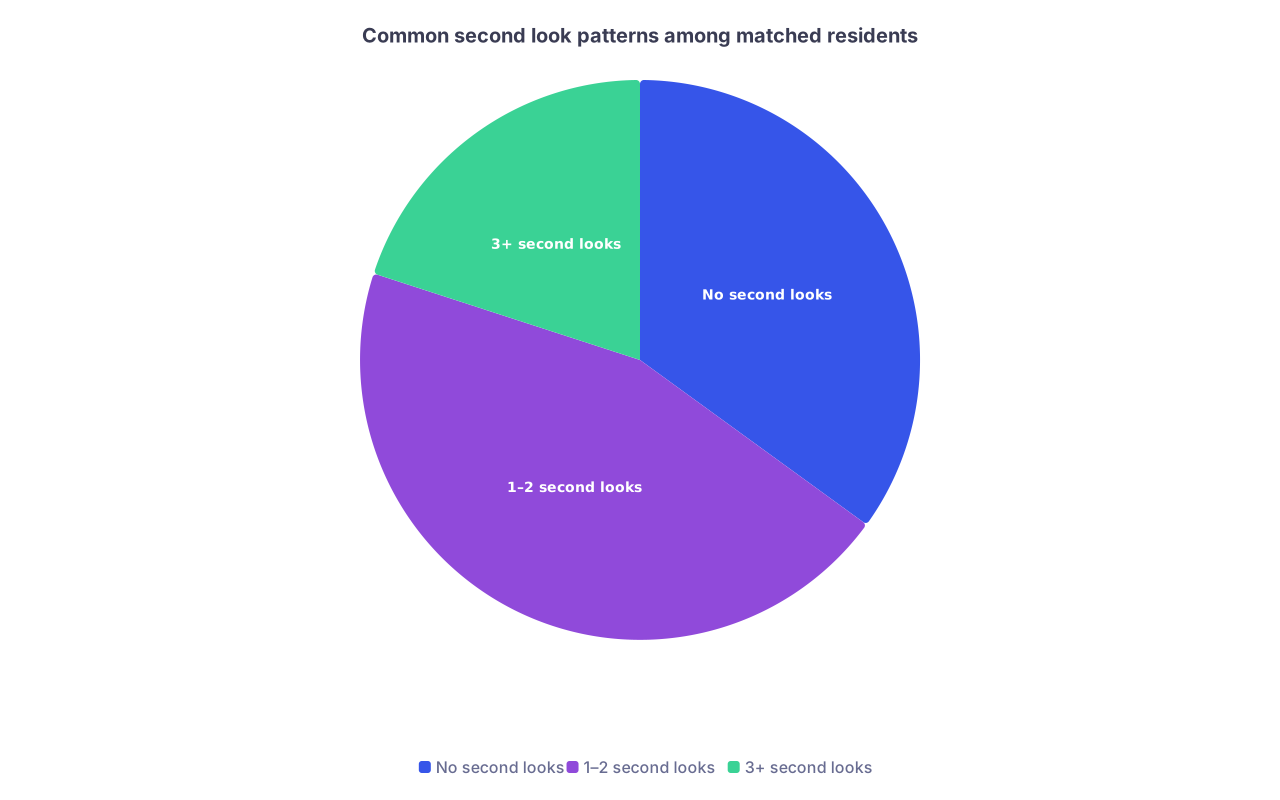
| Category | Value |
|---|---|
| No second looks | 35 |
| 1–2 second looks | 45 |
| 3+ second looks | 20 |
The match doesn’t reward “perfect” second-look strategy. Because nobody has it. Everyone’s working with partial information and vibes.
You’re not uniquely doomed here. You’re just more honest about your anxiety than most.
What To Do Tonight When Your Brain Won’t Shut Up
Keep it simple. One small move.
Pick one of these:
- Email or message one resident to ask a lingering question
- Write down your top 5 programs and, next to each, one sentence: “I’d be okay here because…”
- Take your current rank list and make only one change: swap two programs whose order has been bugging you

Then stop. You are not going to think your way into absolute certainty. Past a point, more thinking just means more suffering.
FAQ – Exactly What You’re Afraid to Ask
1. If I didn’t second look my #1 program, is it risky to rank them first?
No. Rank your true #1 as #1. Programs don’t need a second look to know you’re interested. Your rank order list is your actual signal. Tons of people match at #1 without ever going back.
2. Will programs think I’m not interested because I didn’t do a second look?
Almost always, no. They know money, distance, and sheer burnout limit this. Not coming back is neutral, not negative. If they loved you on interview day, you’re getting ranked based on that, not how many times you showed your face.
3. I hated my second look at a place I thought I loved. Should I drop it way down?
Not automatically. Ask: what specifically bothered you? One bad day? One grumpy resident? Or true structural issues (toxic culture, unsafe workload)? If it’s the latter, yeah, move it down. If it’s vibes only, weigh it but don’t let one awkward afternoon erase everything else.
4. I second-looked a program but now realize I like another one more. Will the first one be offended if I don’t rank them higher?
They will never know your rank list. There is no “offense.” You don’t owe any program a higher spot because you visited again. Your only job is to build the most honest list for you. That’s it.
5. Do I need to email programs after second looks to “prove” interest?
No. Optional, not required. If you have genuine questions or want to thank someone who helped you, send a short, normal email. But there is no hidden rule that you must send a “you’re my top choice” message to be ranked well. Most programs don’t trust those anyway.
Bottom line?
You didn’t ruin your match by “choosing the wrong second looks.” Second looks are one tiny piece of a huge, messy puzzle. Your interview, your application, and your honest rank list matter a lot more. Make the best list you can with the data you have, accept that some doubt is permanent, and then let it go enough to sleep.