
Programs do not have a secret blacklist for applicants who had “too few” interviews. They care why you are in SOAP, not how many invites you got.
If you’re sitting there with 0–2 interviews and a rising panic about SOAP, let’s puncture the biggest myth first: most program directors are not counting your interviews or trying to decode your “popularity.” They are asking a far simpler, more brutal question:
“Can this person safely take care of our patients, fit our workload, and not be a disaster for our program?”
That’s it. Your interview count is, at best, a flimsy proxy. And most of them know it.
Let’s go through what actually happens, what data we do have, and how you should play this if you’re entering SOAP with a thin interview season.
The Core Myth: “Few Interviews = Radioactive SOAP Applicant”
The whispered “rule” goes like this:
“Programs avoid SOAP candidates who had only a couple interviews, because that means nobody wanted them.”
I’ve heard this repeated by chiefs during pre-Match talks, in advising offices, and on Reddit threads written by people who have never sat on a rank meeting in their life. It sounds logical. It’s also mostly wrong.
Here’s why.
1. Programs rarely know how many interviews you had
During SOAP, programs see your ERAS application, transcript, MSPE, letters, scores, personal statement, and now (for many specialties) token usage. They do not get:
- A list of where you interviewed
- How many interviews you had
- How high/low you were ranked elsewhere
Could they guess? Roughly. If you’re a US MD with solid scores and no obvious red flags sitting in SOAP for categorical IM, yeah, they’ll wonder. But they are guessing. Not reading a secret report.
The idea that there’s a SOAP “popularity score” is fiction.
2. “Few interviews” is normal in certain profiles
There are applicant patterns that routinely yield few interviews but still match:
- Region-locked couples
- DO or IMG applicants in competitive metro areas
- People who applied to way too few programs (classic)
- Late USMLE scores or delayed ERAS submission
- Strong candidates who over-reached on specialty or prestige
Most program directors have seen this dozens of times. They don’t equate “few interviews” with “dangerous applicant.” They equate unexplained risk with “dangerous.”
3. SOAP behavior matters more than interview count
Once SOAP starts, programs focus on:
- How quickly you respond
- How coherent your story is
- Whether your references and MSPE align with what you claim
- If your red flags are owned and explained or hidden and evasive
This is where many SOAP candidates actually hang themselves, not on whatever happened in October–January.
What Data Actually Exists About SOAP Candidates
We do not have a published table that says, “Applicants with 0–2 interviews are rejected at X% in SOAP.”
What we do have:
- NRMP Charting Outcomes: shows how interview counts predict main match outcomes, not SOAP
- NRMP Program Director Survey: shows what PDs value, including in filling unfilled positions
- Historical SOAP fill rates and by-specialty competitiveness
Let’s put some numbers on this.
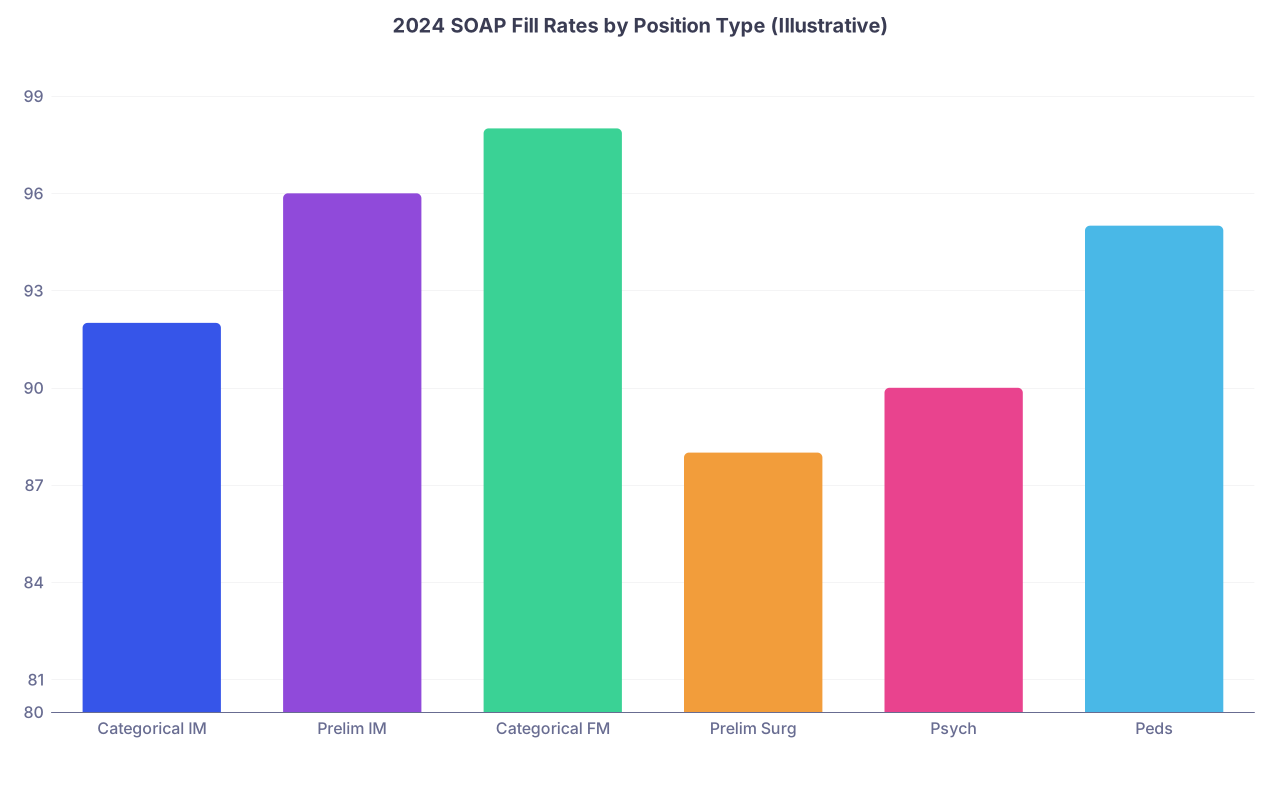
| Category | Value |
|---|---|
| Categorical IM | 92 |
| Prelim IM | 96 |
| Categorical FM | 98 |
| Prelim Surg | 88 |
| Psych | 90 |
| Peds | 95 |
Point is: most unfilled positions do get filled in SOAP. Programs use SOAP aggressively. They are not tiptoeing around candidates because they “only had 1 interview.”
What PDs actually report caring about most in SOAP (echoed repeatedly in surveys and behind closed doors) are:
- Passing USMLE/COMLEX on first attempt (or clear accounting if not)
- No professionalism disasters
- Ability to hit the ground running enough to not drown
- Genuine interest in their program and location
Notice what’s not on that list: “Number of prior interviews.”
How Programs Really Think About SOAP Applicants
The mindset in SOAP is very different from the main Match. During regular season, they can be picky. In SOAP, they’re triaging.
Think like a PD for a second. You have 4 unfilled categorical IM positions on Monday of Match Week. Your priorities look something like:
- Fill every slot with someone who will show up in July and not implode
- Avoid lawsuits, patient harm, and GME headaches
- Minimize repeat SOAP next year by choosing people likely to finish
- Bonus: find people who might become solid seniors or fellowship candidates
Now contrast two imaginary SOAP applicants for the same IM spot:
- Applicant A: US MD, 2 interviews at mid-tier programs, average Step 2, solid letters, no failures, applied to only 40 IM programs because of a misguided advisor, neutral personal statement
- Applicant B: US MD, 12 interviews, but failed Step 1 twice, vague professionalism comments in MSPE, and a defensive explanation in the personal statement
If you think they are picking Applicant B because “more interviews means more desirable,” you’re not thinking like a risk-aware PD. Applicant A gets the call.
Programs don’t avoid you because you had few interviews. They avoid you if they suspect there’s a reason you had few interviews that signals real risk.
Where the “Few Interviews = Avoid” Myth Comes From
Like most toxic myths in medical education, this one is based on a half-truth that got lazily generalized.
Here are the real underlying patterns:
1. Few interviews + obvious red flags = real concern
If you’re:
- Reapplying in the same specialty
- Have USMLE/COMLEX failures
- Ugly professionalism alerts
- Very low class rank or significant remediation
…and you only had 0–2 interviews, yes, programs will infer that a lot of people passed on you for reasons they can probably see. In that case, “few interviews” is just confirming what the file already screams.
But even here, they are not avoiding you because of the interview count; they are avoiding you because of the risk profile.
2. Groupthink and prestige chasing
Many applicants chase the same cluster of “name” programs and cities. Undifferentiated applications get filtered out early. The result: a perfectly competent applicant might only get 1–2 interviews simply because they refused to apply widely.
Advisors then backfill nonsense explanations like “Programs will think you’re a bad bet if you only had one interview.” No. The real issue is that you played a dumb strategy, not that SOAP programs assume you’re toxic.
3. Survivorship bias anecdotes
Every year, unmatched students with strong interviews (on paper) say, “Programs must have hated that I only had two invites.” But when you go back and read their MSPE, their gap years, their Step timing, their weird personal statement, the picture gets clearer.
People blame the piece they can see (“interview count”) instead of the parts they do not want to face.
What Actually Hurts SOAP Candidates (And What Does Not)
Let’s separate real SOAP kryptonite from the fake stuff.
Real deal-breakers (or near it)
- Unexplained or poorly explained professionalism issues
- Angry, evasive, or blame-heavy narratives about failures
- Massive communication delays during SOAP (slow to text/call back)
- Inconsistent stories between your PS, MSPE, and what you say on calls
- Appearing disinterested or “too good” for SOAP spots during conversations
These are the things PDs talk about in the workroom. I’ve heard: “She took 12 hours to call back and then sounded irritated,” or “He blamed every issue on the school; hard pass.”
Notice again: no one says, “He only had 2 interviews, so no.”
Things applicants overestimate
- Number of prior interviews
- Whether your one LOR is from a “famous” person
- How sophisticated your SOAP personal statement sounds
- Having a perfect, polished narrative instead of an honest one
Programs are moving fast during SOAP. They are not writing literary criticism of your essay. They are scanning for competence, honesty, and risk.
How To Present Yourself If You Had Few Interviews
Here’s where you can actually change outcomes.
1. Have a simple, non-defensive explanation ready
If someone asks why you think you had few interviews, you do not launch into a 10-minute rant about ERAS, Step 1 P/F, or your advisor.
Something like:
- “I applied too narrowly, especially geographically. In hindsight, I underestimated how important a broad net is.”
- “I pivoted to this specialty late, so my application was not as targeted as it should’ve been.”
- “I delayed Step 2 and that hurt me in initial screens. Since then I’ve focused on X and Y to be ready to start residency.”
Own it. Show you understand the system now. Move on.
2. Attack the real weak points
If you had:
- Late Step 2 → Be ready to talk about current clinical readiness.
- Limited home program exposure → Emphasize strong rotations and concrete examples of clinical work.
- No specialty-specific LORs → Lean on your best clinical letters and explicitly connect their comments to the target specialty.
Your job is to convince them you’ll be safe and functional on Day 1, not that your application was perfectly optimized 6 months ago.
3. Signal genuine, specific interest in each program
Queue the eye rolls, but this matters more in SOAP than in the main Match. You don’t have 15 interviews to spread the risk. You need a few programs to actually want you.
Specific looks like:
- “I read about your X clinic and your model of resident-led continuity. That’s exactly what I want more responsibility in.”
- “I grew up in smaller communities like yours, so the patient population and the scope of practice are a better fit for me than a quaternary center.”
Generic “I’d be honored to train anywhere” is SOAP white noise.
How Different Specialties Actually Use SOAP
SOAP is not identical across the board. But one constant: nobody has time for abstract heuristics about interview counts.
| Specialty Tier | SOAP Use Pattern |
|---|---|
| Very competitive (Derm, Ortho, ENT) | Rare SOAP positions, highly scrutinized files |
| Mid-competitive (EM, Anes, Psych at top programs) | Some spots, focus on risk and fit |
| Core specialties (IM, FM, Peds, Psych community) | Many spots, emphasis on reliability and passing boards |
| Prelim/Transitional | High volume, fast decisions, focus on immediate work capacity |
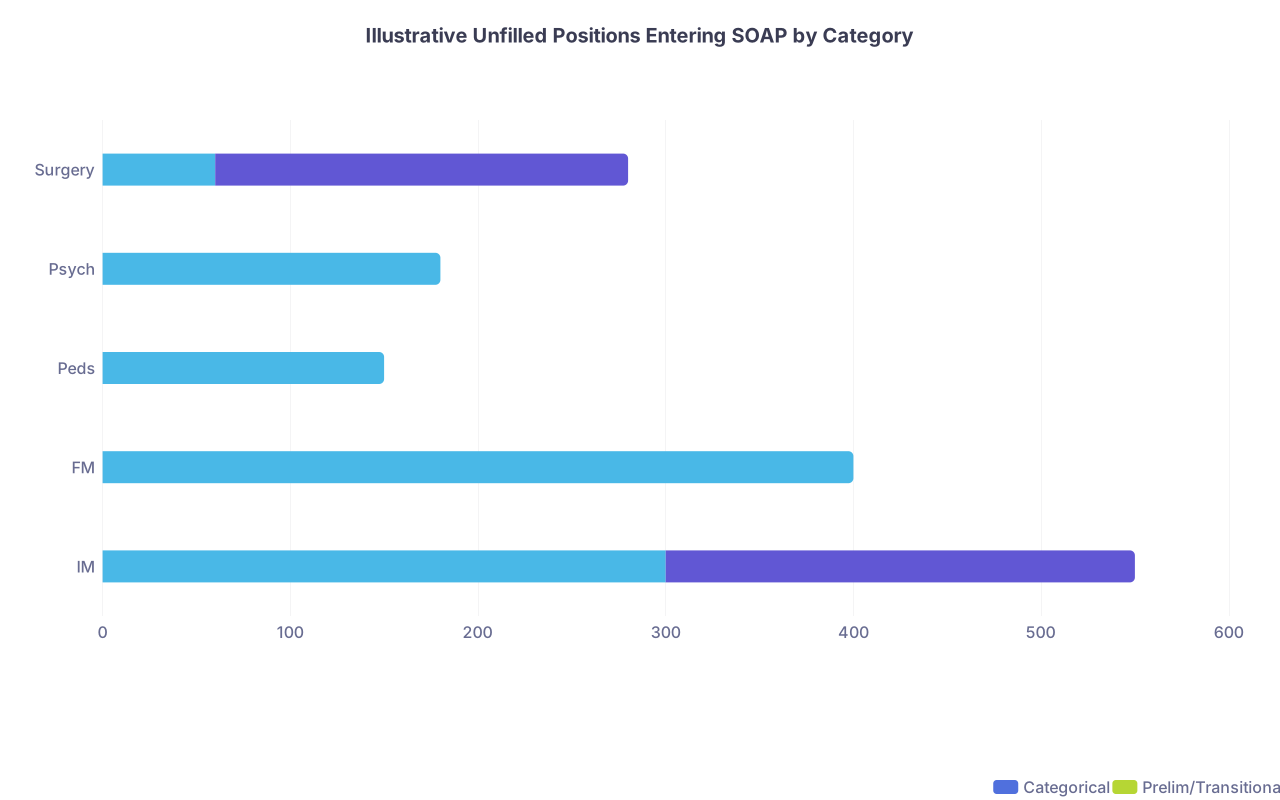
| Category | Categorical | Prelim/Transitional |
|---|---|---|
| IM | 300 | 250 |
| FM | 400 | 0 |
| Peds | 150 | 0 |
| Psych | 180 | 0 |
| Surgery | 60 | 220 |
The more volume a specialty has in SOAP (FM, IM, prelim), the less any one program is obsessing about subtle popularity metrics. They’re filling a workforce. Quickly.
What they really want:
- People who will show up, work, and not quit
- People who can pass Step 3 and boards
- People who are not going to generate daily drama
Being the applicant who is responsive, organized, and honest goes much further than being the one who had 10 interviews and a high MCAT 8 years ago.
What To Actually Do If You’re Heading Into SOAP With Few (Or Zero) Interviews
Here’s the playbook I’ve seen work.

| Step | Description |
|---|---|
| Step 1 | Unmatched on Monday |
| Step 2 | Meet with advisor quickly |
| Step 3 | Identify realistic specialties |
| Step 4 | Update SOAP specific PS |
| Step 5 | Apply broadly in SOAP |
| Step 6 | Prepare 60 sec intro + red flag answer |
| Step 7 | Respond fast to all contacts |
| Step 8 | Follow up briefly and professionally |
Key moves:
- Be brutally honest with yourself and your advisor about your risk factors
- Don’t waste SOAP on long-shot dreams; you already tried that in the main Match
- Have a tight, practiced 60–90 second “who I am + what I want + why I’m ready” script
- Treat every phone call as a mini-interview
- Don’t badmouth your school, the match, or other specialties—ever
And stop obsessing over how your interview count looks from the outside. That’s a sunk cost.
The Bottom Line: Myth vs Reality
Let’s strip this down.
- Programs do not systematically avoid SOAP candidates just because they had few interviews. They rarely even know the number.
- What scares programs is unexplained or unmanaged risk: failures, professionalism concerns, poor communication, or a clear mismatch between your story and your file.
- Your job in SOAP is to present yourself as a safe, reliable, motivated resident who learned from a rough application cycle—not as a rejected popularity contest participant.
Stop trying to game what they might infer from your interview count. Fix what you can control this week: your story, your responsiveness, and your specialty and program choices.
FAQ (Exactly 5 Questions)
1. Will a program ask me directly how many interviews I had?
Sometimes. If they do, give an honest, short answer and pivot to what you learned: “I had two interviews. I applied too narrowly regionally, and I’ve realized I’m genuinely open to training in places like yours where I can get broad clinical exposure.”
2. Should I volunteer that I only had one interview if they don’t ask?
No. Don’t lead with your deficits. If they don’t ask, they either don’t care or they’ve already inferred enough from your profile. Focus on what you bring and why their program fits you.
3. Does being a reapplicant plus few interviews make SOAP harder?
Yes, that combo raises more eyebrows because it suggests a pattern. You need a clear narrative of what’s changed—extra clinical work, stronger letters, improved scores—not just “I tried again and hoped.”
4. Are DOs and IMGs with few interviews treated differently in SOAP?
They’re held to the same core standard—can you function safely and reliably—but DOs and IMGs often start with fewer interviews because of systemic bias and visa issues. Programs know this. They do not automatically equate “DO/IMG + few interviews” with “unacceptable.”
5. If I truly had zero interviews, am I doomed in SOAP?
No, but you’re in a higher-risk group. The key is to broaden specialty and geographic targets, be extremely responsive, and have a grounded, non-victim narrative about why you’re ready for residency despite a rough cycle. Plenty of people with 0 interviews in the main season have matched through SOAP—usually by getting realistic very fast.