
The False Comfort of Backup Specialties: SOAP Outcomes by Field
What if your “safe backup” specialty is actually harder to get in SOAP than your primary choice was in the main Match?
Let me be direct: a lot of applicants enter Match season clinging to a fantasy. The fantasy goes like this: “I’ll shoot for a competitive-ish specialty, and if things don’t work out, I’ll just SOAP into something like IM, peds, or FM. There are always spots. I’ll be fine.”
That story feels comforting.
The data does not support it.
SOAP is not a gentle parachute. It’s a knife fight in a phone booth. And your odds vary wildly by specialty, visa status, grad year, and whether you’re MD vs DO vs IMG. The “backup specialty” you’ve been reassured about on Reddit or by a panicked classmate might be the exact place where outcomes are brutal once you’re in SOAP.
Let’s blow up a few myths and look at what actually happens.
Myth #1: “If I don’t match, I’ll just SOAP into internal medicine or family medicine.”
The most dangerous word in that sentence is “just.”
Yes, internal medicine (IM) and family medicine (FM) have unfilled spots every year. But that’s only half the equation. The other half is how many desperate people are chasing those same spots during SOAP—and who they are.
Here’s what recent cycles have consistently shown (pulling from NRMP’s Results and Data plus SOAP reports):
- IM and FM do leave unfilled positions after the main Match.
- A large share of those unfilled positions are categorical IM and FM at community or lower-tier university-affiliated programs, often in less desirable locations.
- The applicants flooding SOAP are not just “a few unmatched US grads.” You’re competing against:
- Unmatched US MD seniors
- Unmatched US DO seniors
- Previous-year US grads
- US and non-US IMGs, many with strong exam scores and real-world experience
The basic SOAP math looks like this: far more applicants than positions, and the ones with the worst options are the ones who placed all their chips on a “backup specialty” in SOAP instead of planning realistically in the main Match.
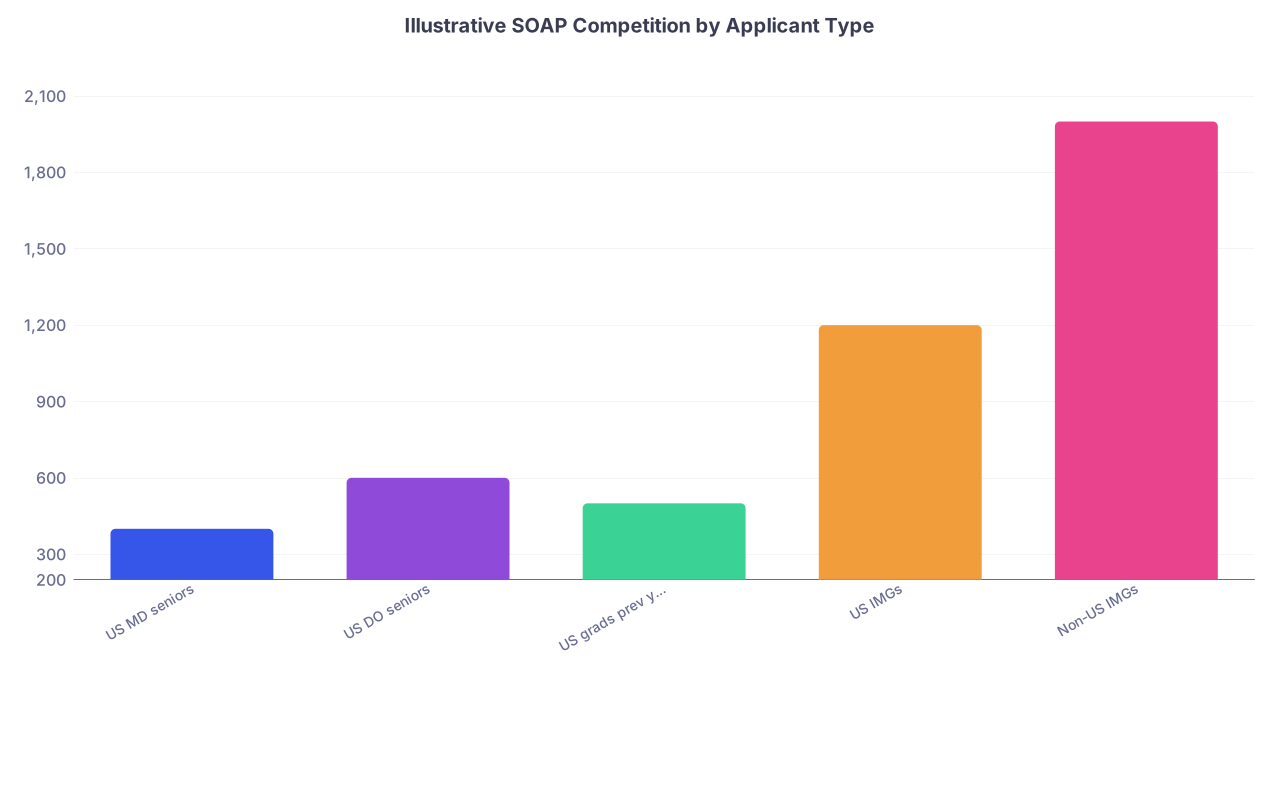
| Category | Value |
|---|---|
| US MD seniors | 400 |
| US DO seniors | 600 |
| US grads prev years | 500 |
| US IMGs | 1200 |
| Non-US IMGs | 2000 |
Those numbers aren’t exact for a given year, but the pattern is stable: SOAP is IMG-heavy and reapplicant-heavy. You’re stepping into their battleground at the last possible minute.
And here’s the real kicker: the “easy” primary care specialties in SOAP are often screening with the same competitiveness signals you ignored earlier—Step 2 thresholds, no failures, recency of graduation, visa status, etc. It’s not a free-for-all lottery.
I’ve watched US seniors with a Step 2 in the 240s, no red flags, and only a few IM applications end up unmatched and then shut out in SOAP because:
- They had no prior IM experience in their application (no sub-I, no letters, no real narrative).
- Their personal statement screamed “I really wanted another specialty but I’ll tolerate you.”
- Their school released their MSPE late, or they had one ugly comment in it.
- The program simply had 60+ applicants for each SOAP IM slot and prioritized people who'd actually applied IM from the start.
Backup on paper. Not a backup in real life.
Myth #2: “Any unfilled spot in SOAP is better than not matching.”
Wrong. Sometimes “not matching” this year is better than torching your long‑term prospects with a desperation SOAP choice you hate and will try to leave.
There’s an uncomfortable truth here: SOAP outcomes cluster by field in a way that creates future dead-ends.
Some examples I’ve personally seen:
- A student aiming for neurology fails to match, then SOAPs into a preliminary surgery year in a malignant program because “at least I’ll be in the system.” They spend a brutal year with no time for interviews, no subspecialty exposure, and zero support. They end up re-applying from a weak position and don’t get neurology anyway.
- Another applicant wants psychiatry, doesn’t match, SOAPs into a low-structure transitional year with minimal psych exposure. They burn a year, then re-enter the Match with still-skimpy psych letters and no clear story for why they belong in that field.
- Conversely, I’ve seen people turn down SOAP offers they weren’t willing to live with long-term, use the extra year to:
- Do a structured research year,
- Fix exam issues (Step 3, better CK if available),
- Build targeted rotations and letters, and come back with a much stronger application that actually landed them in their target specialty (sometimes at better programs than they interviewed at originally).
SOAP can be a lifeline. It can also lock you into:
- A specialty you don’t want,
- In a location you hate,
- At a program that won’t help you laterally move.
That’s not “better than unmatched” in every case. It’s just faster.
Myth #3: “Some specialties are ‘backup-friendly’ in SOAP.”
People love to throw around “backup-friendly” fields: psychiatry, neurology, pathology, PM&R, even anesthesia (before it tightened again). The narrative is always the same: “They had unfilled spots last year, I can just SOAP there.”
Here’s where the data slaps that idea.
Let’s look conceptually at how filled these specialties are before SOAP in the main Match and what their SOAP landscape tends to look like:
| Specialty | Main Match Fill Rate | Unfilled Slots Pattern | SOAP Reality Snapshot |
|---|---|---|---|
| Internal Med | Very high | Dozens–hundreds, mostly community | Heavy competition from IMGs and unmatched US grads |
| Family Med | Lower relative fill | Significant unfilled, wide geography | Still oversubscribed in SOAP, programs screen hard |
| Psychiatry | Very high now | Few unfilled, highly variable | Often *very* competitive in SOAP |
| Neurology | High | Small number, scattered | Programs favor prior neuro interest |
| Pathology | Moderate–high | Some unfilled, often less popular sites | Many IMGs with strong CVs compete |
| PM&R | High | Very few slots unfilled | SOAP options extremely limited |
Psych and PM&R are the poster children of bogus backup mythology. A decade ago, yes, they had more breathing room. Today:
- Psychiatry programs are nearly completely filled in the main Match, and the handful of unfilled spots are inundated in SOAP.
- PM&R is tightly filled, with years having single-digit unfilled spots nationally.
“Backup specialty” only makes sense if:
- You apply to it in the main Match with a real application, and
- It actually has enough total positions + unfilled positions to absorb risk.
SOAP is not how you “try out” another competitive or mid-competitive specialty.
Myth #4: “US MDs and DOs are basically guaranteed something in SOAP.”
No. And this belief is one of the things that quietly ruins careers.
I’ve seen US MD and DO students stroll into mid‑winter with:
- 4–6 interviews in a moderately competitive specialty
- Zero serious applications in primary care or less competitive fields
- No honest backup plan except, “If I don’t match, I’ll SOAP something.”
They match about as often as you’d expect. Which is to say: some do, some don’t. The unlucky ones discover what SOAP is actually like:
- Four preference lists, each limited to 25 programs.
- Programs that may already have internal candidates, prelims, or known IMGs slotted in mentally.
- 10–15 minute phone or Zoom “interviews” where you get one generic question about “Why this specialty?” that exposes your last‑minute story.
- Silence. A lot of silence.
And there are far more US grads in SOAP than you think. Some cycles, hundreds. Many of them stronger than you on paper, with a real narrative in the field they’re targeting.
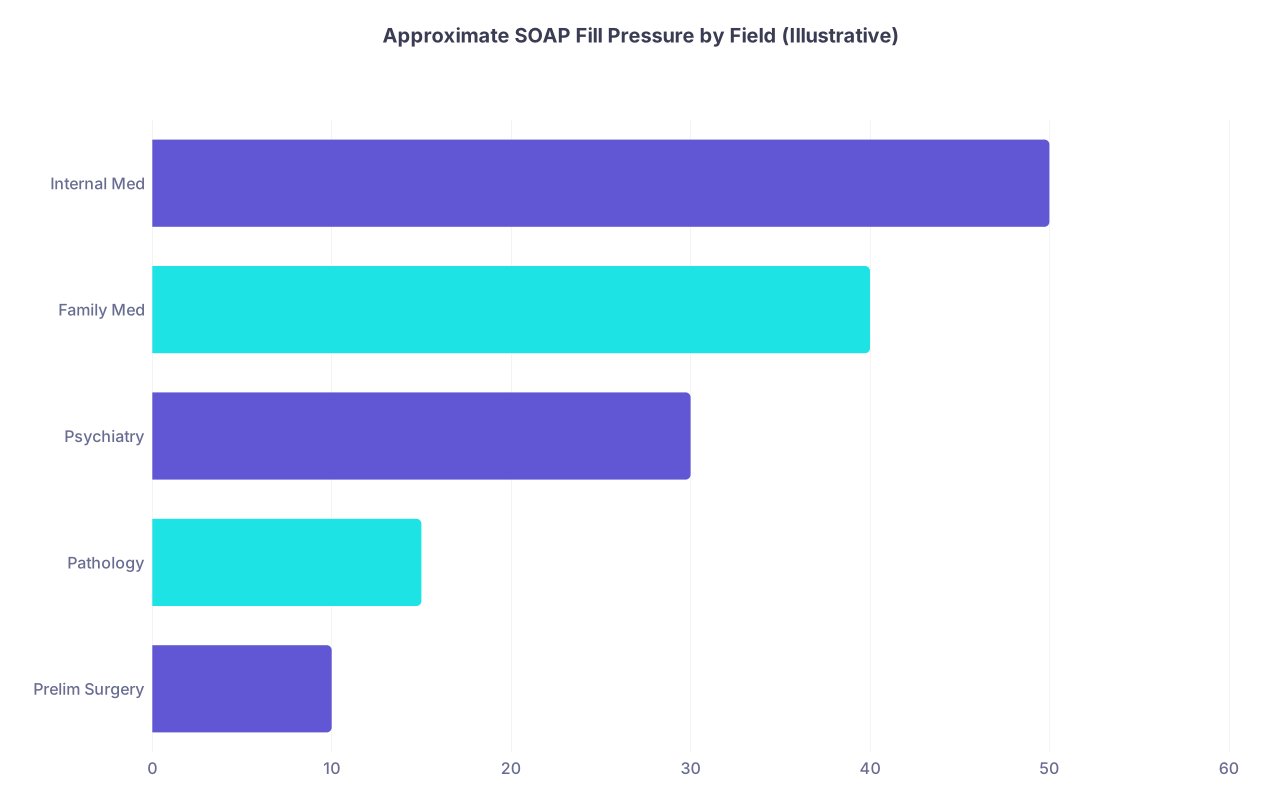
| Category | Value |
|---|---|
| Prelim Surgery | 10 |
| Pathology | 15 |
| Psychiatry | 30 |
| Family Med | 40 |
| Internal Med | 50 |
Think of that value as a “competition index” – applicants per SOAP seat. Again, exact numbers vary by year, but the direction is right: primary care seats draw massive demand; psych and others are a bloodbath when they’re available at all.
Your MD or DO degree helps in SOAP, sure. It doesn’t guarantee anything.
Myth #5: “If a specialty has unfilled spots, it must be less competitive there.”
This is the laziest misread of NRMP data I see.
Unfilled spots ≠ “nobody wanted this specialty.” It often means programs:
- Had higher standards than the applicant pool they got,
- Were location-disadvantaged,
- Needed visa sponsorship and filtered aggressively,
- Had late accreditation or expansion and didn’t land on applicants’ radars in time.
Some unfilled programs are absolutely still selective in SOAP. I’ve seen community IM programs with unfilled spots still filter:
- Step 2 CK < 220 or 230 – auto-reject
- Any exam failure – auto-reject
- Graduation > 3–5 years ago – auto-reject
- No US clinical experience – auto-reject
And remember: SOAP is fast. Programs lean heavily on quick filters:
- US grad vs IMG
- Recent graduation vs old
- Failures vs clean exams
- Specialty-specific letters vs generic
If you never built a credible alternate specialty profile—no letters, no sub‑I, no personal statement that isn’t obviously repurposed—many of those “backup” seats aren’t even in play for you.
So what actually works as a backup strategy?
If you take nothing else from this: backup planning is a main Match problem, not a SOAP problem.
You do not fix a misaligned, overreaching rank list with four days of panic applications in SOAP. You fix it months earlier.
A sane backup plan—if you want to use one—looks like this:
Pick a backup specialty that you’d actually be willing to practice.
Not forever “ideally,” but at least without resentment or planning a permanent escape.Apply to it meaningfully in the main Match.
That means:- A real personal statement for that field,
- At least one strong letter from that specialty,
- A sub‑I or rotation that supports the story,
- A non‑token number of applications (not five programs “just to see”).
Understand the real competitiveness of that backup.
For example:- Psych is not a safe backup anymore.
- Path and PM&R are not infinite safety nets.
- Preliminary surgical years are not benign holding patterns.
Use SOAP as true damage control, not your first line of defense.
Go in assuming it will be:- Brutally competitive
- Disorganized
- Emotionally chaotic
- Unfair in places
Then if it goes well, you’re pleasantly surprised, not blindsided when it doesn’t.
The subtle trap: emotional vs statistical comfort
The idea of a “backup specialty” is psychologically soothing. It reduces anxiety right now. That’s why it’s so popular. People say things like:
- “Worst case I’ll do FM.”
- “There’s always IM.”
- “I can always SOAP into psych.”
What they really mean is: “I need to believe I’m not falling off a cliff if this doesn’t work.”
But there are two kinds of comfort:
- Emotional comfort that makes you feel better in October.
- Statistical comfort that actually makes you safer in March.
A vague SOAP backup gives you the first and almost none of the second.
Real safety comes from:
- Honest self-assessment based on your scores, red flags, school, and geography.
- A rank list and application strategy that doesn’t depend on SOAP miracles.
- Willingness to widen your target range earlier, not when ERAS is closed and you’re stuck.
Quick reality checks by field
I’ll be blunt:
- Psychiatry – Not a true backup now. High fill rates, heavy interest, competitive SOAP.
- Neurology – Better than psych, but still not something you “casually” SOAP into without prior interest.
- PM&R – Tiny field; SOAP opportunities are rare and heavily contested.
- Pathology – Has unfilled spots, but lots of strong IMGs with deep pathology experience chase them.
- Internal Medicine / Family Medicine – Yes, real SOAP possibilities exist. But they’re not guaranteed, and they’re not an excuse to under‑apply in the main Match.
- Prelim Surgery / Transitional Year – Useful in very specific strategies, but often a trap when used as a vague fallback with no long‑term plan.
If your entire safety net is: “I’ll just SOAP into any of these,” you don’t have a safety net. You have a story that helps you sleep.
Final takeaways
Three points to walk away with:
SOAP is not a reliable backup plan. It’s a chaotic, oversubscribed, high-pressure scramble where traditional “backup specialties” are often just as competitive as they were in the main Match—sometimes more so.
Real backup planning happens in the main Match. That means actually applying to a second specialty like you mean it: letters, rotations, statements, and an adequate number of programs.
Not all SOAP offers are better than unmatched. Some will lock you into a miserable or dead‑end path. Be clear-eyed about what you’re willing to accept for the next 3–7 years of your life, and don’t outsource that decision to panic week.
The false comfort of backup specialties is seductive. The data—and the real SOAP outcomes by field—say you’re better off with less comfort now and more control later.