The Match does not blindside you. If you had a weak interview season, you’re already on the edge—and ignoring that for three months is how you end up scrambling blindly in SOAP Wednesday at 2:59 p.m.
You need a pre‑SOAP plan. Structured. Aggressive. Time‑stamped.
This is the three‑month playbook I wish more at‑risk applicants followed instead of “hoping it works out.”
Big Picture: Your 3‑Month Pre‑SOAP Timeline
You’re in the danger zone if:
- You have very few interviews (or none)
- You’re heavy in one ultra‑competitive specialty
- You had red flags (fails, leaves, professionalism issues)
- Your interviews felt off (cold feedback, no second looks)
So for three months before Match Week, you run two tracks in parallel:
- Track A – Maximize the existing Match possibilities
- Track B – Build an aggressive, realistic SOAP backup
Here’s what that looks like over time.
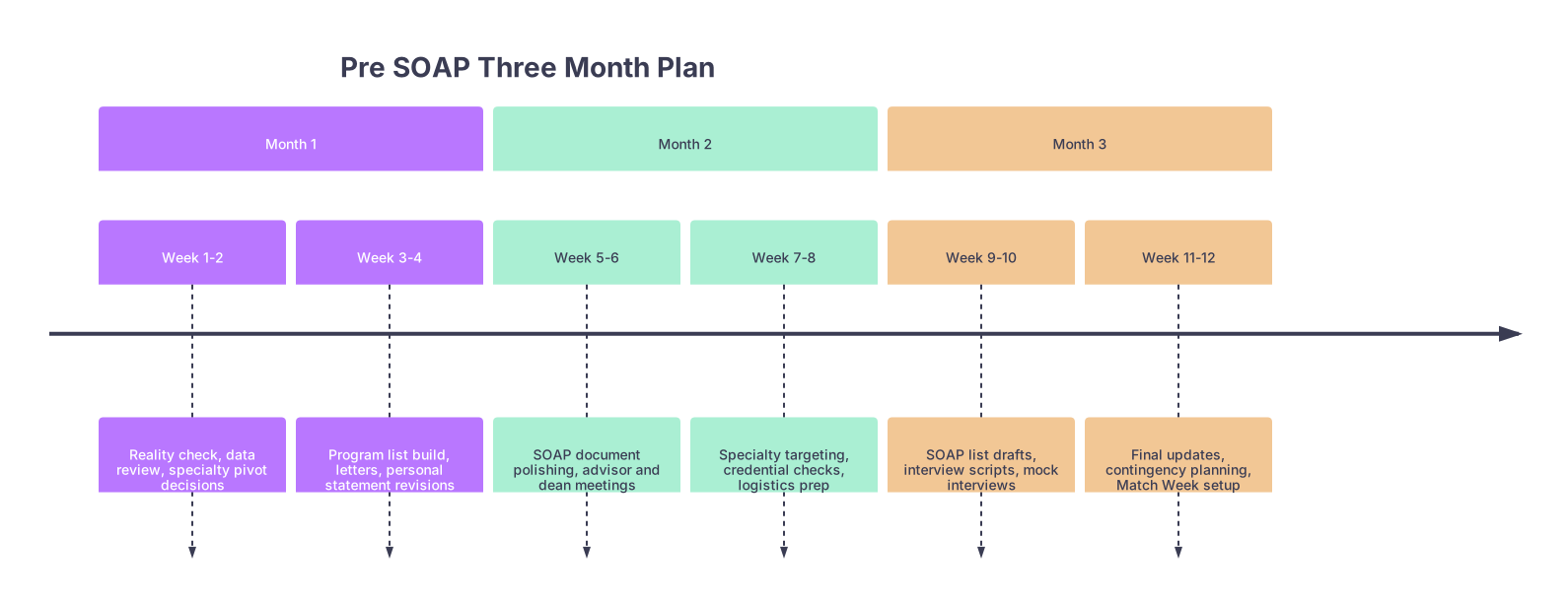
| Period | Event |
|---|---|
| Month 1 - Week 1-2 | Reality check, data review, specialty pivot decisions |
| Month 1 - Week 3-4 | Program list build, letters, personal statement revisions |
| Month 2 - Week 5-6 | SOAP document polishing, advisor and dean meetings |
| Month 2 - Week 7-8 | Specialty targeting, credential checks, logistics prep |
| Month 3 - Week 9-10 | SOAP list drafts, interview scripts, mock interviews |
| Month 3 - Week 11-12 | Final updates, contingency planning, Match Week setup |
We’ll walk this month by month, then week by week.
Month 1 (About 12 Weeks Before Match Week): Brutal Reality & Backup Blueprint
At this point you should stop pretending the season went “okay.” You have enough data to judge risk.
Week 1: Reality Audit & Risk Grading
At this point you should sit down—with numbers, not vibes.
Count your interviews accurately
- Separate interviews by:
- Competitiveness of specialty
- Whether they’re community vs big-name academic
- Whether they’re in “friendlier” regions (home state, IMG-heavy states)
- A weak season example:
- 2 categorical IM interviews (both mid‑tier)
- 1 prelim surgery
- No family med / peds / psych
- Separate interviews by:
Grade your risk honestly
| Risk Level | Categorical Interviews | Specialty Type | Comment |
|---|---|---|---|
| Low | 10+ | Any mix | Still build SOAP plan, but odds are good |
| Moderate | 5–9 | Mix of competitive and less competitive | Take SOAP planning seriously |
| High | 1–4 | Mostly competitive specialties | Assume SOAP is likely |
| Critical | 0 | Any | You are SOAP‑first, not Match‑first |
If you’re high or critical risk, treat SOAP as Plan A‑1, not Plan B.
- Get outside eyes
- Meet with:
- Your school’s Dean of Students / Match advisor
- A specialty advisor (IM, FM, Psych, etc.)
- Ask them directly:
- “With my current interviews, would you be surprised if I did not match?”
- “If I go into SOAP, which specialties should I realistically target?”
- Meet with:
Write their answers down. No denial.
Week 2: Decide Your SOAP Specialty Targets
At this point you should pick realistic backup specialties, not fantasy options.
You need:
- 1–2 “anchor” SOAP specialties (more spots, historically SOAP‑friendly)
- Optional: 1–2 “stretch” areas if you have genuine ties or strong fit
Common anchor targets:
- Family Medicine
- Internal Medicine categorical
- Pediatrics
- Psychiatry
- Transitional Year or Preliminary Medicine (if you’re willing to reapply later)
If you spent all season chasing Derm/Ortho/ENT with no success, your SOAP anchor isn’t “Derm but less competitive places.” It’s FM/IM/Peds/Psych.
Now line this up with your profile:
- US MD with red flags: often IM/FM/Psych are realistic
- US DO: add FM, IM community, Psych, some Peds
- IMG: primarily FM, IM community, occasionally Psych, sometimes Peds in certain regions
Week 3: Build Your SOAP Playbook Skeleton
At this point you should outline all the pieces you’ll need in SOAP, even if you don’t know which programs yet.
ERAS Documents likely required in SOAP:
- CV / Application (already in ERAS)
- Personal statement(s) tailored to backup specialties
- Letters of recommendation aligned with target fields
- MSPE and transcripts (handled by school)
- USMLE/COMLEX scores
Decide on personal statement strategy
- One generic IM/FM/Peds type statement? Lazy and obvious.
- Better:
- 1 tailored to your main SOAP specialty (e.g., Family Medicine)
- 1 multi‑purpose “primary care” or “broad clinical” statement if needed
Map your LORs
- You want at least:
- 2 letters solidly in your SOAP anchor field OR clearly generalist (IM/FM)
- 1 “character” letter if you have a red flag (someone vouching for growth and reliability)
- You want at least:
If you don’t have those, that’s your next action item.
Week 4: Secure Letters & Fix Your Narrative
At this point you should be actively closing gaps.
- Letters of Recommendation
- Contact:
- Medicine clerkship director
- Sub‑I attendings (IM/FM/Peds/Psych)
- Program directors at any places where you rotated
- Use clear language:
- “I’m at risk of not matching in [X]. I plan to enter SOAP targeting [Y specialty]. Would you be comfortable writing a strong letter supporting me for [Y]?”
- Contact:
Don’t dance around it. Faculty smell vague requests and respond with vague letters.
Draft your SOAP personal statement(s)
- Focus on:
- Why this specialty now (especially if it’s a pivot)
- Maturity, resilience, ability to step in and work hard from day one
- Concrete clinical examples, not just “I like continuity of care”
- Remove:
- Any language that wedges you into a dead specialty (“My lifelong dream is ortho…” while applying to FM in SOAP. Programs notice.)
- Focus on:
Start a running SOAP program tracking sheet
- Columns:
- Program name
- Specialty
- Location
- Type (community/academic)
- Notes (IMG‑friendly, DO‑friendly, prior SOAP participation if known)
- Connection (any ties, past rotator, etc.)
- Columns:
You won’t know which programs are unfilled yet, but having structure ready saves you hours later.
Month 2 (About 8 Weeks Before Match Week): Document Readiness & Strategic Positioning
Now you move from “big decisions” to fine‑tuning and pre‑loading.
Week 5: Fix ERAS and Get Your Story Straight
At this point you should assume PDs will scroll your app during SOAP and wonder, “Why is this person in my specialty now?”
Review your ERAS for contradictions
- Does your entire app scream “I only want Ortho”?
- Do your experiences and descriptions show you can function in IM/FM/Psych?
- Edit activity descriptions (you can still adjust some types) to:
- Highlight inpatient medicine, continuity clinics, communication, teamwork
- De‑emphasize niche specialty‑only language if it’s overbearing
Write your “SOAP pivot” script
- You’ll be asked some version of:
- “You applied in X originally. Why Y now?”
- Your answer should have:
- Honesty: “I applied in X because of [short reason]. During the season I reflected on what I actually enjoy day‑to‑day…”
- Continuity: Show how your strengths translate into the new field
- Commitment: “If given the opportunity in Y, I plan to build my career here, not treat it as a placeholder.”
- You’ll be asked some version of:
Say it out loud. Fix the awkward parts now, not on SOAP call #3 when you’re panicking.
Week 6: Advisor Check‑In & Red Flag Damage Control
At this point you should confront any red flags you’ve been dodging.
Meet your Dean/advisors again with specifics
- Show them:
- Your updated specialty targets
- Draft personal statements
- LOR list
- Ask:
- “If I go into SOAP with this plan, what are my odds in [specialty]?”
- “Should I anchor more heavily in [FM/IM/Psych/etc.] instead?”
- Show them:
-
- Common issues:
- Step/COMLEX failures
- Leaves of absence
- Remediation
- Unprofessional behavior write‑ups
- For each, script 3 parts:
- What happened (brief, no drama)
- What you learned / changed
- How your recent performance shows growth
- Common issues:
SOAP interviews are short. You don’t have 15 minutes to monologue your trauma. Tight, direct answers win.
Week 7: Logistics & Technology Prep
At this point you should assume SOAP week will be chaos if you’re unprepared.
Tech setup
- Reliable laptop or desktop (no “my Zoom died” stories)
- Headset or decent mic
- Stable internet with backup plan (campus study room, friend’s apartment)
- A neutral background or virtual background tested ahead of time
Environment
- Identify:
- A quiet room you can reserve for Match Week
- Backup spaces if the first one fails
- Inform:
- Roommates/partners/family that Match Week = no interruptions, no noise
- Identify:
Time blocks
- Mark your calendar for:
- Monday 11 a.m. ET – NRMP emails unmatched status
- Monday: school / advising meetings
- Tuesday: 9 a.m. ET SOAP applications open
- Wednesday–Thursday: SOAP rounds and interviews
- Make sure you do not have travel, major appointments, or elective obligations you cannot reschedule.
- Mark your calendar for:
Week 8: Specialty Target Refinement & Shadowing (If Possible)
If you’re pivoting to something you barely touched (e.g., going from Ortho to Psych), you need real exposure.
At this point you should:
- Arrange brief shadowing or clinic time with:
- A family med doc
- An internist
- A psychiatrist
(whichever you’re targeting)
- Ask them:
- “If you were hiring a SOAP‑applicant intern, what would you care about most?”
Use that language in your interviews and statements. Program directors can tell when you understand the job versus when you’re parroting website fluff.
Month 3 (About 4 Weeks Before Match Week): Execution Readiness
This is where you shift from planning to rehearsal and system‑building.
Week 9: Draft SOAP Application Archetypes
You don’t know exact programs yet, but you know the types of programs.
At this point you should prepare “archetype” pitches.
- Program archetypes
- Community FM in Midwest
- Community IM in smaller city
- Psych program with strong outpatient
- Transitional year linked to mid‑size hospital
For each archetype, write:
- 2–3 bullet points: why you fit that type of program
- 1 short story that shows:
- You work well with limited resources, or
- You relate to underserved populations, or
- You’ve handled high acuity / busy services
You’re building a menu of talking points you can mix‑and‑match when SOAP lists drop.
- Refine your personal statements again
- Cut any:
- Overly niche research obsession that doesn’t fit broad clinical SOAP programs
- Long “origin” story that eats space but says nothing
- Add:
- 1–2 sentences tying your background to the patient population you’d likely see (rural, urban underserved, etc.)
- Cut any:
Week 10: Mock Interviews & Rapid‑Response Practice
SOAP interviews are a different beast. They’re short, rushed, and often over the phone.
At this point you should train for:
- 10–15 minute calls
- No video connection or facial cues
- Tired PDs who’ve already spoken to 10 applicants
Common SOAP questions
- “Why did you not match?”
- “Why this specialty?”
- “Why this program/location?”
- “If you match here, how do you see your career?”
- “Tell me about a time you failed and what you learned.”
-
- Have a friend or advisor:
- Call you on the phone (not Zoom at first)
- Fire 3–4 questions
- Hang up after 10–12 minutes
- Focus on:
- Clear, concise answers (45–90 seconds each)
- Sounding calm and focused, not desperate
- Have a friend or advisor:
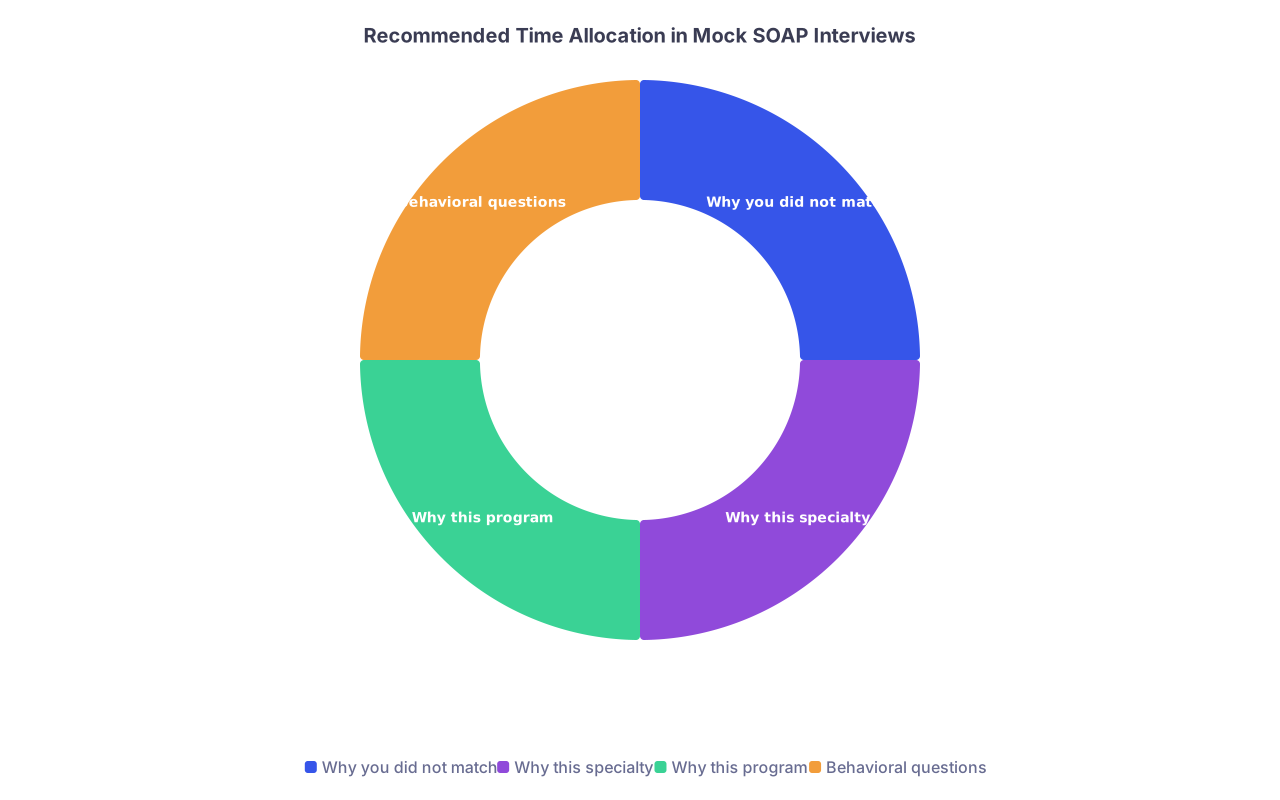
| Category | Value |
|---|---|
| Why you did not match | 25 |
| Why this specialty | 25 |
| Why this program | 25 |
| Behavioral questions | 25 |
You’re not trying to be perfect. You’re training your brain to not freeze when the call comes at 8:07 a.m. on Wednesday.
Week 11: Final Document Polish & Match Day Logistics
At this point you should tie off loose ends.
Documents checklist
- Personal statements:
- Main SOAP specialty PS: done, proofread by someone you trust
- Secondary PS if needed: also ready
- LORs:
- Confirmed received in ERAS and assigned correctly
- CV / ERAS:
- No typos, dates consistent, no unexplained gaps
- Personal statements:
Communication plan
- Decide who you’ll communicate with the moment you learn your status Monday:
- Primary advisor
- Dean’s office contact
- One trusted mentor
- Set that expectation now:
- “If I’m unmatched Monday, can we meet that afternoon to review the unfilled list and finalize my SOAP list?”
- Decide who you’ll communicate with the moment you learn your status Monday:
Match Week environment
- Reserve:
- A private room for Monday–Thursday
- Prepare:
- Water, snacks, chargers, headset, printed notes, program tracking sheet
- Reserve:
This prevents you from scrambling for space when your first SOAP call comes in.
Week 12 (Match Week Minus 1): Dry Run & Emotional Prep
This is where most people fall apart. They either:
- Burn out and mentally check out
or - Spiral in anxiety and do nothing productive.
At this point you should do a full dry run.
Mock “Unmatched Monday” exercise
- On a chosen day:
- 9 a.m.: Pretend you just learned you’re unmatched
- 11 a.m.: Pretend you get the unfilled list
- Noon–3 p.m.: Practice:
- Picking 45–60 programs you’d send SOAP apps to (simulate using your archetypes)
- Writing 3–4 customized program notes (you can’t send custom messages in SOAP easily, but you can have program‑specific talking points ready)
- On a chosen day:
Mental framing
- Decide ahead of time:
- “If I go into SOAP, I will treat every call as a real shot, not a humiliation.”
- Remind yourself:
- PDs using SOAP are not doing charity. They need functional interns.
Your job is to convince them you’ll show up, work hard, and not create drama.
- PDs using SOAP are not doing charity. They need functional interns.
- Decide ahead of time:
Sleep and schedule
- Protect your sleep the weekend before Match Week.
- Lighten your elective load if possible that week. SOAP calls while you’re rounding post‑call? Terrible combo.
Match Week Snapshot: How Your Prep Pays Off
You’re now at Match Week. Here’s how your three‑month plan changes your behavior.

Monday
- 11 a.m. ET: You learn your Match status.
- If matched: great, your SOAP plan was insurance.
- If unmatched or partially matched:
- You already have:
- Advisors on standby
- Target specialties chosen
- Personal statements done
- You already have:
You’re not starting from zero.
Tuesday
- 9 a.m. ET: SOAP applications open.
- You:
- Quickly align your pre‑prepared materials with the actual unfilled list
- Use your archetype notes to select programs that make sense
- Submit efficiently instead of spending 3 hours panicking over each choice
- You:
Wednesday–Thursday
- Calls come in.
- You:
- Use your practiced scripts (pivot story, red flag explanation, “why us” bullets)
- Track each program in your sheet
- Follow up appropriately when allowed
- You:
Programs hear a calm, prepared person—not someone obviously improvising.
One More Thing: What Not to Do in These 3 Months
Quick list of mistakes I see every year:
- Waiting until Match Week to think about SOAP “just in case”
- Refusing to pivot specialties even with near‑zero odds
- Keeping red flags vague or defensive instead of direct and contained
- Writing one generic personal statement for 4 specialties
- Ignoring logistics: no quiet space, no tech setup, no calendar blocking
- Treating SOAP as beneath you, then sounding entitled on calls
Do not do any of that.
Final Key Points
- Assume risk early. If your interview season was weak, act like SOAP is likely and build your plan three months out.
- Prepare documents and scripts before Match Week. Personal statements, LORs, pivot story, red flag explanation—done before the chaos.
- Train for the format. SOAP is fast, phone‑heavy, and high‑pressure. Short, practiced answers and tight logistics win you spots that unprepared applicants leave on the table.