The fear that a “backup specialty” will ruin your chances is wildly overstated—and often weaponized by anxious peers and lazy advice.
Let me be blunt: having a backup specialty does not inherently hurt you. What hurts you is being sloppy, inconsistent, and transparent about hedging in ways that make programs doubt you. Those are very different things.
You’re not losing points because you strategically considered anesthesia as insurance while gunning for derm. You lose points when your application reads like you couldn’t commit to either and didn’t do the work for both.
Let’s take this apart properly.
The Myths That Keep Getting Repeated
Here are the greatest hits I hear every year from MS3s and early MS4s:
- “If PDs find out I’m applying to two specialties, I’m done.”
- “You have to go all‑in on one specialty or they won’t rank you.”
- “Backup applications make your primary specialty think you’re not committed.”
- “Dual applying always hurts you somewhere.”
These are mostly fear stories, passed down from upperclassmen like campfire horror tales, rarely backed by hard evidence or an actual PD’s opinion.
What does the real world look like?
- Competitive specialties (derm, plastics, ENT, ortho, neurosurg, rad onc, some EM markets) are full of people who dual applied.
- Medicine, prelims, transitional year, psych, FM, pathology—routinely see applicants who clearly used them as backups and still got ranked and matched.
- NRMP data consistently shows: people in hyper-competitive specialties who don’t have reasonable breadth in their rank list are the ones who most often go unmatched, not the ones who “tainted” themselves with a backup.
You are not graded on ideological purity. You’re evaluated on whether you look like a good fit for that program, with coherent interest and enough work to back it up.
What the Data Actually Shows (Not Group Chat Panic)
No, there is not a clean dataset that says: “Applicants with backups score -0.4 on commitment scale and lose 3 rank positions.” Residency data does not work that way.
But we do have patterns from NRMP outcomes and PD surveys you should actually care about.
1. Match rates and competitive fields
Look at NRMP’s “Charting Outcomes in the Match” and PD surveys over the past several cycles. The trend is boring but clear:
- The more competitive the specialty (small number of spots, high USMLE averages, heavy research expectations), the more dual-applicants you see in real life.
- Applicants who have no viable secondary options and then apply only to one hyper-competitive specialty with a marginal profile… are much more likely to go unmatched.
Nobody publishes a table labeled “dual apply vs not,” but talk to residents in derm, ENT, ortho, plastics, rad onc, or neurosurg at any mid- to high-tier program. You’ll find a healthy share dual applied to:
- Internal medicine
- Anesthesia
- Transitional year
- Prelim surgery or medicine
- Sometimes pathology or FM depending on their story
And they still matched into their dream specialty.
2. What program directors actually care about
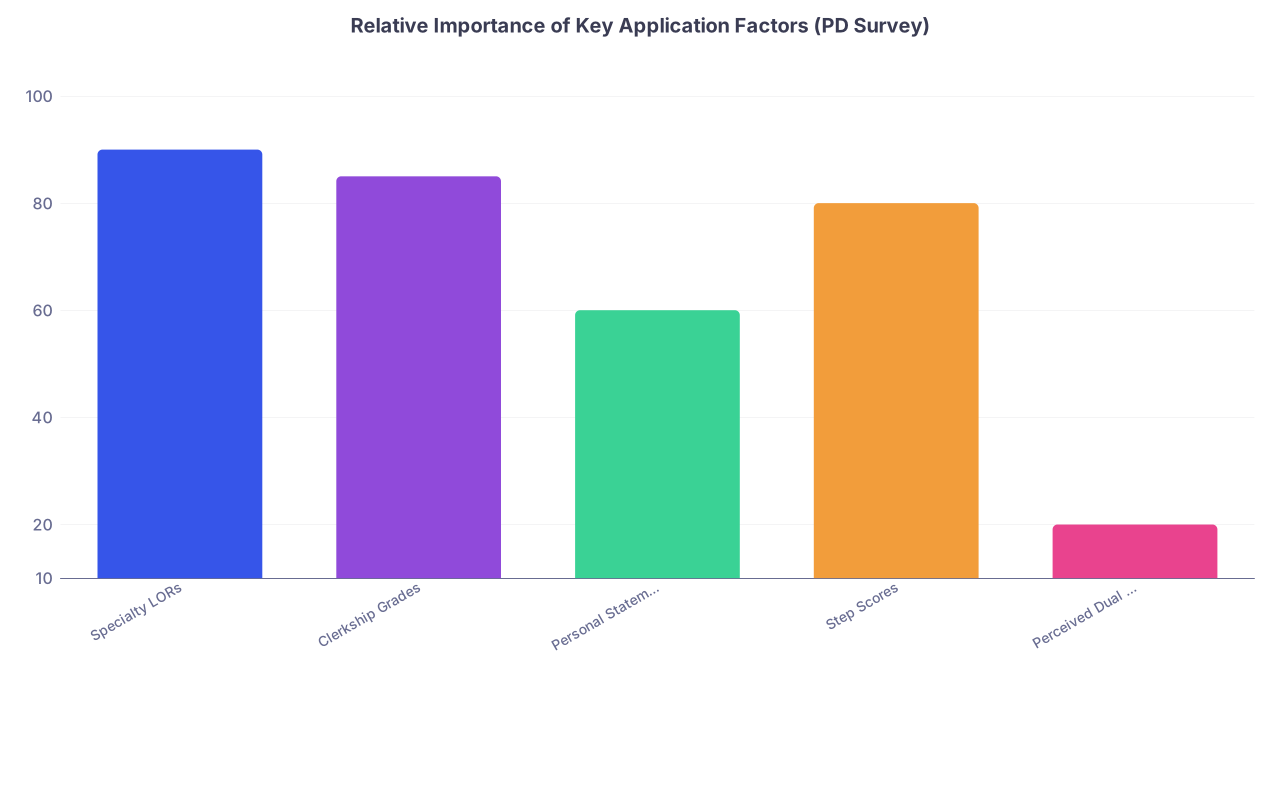
NRMP’s PD survey repeatedly ranks these high:
- LORs in the specialty
- Clinical grades / MSPE
- Step scores (where still relevant) / COMLEX
- Evidence of commitment to the specialty (clerkships, electives, research, interest statement)
- Interview performance and professionalism
Nowhere is there a checkbox for “penalize: suspected backup application.”
What they do react to is inconsistency:
- Your personal statement says you’ve been “dedicated to family medicine since early undergrad” but your CV is 4 years of neurosurg research, three away rotations in neurosurg, and exactly zero FM exposure. That’s not a backup problem; that’s a credibility problem.
- Your interview answer wavers, “I’m also kinda thinking maybe anesthesia or EM…” without a clear “But I’m applying only to X and this is why.” That’s a maturity problem.
Programs do not have time or interest to stalk your ERAS specialty list. They evaluate the application in front of them for their field: Does this person plausibly want to be here and can they do the job?
The Real Risks of a Backup Strategy (And They’re Not What You’ve Been Told)
A backup specialty can hurt you—but for reasons that have nothing to do with some secret blacklist.
Here’s where people actually screw themselves:
1. Diluted effort, not divided interest
You have limited bandwidth: research, away rotations, letters, personal statements, applications, interviews. Trying to build two top‑tier applications when you barely have enough signal for one is where the damage happens.
Concrete example:
- You’re gunning for ortho and also “seriously” applying to anesthesia.
- You do 3 ortho aways, 2 projects, get 3 strong ortho letters.
- For anesthesia, you have: one 2‑week elective, no research, and a generic letter from a random attending who barely knows you.
On paper, you look like:
- A serious ortho applicant.
- A lazy or last‑minute anesthesia tourist.
If ortho doesn’t work out, your “backup” isn’t actually viable. That’s not the concept of a backup hurting you. That’s you not doing the work on either Plan A or Plan B intelligently.
2. Sloppy, copy‑paste personal statements
Program directors do actually read these. Not all of them, not word for word across 80 apps a night—but enough to spot garbage.
Things that kill you:
- Using the same generic story and just swapping “anesthesiology” for “internal medicine.”
- Talking about procedures, OR culture, and acute resuscitation… in your psych personal statement.
- Contradictions: “I’ve always known I’d be a psychiatrist” when half your experiences scream IR, trauma, SICU.
Backup doesn’t hurt you. Lazy narrative construction does.
3. Mixed signals on letters
Letters matter way more than applicants want to believe.
Enter the common disaster:
- You apply to both anesthesia and IM.
- Your three strongest letters are: ICU attending (IM), hospitalist (IM), and cardiology research mentor.
- For anesthesia, you have: one lukewarm “worked with student a few days” letter because you didn’t plan ahead.
What does an anesthesia PD see? “Smart student, but clearly more invested and known in medicine. Why are they here?”
Again, not the concept of backup harming you. This is poor planning in aligning your strongest advocates with your targets.
When a Backup Specialty Helps You
Here’s the part nobody says out loud: used correctly, a backup specialty often helps you—even in your primary field.
Because it forces you to:
- Be realistic about your competitiveness.
- Build skills and experiences that actually translate.
- Not be the person sobbing on SOAP day because you believed “the universe will provide” instead of reading match statistics.
Let’s make it concrete.
Example: Derm + Internal Medicine
You’re aiming for dermatology but not a 270 + 40 pubs unicorn.
What you do right:
- Take IM seriously. Honor it. Build relationships.
- Do derm research, but also help on IM QI or clinical projects.
- Letters: 2 derm, 1 IM chair. All strong, all personal.
- If you dual apply, your IM application shows deep engagement with complex medical patients, derm shows the obvious targeted commitment.
Does IM hold it against you that you also applied derm? No. They see a smart, thoughtful student with strong clinical ability and a realistic plan.
Does derm hate that you rotated in IM and enjoyed it? Of course not. They want people who can manage real patients, not just rashes in a vacuum.
Example: Ortho + Prelim Surgery
The classic pattern. What works:
- Ortho aways, ortho research, ortho letters: check.
- Also show you can function on surgical services generally: good evals, solid OR performance, decent rapport with general surgery attendings.
- If you land a prelim spot, they know you’re ortho-focused—but they rank you anyway because they need responsible bodies and you look like you can carry the pager without imploding.
Prelim programs aren’t shocked you’re using them as a stepping stone. That’s literally the design.
How Programs Actually Figure Out You Dual Applied (Or Don’t)
There’s this paranoid belief that programs can “see” all your other specialties. They can’t.
Here’s what they realistically have:
- Your ERAS for their specialty only.
- The MSPE, which may list your electives/rotations.
- Your CV (research, experiences).
- What you say on interview day.
- Whatever your letter writers hint at.
That’s it.
If they infer you dual applied, it’s usually because:
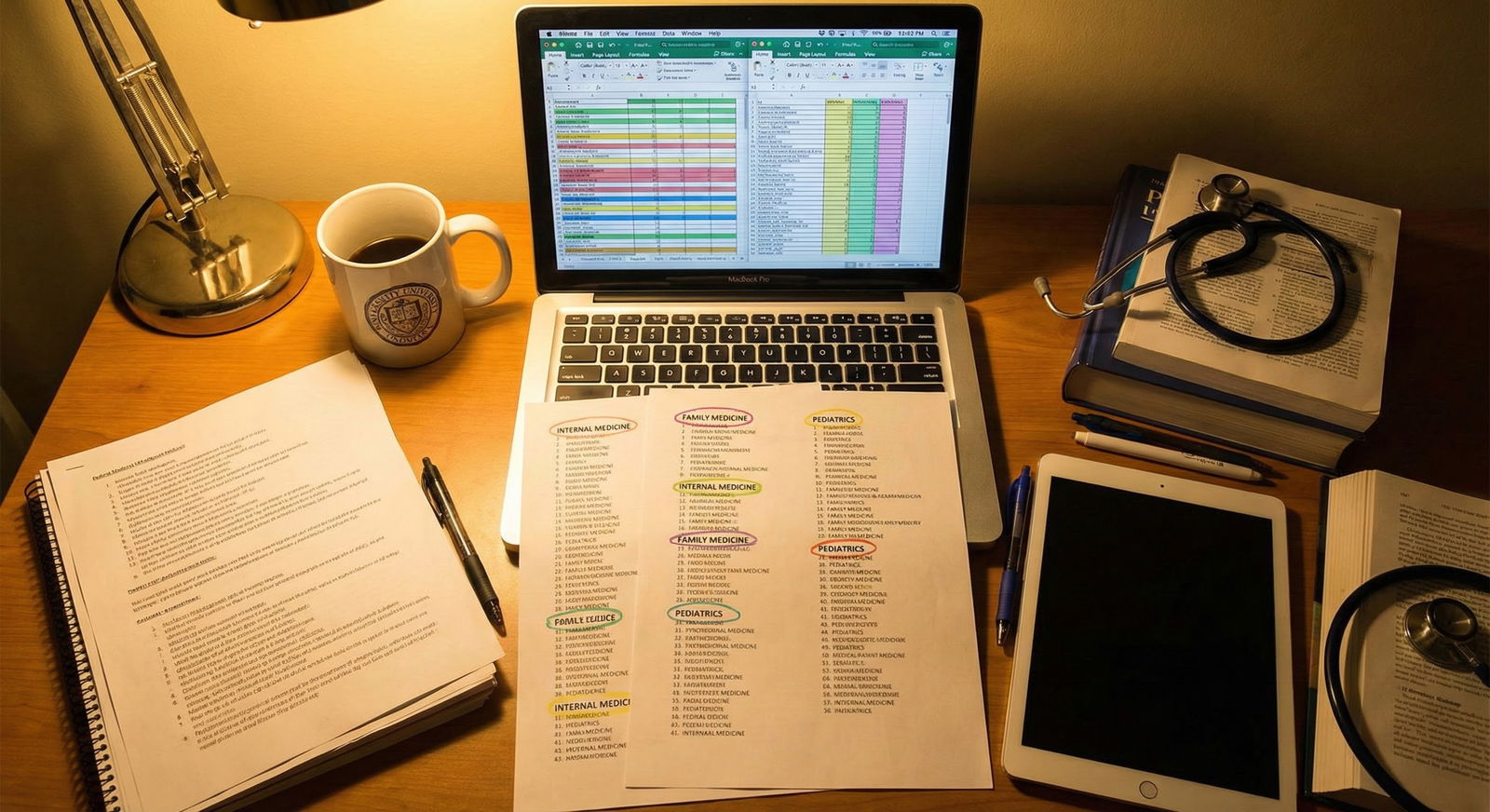
- Your MS4 schedule shows EM, anesthesia, FM, IM, ENT, radiology all jammed into one year in a way that screams “I was shopping.”
- A letter literally mentions, “As [Student] explores both anesthesia and internal medicine…” (you’d be surprised how often this happens).
- You openly tell them.
And even then, the key question in their head is not, “Did this person ever consider another specialty?” It’s:
“Right now, today, does this person actually want to be in our specialty at our program—and can they back that up?”
If the answer feels like yes, they rank you. If it feels like maybe, they move on.
How to Use a Backup Specialty Without Shooting Yourself in the Foot
Here’s the grown‑up version of a backup strategy—what actually works in the real world.
1. Decide your primary specialty first
You cannot build two coherent applications if you’re still existentially undecided. You need a clear:
- Primary: “If I match here, I’m happy. This is me.”
- Secondary: “If I don’t match primary, I can live a good life doing this.”
If your honest answer is, “I’d hate doing my backup,” that’s not a backup. That’s you emotionally outsourcing your anxiety.
2. Understand overlap vs contradiction
Some pairings are very natural:
- Derm + IM
- ENT + prelim surgery
- Ortho + prelim surgery
- Anesthesia + IM
- EM + IM/FM (depending on market)
- Rad onc + IM
- Path + IM/FM (for some applicants)
Some are harder to sell without a really clear story:
- Plastics + psych
- Neurosurg + PM&R (doable, but requires narrative work)
- EM + derm with zero connective tissue
Not impossible. Just higher difficulty from a story standpoint.
3. Build enough signal in both lanes
You don’t need symmetry. You do need sincerity.
For your backup specialty, you should have at least:
- One strong letter from someone in that specialty who actually knows you.
- Solid performance in that clerkship or elective.
- A personal statement that clearly explains why this field fits you—not why you failed Plan A.
If your backup PS reads like, “I didn’t get ortho so now here we are…” you’re done.
| Category | Value |
|---|---|
| Specialty LORs | 90 |
| Clerkship Grades | 85 |
| Personal Statement | 60 |
| Step Scores | 80 |
| Perceived Dual Apply | 20 |
Where You Actually Need to Be Careful
Let’s be fair. There are scenarios where applying to a backup can genuinely ding you—mainly because of how you handle it.
1. During interviews in your primary specialty
If you say:
- “I’m keeping my options open.”
- “I’m also interviewing in [X, Y, Z], just seeing what feels right.”
- “Honestly, I’m not totally sure what I want yet.”
You look like a risk. Nobody wants to rank someone who might be half‑in.
Better approach:
- If you are dual applying, you don’t volunteer that unless asked.
- If asked directly, you answer calmly and confidently:
“I explored [backup] earlier on, but I made the decision to apply only to [primary] because of [specific reasons]. This is the field I see myself in long‑term.”
Or, if you truly are dual applying: “I am dual applying to [backup] because [concrete reason: competitiveness, personal circumstances], but I’m here because [primary] is where I’d be happiest if given the chance. I wouldn’t be in this interview if I didn’t seriously see myself in this specialty.”
Then back it up with your record.
2. Letters that undermine your story
You cannot control everything your letter writer says, but you can avoid obviously risky choices.
Red flag letters:
- “Student is still deciding between [A] and [B].”
- “We discussed many career options including X, Y, and Z.”
- “Student is exploring the possibility of [other specialty].”
Pick writers who:
- Are 100% on board with you applying to that specialty.
- Can honestly frame you as someone who fits it.
If a mentor persistently pushes you toward another field, they’re probably not your best letter writer for the one you’re actually choosing.
3. Over‑applying out of fear
Another quiet way a “backup” hurts you: interview burnout and incoherence.
People who shotgun:
- 70+ apps in a competitive field
- 80+ apps in a backup
- Accept 30–40 interviews total across both
Guess what happens?
- You’re exhausted.
- Your stories blur.
- You sound generic and forget which program is which.
- Your performance drops—everywhere.
That’s not about backup vs no backup. That’s you letting fear turn the whole process into a volume game you can’t execute well.
Strategic Backups by Specialty: A Quick Reality Check
Not exhaustive, but this is how programs tend to actually see common pairings.
| Primary | Common Backup | Generally Viewed As |
|---|---|---|
| Dermatology | Internal Medicine | Normal / realistic |
| Orthopedics | Prelim Surgery | Standard |
| ENT | Prelim Surgery | Standard |
| Neurosurgery | Prelim Surgery/IM | Expected |
| Rad Onc | Internal Medicine | Common |
| EM (tight jobs) | IM or FM | Market dependent |
None of these are inherently “application poison.” PDs have seen them for years.

| Step | Description |
|---|---|
| Step 1 | Choose Primary Specialty |
| Step 2 | Assess Profile Realistically |
| Step 3 | Single Apply Reasonable |
| Step 4 | Identify Backup Specialty |
| Step 5 | Focus on Strong Single Application |
| Step 6 | Secure Backup LOR & Rotation |
| Step 7 | Write Coherent, Separate PSs |
| Step 8 | Apply & Interview Strategically |
| Step 9 | Competitive Field? |
| Step 10 | Match Risk High? |
The Bottom Line: It’s Not the Backup, It’s the Execution
You don’t get extra points for pretending you’re fearless and refusing a backup out of pride. The match is a numbers game with human judgment layered on top, not a hero’s journey where courage is rewarded regardless of odds.
A backup specialty hurts you only when:
- It exposes that you have no coherent story.
- It reveals you didn’t put in the work to be competitive anywhere.
- It spreads your energy so thin that everything you present is mediocre.
A backup specialty helps you when:
- It’s thoughtfully chosen, with genuine elements of fit.
- You invest enough to make that application real, not cosmetic.
- You stay honest with yourself about risk instead of outsourcing it to superstition.
Years from now, you won’t remember how many late-night Reddit threads insisted that “dual applying is death.” You’ll remember whether you made clear-eyed, adult decisions about your future—or let fear and folklore drive the most important application of your career.