
The obsession with school prestige is wildly overblown for residency applications—but it’s not irrelevant.
If you want the unvarnished version: name brand helps at the margins, but it will not rescue a mediocre application, and it is not required for a strong one. I’ve seen community med school grads match derm at top programs, and I’ve seen Ivy MDs scramble into prelim spots. The pattern is painfully clear.
Here’s how school prestige actually fits into a strong residency application, and how much you should care.
The Real Hierarchy: What PDs Care About More Than Prestige
Let me start with the part most applicants do not want to hear: your med school name is not in the top 3 factors for most Program Directors.
If you look at National Resident Matching Program (NRMP) Program Director surveys over the years, the consistent “heavy hitters” are:
- Board scores (Step 2 CK now that Step 1 is pass/fail)
- Clerkship performance and MSPE (Dean’s Letter)
- Letters of recommendation (especially specialty-specific)
- Interview performance and perceived fit
- Class rank / AOA (where applicable)
- Prior professionalism concerns or red flags
School name sits below these in most specialties. It’s in the “nice to have” column, not the “must have”.
But the impact isn’t zero. Here’s a quick comparison of how factors actually stack up for many programs.
| Factor | Typical Impact Level |
|---|---|
| Step 2 CK score | Very High |
| Clinical grades/MSPE | Very High |
| Specialty letters | Very High |
| Interview performance | Very High |
| Research in the field | Moderate–High |
| School prestige | Low–Moderate |
| Extracurriculars/service | Low–Moderate |
You build a strong residency application on the back of performance and relationships, not branding. Prestige nudges doors open; it does not carry you through them.
When School Prestige Actually Matters (And When It Really Doesn’t)
Let’s separate the hype from the situations where school name changes your odds in a noticeable way.
Situations where prestige can help
- Hyper-competitive specialties
Dermatology, plastic surgery, neurosurgery, orthopedics, ENT, radiation oncology—these fields are irrationally competitive. Here, program directors are searching for any quick filter to triage hundreds of applications.
In these specialties, coming from a top-20 research-heavy school (think UCSF, Penn, Hopkins, WashU, Columbia, etc.) can help you:
- Get more interview invites with high-ranked programs.
- Be assumed to have had stronger clinical and research environments.
- Benefit from faculty who have pre-existing relationships with PDs.
But even here, what actually gets you ranked high is still: your Step 2 score, letters from big names in that field, and strong research.
- Big-name academic programs
If you’re aiming for Mass General, UCSF, Brigham, Mayo, or similar academic powerhouses, school name sometimes functions as a proxy for “this person is already vetted by an intense system.”
In practice, this looks like:
- Slightly more lenient cutoffs for applicants from highly ranked schools.
- More benefit of the doubt if your application has a few soft spots.
- Easier networking—your faculty know their faculty.
Again: edge, not guarantee. I’ve seen Harvard MDs turned down by Harvard-affiliated residencies while state-school grads got those spots.
- International medical graduates (IMGs)
For IMGs, “school reputation” matters a lot more—but it’s really about signal and trust, not prestige in the U.S. sense.
US-IMGs from well-known Caribbean schools (SGU, Ross, AUC) or top international schools with established track records (e.g., some Indian, UK, German, or Israeli institutions) have a clearer path than from completely unknown schools. PDs like predictability.
If you’re an IMG from a lesser-known institution, you can still absolutely match. But you’ll be judged more heavily on:
- Very strong Step 2 CK score
- U.S. clinical experience
- Strong U.S.-based letters
- Clear evidence you know what you’re signing up for in that specialty
Situations where prestige matters very little
- Bread-and-butter, large specialties
Internal medicine, pediatrics, family medicine, psychiatry, even many general surgery programs—these are much more score- and performance-driven than prestige-driven. Community programs especially do not care whether your school was top-10 or bottom-10, as long as:
- You passed your exams on time
- You have a solid Step 2 CK
- Your MSPE is clean
- Your letters say you’re safe, reliable, and teachable
I’ve watched strong students from unranked state schools beat out “top 10” applicants in IM and peds all the time.
- Your home program
Your home residency program is heavily influenced by how you performed in person:
- How you worked on core rotations and sub-Is
- What your residents and attendings say about you
- How you fit their culture
Yes, there are exceptions—some elite departments are brutal to their own students, some are weirdly hostile to home applicants—but for many places, being a known quantity beats name brand.
- Regions where the name doesn’t travel
The “prestige map” is local. A mid-tier midwestern school may mean a lot in the Midwest but almost nothing on the coasts, while a smaller east coast private school may be completely unknown west of the Mississippi.
Program directors trust what they know. A “no-name” school with a consistent pipeline of good residents often gets more respect locally than a national brand that rarely sends applicants.
How Prestige Shows Up in Real Application Decisions
Let’s walk through a realistic scenario.
Two applicants both want academic internal medicine at a mid-to-high tier university program:
- Applicant A: Top-10 MD school, Step 2 CK 234, strong narrative, decent research, good letters.
- Applicant B: Unranked state MD, Step 2 CK 252, honors in medicine and surgery, one solid research experience, glowing letters from enthusiastic faculty.
Who gets the interview?
Most academic IM programs I’ve seen will interview both. But if they only have room for one? Applicant B usually wins. Stronger score, stronger perceived clinical performance. Prestige doesn’t erase a 20-point score gap.
Where prestige may tilt the scale is when everything else is too close to call:
- Applicant A: Top-10 school, Step 2 245
- Applicant B: Unknown school, Step 2 245
If the program doesn’t know anyone at Applicant B’s institution but has long history with Applicant A’s school, Applicant A might get the invite first. Not because 245 from a “better” school is “more 245,” but because the PD thinks, “We’ve had good experiences with that school’s grads.”
That’s the level of influence we’re actually talking about.
The Prestige Trap: Where Applicants Waste Time and Energy
Here’s where people screw this up.
They:
- Blame their school name for outcomes that are actually from low scores or weak letters.
- Under-apply because “my school is good, I’ll be fine,” then get burned.
- Over-apply to ultra-elite programs because “I’m at a top school, I should aim high,” and eat 40 rejections.
- Ignore their local programs, where they have the strongest real advantages.
I’ve literally heard students say, “I don’t need a 250, I’m at [top school].” Then they match at a backup community program they never really wanted because their application looked lazy next to motivated state-school applicants.
Prestige is not a substitute for work. Programs know the difference.
How to Build a Strong Application When Your School Isn’t Famous
If your school doesn’t turn heads on paper, your strategy is simple: you out-perform and out-connect.
Focus on levers that actually move your chances:
- Crush Step 2 CK
You do not need a 270. But you should aim to be clearly above your specialty’s average for the programs you want. A high Step 2 score cleans up a lot of doubts about school reputation, especially for IMGs and DOs.
- Be a monster on core rotations
You want attendings who say things like:
- “Top 5% of students I’ve worked with in the last 5 years”
- “Functioned at or above the level of an intern”
- “We would be thrilled to have this student as a resident here”
Those phrases show up in letters, and PDs notice. They cut through any anxiety about where you trained.
- Targeted, not random, research
You don’t need 12 PubMed-indexed papers. You do need something to point to that shows:
- You understand academic work in your field (if you’re aiming academic)
- You can finish what you start
- You’ve worked with someone willing to vouch for you
One solid project with a respected faculty member in your specialty beats three half-baked poster abstracts with nobody to speak for you.
- Exploit your home and regional connections
Your biggest built-in advantages are:
- Your home program(s)
- Nearby institutions where your faculty have friends
This is where your letters and phone calls actually get read with interest. Students chase coastal logos and ignore the PD two floors above them who would happily rank them to match.
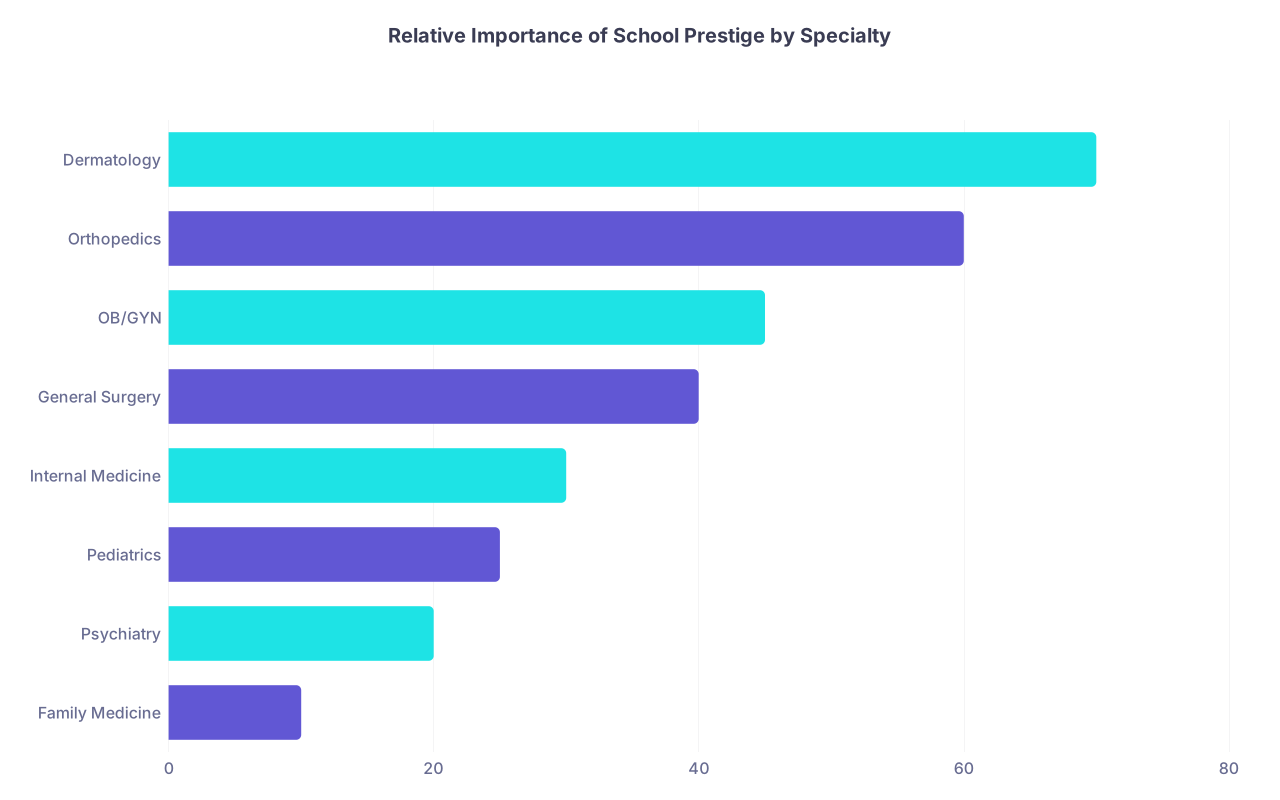
How Much Prestige Matters by Specialty: A Rough Feel
Not perfect, but this tracks with what I’ve seen and what PDs quietly admit.
| Category | Value |
|---|---|
| Family Medicine | 10 |
| Psychiatry | 20 |
| Pediatrics | 25 |
| Internal Medicine | 30 |
| General Surgery | 40 |
| OB/GYN | 45 |
| Orthopedics | 60 |
| Dermatology | 70 |
Think of those numbers as “how much programs tend to care about school name, relative to other factors,” on a 0–100 scale. Not scientific. But directionally right.
Primary care? They care way more that you can communicate, show up, and not implode on call. Derm and ortho? They’re drowning in top-10 applicants and historically biased toward certain pipelines.
What If You’re Already at a “Prestigious” School?
You’ve got an advantage. Use it correctly.
Do not:
- Assume your school name will fix a mediocre Step 2 or poor clinical reputation.
- Only apply to “top 10” programs because “it would be embarrassing” to go elsewhere.
- Skip relationship-building because “my letters will naturally be strong.”
Do:
- Get involved with faculty who are actually known in your desired specialty, not just “famous generally.”
- Make sure your performance matches the expectations of your school. PDs do notice when a student underperforms relative to the brand.
- Use your network for away rotations and targeted mentorship in the programs you actually want.
The hidden downside of prestige: expectations are higher. A “solid but not great” application from a very big-name school can look worse than the same application from a scrappy state school.
How to Decide Where to Apply Given Your School Background
You should not let school prestige paralyze your application strategy. Use it as one variable among many.
Here’s a simplified way to think about it:

| Step | Description |
|---|---|
| Step 1 | Start |
| Step 2 | Include more academic and top-tier programs |
| Step 3 | Mix of university-affiliated and community programs |
| Step 4 | Heavier focus on community and home region |
| Step 5 | Leverage faculty contacts & regional programs |
| Step 6 | Emphasize performance, research & strong letters |
| Step 7 | Build balanced list: reach, target, safety |
| Step 8 | Step 2 CK relative to specialty? |
| Step 9 | School well-known in region? |
The point: your scores, performance, and connections should dictate most of your application list. School prestige just shifts the boundaries slightly.
The Short Answer You Probably Wanted at the Start
So—how much does school prestige matter for a strong residency application?
Here’s the clean version:
- It matters some, especially for hyper-competitive specialties and elite academic programs, and especially when PDs don’t know anything else about you yet.
- It almost never outweighs Step 2 CK, clerkship performance, letters, and interview. Those are your real power tools.
- A “non-prestigious” school is not a ceiling. It just means you have to be clearer, louder, and more consistent with the signals that do travel: scores, narrative, and people willing to go to bat for you.