
The myth of the “perfect” residency application does more damage than your Step score ever will.
You see it every cycle. Students trying to manufacture some Instagram-filtered version of themselves: flawless Step 2, honor in every rotation, 12 papers, 600 hours of volunteering, founder of three organizations, plus a “passion for global health” that somehow appeared two months before ERAS opened.
Program directors are not impressed.
They’re tired.
And they’re very good at spotting what’s real versus what’s curated to death.
The obsession with a perfect application is not just wrong; it actively makes your file worse—more generic, less credible, and harder to advocate for in a rank meeting.
Let’s go through what the data and actual PD behavior show, not what anxious MS3 group chats keep repeating.
What PDs Actually Read First (And What They’re Looking For)
Let me kill a common fantasy: PDs are not reading your ERAS the way you read your own CV.
They’re skimming. They’re pattern-matching. They’re triaging.
Most programs have far more applications than they can seriously review. The order varies, but a very common pattern I’ve seen and heard (from IM, EM, and gen surg PDs) is something like:
- USMLE/COMLEX scores and exam history
- Transcript / MSPE flags (fails, professionalism issues, repeated years)
- Home school / geographic ties
- Experiences and personal statement (for those not screened out)
They are not hunting for perfection. They are trying to answer a much more practical question:
“Will this person function safely, work hard without imploding, not poison the culture, and have at least some chance to grow here?”
That’s it. Not “Is this the most decorated applicant in the pile?”
Look at NRMP’s own Program Director Survey (2018, 2020, 2022 cycles). Over and over, PDs rank things like:
- Evidence of professionalism and ethics
- Interactions with faculty/residents
- Perceived commitment to the specialty
- Passing USMLE/COMLEX on first attempt
…above “number of publications” or “class rank” in many specialties.
The fantasy of perfection comes mostly from applicants talking to other applicants, not from PDs.
Why “Too Perfect” Files Raise Red Flags
Here’s what nobody tells applicants: a file that looks immaculate on paper—no gaps, no dips, all superlatives—does not read as “amazing” by default.
Sometimes it reads as:
- Overcoached
- Overinflated
- Or simply unbelievable given the context
I’ve watched faculty flip through ERAS and say things like:
- “Twelve ‘most meaningful’ activities? Come on.”
- “Everything’s ‘passionate’ and ‘life-changing.’ I don’t trust this.”
- “This looks like someone built their life around what they think we want.”
That last line is the kiss of death.
There are three specific ways “perfect” applications backfire.
1. The Overstuffed CV Problem
If every activity is “life-changing,” none of them are.
You list 25 experiences, 18 leadership roles, 14 research lines, and somehow every one of them was 10+ hours a week. During full-time clerkships. While studying for Step.
Nobody believes you.
PDs know what realistic time and emotional bandwidth look like in med school. If your CV suggests you’ve been simultaneously:
- clerkship superstar
- full-time basic science researcher
- president of three organizations
- free clinic coordinator
- global health missionary
…they don’t think “wow.” They think “what’s real here and what’s puffed up?”
You never want the reader asking “what’s fake?”
You want them thinking, “Okay, this adds up. This story makes sense.”
2. The Too-Polished Personal Statement
PDs are not English professors. They’re not grading your prose style.
What they do notice: when your statement sounds like ChatGPT plus a thesaurus plus your school’s career office.
Hyper-polished, cliché-heavy, perfectly structured personal statements can be a liability. Why? Because everyone else’s looks exactly the same.
“Since childhood, I’ve wanted to be a physician…”
“My rotation in X was transformative…”
“I am passionate about patient-centered care, lifelong learning, and advocacy…”
Cut-and-paste values. Plug-and-play adjectives. Zero sense of an actual human.
And if your letters also read like generic templates, and your CV is stuffed to the gills, the whole application starts to feel overproduced.
PDs don’t need perfect writing. They need some evidence you’re a real person with a spine and a personality who will show up at 4:30 a.m. and not melt down.
3. The Emotional Red Flag: “Will This Person Break?”
Programs aren’t just screening for excellence. They’re screening for risk.
A hyper-perfect file can trigger a very quiet, very real concern:
- “Is this a perfectionist who will crumble the first time they’re average?”
- “Are they so image-focused that they’ll avoid asking for help?”
- “Did they ever have to struggle and recover, or has everything been curated and protected?”
Residency is structured failure and escalating responsibility. If your file says, “I only feel safe when I’m flawless,” that’s not attractive. That’s terrifying.
What the Data Actually Shows About “Strength”
Let’s get concrete.
Look at the NRMP charting outcomes and PD survey across specialties. You see the same pattern in almost every field: yes, test scores and academic performance set basic thresholds. But above that floor, diminishing returns hits quickly.
A 250 vs a 240 on Step 2 does not transform a mediocre overall file into a superstar.
What moves the needle more consistently:
- No professionalism issues
- No exam failures
- Evidence of reliability
- Signals you actually want that specialty and that region
- Strong, specific letters from people who clearly know you
The PD survey repeatedly shows that programs care quite a lot about “perceived interest in our program” and “interactions with faculty and residents.” Those are inherently human, not perfection metrics.
Here’s how the fantasy differs from the reality in many core fields:
| Aspect | Applicant Myth Focus | Typical PD Priority |
|---|---|---|
| Step 2 Score | Needs to be stellar | Needs to be safe |
| Research | Quantity matters most | Fit with goals + any |
| Extracurriculars | As many as possible | Coherent story |
| Personal Statement | Perfect writing | Authentic voice |
| Letters of Rec | Big names | Specific, credible |
No, this doesn’t mean you can blow off exams or not care about research. It means once you’re past the basic screening thresholds, “more perfect” isn’t the game.
“More believable” is.
Realistic Profiles: What PDs Actually Trust
The files PDs fight for in rank meetings are rarely “perfect.” They are coherent.
They tell a story that aligns across:
- Transcript
- Scores
- Experiences
- Personal statement
- Letters
Even when there are imperfections—maybe especially when there are.
I’ve seen applicants with a Step failure match competitive specialties because their narrative and performance after the failure were brutally consistent: remediation, improved scores, strong clerkship comments, and letters that directly addressed their growth.
I’ve also seen spotless Step scores and laundry-list CVs get quietly pushed down because no one could answer the question, “Who is this person actually?”
You know what a realistic, trusted profile looks like to a PD?
- A Step/COMLEX record that’s solid (not necessarily stratospheric) and clean enough to not keep them up at night
- Clerkship comments that show patterns of work ethic, teachability, and decency
- A set of 3–8 meaningful experiences that actually hang together
- Research or scholarly work that fits the story (not randomly bolted on)
- A personal statement that sounds like one human voice
- Letters with specific anecdotes and relative ranking (“top 10% of students in X years”)
Let me show you this visually.
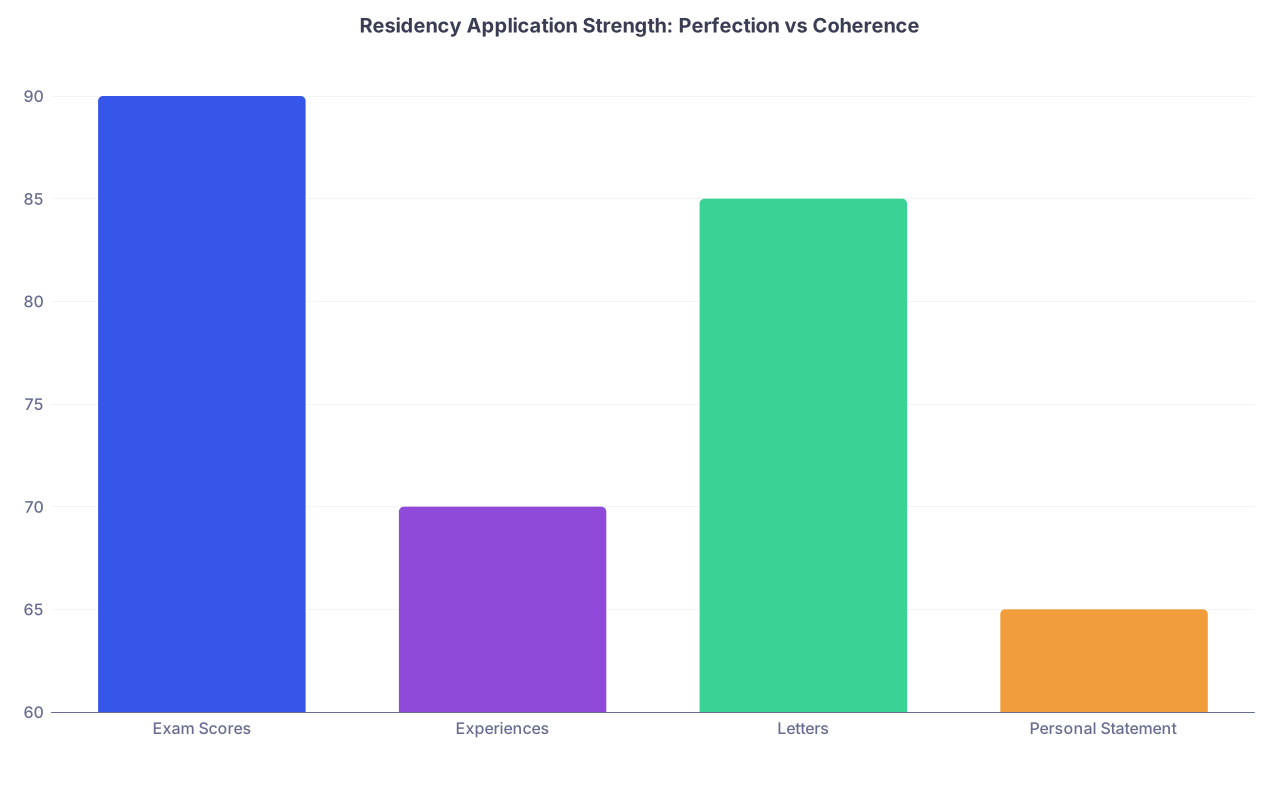
| Category | Value |
|---|---|
| Exam Scores | 90 |
| Experiences | 70 |
| Letters | 85 |
| Personal Statement | 65 |
That’s the “perfect” mindset: max out everything, even if the story is artificial.
Now compare that to this:
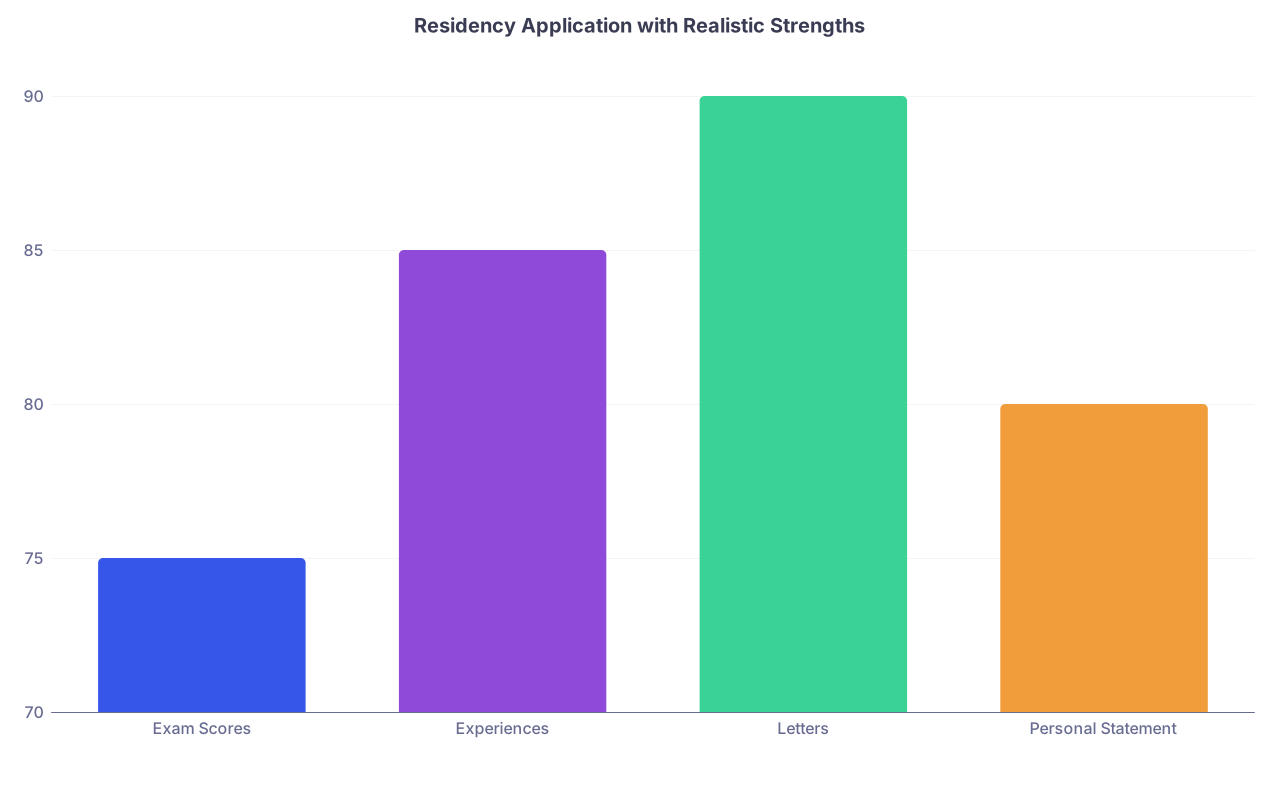
| Category | Value |
|---|---|
| Exam Scores | 75 |
| Experiences | 85 |
| Letters | 90 |
| Personal Statement | 80 |
Same rough “total strength,” but the second one looks like an actual resident in the making, not a Step bot who lived in a library and printed hobbies off a template.
Guess who PDs tend to trust more.
How Over-Engineering Your Application Makes You Blend In
There’s another cost to chasing perfection that people ignore: it makes you boring.
When everyone tries to look like the “ideal” candidate, they all end up with the same:
- Global health trip
- Free clinic volunteering
- Mentor-labeled research line
- Leadership in a specialty interest group
- Statement about “patient-centered, evidence-based, multidisciplinary care”
It’s all safe. And utterly forgettable.
The resident they actually remember in discussions is the one with a credible, specific story:
- The former paramedic who worked nights during M1–M2 and actually stopped some activities to avoid burning out
- The non-trad with a previous career in engineering who did one substantial QI project that used those skills
- The student who had a real mental health dip during M2, reduced load, then came back strong with solid clerkship honors and very real insight into limits
I’ve heard PDs say “I remember this one” about people with:
- A visible gap explained well
- Fewer, deeper experiences they could talk about in detail
- An honest, not melodramatic narrative of failure and course correction
That’s how realism wins: not by showing you’re flawless, but by giving the committee something true enough to stick.
How to Make Your Application Realistic Without Underselling Yourself
Let me be clear: “realistic” is not code for “mediocre” or “lazy.”
It means aligned with who you actually are and what you actually did, presented in a way that helps a PD judge your likely performance and growth.
A few principles that separate realistic strength from the perfect-application trap:
Depth over breadth.
One substantial longitudinal experience beats five random clubs you barely remember.Specificity over adjectives.
“Led weekly case-based teaching for 8 MS2s, redesigned the curriculum after feedback” beats “passionate about education and leadership.”Coherence over decoration.
If you’re going into EM, your trauma research, EMS volunteering, and EM interest group leadership hang together. Throwing in a random dermatology case report from a single shadowing day just to have “more research” muddies the story.Honesty over spin.
A gap, LOA, or low preclinical performance that’s owned, contextualized, and clearly followed by upward trends reads far better than vague excuses or suspicious silence.Voice over perfection.
A clearly human statement with a couple of stylistic imperfections is more persuasive than a flawless wall of clichés.
Here’s the ironic truth: realistic profiles actually take more thought. It’s harder work to filter, prioritize, and align your story than to mindlessly list everything impressive you’ve ever done.
But PDs reward that work, because that’s exactly what they’ll have to do with you as a resident: make sense of your strengths, limits, and trajectory, then trust you with patients.
The Process PDs Use: Risk, Fit, and Story
If you want to understand why realism wins, you have to think like someone who signs contracts and answers to hospital leadership.
The PD doesn’t ask, “Is this the best human ever created?” They ask:
- “Risk: Are they likely to fail exams, burn out, be unprofessional, or quit?”
- “Fit: Will they function in our clinical environment (acuity, call schedule, culture)?”
- “Story: Do their materials all point in the same direction, or are there contradictions?”
Realistic applications help with all three.
Risk: A file with one documented struggle and clear recovery actually reassures them more than a spotless record from someone who’s never had to take a punch.
Fit: Concrete experiences and honest explanations of geography, family, and career goals make it easier to see you in their clinic, OR, or ED.
Story: When letters, CV, and statement echo each other—same strengths, same concerns addressed—it’s easier to defend you in ranking meetings.
Let me sketch the mental flow a lot of them are running, whether they articulate it or not:

| Step | Description |
|---|---|
| Step 1 | Application Received |
| Step 2 | Screened Out |
| Step 3 | Maybe Interview, Needs Discussion |
| Step 4 | Review Experiences & Letters |
| Step 5 | Lower Priority |
| Step 6 | Interview & Rank Higher |
| Step 7 | Score & Exam History Safe? |
| Step 8 | Any Big Red Flags? |
| Step 9 | Coherent Story? |
| Step 10 | Good Fit for Program? |
Where does “perfect” matter there? Mostly at B. Past that, realism and coherence dominate.
The Quiet Advantage of Being Real During Interviews
One last piece: the application doesn’t exist in isolation. It leads directly into interviews.
If you built a fake-perfect persona on paper, you’ve created a trap for yourself. Now you have to play that person in real time.
I’ve watched this crash and burn.
Applicant walks in with a file that reads like “Top 1% of Humankind.” The faculty interviewers:
- Try to probe any weakness or limits. Applicant deflects or spins.
- Ask about one of the 15 activities listed as “most meaningful.” Applicant gives shallow, generic answers because they barely remember it.
- Test how the applicant talks about stress, errors, and learning moments. Applicant gives textbook answers without any real vulnerability.
They walk out saying, “Something felt off” or “I didn’t get a sense of who they are.” That’s death.
Compare that to a realistic profile where:
- The big experiences are real; you can talk about them naturally, including the messy parts.
- Your stated interests line up with things you’ve actually done.
- The imperfections in your record are the same ones you own in person, with the same explanation and growth arc.
Faculty walk out saying, “Yeah, I get this person. They’ll work here.”
The “perfect” application gets you a brittle persona you have to defend. The realistic one gives you ground to stand on.
The Bottom Line: Stop Chasing Perfect, Start Building Credible
Strip away the anxiety and the mythology and you’re left with three blunt facts:
- Program directors do not want perfect; they want predictable, safe, and real.
- Above basic thresholds, coherence, depth, and credibility consistently beat superficial “perfection.”
- The more your application reflects an actual human trajectory—with strengths, limits, and growth—the easier it is for a PD to bet three to seven years of training on you.
That is the actual game. Not hacking your way to some fantasy of the “perfect” ERAS file that doesn’t exist in real life.
If your application makes sense, holds up under scrutiny, and lines up with the person who shows up on interview day, you’re already ahead of most of the field.
Perfect is overrated. Real is matchable.