
“All doctors pay off loans easily” is one of the most persistent, dangerous lies in medical training.
It’s the kind of line you hear from an attending who trained in the 90s, or from a relative who thinks “you’ll be rich, why are you worried?” It sounds reassuring. It’s also wildly out of date and financially reckless if you plan your life around it.
Let me be blunt: some doctors pay off loans easily. Many do not. A non-trivial number never really dig out; they just manage the debt until retirement or push it onto forgiveness with a massive tax bomb at the end.
If you’re making six-figure decisions based on the myth that “it’ll all work out because I’m a doctor,” you’re playing financial chicken with compound interest.
Let’s walk through what actually happens when you mix modern med school tuition, federal loan policy, and real physician salaries — not the fantasy numbers people toss around at dinner parties.
The Numbers: Training vs Income vs Debt
Here’s the uncomfortable arithmetic nobody wants to do out loud at the white coat ceremony.
Current typical federal med school debt for MD grads? Around $200k–$250k is common; $300k+ is absolutely not rare, especially at private schools or for students who borrowed for undergrad too. I routinely see $350k–$450k portfolios from new attendings in high-cost cities.
Residency salaries, meanwhile, hover roughly in the $60–75k range depending on region and PGY level. You are not “a six-figure earner” during the 3–7 years when your balance is growing the fastest.
Now layer in interest. Federal grad loans carry rates in the 6–8% range for most of the last decade. That’s brutal. During residency, even if you’re in an income-driven repayment plan (IDR), your required payment may not fully cover accruing interest, so your balance quietly swells.
Here’s a simple illustration of why this “all doctors pay it off easy” story collapses on contact with reality:
- Starting principal: $300,000
- Interest rate: 7%
- Let’s say your effective residency payments barely touch interest. Four years go by.
- Rough growth at 7% compounded: balance becomes roughly $393,000.
You haven’t bought a house. You haven’t saved for retirement. You just worked 70–80 hours a week and watched your net worth go further negative.
Now you start as an attending. Sure, if you grab a $450k+ job in a no-tax state and live like a resident, you can destroy that balance in under a decade. But that is not the median outcome.
Plenty of primary care and academic roles sit in the $190k–$260k range. After taxes, malpractice, retirement contributions, and something resembling a human life, you’re not pushing $8–10k a month toward loans without pain.
Here’s the comparison that matters:
| Scenario | Debt at Repayment Start | Starting Salary | Debt-to-Income Ratio |
|---|---|---|---|
| Conservative (low debt) | $180,000 | $260,000 | 0.7 : 1 |
| Typical MD private school | $300,000 | $230,000 | 1.3 : 1 |
| High-debt + primary care | $400,000 | $200,000 | 2.0 : 1 |
Historically, a debt-to-income ratio around 1:1 was considered “fine” for physicians. Once you creep toward 2:1, you’re in a zone where “I’ll just knock it out in a few years” is fantasy unless you’re willing to be extremely aggressive and lucky.
The Quiet Killer: Interest and Residency Choices
The romantic version of this myth ignores one thing that ruins otherwise smart physicians: timing.
During med school, most people are in survival mode. So the loans pile up largely unnoticed. Then residency hits and you’re too busy drowning in notes, pages, and 4 a.m. pre-rounds to think about amortization schedules.
But there are three pivot points where doctors either set themselves up to win — or to stay chained to debt for 20+ years.
Pivot 1: What you do during residency
I still hear residents say, “I’ll just go into forbearance; I can’t deal with this right now.” That’s how you light tens of thousands of dollars on fire.
Forbearance means no required payments, but full interest accrual, and you lose the chance for those years to count toward Public Service Loan Forgiveness (PSLF) or other IDR forgiveness clocks.
With modern rules (especially after 2023’s SAVE plan and PSLF fixes), the strategy for most residents is:
- Get on an income-driven repayment plan early
- Make the smallest qualifying payment you can
- Let the IDR/PSLF clock run while you’re in training
That’s not intuitive. It feels wrong because your balance may still grow. But those low payments are “buying” qualifying months toward forgiveness, which is often worth far more than the interest you’re stressing over.
Throwing everything into forbearance because “I’ll be rich later” is the kind of mistake that keeps you paying for an extra five, ten, fifteen years.
Pivot 2: Where and how you practice
The myth assumes one generic “doctor salary.” That doesn’t exist.
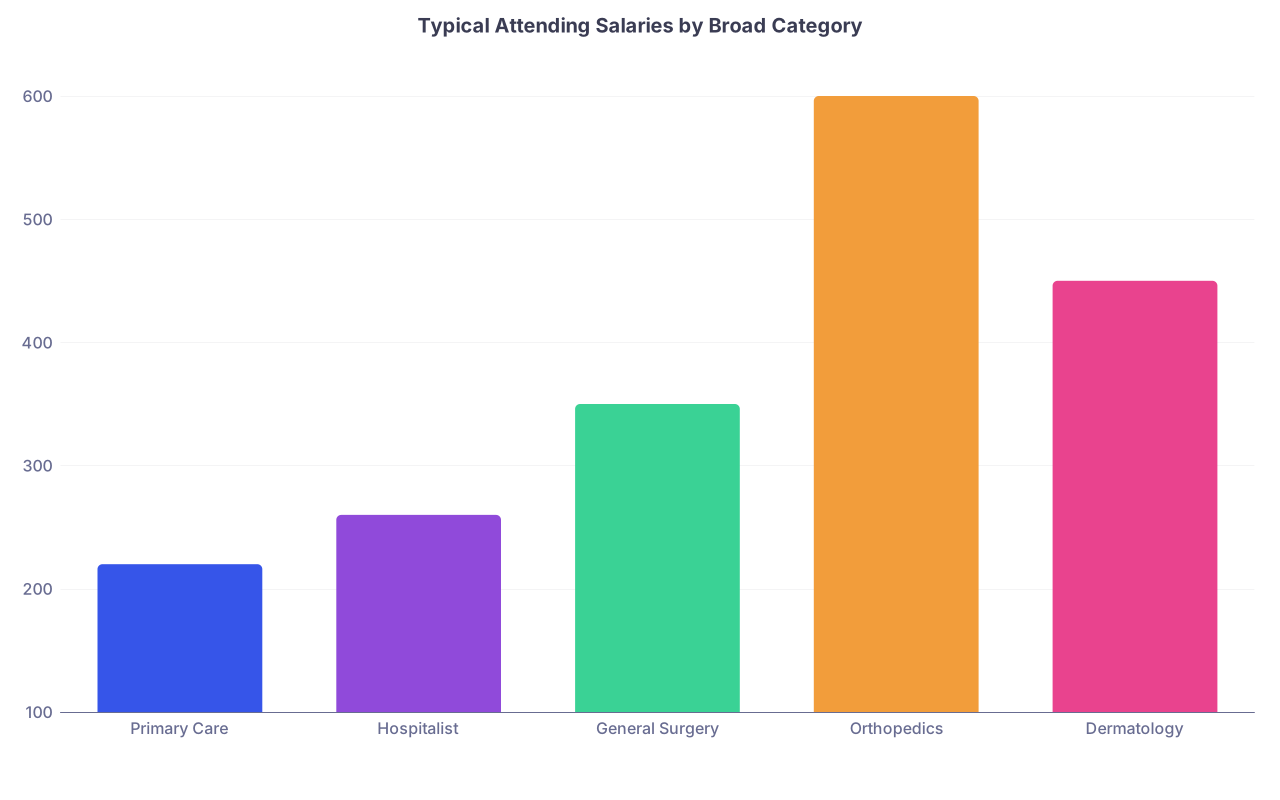
Look at this spread:
| Category | Value |
|---|---|
| Primary Care | 220 |
| Hospitalist | 260 |
| General Surgery | 350 |
| Orthopedics | 600 |
| Dermatology | 450 |
Those are rough, ballpark, and vary wildly by region, call, RVU structures, and academic vs private. But the direction is right.
Now fold in:
- Cost of living (San Francisco vs Midwest)
- State taxes
- Malpractice premiums
- Family size and childcare
A $220k family medicine salary in rural Minnesota with a low mortgage and no state income tax is radically different from $220k in Boston renting a two-bedroom. Same “doctor pay,” completely different loan reality.
Also, some jobs qualify for PSLF (501(c)(3) hospitals, some academic centers, VA), and others don’t (many private groups, some urgent care chains, some telehealth arrangements). Whether your job counts for PSLF can be the difference between grinding for 10 years vs 25.
“All doctors are rich” completely ignores those structural differences.
Pivot 3: Lifestyle in the first 5 attending years
This is where I’ve watched people either escape or get stuck.
Two new attendings finish IM residency with about $300k in loans each:
- Doctor A jumps to a $260k academic job, buys a $900k house with 5% down, leases a luxury SUV, and increases lifestyle everywhere (“I’ve sacrificed enough; I deserve this”).
- Doctor B takes a $260k job at a PSLF-qualifying hospital, rents modestly, drives the same beater from residency for 3–4 more years, shoves $6–8k/month into loans or follows a carefully planned PSLF/IDR strategy.
Same specialty. Same gross pay. Very different financial future.
Doctor A will be “fine.” Eventually. But that’s the point: eventually. There will be 30s and maybe 40s filled with quiet anxiety, delayed savings, and less flexibility.
Doctor B has options by year 5–7: loans gone or on auto-pilot toward forgiveness, retirement savings ramped up, ability to go part-time, change jobs, or walk away from toxic environments.
“All doctors pay it off easily” makes Doctor A’s choices look harmless. They’re not.
PSLF, IDR, and the Fantasy of Simple Forgiveness
Here’s the other side of the myth: “Don’t worry, PSLF will wipe it all away.”
Let’s destroy another lazy narrative. PSLF is powerful. It’s also not automatic, and not everyone qualifies.
To get PSLF, you need:
- Direct federal loans (or have consolidated into Direct loans)
- A qualifying income-driven repayment plan
- 120 qualifying payments while working full-time for a qualifying employer
- Correct paperwork and employer certification over a decade
Most physicians won’t make 120 payments during residency alone; they’ll need both residency and attending years at qualifying institutions. Leave for private practice at year 7 with 80 payments? You probably blew PSLF.
There are also 20–25 year forgiveness paths under IDR plans (like SAVE), but that “forgiveness” can be taxable (unless tax law changes). Translation: you may face a huge tax bill in your 50s or 60s.
So no, “I’ll just use forgiveness” is not an excuse to ignore math.
What PSLF and IDR actually give you, when used correctly, is leverage:
- The option to keep payments lower early in your career
- The chance to structure your career choices (academic vs private, geographic moves) around maximizing or discarding forgiveness
- A way to avoid financial catastrophe when your debt-to-income ratio is ugly (like 2:1)
You still need to think. And plan. And run actual numbers, not vibes.
Who Actually Pays Off Loans “Easily”?
There is a subset of doctors who really do wipe out loans without much struggle. Let’s be honest about who they are, because pretending everyone fits this mold is dishonest.
They tend to have one or more of the following:
- Lower debt to start (public schools, strong family help, scholarships, military HPSP)
- High-paying specialties or geographies (ortho, derm, GI, anesthesia, procedural subspecialties, or just well-negotiated W-2/1099 setups in lower COL areas)
- Aggressive early-phase discipline (living like a resident 3–5 extra years, no house until loans are nearly gone, minimal lifestyle creep)
- Solid financial literacy during training (they learned about IDR/PSLF, interest, and investment basics before graduation, not at age 40)
This group exists. You will meet them. They’ll say things like “I just killed my loans in five years; it wasn’t that bad.”
They are the exception, not the default trajectory. They’re also often oblivious to how much structural advantage they had (supportive family, partner with income, low COL city, no kids in training, etc.).
You’ll rarely hear from the hospitalist in her late 40s still carrying a six-figure balance because every time life stabilized, another financial hit landed — divorce, parent illness, kid with special needs, job change, burnout.
Those stories don’t show up on Instagram. But they’re extremely real in hospital cafeterias at midnight.
What the Data Actually Shows: Not “Easy,” but Possible With Strategy
Let’s cut through to the main question: Are student loans an automatic, crippling life sentence for physicians?
No. But they are a powerful constraint that you either manage on purpose — or get steamrolled by.
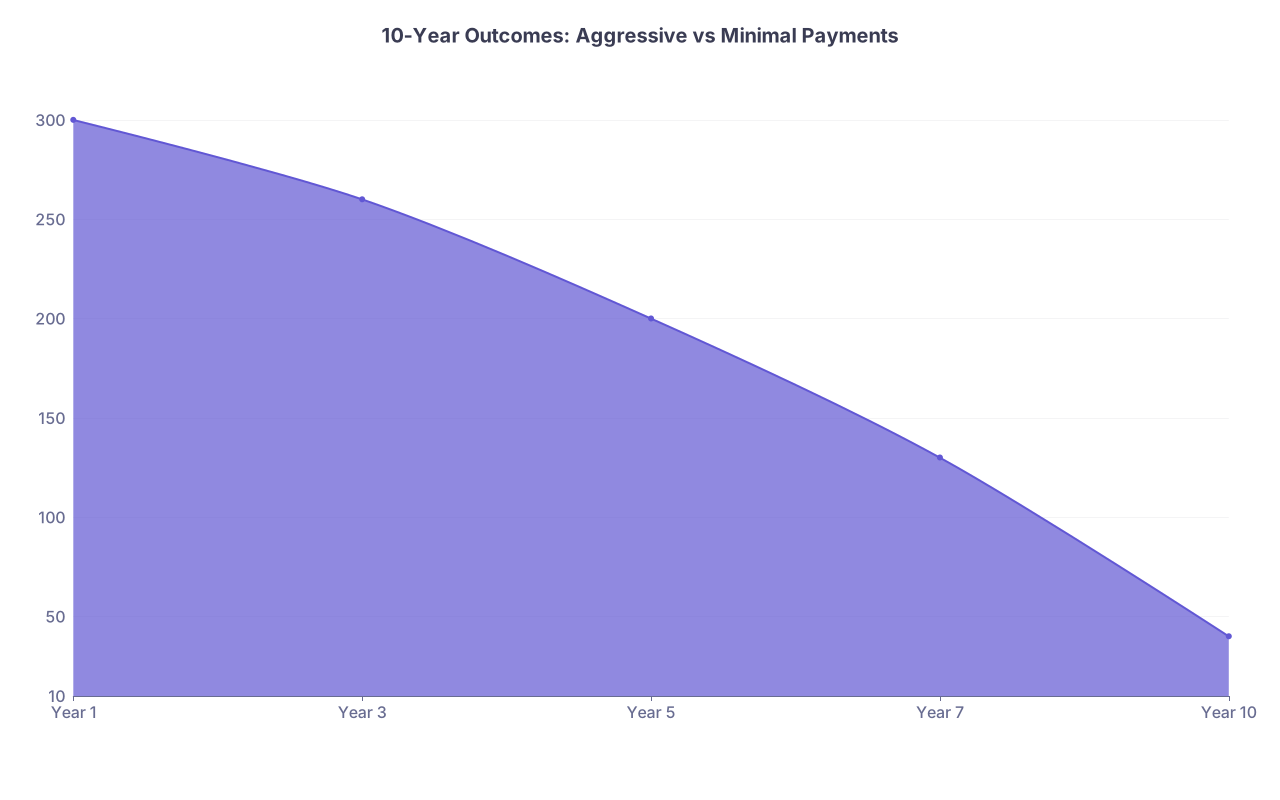
Look at a simplified contrast: same debt, different strategy over 10 years as an attending.
| Category | Value |
|---|---|
| Year 1 | 300 |
| Year 3 | 260 |
| Year 5 | 200 |
| Year 7 | 130 |
| Year 10 | 40 |
Think of that line as the attending who:
- Forces payments high (or optimizes PSLF)
- Avoids big lifestyle jumps early
- Treats the loans like a 5–10 year emergency, not a background hum
Now compare the physician who:
- Makes minimum payments on a non-optimized plan
- Refinances badly or at the wrong time
- Buys the big house and big car immediately
That second doc often looks fine on paper — nice life, good income, respectable title — but carries loans into midlife, with heavily delayed retirement savings. They probably will “pay it off.” Eventually. But it was not easy, and the opportunity cost is enormous.
The danger of the myth is not that it’s totally false. It’s that it hides the tradeoffs.
Many doctors can pay off loans. Few can do it easily while living in a high-cost city, buying the expensive house right away, working fewer hours, and starting late on retirement savings. Something has to give: savings, lifestyle, geography, specialty, or timeline.
So What Should You Actually Do?
You do not need a PhD in finance. You need basic clarity and a refusal to make blind assumptions.
Here’s the stripped-down, reality-based approach:
Know your numbers early. Not “ballpark.” Actual projected debt at graduation with interest, and likely income in your chosen specialty. Run a rough debt-to-income ratio.
Treat residency like the strategic phase, not a pause button. Get on a qualifying IDR plan. Certify employment if PSLF-eligible. Do not casually go into forbearance just because everyone around you says “that’s what people do.”
Decide on a path: forgiveness-focused vs payoff-focused. PSLF/IDR and aggressive payoff are different games with different rules. Mixing them without intent is how people waste money.
Control lifestyle for the first 3–5 attending years. That’s the window where you either explode the debt or let it calcify into something you live around for decades.
Get real advice if your situation is complex. A fee-only planner who actually understands physician student loans is cheaper than years of bad decisions.
The Bottom Line
Three things I want you to walk away with:
- “All doctors pay off loans easily” is outdated nonsense. Modern tuition + interest + realistic salaries make that statement flatly wrong for many physicians.
- Some doctors do pay off loans quickly and relatively painlessly — but they usually have lower debt, higher pay, better planning, or all three. That is not automatic just because you have an MD or DO.
- The gap between “crushed by loans” and “financially free” is mostly strategy in the first 10–15 years: understanding your options, using IDR/PSLF intelligently, and not letting lifestyle creep outrun your actual math.
The MD makes you a doctor. It does not make the loans disappear.