
The biggest myth about divorce and med school loans is this: people think the debt magically becomes “ours” just because you were married. It usually does not.
If you’re staring at a divorce while sitting on $250k+ of med school debt, you are not dealing with a theoretical problem. You’re dealing with:
Who is legally on the hook?
How bad do income-driven plans get when your ex’s income disappears?
Can a judge stick your spouse with part of your loans?
Let’s walk through what actually happens and what you should do right now, step by step.
1. First Reality Check: Whose Name Is On The Med School Loans?
Here’s the basic rule that people mess up constantly:
Student loans follow the borrower, not the marriage.
If the loans are in your name only (no co-signer):
- You are legally responsible for them.
- Your ex does not automatically take any of that debt after divorce.
- The lender does not care about your divorce decree. At all.
If there are joint obligations or co-signers, then it gets interesting.
Common setups I see with med school debt
Federal Direct Loans only (no co-signer)
This is the most common for med students and residents now.
In that case:- The loans are 100% yours.
- Divorce does not change the contract.
- The fight is usually about who pays other stuff so you can afford the loans, not about splitting the loans themselves.
Private refinance with a spouse as co-signer
Example: You refinanced $300k with SoFi, spouse co-signed because you were still a resident with low income.Legally:
- You’re both on the hook to the private lender.
- The lender can go after either of you for the full amount if you default.
- The divorce court can assign responsibility (e.g., “Doctor pays this loan”), but if you stop paying, the lender can still chase the co-signer. The decree doesn’t shield them from the bank.
Spouse took out PLUS loans or private loans “for you”
Say your spouse borrowed Parent PLUS or private loans in their name to support school living costs. Those are their loans in the lender’s eyes, even if the marriage considered them “for your education.”
Bottom line:
Before you worry about “who should pay,” figure out “who does the bank see as the borrower.”
Pull a full list:
- Federal: studentaid.gov – check loan types, balances, servicers
- Private: pull a recent credit report (annualcreditreport.com) and list all student lenders
Write down: Whose name? Federal or private? Any co-signer? Refi contract?
That’s the map you’ll use with your lawyer and any financial planner.
2. Community Property vs Equitable Distribution: Does Your State Matter?
Yes. It matters a lot, but not in the way people think.
There are two big systems for divorce property and debt in the US:
| System Type | Example States |
|---|---|
| Community Property | CA, TX, AZ, WA |
| Equitable Distribution | NY, FL, IL, MA, GA |
That’s not a complete list, but it gives you the idea.
Federal vs state: who controls what?
- Loan contract (who owes lender) = federal law / contract law
- How divorce court treats debt between spouses = state law
So a California judge can say, “We consider half this debt to be marital,” but the lender still only sees the borrower(s) on the note.
How courts often treat med school loans
Pattern I see in many cases:
- If loans were taken out before marriage
Often treated as separate debt of the borrower. - If loans were taken during marriage, but only in one name
Depends:- Some judges say: the degree will generate higher income, so the degree-holder keeps the debt.
- Some say: the marriage benefited from the future earnings, so a portion of marital assets might offset that. Rarely do they actually “assign” part of the student loan to the non-borrower spouse.
- If both spouses are doctors with loans
Usually each keeps their own educational debt, then the court handles everything else (house, retirement, support) to create something “fair.”
Do not assume: “We live in a community property state so my spouse automatically owes half my med school loans.”
That’s not how the contracts work, and most courts are reluctant to saddle a non-degree spouse with professional school loans in their name.
What actually happens more often:
The doc keeps the loans, the other spouse may get:
- More of the house equity
- More of retirement accounts
- Higher spousal support for a period
The court tries to balance overall fairness, not literally split each debt 50/50.
3. The Big Mess: Income-Driven Repayment, PSLF, and Divorce
If you’re on an income-driven plan (IBR, PAYE, SAVE/REPAYE), divorce can dramatically change your monthly payment. This is where most med couples get blindsided.
Key idea:
IDR plans look at your “household income” and family size, but how that is defined changes once you’re divorced and depending on how you file taxes.
Federal loans and income-driven plans after divorce
- After divorce, you can usually certify your income based on your income only (not your ex’s), once you’re no longer filing jointly.
- That can drop your monthly payment a lot if your ex made good money.
- If you’re pursuing PSLF:
- Lower payments = more forgiven.
- Divorce can actually accelerate your effective subsidy.
But timing matters:
- If you’re still married and file jointly:
IDR may use combined income (depending on plan). - If you’re separated or divorced and file separately:
Your payment can be recalculated using just your income.
Here’s a simplified comparison for a resident making $70k, married to a spouse making $150k:
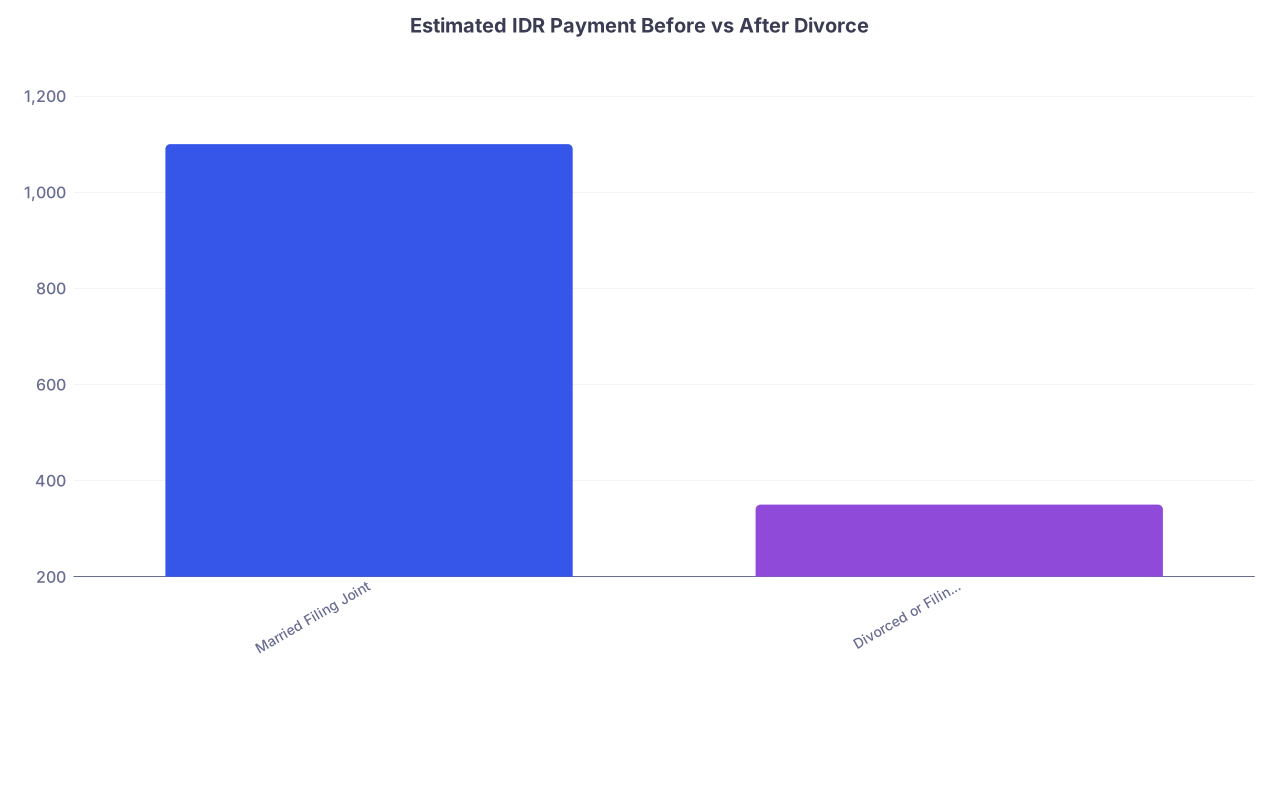
| Category | Value |
|---|---|
| Married Filing Joint | 1100 |
| Divorced or Filing Separate | 350 |
Rough ballpark, but I’ve seen jumps exactly like that.
What you should actually do
Ask your divorce attorney and accountant about filing status for this year:
- Married filing separately vs jointly this last year before divorce is final.
- Run the numbers: tax cost vs IDR savings. Sometimes paying more tax is still cheaper overall if your loan payment drops for 12 months.
As soon as the divorce is finalized or you separate:
- Update income-driven repayment paperwork.
- Submit an “alternative documentation of income” if your circumstances changed.
- Make sure your loan servicer knows your new family size and marital status.
If you’re aiming for PSLF:
- Keep working for a qualifying employer (government or 501(c)(3)).
- Do not let a missed recertification or chaos during divorce knock you into forbearance for months. Those months don’t count.
4. Private Refinance: The Trap Almost No One Thinks About Until It’s Too Late
Refinancing federal med school loans into private loans while married can bite you in divorce for three reasons:
- You lose federal IDR flexibility and PSLF options.
- The interest rate may look great but you lose hardship protections.
- If your spouse co-signed, you’re tied financially even after divorce unless the lender releases them.
I’ve seen this scenario:
- PGY-3, $280k in federal loans at ~6.8%
- Spouse is a software engineer making $200k
- They refinance to a private 4% 10-year loan, spouse co-signs
- Two years later they divorce, now-attending makes $300k, ex makes $250k
- Private lender won’t release the ex as co-signer because the attending is “borderline” on their own under new underwriting
Result: The ex is stuck with exposure on a $250k+ loan for someone they’re no longer married to. Even with a divorce decree saying “Doctor pays,” the lender can still come after the ex if the doctor stops paying.
What to do if you’re already in the trap:
- Talk to the lender about co-signer release. Some allow it after a number of on-time payments; some do not.
- If your attending income is strong, apply to refinance again in your sole name with a different lender.
- Do not sign a divorce agreement that pretends the co-signer risk doesn’t exist. Put in writing:
- Who must refinance by when
- Who must indemnify whom if the lender ever pursues the co-signer
- What happens if refinance isn’t approved (e.g., additional assets or support to compensate)
5. How Courts Actually Use Loans When Dividing Everything Else
Here’s how this usually plays out in the real world in a fairly typical scenario:
You: IM attending, $320k federal med school loans, on SAVE, going for PSLF at a nonprofit hospital. Married 8 years. Two kids. Spouse worked part-time and did most childcare.
Divorce court is looking at:
- Your earning power: rising, stable, strong.
- Your debt: large but manageable under IDR and PSLF.
- Spouse’s earning power: lower, maybe career was slowed by childcare.
Likely outcomes I’ve seen:
- You keep 100% of your med school loans.
- Spouse gets more of:
- House equity
- Retirement accounts
- Possibly longer or higher spousal support
- Child support calculated from your income, not your loan payment. Courts don’t usually give you full credit for high student loan payments when calculating support, especially for professional degrees.
Judges often see med school debt as the “price of admission” to your career. That means you keep both the credential and the obligation, and the other stuff gets shifted to make the whole thing feel more even.
So if you walk in expecting, “We’ll just split my $320k in half,” you’re going to be disappointed. Plan for the more realistic scenario: you keep the loan, and you negotiate everything else with that premise.
6. Step-by-Step Playbook: What To Do If You’re Divorcing With Med School Debt
Here’s the practical part. Do this in order.
Step 1: Get crystal clear on the loans
List every loan with:
- Lender/servicer
- Balance
- Interest rate
- Type (federal vs private; Direct, Grad PLUS, etc.)
- Borrower’s name
- Any co-signer
You cannot negotiate intelligently if you’re hand-waving numbers.
Step 2: Clarify your repayment strategy before finalizing divorce
You need a plan like one of these:
- Federal, staying in PSLF with IDR
- Federal, paying aggressively as attending and done in 5–10 years
- Private refi post-divorce in your name only
- Mixed strategy (some PSLF-eligible, some private, some aggressive payments)
Why this matters:
The way you’ll handle loans affects how much cash you’ll have every month, which affects:
- Spousal support arguments
- Child support (sometimes)
- Housing decisions
- Retirement contributions
Bring rough projections to your lawyer. Your lawyer is not a loan planner. Do not assume they understand SAVE vs PSLF vs private refinance.
Step 3: Decide how to use property and support to offset loan burden
You’re probably keeping the loans. So negotiate around that:
You might say:
“I’ll take full responsibility for my med school loans. In exchange, I keep more of my retirement account and we split the house equity slightly in my favor.”
or
“I’ll agree to higher support for a period if we recognize in the settlement that I’m also servicing substantial educational debt.”
Be strategic. Don’t just emotionally accept “all the debt” without getting anything in return on the asset or support side.
Step 4: Nail down IDR and taxes with a pro
Talk to a CPA who actually understands student loans or a student loan planner. You want clarity on:
- Should you file married filing separately this year if you’re still technically married?
- How will that affect your current IDR payment vs joint filing?
- After divorce, when should you recertify income to drop your payment?
This is one of those areas where a 1-hour paid conversation can save you thousands.
Step 5: Put loan-related obligations in the divorce decree
You cannot change the lender’s contract, but you can:
- Specify who is responsible for which loans.
- Require refinance by a certain date (if there’s a co-signer spouse).
- Allocate consequences if someone doesn’t follow through.
Is it enforceable? Depends on state law, but having it in writing gives you a fighting chance if your ex decides to stop paying a loan the court said they’d cover.
7. Common Scenarios and How I’d Handle Them
Let me give you a few concrete situations I’ve seen versions of.
Scenario A: Resident, huge loans, non-med spouse, early divorce
You: PGY-2 with $280k federal loans on SAVE. Spouse earns $60k. No kids. Married 3 years.
What probably happens:
- You keep 100% of your student loans.
- Few assets to split.
- Likely minimal or no long-term spousal support given both are early career.
Your move:
- Negotiate clean separation of finances.
- As soon as you’re separated, recertify IDR based only on your income if you were using joint income before.
- Do not even think about private refinancing yet.
Scenario B: Two doctors, both with med school debt
You: Cards fellow, $400k loans.
Spouse: Anesthesiologist, $350k loans. No kids, higher assets, both high income.
Most judges will say:
- Each keeps their own med school loans.
- Bigger fight will be over:
- House
- Investments
- Retirement accounts
- Maybe short-term support if there’s a small earnings gap, but it’s not a breadwinner/non-earner dynamic.
Your move:
- Do not waste time trying to get the court to split your loans. Focus on assets and clean separation.
- Consider each of you handling your own refinance/PSLF strategies independently after divorce.
Scenario C: Co-signed refinance disaster
You: Attending hospitalist, $220k private refi, ex-spouse co-signed. Income solid but not amazing ($230k). Divorce now.
Your biggest goal:
Get that ex off your loan. Fast.
Your move:
- Apply for a new refinance in your name only with multiple lenders.
- Show your ex (and their lawyer) the offers and timeline.
- Put in the decree something like:
- “Doctor will refinance the XYZ loan into their name only within 6 months. Until then, Doctor will pay and indemnify Spouse for any claims arising from this loan.”
- If you absolutely cannot refi solo now, consider:
- Giving the ex more of another asset in exchange for staying on temporarily.
- Committing in writing to refinance as soon as income increases or debt falls below set threshold.
8. Visualizing Your Post-Divorce Loan Strategy
If you’re a visual person, here’s the mental flow of your next year:

| Step | Description |
|---|---|
| Step 1 | Divorce or Separation |
| Step 2 | List all loans and borrowers |
| Step 3 | Choose IDR plan and PSLF vs non PSLF |
| Step 4 | Check for refi options and co signers |
| Step 5 | Decide tax filing status |
| Step 6 | Re certify income after status change |
| Step 7 | Refinance to solo if possible |
| Step 8 | Update budget and support expectations |
| Step 9 | Review annually or with big life changes |
| Step 10 | Federal or Private |
That’s basically your roadmap for the next 6–12 months.
FAQs
1. Can a divorce judge force my ex to pay part of my med school loans?
The judge can allocate responsibility between you and your ex in the divorce order, but that does not change the loan contract. If the loans are only in your name, the lender still sees only you. The court could say, for example, “Ex pays you $X per month as reimbursement,” but they will not become a legal borrower to your servicer. Enforcement is through family court, not the lender.
2. Will my student loans be reduced or forgiven because I divorced?
No. Divorce by itself does not reduce or forgive student loans. The only indirect “relief” you might get is:
- Lower IDR payments if your household income drops and you certify just your income.
- Potentially better positioning for PSLF because those smaller payments still count toward forgiveness.
But the principal doesn’t vanish because of the divorce.
3. Does child support or alimony get reduced because I have huge med school loans?
Usually not in the way you’re hoping. Courts look primarily at income, needs, and custody. Some judges will consider high student loan payments when setting support, but professional school loans are often seen as a voluntary career investment. You should not assume your $2k/month loan payment will be fully “credited” in support calculations.
4. Should I delay refinancing until after the divorce is final?
In many cases, yes. Here’s why:
- If you refinance while still married, you might be tempted or pressured to involve your spouse as a co-signer. Bad idea given the divorce.
- Your solo income as an attending post-divorce might qualify you for similar or better rates on your own.
- Refinancing federal loans before you’re sure you won’t need IDR/PSLF flexibility is risky during a life change like divorce.
Get the legal and income picture stable, then refinance in your name only if it still makes sense.
Key takeaways:
- The loans belong to whoever signed for them, not to “the marriage,” and the lender doesn’t care about your divorce decree.
- Divorce can actually help federal loan payments if it separates your income from a high-earning ex, especially on IDR and PSLF.
- Use the divorce settlement to balance the fact that you’ll likely keep all your med school debt—through asset division, support, and clear written obligations—rather than fantasizing about the court “splitting the loans.”