
Last month I talked with a dual-physician couple: PGY-2 IM and PGY-1 EM. Combined income ~ $130k. Combined federal loans? $680,000. Private loans on top. They said the same line I hear constantly: “We’re doing OK individually, but together this feels unmanageable.”
If that feels familiar, this is for you. You’re not just “two people with debt.” You’re a financial unit now, and the rules change when you put two big loan portfolios under one roof.
Step 1: Get Brutally Clear on the Numbers (Together)
Do this before you talk strategy, PSLF, refinancing, anything.
You need a shared loan dashboard. Not “I roughly owe 300k.” Exact numbers.
Sit down one evening and collect:
Each person’s federal loans:
- Loan types (Direct Subsidized/Unsubsidized, Grad PLUS, Perkins, FFEL if any)
- Servicer (MOHELA, Nelnet, Aidvantage, etc.)
- Current balances and interest rates
- Status (in repayment, grace, forbearance)
- How many qualifying PSLF/IDR months each already has (log into StudentAid.gov)
Each person’s private loans:
- Lender, balance, rate, variable vs fixed
- Cosigners (parents? each other?)
- Current monthly payment
Each person’s income:
- PGY level, current annual salary
- Moonlighting? 1099 work?
- Expected attending salary ranges by specialty and setting
Create an actual table (Excel/Sheets, not just in your head). Something like this:
| Item | Partner A (IM) | Partner B (EM) |
|---|---|---|
| Federal loans total | $320,000 | $360,000 |
| Avg federal interest rate | 6.3% | 6.8% |
| Private loans total | $40,000 | $0 |
| PSLF-eligible months | 8 | 0 |
| Current PGY salary | $70,000 | $62,000 |
You cannot coordinate a joint strategy if you don’t see the full combined picture.
Two rules here:
- No shame language. “Your loans are worse” is banned. It’s “our situation.”
- Full transparency or expect future fights. Hidden loans or “I’ll just handle mine” is a disaster later when budget decisions get tight.
Step 2: Decide Your Core Objective as a Couple
Dual-physician couples usually fall into one of three categories:
- Both headed to PSLF-eligible careers (academic, VA, non-profit hospital).
- One PSLF-eligible, one probably private practice.
- Both planning private or non-qualifying settings.
Your core objective as a unit depends on this:
If you’re both PSLF-eligible long term:
- Primary goal: Maximize PSLF value while maintaining lifestyle sanity.
- That usually means staying in income-driven repayment (IDR) and minimizing taxable income strategically while hitting 120 months of qualifying payments each.
If only one is PSLF-eligible:
- Goal: Optimize that person’s PSLF path, while aggressively managing or refinancing the other’s loans when appropriate.
If neither is PSLF-eligible:
- Goal: Minimize total interest and pay down quickly, often via aggressive refinancing after training.
You need to say out loud: “Our primary strategic goal is _______.”
If you skip this and just tinker with monthly payments, you’ll overpay interest or miss forgiveness opportunities.
Step 3: Understand How Your REPAYE/ SAVE Payments Interact
Here’s the part that screws up a lot of couples: income-driven repayment is calculated per borrower but based on household income, depending on how you file taxes and which plan you pick.
You don’t need to be a policy nerd, but you must understand the levers:
- Every borrower gets their own IDR calculation.
- For most modern plans (especially SAVE), married filing jointly usually means both of your incomes are counted for both of your payments.
- Some plans (like PAYE and old IBR) let you use only your own income if you file married filing separately (MFS).
We’re at the point where SAVE is the main game, but married filing choices still matter.
So your actual decision tree looks more like this:

| Step | Description |
|---|---|
| Step 1 | Married dual physicians |
| Step 2 | REFI post training |
| Step 3 | Lower total tax - higher IDR |
| Step 4 | Higher tax - lower IDR |
| Step 5 | Prioritize PSLF borrower IDR |
| Step 6 | Plan for refinance and payoff |
| Step 7 | Any PSLF goal? |
| Step 8 | Both on SAVE? |
| Step 9 | Which has more debt? |
| Step 10 | Joint vs Separate taxes |
The key point: the tax filing choice is not just a tax issue. It’s a loan issue. And dual-physician couples have large incomes and large debts—so the stakes are high.
You need:
- A tax projection (Joint vs MFS) using software or a CPA.
- An IDR projection (Joint vs MFS) using something like StudentAid’s loan estimator or a physician-specific loan advisor.
Then you compare: extra tax paid vs IDR savings. Often this is thousands of dollars difference either way.
Step 4: Pick a Coordinated Strategy Based on Your Path
Now let’s get more concrete.
Scenario A: Both in PSLF-Eligible Jobs Long Term
Example: IM hospitalist at a 501(c)(3) system + Child psych at academic center.
Joint strategy:
Both on SAVE (or best available IDR) during residency
Make sure every payment is qualifying PSLF time. No forbearance “breaks” unless there’s a true emergency. That forbearance will haunt you.Decide tax filing status annually with PSLF in mind
For high debt-to-income, MFS sometimes wins. For lower debt or big pay gaps, MFJ might be just fine.No private refinancing of federal loans
If there’s a plausible PSLF path, don’t kill eligibility by refinancing federal loans into private during or right after training.Track PSLF counts annually for both
MOHELA will screw this up at some point. Fixing it early is easier than 10 years later.Agree on a lifestyle ramp-up schedule after training
If you both jump to maximum lifestyle the moment you’re attendings, even with PSLF coming, you’ll feel constantly squeezed. Decide:- Years 1–3 attending: live on X, save/pay off side goals with the rest.
- After PSLF hits: adjust.
This path usually produces the largest net financial win, but only if you’re actually committed to staying in qualifying employment.
Scenario B: One PSLF, One Private Practice Likely
Example: Academic rheumatologist + private practice dermatologist.
This is where couples get into trouble if they treat everything “equally.” It’s not equal.
Here’s the clean way to handle it:
PSLF-bound partner
- Stick with SAVE or other best IDR.
- Strongly consider MFS if their debt is huge and the private-practice spouse will have very high income.
- Focus on maximizing PSLF value: long-term in qualifying employer, low taxable income where reasonable (retirement accounts, HSA, etc.).
Private-practice-bound partner
- Stay IDR during residency/fellowship.
- Once in attending private practice and income stabilizes:
- Recalculate: Does PSLF remain realistic? Probably not if they’re now non-qualifying.
- At that point, strongly consider refinancing to a lower rate and attack aggressively.
Do not let the PSLF spouse subsidize the non-PSLF spouse’s refinancing at the expense of their own PSLF advantage.
Translation: don’t divert money that should be building your PSLF “arbitrage” (paying less than what’s forgiven) just to feel good about the other person’s declining balance.
You can absolutely help each other, but do it after you’ve maximized the PSLF path.
Scenario C: Neither Planning PSLF-Eligible Careers
Example: Two orthopedists joining private groups. Total loans = $900k.
PSLF is off the table. Now the priority is simple:
- Minimize interest.
- Attack principal aggressively.
- Avoid dumb mistakes in early career.
Your rough playbook:
During residency/fellowship:
- Stay in an IDR plan like SAVE to keep required payments low and avoid capitalization via unnecessary forbearance.
- Make extra payments only if it doesn’t crush your emergency fund or retirement savings.
End of training → refinance decision
Once both of you:- Have signed attending contracts
- Are comfortable with the job stability and location for at least 2–3 years
Then start shopping individual refinancing offers. Do not automatically do a joint refinance; lenders usually evaluate each of you separately.
Sequence your aggressive payoff.
Instead of each of you paying “whatever” to your loans, coordinate:- Target the highest interest loans first (often private or one spouse’s worst-rate batch).
- Maintain required minimums on everything else.
- Throw all extra cash at the single worst rate until gone.
- Then move down the list.
This is where being married to another physician becomes a superpower—if you don’t inflate your lifestyle to match your combined income immediately.
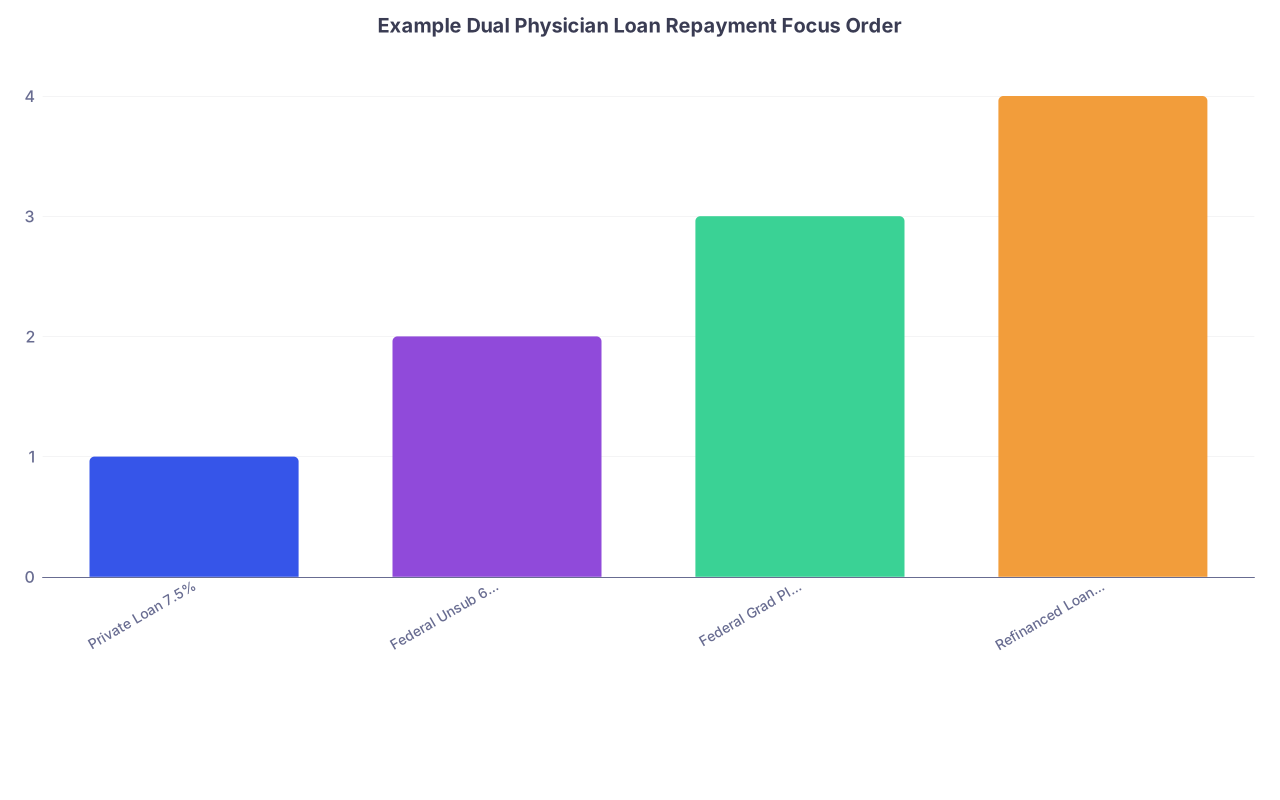
| Category | Value |
|---|---|
| Private Loan 7.5% | 1 |
| Federal Unsub 6.8% | 2 |
| Federal Grad Plus 6.3% | 3 |
| Refinanced Loan 4.25% | 4 |
The chart above is not about dollar amounts—it’s the priority order. The exact numbers are yours to fill in.
Step 5: Coordinate Taxes, Retirement, and Loans as One System
Most couples treat these as separate silos: “Here are our loans. Separately, here are our 403(b)s.” That’s lazy planning.
Loans, taxes, and retirement are tightly interlocked for you.
Here’s how to think about it:
- Maxing pre-tax retirement (403(b)/401(k), 457 if available) lowers your IDR payments (because it lowers AGI).
- Filing MFS may:
- Increase your overall tax bill.
- But substantially decrease IDR payment for the higher-debt spouse.
- HSA contributions, pre-tax FSA, and other deductions also lower AGI → lower IDR.
You should be asking each year:
- How much do we save by:
- Filing MFJ vs MFS on taxes?
- Having one or both max 403(b)/401(k)?
- Using traditional vs Roth contributions this year given our IDR situation?
- Can we use pre-tax contributions as a way to legally reduce our loans cost without under-saving for retirement?
Sometimes, the best play is:
- PSLF-eligible spouse:
- File MFS, use pre-tax 403(b)/457 to drive down IDR payment.
- Non-PSLF spouse:
- Max Roth or do backdoor Roth for long-term wealth building.
You’re not just choosing a loan plan. You’re engineering your entire taxable profile around your loans.
Step 6: Decide How “Joint” Your Money Really Is
Now the touchy part. Mechanics are easy. Emotions are not.
When one spouse has $150k and the other has $450k, resentment can creep in fast if you don’t define the rules.
You need a candid conversation and an explicit policy. Some workable models I’ve seen:
Fully joint model
- All income goes to joint accounts.
- All loans considered “family debt.”
- Payments come from joint pool, no tracking of “who got more help.”
- This requires high trust and alignment.
Proportional fairness model
- You agree to fund payments according to some ratio:
- By original principal
- Or by income
- Example: One owes 1/3 of combined debt, the other 2/3 → you split total loan payment 1/3 vs 2/3 from your respective “allowance” or personal accounts.
- You agree to fund payments according to some ratio:
Hybrid
- Joint account covers minimum payments for both.
- Any extra aggressive paydown uses a ratio formula or is discussed case-by-case.
What I rarely see work long term is:
“We’ll each just manage our own loans separately.”
That sounds fair but fails when:
- One partner picks PSLF and low payments, the other refinances and pays $5k/month.
- One takes longer training (e.g., cards, GI), earning less, but ends up with greater long-term income.
- Kids and housing show up.
If you don’t draw the lines early, you’ll default to whoever’s more stressed at the moment… which is not a strategy.

Step 7: Plan for Life Events That Will Disrupt the Plan
Your joint debt strategy isn’t happening in a vacuum. Over the next 5–10 years, you’re probably going to:
- Move at least once (maybe across states)
- Switch jobs at least once each
- Consider buying a house
- Maybe have children
- Deal with parental health or financial issues
These all hit the loan plan.
Some guardrails that help dual-physician couples:
Do not buy a house just because you “feel behind” classmates.
With massive debt, you need:- Stable attending income for at least 6–12 months
- A real emergency fund (3–6 months of combined expenses)
- A clear loan strategy before you stack a mortgage on top.
Keep your fixed expenses lower than your colleagues initially.
You’re fighting gravity here: two high incomes make lifestyle creep feel “normal.” It’s not. If 40–50% of your take-home is locked into fixed recurring bills, you’ll have no flexibility to attack loans or handle job changes.Revisit your loan plan every year
At minimum:- When either of you changes jobs
- When you switch from trainee to attending
- When you get married (if not already)
- When you have a kid
Your first plan will be wrong in some way. That’s fine. The couples who win are the ones who revise on purpose, not react only when something breaks.
Step 8: When to Pull in Professional Help (And What to Avoid)
There are three main types of “help” you’ll run into:
- Loan servicers – They can tell you what’s allowed. Not what’s smart.
- Generalist financial advisors – Some are good, many are clueless about PSLF/IDR nuance.
- Physician-focused student loan planners or fee-only advisors – Generally your best bet.
Look for:
- Someone who has worked with dual-physician couples specifically.
- Fee structure that’s flat or hourly, not based on assets (you won’t have many investable assets yet, most of your “net worth” is negative).
- Willingness to run Joint vs MFS tax + IDR optimization side by side.
Avoid:
- Anyone who pushes you hard into refinancing federal loans when PSLF is even moderately plausible.
- Advisors whose main “value” is selling you whole life insurance while hand-waving your debt.
You probably don’t need ongoing, years-long planning at PGY-1. But one or two deep sessions around:
- End of residency/fellowship
- First year as both attendings Can easily be worth thousands in avoided mistakes.
Quick Example: How It Might Look in Real Life
Let me stitch one together.
- Partner A: Pediatrics → Academic hospitalist, $280k expected.
- Partner B: Anesthesia → Private practice, $450k expected.
- Debt: A = $260k federal, B = $420k federal + $40k private.
A possible coordinated path:
During residency/fellowship:
- Both on SAVE, MFJ while income is low.
- Track PSLF months for A; B accumulates IDR credit but likely won’t use PSLF.
Transition to attending:
- A takes academic job at PSLF-eligible hospital.
- B joins private group.
Year 1 of dual-attending income:
Run tax projections MFJ vs MFS.
Run SAVE/IDR projections under both statuses.
Discover:
- Filing MFS raises tax bill by $5k/year.
- But cuts A’s IDR payment by $12k/year and keeps PSLF value high.
→ They choose MFS.
B refinances only B’s private loans immediately to a lower rate, keeps federal on IDR for now until sure private practice job is stable.
After 12–18 months of stable income:
- B refinances federal loans aggressively with 5–7 year payoff target.
- A stays on IDR for PSLF.
They agree:
- Joint account covers:
- Both minimum payments (A’s IDR, B’s refi)
- Max 403(b) for A and backdoor Roth IRAs for both
- Any additional extra loan payoff:
- Goes to B’s highest-rate refinanced loans first, because PSLF makes A’s effective interest rate low.
In 10 years:
- A hits PSLF, wipes out remaining federal balance tax-free.
- B is already debt-free because of aggressive refi payoff.
- Their net worth difference vs two random, uncoordinated IDR paths? High six figures, easily.
That’s what a coordinated dual-physician loan strategy can actually look like.

FAQ (4 Questions)
1. Should dual-physician couples always file taxes married filing separately to lower IDR payments?
No. Sometimes MFS is dumb. You need to actually compare the extra tax cost vs the IDR savings. For some couples with moderate loans relative to income, MFJ plus higher IDR payments is better overall. For very high debt-to-income ratios—especially when one or both are going for PSLF—MFS often wins. But this is math, not vibes. Run real numbers for your actual situation.
2. Is it ever smart for one spouse to refinance while the other stays on PSLF/IDR?
Yes, that’s actually common. For example, if one partner is in a stable private practice job and PSLF is off the table, refinancing their loans can save a lot in interest. Meanwhile, the PSLF-targeted spouse stays on federal IDR and keeps PSLF eligibility. The danger is emotional, not technical: you have to agree as a couple on how much joint money is going toward which loans so no one feels like they’re subsidizing the other unfairly.
3. What if one of us has way more debt than the other—should we keep finances separate?
You can, but most married dual-physician couples are better off treating loans as a joint problem with an agreed set of rules, rather than two separate silos. Otherwise every decision—housing, kids, cars—turns into “your loans vs my loans.” A more functional model is: we’re a team, here’s how we’re going to distribute our combined resources in a way that feels fair and gets us both to a solid place.
4. How soon after finishing residency should we refinance our loans?
Not the day you walk out. Wait until at least one of you has a signed attending contract and has been in the job long enough to feel reasonably confident it’s not a 6-month fling. You also want a basic emergency fund. Once those are in place and PSLF is clearly off the table for that person, refinancing high-rate federal and private loans starts to make sense. For the PSLF spouse? Do not refinance at all if there’s any realistic long-term qualifying employment plan.
Key takeaways:
First, stop thinking “my loans” and “your loans”—build one shared dashboard and pick a primary strategic goal as a couple. Second, treat taxes, retirement savings, and IDR choices as one integrated system, not separate decisions. Third, revisit the plan every year and after major life changes; the couples who adjust on purpose, together, are the ones who actually get out from under this mountain.