If you’re staring at a $250,000 tuition bill, scraping by on $12/hr as a scribe, here’s the real question in your head:
“Is throwing $50 or $200 a month at my loans in med school actually doing anything… or is that just financial cosplay?”
Let’s kill the myths with numbers instead of vibes.
The Big Myth: “Any Payment in Med School Is Better Than Nothing”
This is the line you hear from parents, random attendings, and sometimes even “financial literacy” seminars:
“Just pay something during med school. Every little bit helps!”
Sometimes true. Often misleading.
Occasionally flat-out wrong.
To answer this correctly, you have to separate three different questions:
- What kind of loans do you have (subsidized, unsubsidized, Grad PLUS, private)?
- Are you going for PSLF or long-term income-driven forgiveness, or are you planning to pay everything off?
- What interest rates are we actually talking about?
If you do not tie your actions to those three, you’re just guessing.
First Principle: Interest Math Does Not Care About Your Feelings
Let’s set up a simple example. Say you borrow:
- $60,000 per year
- 4 years of med school
- 7% interest (very typical federal grad rate ballpark over last several years)
Total principal: $240,000.
You borrow at the start of each academic year. Interest accrues while you’re in school.
Rough, but useful math:
- Year 1 loan accrues interest for 4 years
- Year 2 loan accrues for 3 years
- Year 3 for 2 years
- Year 4 for 1 year
Interest accrued by graduation (ignoring compounding during school for simplicity, which slightly underestimates the real number):
- Year 1: $60,000 × 7% × 4 ≈ $16,800
- Year 2: $60,000 × 7% × 3 ≈ $12,600
- Year 3: $60,000 × 7% × 2 ≈ $8,400
- Year 4: $60,000 × 7% × 1 ≈ $4,200
Total interest during school ≈ $42,000
So you graduate with roughly:
- Principal: $240,000
- Accrued interest: $42,000
- Total: $282,000
That’s the starting point.
Now, what if you pay $100/month during med school?
- $100 × 12 months × 4 years = $4,800 total
At 7% interest, that $4,800 prepayment roughly offsets about $4,800 ÷ 0.07 ≈ $68,500‑years of principal-time. Spread over your loan structure, you maybe cut a few thousand off long-term total interest. Not nothing. But not life-changing either.
So yes, mathematically any payment “helps” a little. The real question is: is that the best use of that money and your limited bandwidth?
PSLF & IDR Forgiveness: When Extra Payments Are Literally Throwing Money Away
Here’s where people massively overpay: they make “responsible” extra payments during med school and residency, then end up qualifying for forgiveness anyway.
If you’re aiming for:
- Public Service Loan Forgiveness (PSLF) – 120 qualifying payments while working full-time for a non-profit/government employer (most academic / safety-net hospitals qualify), OR
- Long-term IDR forgiveness – 20–25 years of income-driven repayment with remaining balance cancelled at the end (taxable under current law, unlike PSLF),
then the math changes totally.
With PSLF, your total cost is driven mainly by:
- Your income during residency and early attending years
- Your family size and filing status
- Your chosen IDR plan (SAVE, PAYE, IBR, etc.)
- How early you consolidate and start making qualifying payments
It is not driven by how much your balance grew in med school, because if you make it to PSLF, that extra balance is still wiped out tax-free at year 10 of qualifying payments.
So for someone who:
- Starts repayment (IDR) in PGY1
- Works 10 years in a PSLF-eligible setting (residency + early attending)
- Then gets PSLF
Extra payments in med school are usually:
- Not needed to qualify
- Not required to reduce taxes (PSLF is tax-free)
- Not changing the endpoint: forgiveness of whatever remains
In that scenario, that extra $4,800–$10,000 you squeezed out of med school ramen budget?
You just reduced the amount forgiven. That is the definition of lighting money on fire.
When Paying in Med School Does Make Sense
There are real cases where paying during med school is actually smart. But they’re narrower than most people think.
1. You Have High-Interest Private Loans
If you made the mistake (or were forced by aid policies) to take out private loans at 9–12%, that’s a financial dumpster fire.
Here, even small payments can be surprisingly impactful. At 10%:
- $10,000 private loan
- 4 years of med school
- Simple interest approximation: $10,000 × 10% × 4 = $4,000 interest
If you can aggressively pay down or at least keep interest from ballooning on high-rate private loans, that can absolutely be worth the sacrifice. Private interest isn’t getting PSLF’d.
In other words:
Federal 6–8% loans? Maybe.
Private 10–12% loans? That’s war.
2. You Are Sure You’ll Pay Everything Off (No PSLF, No IDR Forgiveness)
If your plan looks like this:
- Competitive specialty, high attending salary probability (ortho, derm, gas, cards, etc.)
- Strong expectation you’ll be in private practice or a high-paying non-PSLF environment
- Personality leaning strongly toward being debt-free ASAP
Then reducing principal sooner actually matters. Simple reason: compound interest works against you the longer the balance is high.
In this path, there is an argument for some med-school payments, especially targeted at the highest-rate loans.
But honestly? The big lever isn’t $50/month during M2. The big lever is:
- Living at least somewhat like a resident for a few years as an attending
- Aggressively refinancing and throwing 5–10k/month at the balance when you’re finally making $400k+
A lot of “pay early” med students are basically fighting a forest fire with a spray bottle, then later, when it actually matters, they upgrade to a garden hose instead of a fire truck.
3. You Have Unsubsidized Loans Where Interest Capitalization Is Coming
Right now federal med loans are unsubsidized. Interest accrues during med school and capitalizes (added to principal) when you enter repayment or change status.
If you pay at least some or all of the accrued interest before capitalization, you avoid compounding interest on interest.
This can make a noticeable difference if you:
- Have high balances
- Are not going the PSLF route
- Expect to pay off in full
Still, the leverage is moderate. Paying $2,000 of accrued interest before capitalization saves you from future interest on that $2,000. Over a long repayment, that might save a few thousand more. Worth it if you can do it without wrecking your emergency cushion or sanity. Not worth panic or deprivation.
The PSLF Reality Check: Timing Beats Tiny Payments
If you’re even considering PSLF, here’s where you should actually focus your energy:
1. Consolidate early after graduation
Turn your multiple med school loans into a Direct Consolidation Loan quickly so you can start PSLF-eligible payments as a PGY1, not PGY3.2. Enroll in an IDR plan ASAP
SAVE (the new REPAYE-like plan) is often ideal. Low payments based on your residency income. Each of those payments counts as 1/120 toward PSLF.3. Get your employer certified
Submit the PSLF form annually, make sure your residency and attending employer(s) all qualify.
These steps are worth tens of thousands of dollars.
Your $50 autopay during second year? Maybe worth hundreds, low thousands over decades. That’s the scale difference.
Let me put that in a table so you can see the tradeoff.
| Action | Typical Med Student Effort | Long-Term Dollar Impact |
|---|---|---|
| Pay $50/month during school | Moderate | Hundreds–low thousands |
| Pay $100/month during school | High | Low–mid thousands |
| Start PSLF-eligible payments PGY1 vs PGY3 | Low–moderate | Tens of thousands+ |
The “I’m being good and paying early” mentality leads people to obsess over the left column and completely ignore the right.
Opportunity Cost: What Else Could That Money Be Doing?
You have maybe $50–200 per month of actual discretionary flex in med school if you’re not getting outside support. Less if you live in a HCOL city.
You can use that to:
- Pay down loans early
- Build a real cash cushion
- Invest in career capital (Step prep, specialty conferences, resources that help you match better)
- Maintain mental health capacity (gym membership, occasional meals, therapy, etc.)
Here’s the part people hate to hear:
For most med students, #2–4 beat #1.
Because:
- A real emergency fund keeps you from putting emergencies on credit cards at 20–30% APR. That dwarfs student loan interest.
- A slightly better Step 2 score can literally swing your entire specialty trajectory and lifetime earning power.
- Protecting your mental health means better performance, fewer leaves, lower risk of burnout derailing your career entirely.
Paying $100/month on a 6.5–7% loan while you have zero savings and an unhedged life is financially fragile. It looks virtuous. It’s actually dumb risk management.
What the Data and Modeling Actually Say
When financial planners model this out (yes, real ones who actually run calculators, not blog posts), some consistent patterns show up:
- If you go PSLF and complete it, extra payments along the way overwhelmingly reduce your forgiveness without necessarily changing your risk profile.
- If you’re undecided between PSLF and full payoff, early flexibility (cash in your own account) has more value than tiny shifts in loan principal.
- For people who end up paying in full, the biggest savings come from:
- Refinancing at attending-level income
- Compressing repayment aggressively when you’re earning six figures
- Avoiding capitalized interest from long deferments and bad plan changes
The med school years are just not the main battlefield in the war.
Let me visualize roughly what happens to your loan balance under three common paths.
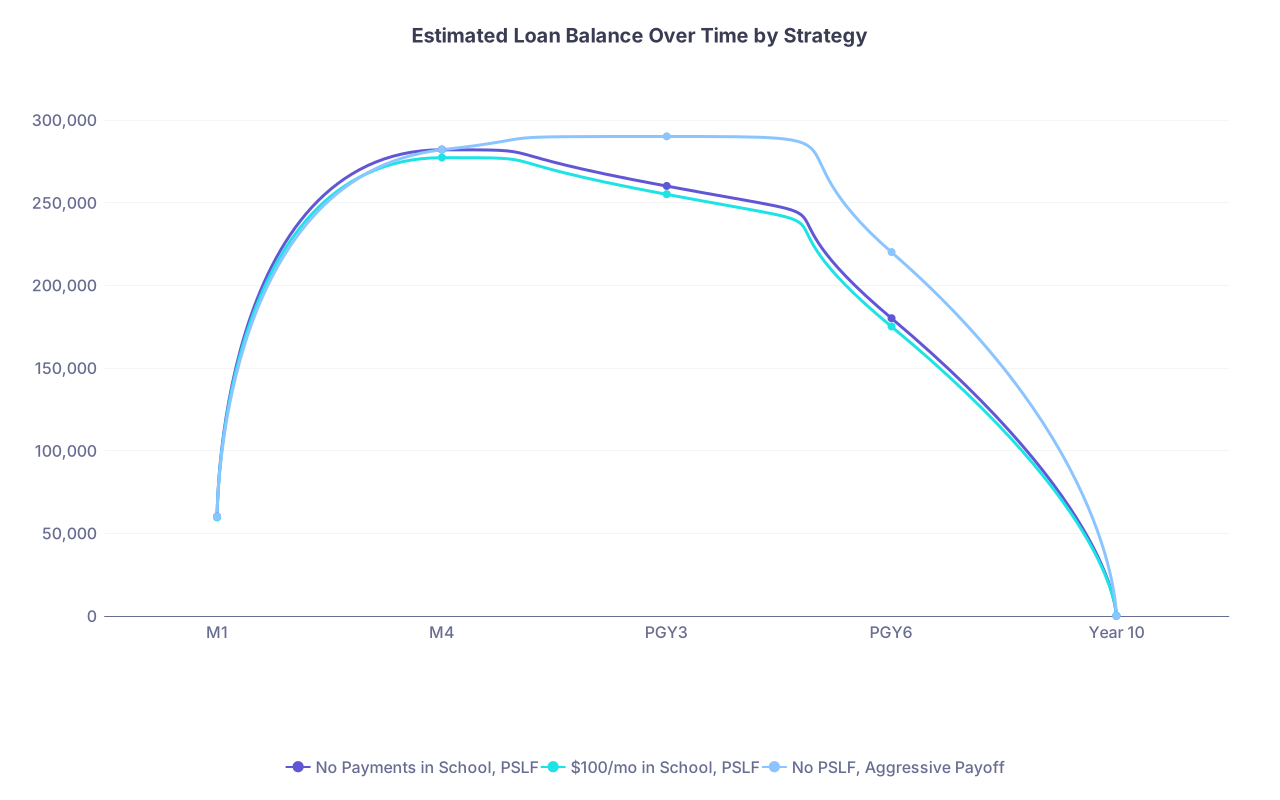
| Category | No Payments in School, PSLF | $100/mo in School, PSLF | No PSLF, Aggressive Payoff |
|---|---|---|---|
| M1 | 60000 | 59500 | 60000 |
| M4 | 282000 | 277200 | 282000 |
| PGY3 | 260000 | 255000 | 290000 |
| PGY6 | 180000 | 175000 | 220000 |
| Year 10 | 0 | 0 | 0 |
The point of that chart isn’t the exact numbers (these are stylized).
The point is: the shape is dominated by whether you do PSLF or aggressive payoff, not by whether you threw a few hundred bucks at M1 loans.
The One Group That Really Should Ignore the “Pay Now” Pressure
International med grads and DO/MDs headed into riskier specialty paths with uncertain matching or job prospects often get the worst advice: pay aggressively now.
If your future income, geography, or immigration status is unstable, you need maximum optionality:
- Bigger cash buffer
- Lower high-interest consumer debt first
- Deep understanding of IDR and forbearance options
Your early priority is surviving and gaining leverage. Not “earning” some imaginary gold star by prepaying federal loans in school.
Practical Heuristics: What I’d Tell a Med Student in 10 Seconds
Here’s the unglamorous, data-consistent shortcut:
Planning PSLF?
Don’t pay in school. Focus on saving a buffer and making sure you start PSLF-eligible payments as early in residency as possible.Unsure on PSLF, but likely academic/non-profit early on?
Same thing: skip med school payments, hoard cash, buy flexibility. You can always make lump-sum payments later if PSLF doesn’t pan out.Confident you’ll do private practice, high income, no PSLF?
Consider modest targeted payments in school only after you have a few thousand in emergency savings and no high-interest credit card debt.Have nasty private loans at 9–12%?
Those are the only loans where I’d say: yes, paying during med school can be quite valuable, after you have a minimum cash buffer.
Common Emotional Traps (And Why They Cost You)
I’ve watched med students do dumb financial things for predictable emotional reasons:
“I just hate seeing the balance grow.”
So they starve future themselves of flexibility to make a psychologically satisfying but economically weak move.“My parents keep telling me I should be paying something.”
Your parents bought houses at 4x salary with fixed 3% mortgages. Their intuition is from a different planet.“I don’t want to feel like I’m doing nothing.”
Then do something that actually matters: learn PSLF rules cold, build an emergency fund, understand IDR vs refinancing.
Feelings are fine. Just don’t confuse them with strategy.
A Quick Flow of What To Actually Do
Let me spell the real decision flow out visually.

| Step | Description |
|---|---|
| Step 1 | Med Student With Federal Loans |
| Step 2 | Build Emergency Fund |
| Step 3 | Make No Med School Payments |
| Step 4 | Consolidate Early PGY1 |
| Step 5 | Start IDR and PSLF Clock |
| Step 6 | Build Small Emergency Fund |
| Step 7 | Pay Down Private Loans First |
| Step 8 | After Savings, Optional Modest Payments in School |
| Step 9 | Prioritize Savings and Flexibility Over Early Payments |
| Step 10 | Planning PSLF or IDR Forgiveness? |
| Step 11 | Any High Interest Private Loans? |
| Step 12 | Committed To Fast Full Payoff? |
So… Does Paying During Med School Actually Matter?
Here’s the blunt version.
For most students headed toward PSLF or any forgiveness path, paying during med school is economically pointless or actively harmful.
You’re just shrinking what would have been forgiven anyway.For students avoiding PSLF and planning to pay everything off, early payments matter—but marginally.
The real leverage comes later, when you’re an attending and can drop giant payments, not from starving yourself for $50–100/month as an M2.The only time med school payments are clearly powerful is with high-interest private loans.
Those are cancerous. Attack them once you have a basic safety net.
Stop letting guilt, parental pressure, or vague “be responsible” vibes drive this decision. Let the repayment path and the math decide, not your anxiety.